
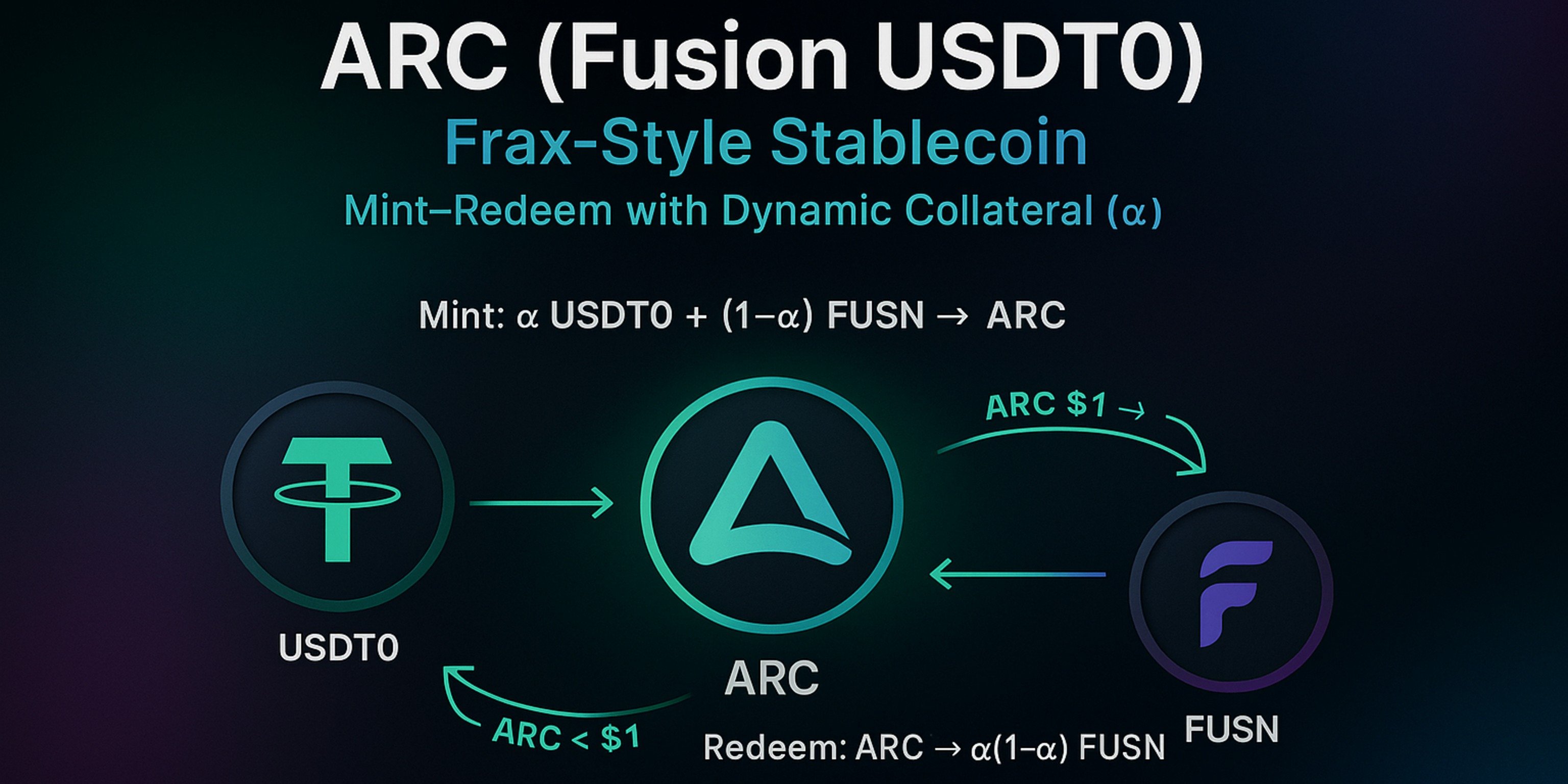
ARC (Fusion USDT0) is a Frax-style stablecoin pegged to 1.00 USDT0. It keeps a tight peg using:
a dynamic collateral ratio (CR = α) in USDT0, and
a share token (FUSN) for the algorithmic leg (1−α).
Users can always mint and redeem around $1 of value with the split between USDT0 and FUSN adapting over time. This is the fractional-algorithmic design that made Frax V1 capital-efficient without relying on supply-only rebases. ARC is not a TOM/Ample-style token; the peg is enforced by mint/redeem arbitrage and a moving α—a banking-style balance-sheet controller.
To mint 1 ARC, deposit:
α USDT0, and
(1−α) worth of FUSN (burned).
Example: If α = 0.98, you deposit $0.98 USDT0 + $0.02 in FUSN to mint 1 ARC.
To redeem 1 ARC, you receive:
α USDT0, and
(1−α) worth of newly-minted FUSN.
(Optionally, the protocol can atomically swap the FUSN leg to USDT0 and return ~$1 in collateral; economically equivalent.)
Example: If α = 0.90, a redeemer gets $0.90 USDT0 + $0.10 in FUSN per ARC.
ARC is redeemable for $1 of value, not “one unit of a token.” That keeps arbitrage clean even if the collateral drifts slightly from $1.
Trade: Mint at $1 of value → Sell >$1 → Keep the spread
Cost per ARC: α·USDT0 + (1−α)·FUSN (=$1 total)
Sell price: P_market > 1.00
Edge per ARC: P_market − 1.00 − fees − slippage
Example: ARC at $1.006, α=0.96 ⇒ Mint at $1.00, sell $1.006; after costs ~0.35–0.45% net. Many such mints expand supply and collapse the premium back toward $1.
Trade: Buy < $1 → Redeem at $1 value (USDT0+FUSN) → Convert FUSN leg → Keep the spread
Edge per ARC: 1.00 − P_market − fees − slippage − FUSN→USDT0 conversion cost
Example: ARC at $0.992, α=0.92 ⇒ Buy $0.992, redeem to $0.92 USDT0 + $0.08 FUSN; swap the FUSN leg. After costs ~0.3–0.5% net. Redemptions reduce supply and lift price back toward $1.
Why it works:
Premiums incentivize mint→sell, increasing supply until price normalizes.
Discounts incentivize buy→redeem, reducing supply until price normalizes.
α adjusts with sustained deviations (see §4), letting the market “vote” on the backing it demands while preserving $1 redeemability.
When demand is strong and ARC trades at/above $1, the controller can lower α (de-collateralize). New ARC requires less USDT0 and more FUSN, raising monetary efficiency while maintaining the $1 target.
A portion of the USDT0 collateral can be deployed (e.g., on Aave) to earn on-chain yield—protocol revenue that supports buybacks and operations.
If ARC trades below $1, the controller raises α (re-collateralize), so redemptions return more USDT0 and less FUSN, strengthening backing and confidence.
The Growth Ratio (ARC supply × $1 / FUSN market cap) indicates how much “shock” the system can absorb with reasonable FUSN dilution—lower is safer.
Fast, reliable redemption keeps ARC from drifting below the value of reserves.
De-collateralize: if ARC > $1 over a sustained window, lower α by a small step (e.g., 0.25–1.00 bps per interval; configurable).
Re-collateralize: if ARC < $1, raise α by a step (symmetric or faster than de-collateralization).
Equilibrium: if ARC ≈ $1, hold α steady.
Policy knobs (governable bounds):
Step size per interval, minimum/maximum α, observation windows, atomic swap toggles for redemptions, and daily/weekly caps on α movement.
FUSN is the volatile, value-accrual token (like FXS in Frax):
As ARC demand grows and α falls, more FUSN is used in mints (and/or burned), creating structural demand linked to ARC growth.
A stronger FUSN market cap improves stability (better capacity to absorb redemptions and shocks).
Protocol revenues (e.g., PSM/fees) can be routed to buybacks or reserves to mitigate dilution and align incentives.
Collateral (USDT0) can be strategically deposited into whitelisted venues (e.g., Aave) to generate yield. Fusion routes this revenue to:
ARC buybacks and peg support, and
programmatic distributions (e.g., Boardroom policies), closing the loop between use, stability, and value accrual.
$1 mint/redeem with dynamic α → peg is enforced by arbitrage, not by hoping supply rebases find demand.
Direct redeemability + re-collateralization provide downside defenses missing in many purely algorithmic models.
Collateral yield adds a sustainable revenue source to reinforce the peg and fund operations.
Mint ARC when you want USDT0-par exposure with protocol yield support.
Hold or LP ARC/USDT0 for low-volatility yield opportunities.
Arb premium/discounts via the mint/sell or buy/redeem loops.
Redeem ARC at ~$1 value whenever you need to exit; the mix of USDT0 vs. FUSN depends on α at that time.
Smart contract & market risk: Audits, timelocks, and conservative parameter bounds help, but cannot remove risk.
Liquidity risk: Deep, incentivized ARC/USDT0 pools reduce slippage and improve arb reliability.
Oracle/ops risk: Use robust TWAPs and circuit breakers; publish weekly parameter reports.
Model risk: Cap α step sizes, maintain reserves, and monitor the Growth Ratio to avoid over-extension.
Collateral Ratio (CR = α): Portion of each ARC backed by USDT0 (e.g., α=0.97 → $0.97 USDT0 + $0.03 FUSN per ARC).
Algorithmic Ratio (AR = 1−α): Portion backed by FUSN value.
De-collateralize / Re-collateralize: Lower/raise α based on persistent price deviations around $1.
Growth Ratio: ARC supply (×$1) divided by FUSN market cap; lower is safer.
ARC (Fusion USDT0) implements the Frax V1 mint/redeem + dynamic α model.
Users can always mint and redeem around $1 of value; α moves with market signals.
Arbitrage (mint→sell on premium, buy→redeem on discount) pulls price to peg.
Capital-efficient by design and defensive when stressed via re-collateralization.
Collateral yield reinforces the peg and funds the protocol flywheel.
ARC is Frax-style by construction—not a TOM fork—delivering peg reliability, capital efficiency, and a clear path to sustainable growth.