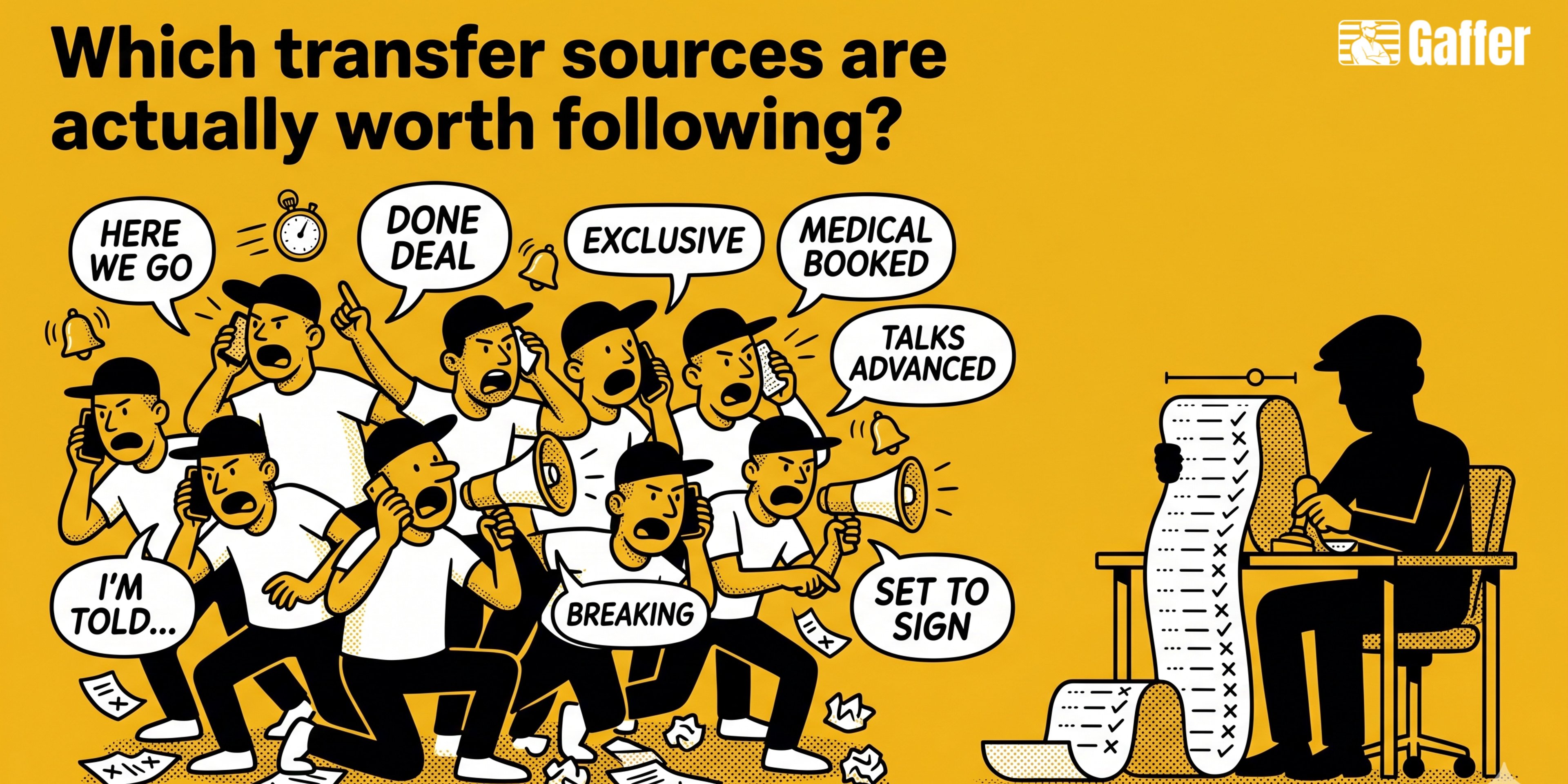
Open your feed during the window and everyone sounds certain. The same name gets twenty different “updates” before lunch, each one breathless, half of them lifting the same foreign report and dressing it up as their own. The problem was never too few sources. It’s that they all use the same confident voice, whether they’ve made fifty calls or none.
So which actually earn a place on your feed? The most reliable transfer news sources are the few that keep a public, dated record of what they said and when: a small group of tier-one journalists, and for your own club, its full-time correspondents. Almost everything else, the apps, the aggregators, the countdown-emoji accounts, relays those sources rather than reporting, and inherits whatever they get wrong. Worth knowing where you’re starting from, too. Across two decades of resolved newspaper rumours, only about 24% came true. The feed is noise by default, and a source has to earn its way up from there.
Here is the filter, source type by source type, and the one test that sorts the lot.
Before ranking anyone, ask the question that does most of the work. Does this source keep a public, dated record of its past claims, misses included? A reporter you can check against what they said last August is playing a different game from an account that quietly deletes the calls that died. Reliability isn’t a tone of voice. It’s a history you can look up. Hold every name below to that test.
A handful of reporters have earned the benefit of the doubt by being right in public, on the record, for years. The consensus names are David Ornstein of The Athletic, routinely rated the single most reliable source for English deals, and Fabrizio Romano, who built “here we go” on what he calls slow journalism and reportedly makes around fifty calls a day before he commits. For specific leagues the names narrow further: Gianluca Di Marzio in Italy, Florian Plettenberg in Germany, Paul Joyce for the Merseyside clubs.
You don’t have to take any of this on trust. Club subreddits hand-rank reporters with tier flairs, Tier 1 for the proven down to Tier 4 for the chancers, scored by thousands of fans against actual outcomes window after window. It’s tribal and it isn’t science. It’s also the most honest free reliability data in football, so check a new byline against the flairs before you believe a word.
One thing the tier-ones won’t print: even the best work in a mill where most stories never happen. Their hit rate is high because they wait. When one of them stops hedging and writes in the indicative, that’s your signal.
For your club specifically, the global names are only the second-best option. Better are the two or three reporters who cover your club for a living: The Athletic’s club correspondent, the BBC’s regional reporter, the local paper’s veteran who has been in the press room since before your manager played. They know the building. When a global account and your club correspondent disagree about your club, back the correspondent. Following them costs nothing and filters out most of the noise on its own.
This is where most fans actually live, and where the confusion starts. Sites and apps like NewsNow, TEAMtalk, Sky Sports, ESPN and Football365 are useful for breadth, and one or two are worth keeping for what they specialise in. The thing to understand is what they are. NewsNow, the biggest, is a pure aggregator: it pulls stories from across the web in real time and does no reporting of its own, so its reliability is only ever as good as the source it happens to be quoting. A NewsNow headline is a pointer, not a verdict.
Use them as a net, not a judge. Read the aggregator to find the story, click through to whoever actually said it, and rate the claim on that name. Transfermarkt is the one to keep for its own sake, not for live rumours but for squad data, fees and confirmed deals once they land. For working out whether tomorrow’s link is real, the aggregator can’t help you. It was never built to.
Anonymous “in the know” accounts are the wild end of the mill, and the receipts test earns its keep here. A few are genuinely good. Honest collators like @Sport_Witness gather and scrutinise foreign reports rather than inventing them, and curated lists of the more reliable ITK accounts exist if you want a vetted starting point.
The rest are running a numbers game with a stopwatch emoji. The tells are consistent: vague timelines (“expect news soon”), claims built so they can never be wrong (“talks have cooled”), quietly deleted misses, and the constant ask to retweet. A real source has no reason to farm your engagement. If an account won’t show you its misses, you’re reading fiction.
Notice what every category above has in common. The good sources keep their own receipts, sort of, scattered across years of posts you would have to dig out by hand. The crowd keeps a rough tally in subreddit flairs. But nobody keeps the score for you, per source, per club, in one place you can check before you believe the next link. Your own best calls vanish into the group chat. The account that missed five on the spin still has the same follower count this morning.
That gap is the whole reason Gaffer exists. Gaffer is the home for your club, showing which rumours your fanbase believes and remembering who called it. Every link about your club on the record: what your end believed, who read it right, who fell for the agent’s auction. Dated. Locked. Checkable. It’s the reliability guide you would otherwise build by hand, kept for you.
Paper money. No betting, no deposits, ever. Just the record.