
Remember when DeFi meant ‘farm, dump, and run’?
Yam, Tendies, Pickle, Pizza.
For you, these might just be food items but for me, it’s a reminder of DeFi Summer which also coincided with the Covid summer of 2020. It was a chaotic era full of restrictions and lockdowns but also a glorious era. An era where protocols tempted with 10,000% APYs… and collapsed faster than they launched.
Yet one protocol survived: Curve Finance.
Its secret?
The vote-escrow (ve) model
A tokenomics breakthrough that turned hit-and-run farmers into long-term stakeholders.
Here’s how Curve cured the food farm death spiral… and why its lessons still matter today.
The early DeFi projects were terminally ill.
The diagnosis?
Incentive misalignment.
Protocols like Pickle, Yam and a dozen others offered unsustainable APYs to attract liquidity providers (LPs). The LPs came, sure, but they were not loyal. The capital was mercenary, they farmed the native token, causing the emissions to skyrocket. The tokens were then dumped triggering a death spiral.
The mercenaries moved onto the next protocol like parasite-hopping hosts.
One example that I remember very clearly is Pickle Finance.
Pickle was a yield optimiser where users could deposit assets into Pickle Jars to earn $PICKLE at very high rates. Think Yearn Vaults but with a spicy branding twist and hollow tokenomics. The token had no utility beyond emissions farming.
The emissions were unsustainable, the token had no utility beyond farming, and when a vault hack hit, it was game over. Eventually, Pickle was absorbed by Yearn in a mercy merge.
As a result, we now have graveyards full of fork protocols. They did not innovate and had the exact same issues: high emissions and no incentive to hold the underlying token.
Initially, Curve Finance was not immune to the farm-and-dump disease but it certainly developed the best immune system.
All thanks to the veToken antibodies.
Rather than give CRV rewards to all LPs, Curve required locking up CRV tokens in exchange for veCRV which is a non-transferable token that gives voting power and a share of protocol revenue under certain conditions (more on that later).
The formula was simple but powerful:
veCRV = CRV × (Lock Time in Years / 4)
This means that longer locks = more veCRV = more influence and potential rewards.
As a result, LPs had to make a choice between dumping their CRV and hopping to the next host or committing long-term and sharing the protocol’s future.
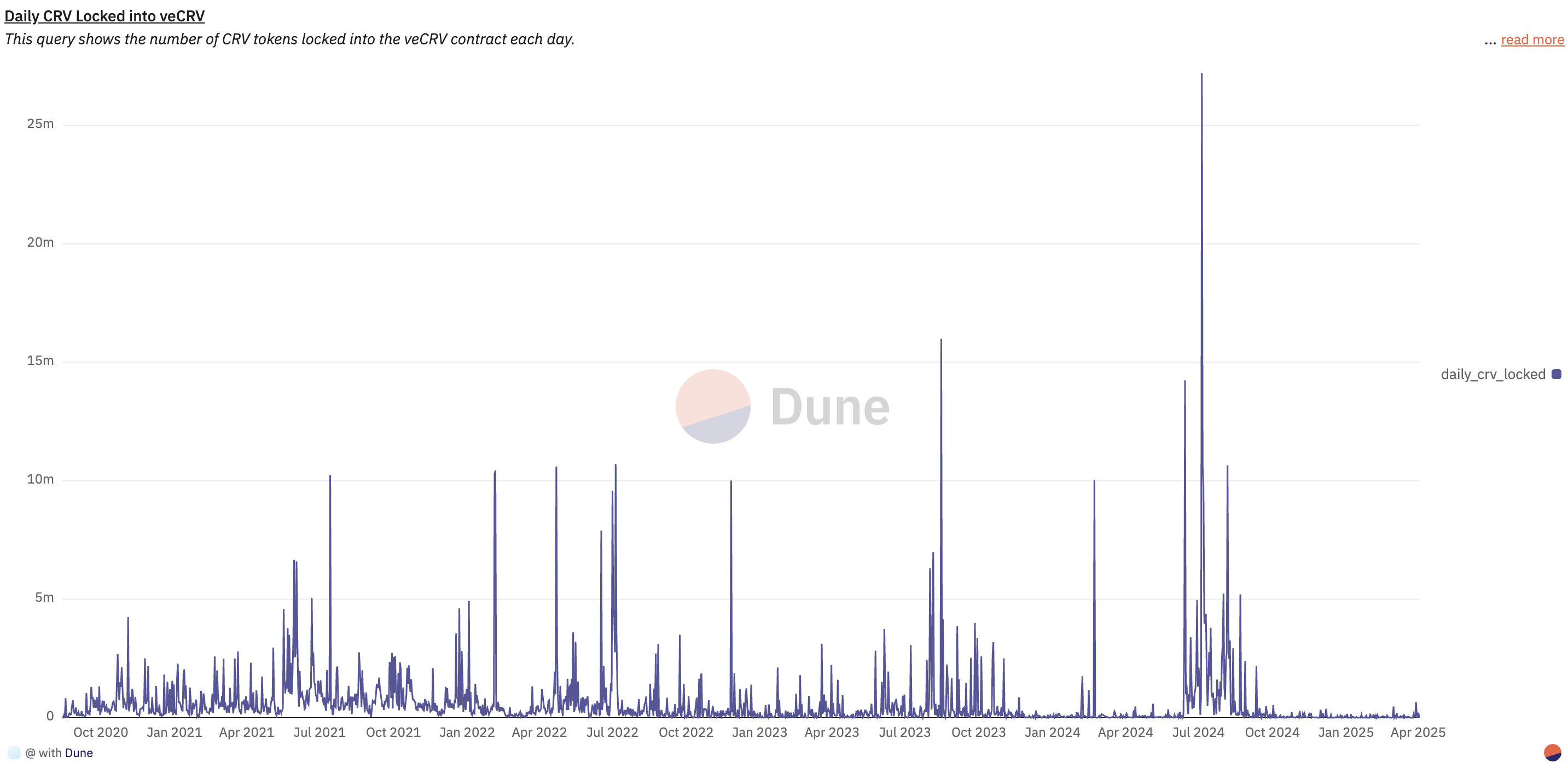
The evidence speaks for itself. This chart shows that even years after DeFi Summer, users are still locking CRV. That’s not typical farming behaviour but long-term alignment. veTokenomics turned emissions into commitment.
Locking CRV cuts sell pressure and gives governance power, aligning users with the protocol’s future.
veCRV holders vote on gauge weights, directing where future emissions go. This kickstarted a meta-game of sorts where protocols fight for influence over Curve governance known as “Curve Wars”. Convex Finance emerged as the leader in the game.
What is Convex Finance?
Convex is a meta-protocol built on top of Curve.
The goal is to control veCRV without locking CRV yourself.
How Convex Aggregates veCRV:
Users deposit CRV into Convex.
Convex locks it as veCRV and earns voting power.
In return, users get cvxCRV, a liquid token that represents their staked position.
Convex uses its veCRV voting power to direct emissions and boost rewards for its own LPs.
As a result protocols started bribing CVX holders to vote on their gauges which set off the “Curve Wars”
TLDR: Convex weaponised veCRV by aggregating and centralising the voting power. They boosted the yields but took governance power away from smaller users.
To make the deal for locking your CRV tokens even sweeter, Curve rewards active participants with up to 50% of trading fees (real revenue, not just inflation). The asterisk is that users have to lock their CRV directly via Curve Finance, vote actively, and claim their rewards weekly.
As of writing, 900m of the total 2.3b CRV (or around 40%) is locked in veCRV and effectively removed from the liquid market.
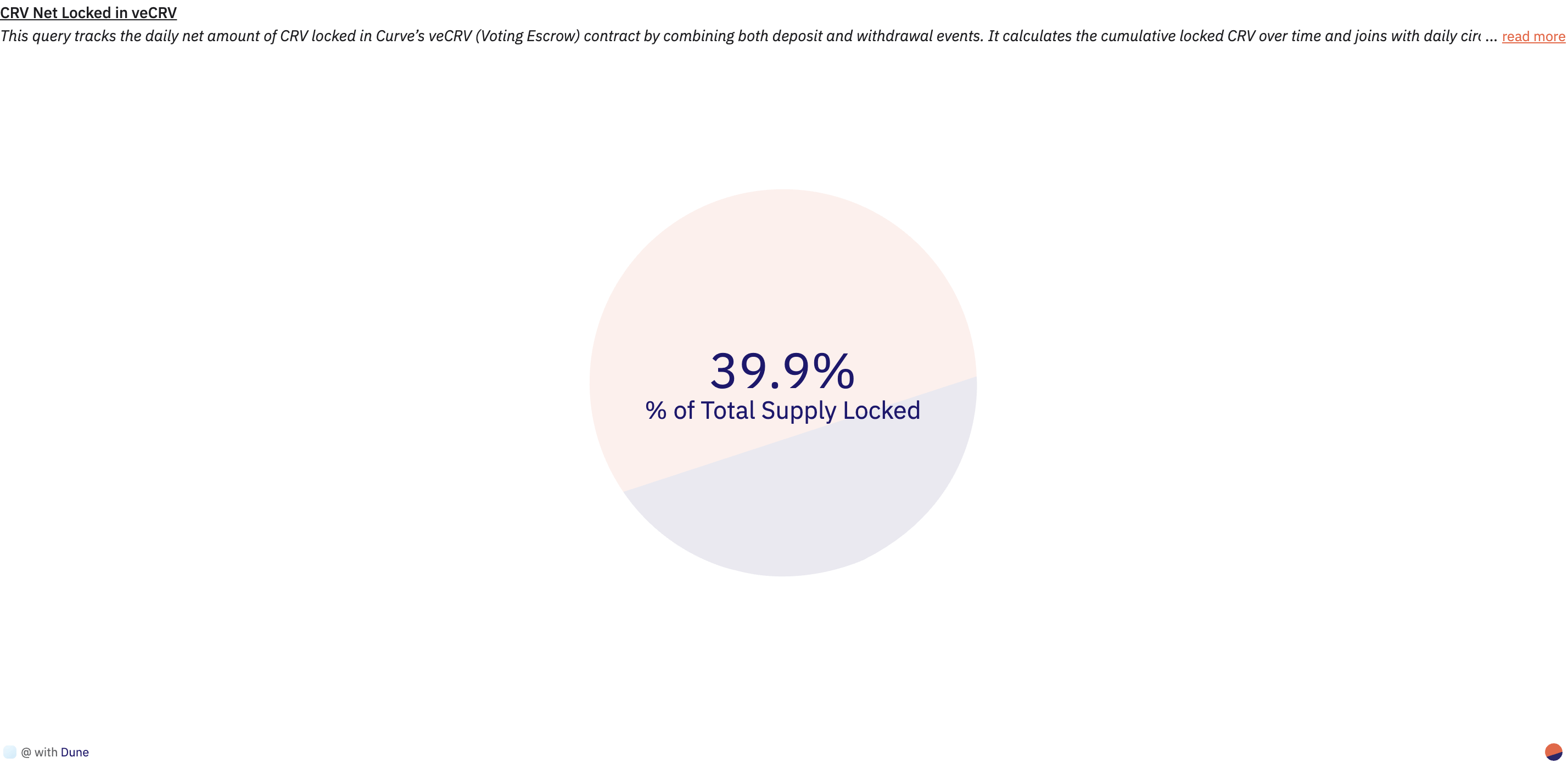
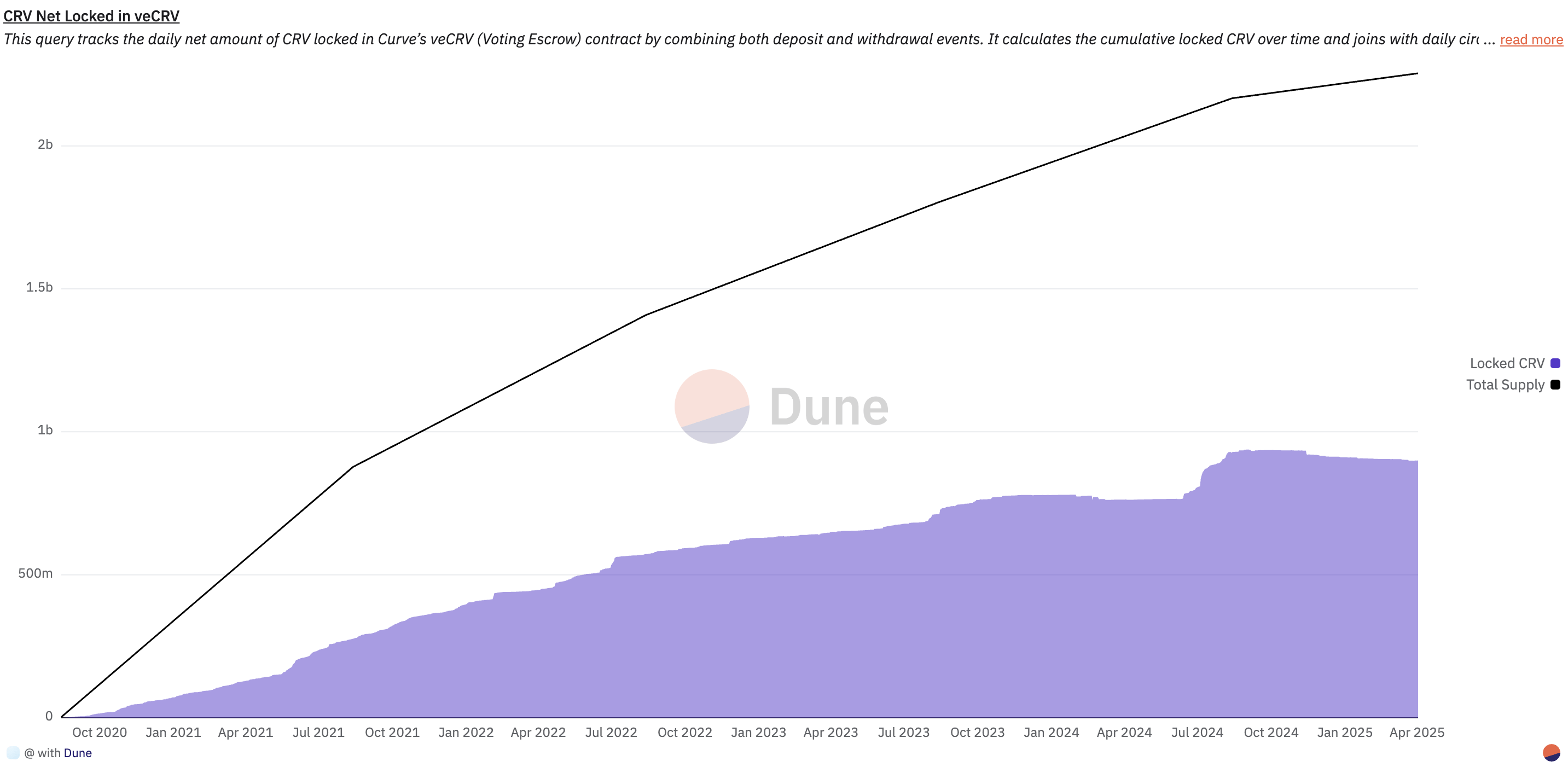
Curve neutralised the emissions rather than slowing them down by tying rewards to time-locked staking. This created protocol loyalty at the token level.
The locking mechanism could also be a way to get around the Howey Test. The rewards are tied to time locked rather than the token itself. Could this be a way to get around the “security” status?
Why Curve’s veTokenomics Worked and Forks Failed
veTokenomics didn’t succeed just because of the lock-up mechanic.
It worked because:
Curve had utility consisting of deep stablecoin liquidity and constant trading volume.
It launched in a single-chain, DeFi 1.0 world where liquidity was less fragmented.
The Curve team fostered an ecosystem around itself: Convex, StakeDAO, Votium.
The revenue model (50% of fees) gave actual value accrual, not just inflation rewards.
Forks copied the mechanism but not the context and failed because they had emissions with no purpose.
While the veToken model helped to solve the farm-and-dump problem, there is no cure without side effects.
The most obvious one is centralisation. Despite being designed to decentralise protocol control by aligning the LPs to long-term contribution, in practice the power is concentrated in the hands of the few. Most notably Convex Finance controls a massive amount of veCRV which is locked on the behalf of others.
This effectively means that a handful of whales and DAO delegates decide where most of the Curve emissions go. A system that was designed to empower the community ended up outsourcing governance to the most capital efficient actors. What if the incentives change and Convex no longer acts in Curve’s interest?
It’s no longer a pure democracy but it’s a meta-game of vote-buying, bribes, and strategic alliances.
If Curve’s gauge votes are mostly driven by bribes, are we really decentralising… or just automating plutocracy?
Even among smaller holders who do lock CRV, most don’t vote.
The simple reason is that researching proposals to vote and then claim the rewards is a tedious grind. The yield can be boosted passively through Convex so why bother?
Even though veTokenomics give power to token holders, they do not motivate them to use it. The system still relies on an engaged user base but the incentives push tokenholders towards delegation and passivity.
The veToken model solved the liquidity bleed — but left governance participation an open wound.
Whilst it can be argued that the farm-and-dump plague of DeFi summer has been treated, the truth is that the virus has simply mutated.
Today’s symptoms are different but just as deadly:
Mercenary capital now jumps chains, farming incentives and airdrops with zero loyalty.
Governance is still broken — either dominated by whales or ignored by the masses.
Yield remains hollow — often backed by inflation, not real economic activity.
So what’s the real cure?
It definitely won’t be copy-pasting Curve. The veToken model was tailored to a single-chain world of DeFi 1.0.
Modern protocols face a multichain, modular and meta-protocol driven reality. They need to combine stickiness, composability and revenue whilst creating meaningful governance.
Some are already expermienting with rebasing, NFTs, or vote-lock hybrids. Whether these solve governance inertia remains to be seen.
veTokenomics was the first great tokenomic innovation, a breakthrough that turned emissions into alignment.
But the game has changed.
In my next pieces, I’ll explore the rise o (3,3), ve(3,3) and x(3,3) — the next-gen experiments in incentive design that aim to combine liquidity, governance, and sustainability.
Every era has its virus. Every virus needs a cure.
Let’s see if these new models are medicine or just another shot in the dark.
Yearn and Pickle Merger - https://medium.com/iearn/pickle-yearn-ferment-co-operation-dill-eec43b93d0ea
Length of Lock and Size of Rewards - https://outlierventures.io/article/vegood-vebad-and-veugly/
Dune Queries - https://dune.com/queries/4930233/8158917
Dune Dashboard - https://dune.com/throwaway953423356/vecrv-metrics
Gauge Weights - https://resources.curve.fi/reward-gauges/gauge-weights/
Curve Wars - https://bitsbyblocks.com/overview-of-ve-tokenomics-model/
veCRV Centralisation - https://simpleswap.io/blog/vecrv-and-its-impact-on-curve-finance