
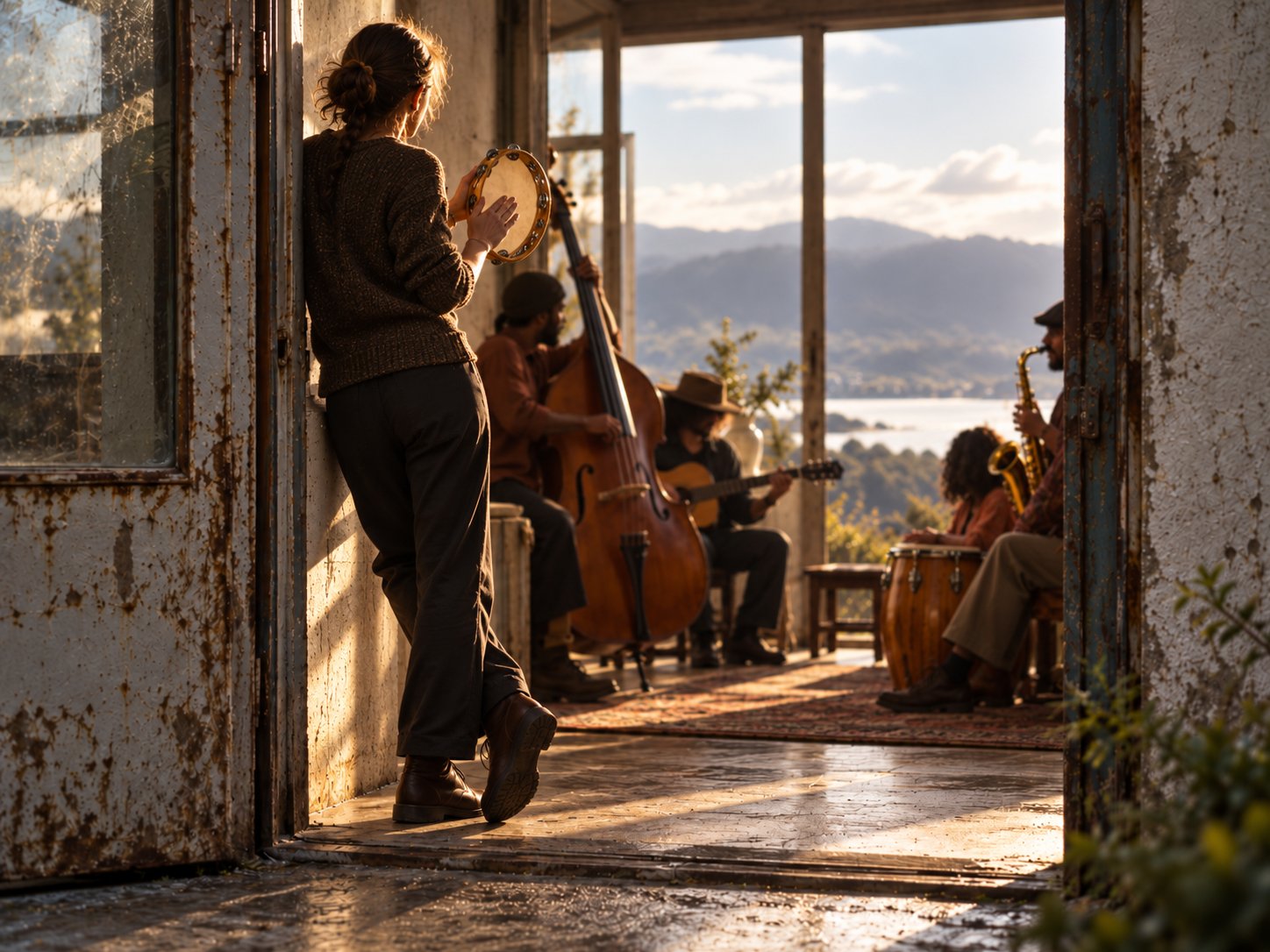
There is a moment when musicians who have never played together begin to find one another.
One may come from a tradition in which rhythm is embodied, another from a discipline of written composition. A third may have learned through listening, repetition and the intimate transmission of knowledge across generations. Each brings an understanding of timing, structure and expression shaped by the world they come from.
There may be no conductor or common score, nor perhaps not even an agreement about where the music should begin. Some of the most compelling improvised music has indeed been made this way.
At first, the sounds may compete. One musician follows a phrase that another refuses. A rhythm emerges, dissolves, then returns in another form. What appears to be dissonance may become the beginning of an entirely different conversation.
Gradually, something takes shape. It does not necessarily resemble the music any of them would have made alone. Nor does it require them to surrender their traditions, instruments or the disciplines through which they learned to play.
They are composing through the encounter itself.
But there is also a room. Someone owns the hall, controls the microphone and decides who is let in.
As we reach the end of this series, the scene offers one more way into the question that has followed us throughout:
what does it mean for different orders to meet without requiring one to become a version of the other?
We are accustomed to encountering law through its formal expressions. Statutes, judgments, regulations and registers give enduring form to rights and responsibilities. Yet even within these institutions, law remains in motion. In common law systems, courts interpret and develop principles through particular disputes, while the meaning of earlier decisions continues to evolve.
Much of lawful life also unfolds elsewhere.
People establish relationships through promises, exchanges and acts of recognition. Families and communities maintain obligations that may precede any written instrument. Individuals arrange their affairs through trusts and contracts, while Indigenous Peoples maintain their own orders, grounded in distinct relationships, practices and sources of authority.
These are not equivalent forms of law, nor do they derive legitimacy from a common source. Yet each is lived through relationships that continue to change.
At particular moments, something more deliberate may take shape: a declaration, an agreement, a collective decision or the exercise of authority in particular circumstances.
There is something compositional in this. An encounter gives rise to a situated expression, making something of an existing relationship intelligible to another, or perhaps establishing an entirely new undertaking. What takes shape belongs to that moment without exhausting the relationships it arose from.
Recording gives such expressions another form of existence. It preserves commitments and enables recognition beyond their immediate setting, but can also create distance between a living relationship and its fixed representation.
The record endures in one form while the world from which it arose continues to move.
Different orders intersect throughout ordinary life, often without conflict or any conscious need to distinguish their boundaries.
A community may approach an agreement through collective responsibilities, while an institution understands the same arrangement through contractual rights and delegated powers. The parties may agree upon particular actions without sharing an account of the ultimate source of their authority.
Such encounters have always been part of human affairs. Merchants developed ways of dealing with strangers. Communities negotiated arrangements concerning land, passage and exchange. Some relationships endured; others ended in disagreement, exploitation or violence. The ability to participate has never guaranteed equality.
Think of the representative at the portal in the previous essay. She can enter, but the hall is not hers. The categories through which she becomes visible have already been chosen.
Entering is not the same as being heard.
Yet neither should we mistake the dominance of one order for the absence of others.
Composition becomes possible when participants bring something of their own into relation with others. What emerges may be a new obligation, a shared responsibility or a limited arrangement negotiated across different sources of authority.
Its consequences need not be identical in every order. An undertaking might bind within one, carry recognition without binding force in another, and remain unrecognised in a third.
Something new has been composed without requiring the originating orders to become one. But the integrity of that composition is compromised when participation is mistaken for consent.
An insistence on harmony may destroy the possibility of composition.
If one musician must abandon their understanding of rhythm before being allowed to play, the encounter has already been decided.
Different orders may hold incompatible understandings of jurisdiction, responsibility or consent. One may recognise an obligation another cannot accommodate. A collective may decline to disclose the knowledge through which its authority is understood. An institution may be unable, under its own mandate, to accept a proposed arrangement.
Sometimes the parties find a more limited cooperation. Sometimes the encounter ends without agreement.
The possibility of refusal matters. So does the freedom to remain silent, to preserve knowledge within its originating relationships, or to decline an arrangement whose terms would compromise them. Consent that has not been established cannot be treated as consent obtained.
Composition is not an obligation to cooperate.
Nor does it require everyone to make themselves wholly intelligible to everyone else.
Musicians can play together without revealing everything they know about music.
Before musicians play together, they may exchange a few words. A key, a rhythm, a gesture towards where the music might begin. Sometimes nothing is said. One musician plays, another listens, and a shared understanding begins to emerge.
They establish enough understanding for that encounter. The rest remains their own.
SILT is closer to that exchange than to an instrument or a score.
Source → Standing → Presentation → evaluation at the encounter.
It provides a bounded semantic grammar through which participants can express the relevant grounds and conditions of their participation, without requiring their originating order to be reconstructed inside the receiving system.
The Presentation is not the relationship itself. Nor does evaluation constitute the Standing or Authority from which it arises.
SILT does not decide which order prevails, whether an agreement is lawful or what consequences follow from it. Those matters remain with the relevant orders and instruments. What SILT can help preserve is the meaning of what was expressed as an encounter moves into downstream arrangements, without becoming responsible for their enforcement.
A grammar does not write the music, but it shapes what can be expressed. That is both its value and its risk.
SILT Core v0.2 is published openly, with a public conformance suite and interim governance. Its four base encounters and 30 adversarial variants are validated through the repository's CI. It does not yet claim foundation governance or institutional neutrality.
The invitation to challenge it is meant literally.
The point of such infrastructure is not simply to improve the accuracy of digital records. It is to make room for relationships that existing systems struggle to accommodate.
A community might engage an institution while maintaining its own grounds of collective authority. Individuals might establish private arrangements without surrendering the entirety of those relationships to a platform. An AI agent might act under a bounded delegation whose source and limits remain intelligible across systems.
The arrangements differ, but each depends upon the possibility of bringing independently grounded Standing and Authority into an encounter. Some will produce agreements. Others will expose disagreements previously hidden beneath apparently neutral technical categories.
A disagreement made visible may be more valuable than an agreement produced through misunderstanding.
An expression of limited Authority may be more trustworthy than an apparently universal permission whose origins have been forgotten.
None of this guarantees equality. Whoever controls access to the hall still has power over the conditions of the encounter. SILT cannot dissolve those asymmetries through semantic design.
It can, however, help preserve the distinctions that make meaningful participation possible, including where those distinctions cannot be reconciled.
We began with musicians finding one another in a room where no single score determined what they could play, and where someone still owned the hall.
The music did not emerge because their differences disappeared. It emerged through attention, dissonance, restraint and improvisation, through the willingness to discover what might be imagined together.
Law, too, has always involved acts of composition, although its forms and consequences belong to another domain. Agreements may bind, decisions may dispossess, and the exercise of authority may shape lives across generations.
Yet lawful relationships do not emerge only through the top-down application of rules. They are sustained through people and communities who recognise responsibilities, negotiate commitments and act within orders of meaning that no single institution created. Law is fundamentally relational.
The world was never composed in a single language, under a single law, or according to a single account of who we are.
We have inherited systems that often behave as though it were.
Perhaps the task is not to perfect those systems until everything fits within them, but to learn to build differently, with room for relationships we do not own, authority we did not confer and meanings we cannot fully translate.
The art of lawful composition begins there.
>>>
Explore the work:
SILT is an open standards and research project exploring how different systems of identity, authority and legitimacy can become mutually legible without being collapsed into a single model.