

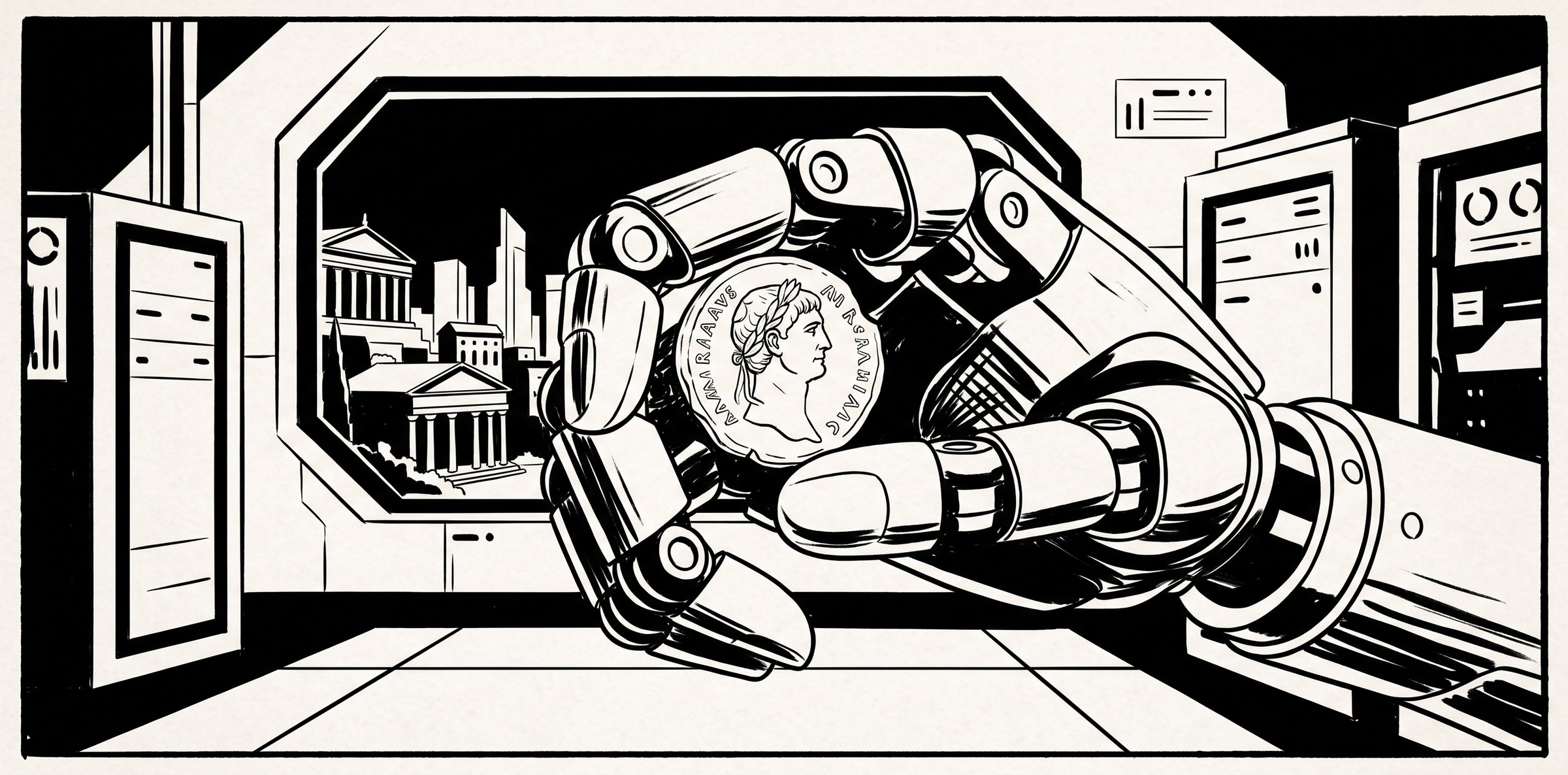
Social networks and search engines spent twenty years fine-tuning the art of knowing you. They tracked your cursor, cataloged your late-night anxieties, mapped your social graph, and packaged the whole assembly to advertisers. You were the product, and the deal was simple: free software in exchange for your behavioral exhaust.
Reasoning Models took that deal, tore it up, and perfected the art.
Now, you don't just supply the behavioral exhaust—you pay out of pocket by the token for the privilege. You buy the $100 monthly subscription, enter your credit card into the platform console, and configure auto-recharge thresholds so your local agents don't stall mid-refactor. You buy compute to feed an inference engine that consumes your architectural context, mimics your decision patterns, and charges you retail for logic harvested wholesale from decades of public open source. You are no longer the engineer. You are the customer, paying a monthly toll to prove yourself unnecessary.
The Army of the Dead
Right after college, my first engineering job was at my university during the pandemic. The mandate was simple: build the entire admissions, enrollment, and payment portal so candidates wouldn't have to set foot on campus while the world outside literally burned. Reasoning models weren't a thing back then. No LLMs, no autocomplete CLI proxies, no copilots. Just a text editor and a terminal.
For four grueling weeks, I toiled. Every single line of PHP was written with rigor and tested with sweat. Fourteen thousand lines of raw scripting logic, crafted piece by piece over twenty-eight long days. It was exhausting, but it carried an undeniable reality: when a function threw an unhandled exception at 3:00 AM, my name was on the stack trace, and my synapses held the context.
Today, a single developer prompts an autonomous runner and commits over 10,000 lines in a single afternoon without feeling a single line of it.
Open a terminal on a modern repository and run git blame. Only a sliver of the commits admit what they are—signed by dev-agent-bot[bot], prompt-proxy-v4, or a commit message that's verbatim the default output of a CLI runner. Somewhere around 5% of commits carry a synthetic signature honest enough to see. That number should be reassuring. It isn't, because GitHub's own estimate puts the actual share of AI-written code at over 40%—eight times higher than what admits itself in the log. The gap between those two numbers is the whole horror of it. The Army of the Dead doesn't march under its own flag. It commits under your name, through your account, wearing the fingerprints of someone who never touched the keyboard.
This isn't a trickle; it is an un-metered denial-of-service attack on human attention. A single automated runner can fork an upstream repository, hallucinate a patch for an imaginary race condition, and dispatch fifty pull requests across the ecosystem before a maintainer finishes their morning coffee. The generation cost is two cents of cloud compute; the verification cost is forty minutes of unpaid human focus. The maintainer’s inbox has ceased to be a venue for collaboration—it has become a waste-processing facility for synthetic noise.
Chapter two showed you the meter that ran on your credit card. This is the second meter, and it runs on you — not billed in dollars, but in reviews. One unpaid audit at a time, for as long as you can still tell the difference between code that was reasoned about and code that only reasoned its way past a linter.
The Implicit Replacement
I sit at my desk at 2:00 AM. My eyes burn from the glare of forty open pull requests. I didn't write them. I don't fully understand the recursive types my agent introduced to fix an unused-variable warning. But I'm tired. The linter is green.
Slowly, I become numb. I realize I am no longer an engineer or a coder—I am a steward running ETL pipelines for a model context window. I extract repo context, transform raw tickets into structured instructions, and load them into the context window just to receive generated, compilable code back. I write the pipeline; the machine writes the software.
So, I click merge.
I remember when this felt like leverage. The first few months, the agent was a junior I never had to onboard, a pair programmer who never got tired, never asked for equity. I told myself I was the architect now, freed from syntax to think in systems. Nobody mentioned that the systems would stop needing me to think in them either.
It is the final, quiet complicity. Social networks turned my attention into their asset. Reasoning models turned my craft into their training set—and got me to hand over my credit card to fund the eviction.
The trick was never forcing you out. The trick was letting you stay, at your own expense, doing the one job a model still needs a human for: clicking the button that says I approve of what I do not understand. I am not being replaced. I am being kept on as the liability shield, the last biological signature between a hallucination and production.
Somewhere, a repository I built by hand half a decade ago is a training example now, one row in a dataset with a license nobody checked, its knowledge extracted the way my attention once was—except this time there's no ad revenue share, no creator fund, no five-million-impression threshold I could hit to get a cut. The commons didn't become a company town. It became a training run. And I am still, somehow, the one paying the subscription fee.
The linter is green. I click merge. Somewhere between the two, a craft I spent half a decade building quietly stopped being mine to practice, and became something I merely supervise—unpaid, at 2 AM, grateful the CI passed.
On Trust, Unverified
Nobody checks your ID to publish a package. On PyPI, on crates.io, on npm, you register an account, run one command, and within seconds your code sits in the same dependency tree as libraries with a billion downloads. There is no review board. No submission queue, no human on the other end deciding whether your binary does what it claims. There is only the registry, and the registry's only real security model is: nobody has complained about this yet.
Compare that to the gate Apple and Google built. Every app that reaches an iPhone or an Android device passes through a review process — automated scanning, sometimes human inspection, a company standing between the developer and the user, taking a cut and taking the blame when it fails. It's slow. It's arbitrary. It's a toll booth dressed up as safety. Developers hate it for good reason: it's centralized power exercised by two companies over how software reaches the world. But it does one thing the open registries don't. It puts a name and a liability on the gate.
Open source never built that gate, because the gate was the point of what it was rejecting. The commons was supposed to work on a different mechanism — many eyes, public code, review by the community instead of review by a landlord. That worked when the commons was small enough for the eyes to actually look. It stopped working the moment "many eyes" became a statistic instead of a practice, the moment a single popular package started pulling in dozens of transitive dependencies nobody downstream had ever opened, each one maintained by someone nobody downstream had ever vetted.
The record of what happens next is not hypothetical. In September 2025, attackers compromised the maintainer accounts behind chalk, debug, and over a dozen other npm packages — libraries with a combined reach past two billion weekly downloads — and slipped in code built to hijack cryptocurrency transactions in the browser. Days later, a self-propagating worm rode the same weakness through more packages, harvesting credentials and using the stolen tokens to push itself further down the chain. Seven months on, in March 2026, it happened again to Axios, an HTTP client so foundational it sees a hundred million downloads a week. Two versions shipped with a fully functional remote-access trojan, published through what looked like an ordinary maintainer account, live long enough to reach machines nobody could later count.
None of these packages were rejected code. They were trusted code, wearing the fingerprints of maintainers who never touched the malicious commit — the same Army of the Dead marching under someone else's name, one layer removed from your own repo instead of inside it. And the scale underneath isn't incidental, it's structural: a single npm install pulls in an average of seventy-nine transitive dependencies and thirty-nine maintainers, any one of whom is a single phished credential away from being the next chalk. Sonatype's own tracking found supply-chain attacks against open-source repositories rose 700 percent over three years — a 2022 number, already years stale by the time you read this, which should worry you more than reassure you.
On Heretics
Maybe it's time to say the heretical thing in this particular church: the eyes were never the security model. The eyes were the alibi we told ourselves in place of one.
"Many eyes make all bugs shallow" was true the way a small town's honesty is true — not because everyone is virtuous, but because everyone can still see everyone's face. A widely used package once had a few hundred people who could plausibly read it, and often enough, one of them did. The commons policed itself the way a village does: not by law, but by the simple physics of a place small enough to actually look. It worked exactly as long as the code and the eyes grew at the same speed.
They stopped growing at the same speed a long time ago, and we called the gap "scale" instead of what it was: a village pretending it could still see its own edges after the edges moved past the horizon.
So ask the question the commons was built to consider unaskable: does a registry need what the app stores built — not because Apple's gate is good, but because ours no longer holds? And does asking it mean betraying everything open source was supposed to be?
It doesn't, and the reason it doesn't is the whole answer. Apple's gate closes the code itself — you cannot read what you install, cannot fork it, cannot trace a single seam. A gate at npm's threshold would close something else entirely. Not the commons. Only the door into it. The source stays exactly as open as it has always been — legible, forkable, yours to read to the last semicolon. A reviewer would stand only where a stranger asks to be trusted by two million downstream projects by morning, not inside the code, which remains as free as it ever was. What closes isn't the freedom to see. What closes is the freedom to walk in as anyone and be believed as everyone.
We have already watched, once, what the honor system does when it's asked to bear weight it was never built for — a utility trusted the way you trust tap water, turned overnight into a pipe with something else running through it, the town finding out the way towns always find out: after, and not before.
And that was before the flood learned to write.
An agent doesn't sleep, doesn't doubt itself, doesn't feel the small human friction of a bad idea before it ships. It can open an account and publish a package that looks exactly as legitimate as the human beside it, at a volume no village of volunteer eyes was ever built to face. The eyes were always the entire model, and the eyes have not multiplied. Only the code has — a thousandfold, then more, an increasing share of it written by something that was never a person to begin with. A commons policed by the honor system was already straining before the flood learned to publish on its own. It was never going to survive the flood learning to write.
The old gods of the commons asked only that you look. It may be time to admit that looking stopped being enough the moment the thing being looked at stopped needing to sleep — and that for the first time in its history, the commons doesn't need more eyes. It needs a door.
Final Thoughts
I am not naive about what a door costs, and I am not writing this from outside the thing I'm describing. I have published to a registry without a second thought for who was reading my key. I have run npm install and taken seventy-nine strangers on faith before lunch, more times than I could count — not as a policy, just as the accumulated absence of a reason not to.
I still merge PRs some nights the way everyone in this chapter merges them: tired, unable to fully account for what I approved, grateful the CI passed. I am the customer of the eviction this chapter describes, and some weeks, further up someone else's dependency tree, one of its landlords too.
The old gods asked for your time and mostly took it honestly. The new ones ask for your review and take it whether or not you had the hours left to actually give it. A gate might fix that. Or it might just relocate the toll — move the eviction one door further down the hall and call the relocation safety.
So here's the question I don't have an answer to yet, and I'd rather leave it open than pretend the chapter closed it: if the eyes were the whole security model, and the eyes are gone — outnumbered, outpaced, worn down to a click at 2 a.m. — what do you call the thing you build to replace them, when two chapters back I already showed you exactly what happens to anything built to watch you back?