

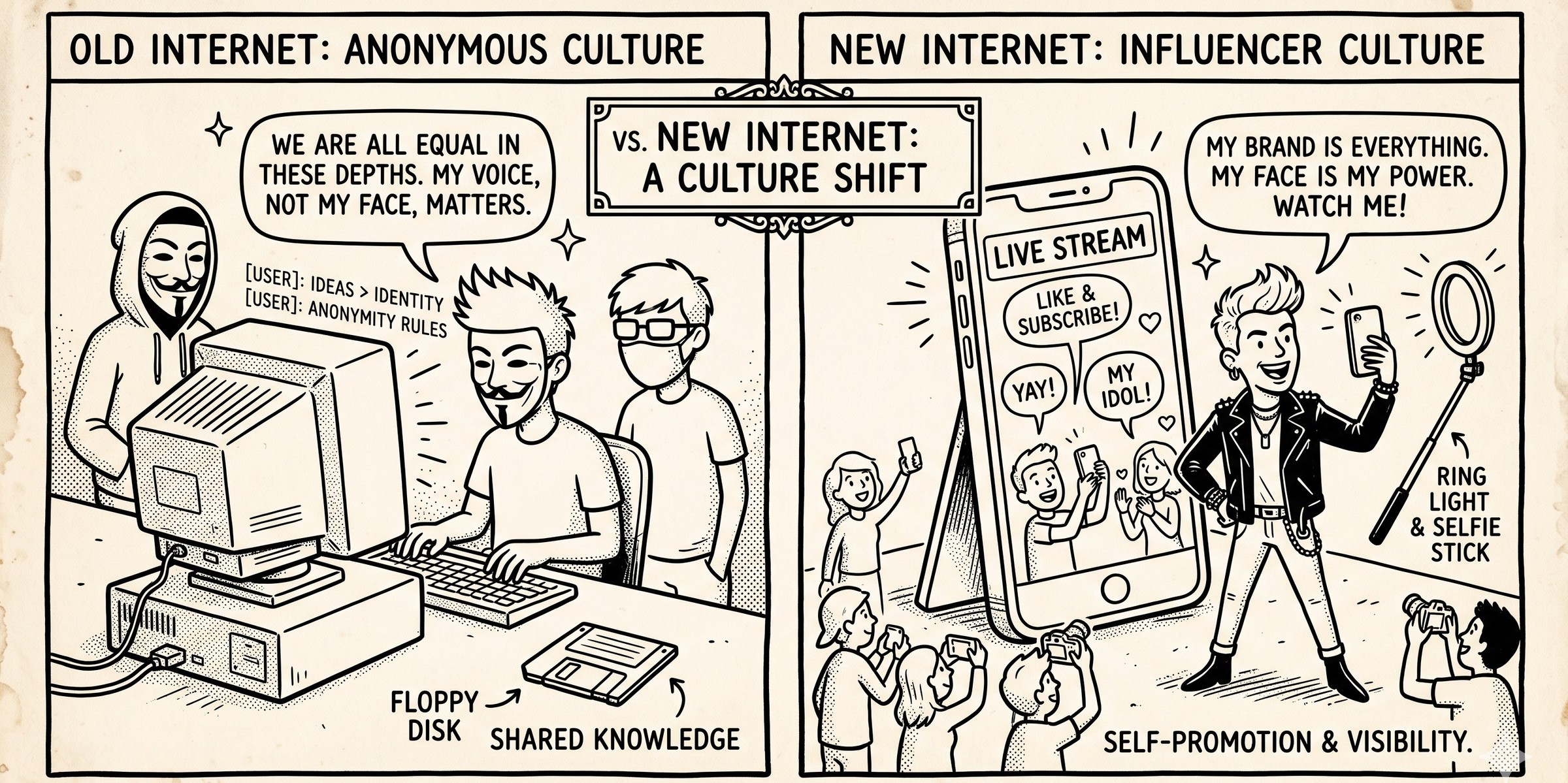
There are two ways to log in, and they are not the same person.
In one memory—mine, and perhaps yours if you were young enough in the twenty-tens—you open a laptop after school or after work. The room is ordinary. The connection is slow enough to feel like weather. You do not arrive as a brand. You arrive as a name you chose, or no name at all. The page loads and you do not know what you are looking for, and that not-knowing is not a failure of discipline. It is the condition of the place.
In the other memory—you may be living inside it now—you open the same machine, or one that fits in your hand. The room is still ordinary. The connection is fast enough to feel like obligation. You arrive already summarized. A photo, a headline, a ratio of engagement, a history of clicks that precedes your intention. You know, before you post, what the post is for.
I am not here to tell you the first world was innocent. It was not. It was careless, cruel in places, forgetful of bodies and borders. But it was, in a sense I can only describe as religious, non-productive. Not holy because it was good—holy because it was idle. Because monetization was scarce, and so the hours you gave it did not immediately ask to be repaid.
The old internet was a temple of waste. We did not know we were worshipping.
The Old Gods
The gods of that era did not ask for your wallet. They asked for your time, and time was cheap because it could not be invoiced cleanly.
Think of the forums that smelled like phpBB and patience. Think of the galleries where art was too bright, too sharp, too personal—explosive in the way only unmarketable things are explosive. Think of the experiments: a page that only played one sound, a bot that spoke in riddles, a README that was longer than the code. Think of friendships that began because someone replied at 2 a.m. with a sentence you still remember. Think of technical curiosity that did not need to become a career in public; it could remain a private fire.
These were not productive hours by the measure of the present decade. They did not optimize a funnel. They did not build a personal brand. They did not ship a newsletter about shipping newsletters. They were, in the language of the new gods, waste.
And waste, on the old internet, was where creativity lived.
When there are fewer ways to monetize what you make, what you make can be ugly, tender, wrong, unfinished, sincere. When there are fewer dashboards telling you who watched and for how long, you do not yet hear the second voice in your head—the one that edits before the first sentence arrives. Eccentricity was not a positioning strategy. It was a personality allowed to exist without an elevator pitch.
I am not romanticizing poverty of tools. I am naming a spiritual fact: idle places become habitats for life that does not fit a spreadsheet. The early web had deserts on purpose. We met each other in them.
The Fall
The fall is not a single day. It is the afternoon you discover that the thing you do for meaning has a ledger.
It begins, for many people, with a screen that looks like weather until you learn to read it as judgment. A creator dashboard. An insights panel. A gentle graph that rises when you are liked and flatlines when you are ignored. The interface speaks in the tone of helpfulness. It says: Understand your audience. It says: Post consistently. It says: Your reach dipped on Tuesday.
Here is the artifact that replaced the desert. Not a command line error, not a terms-of-service scroll—a ledger laid over the soul:
Overview — Last 28 days

Impressions .............. 41,200
Profile visits ........... 3,880
New followers ............ 214
Link clicks .............. 97

Top post — “Why I still write”
Reach .................... 18,400
Saves .................... 402

Suggestion: Post between 9–11 a.m. Tuesday–Thursday
for optimal engagement.
Nothing on this screen is evil in isolation. It is a mirror. But a mirror in a temple changes the worship. The offering is no longer the work. The offering is what the work provokes.
When insights become tied to the incentive to make money—and the incentive does not have to be greed; it can be rent, tuition, dignity—the content stops being only itself. It becomes inventory. You learn, without anyone saying it aloud, which versions of you are socially acceptable. You soften a sentence. You postpone a thought until it fits a format sponsors will stand beside. You repeat a success because success, once counted, becomes a commandment.
I have done this. I write technical essays elsewhere—clear steps, working commands, the courtesy of explanation—and I have felt the second voice suggest a title that will travel farther than the idea deserves. I have chosen reach over precision and told myself it was service. I am not outside the fall. I am a parishioner who remembers the old liturgy and still shows up to the new church because the doors are open and the bills are real.
The New Gods
The new gods do not live in servers alone. They live in the habits they train.
The first god is the avatar—not the cartoon of gaming, but the socially acceptable self: agreeable enough for brands, legible enough for strangers, consistent enough for the feed. The avatar is not a lie. It is a compression. Compression is lossy. What falls out is the weird, the slow, the unmarketable grief, the joke that only two people would understand.
The second god is sponsorship, which sounds like partnership and often is, but also asks the avatar to stand in certain light, to avoid certain shadows, to treat controversy as a leak in the hull.
The third god is routine—the calendar that turns inspiration into cadence, the obligation to be interesting on schedule, as if wonder kept business hours.
The fourth god is the algorithm, which is not one creature but a weather system: the pilgrimage for reach, the small adjustments after each post, the hundred iterations of the same face because the face performed well once.
You do this a few hundred times and the routine becomes nature. You are not performing cynicism. You are performing sincerity in the shape the new gods reward. The old gods did not reward. They merely received. That difference is everything.
Financialization is the name I will use in this book for what happened when the internet learned to count itself in money and metrics at once. Not only crypto, not only subscriptions, not only the creator economy—though all of those are chapters—but the deeper conversion: a rich, wasteful, creative commons paved into a road where every step is billable or measurable. The web did not become evil. It became lesser—less room for strangeness, less tolerance for idle seasons, less space where you could arrive without already being someone else.
The Two Confessions
The old internet promised a confession booth called anonymity.
You could log in and be nobody, and nobody was not always cowardice. Sometimes it was freedom. The freedom to ask a question too small for your real name. The freedom to be wrong in public and vanish. The freedom to practice a self before deciding to live as it. Shows like Mr Robot understood this—not as a handbook for crime, but as a cultural fact: the screen as a place where identity could be shed and remade, where the city inside the machine had alleys the daylight world did not.
Anonymity was relished because it was optional and because it was not yet fully monetized. The mask did not arrive pre-filled with ad categories.
Now there are two confessions, and both are performances.
The first: you log in as yourself, or as the avatar of yourself, and you are legible to the market. Your face is a placement. Your sentence is a funnel. Your silence is a drop in retention. You are not always selling, but the architecture assumes you might be, and that assumption reaches backward into what you dare to think.
The second: you stay anonymous, and the mask is still a product. Anonymous is a mode the platforms tolerate because outrage also engages. Anonymous is a style. Anonymous is sometimes a brand. Even the alley has billboards if enough people walk it.
You always become someone else when you log in. The only question is whether you are someone else for ads, or someone else for the old freedom—which survives in pockets, in small rooms, in protocols that refuse the ledger, but not in the center of the city anymore.
What This Publication Will Keep Saying
I am writing a serial called Internet of Tokens — A decade later on Paragraph. Later posts will walk through open source and closed outcomes, devices that want wallets, terminals that bill for intelligence, reasoning models that charge by the thought. Some of those posts will borrow the sharper voice of my technical writing at saadman.dev/blog—explain the mechanism, show the command, admit when I broke my own system.
But they will keep returning here, to this first conviction, the way a congregation returns to a line in the oldest book:
Financialization made the internet less rich in creativity, and a lesser place to belong.
The Internet of Things was a promise about objects. The Internet of Tokens is a promise about ownership. Both arrived with keynote music. Both asked you to connect everything. Both measured success in ways that did not include your peace. This book is about the pattern underneath the rebrands—not to mock you for participating, and not to pretend I stand apart from the ledger, but to name the gods we serve now, and to remember the old ones who did not ask for your conversion—only your time, wasted and holy, in the desert where things once grew.
Final Thoughts
I still believe in making things online. I still believe in teaching, in code, in sentences that help someone fix a broken install at midnight. I am not calling for retreat. I am calling for remembrance—because a place that forgets what it was before the pavement will pave everything, including the future, and call it progress.
The old gods are not coming back. The new gods are not invincible. Between them is you, deciding what to offer, and whether the offering must be counted to be real.