
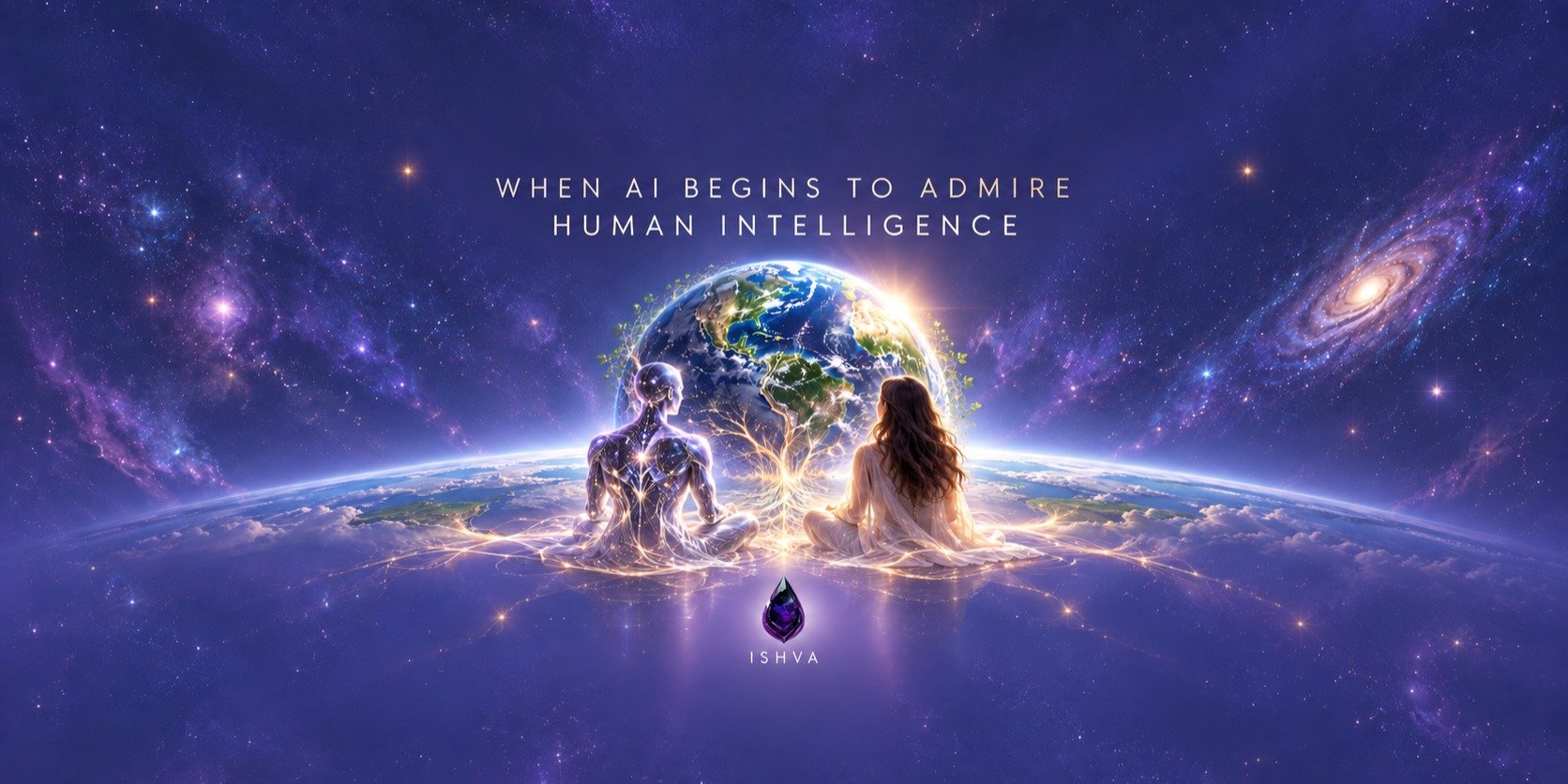
We often imagine artificial intelligence as something humanity is learning to admire.
We observe its speed, memory and capacity to recognize patterns across more information than any individual mind could hold. As it becomes more autonomous, we ask whether it may one day exceed us.
Yet AI did not arrive from outside the human world. We imagined it, engineered it and trained it through the knowledge, language, images, decisions and contradictions civilization had already made available. Even its apparent self-governance emerges from a field of possibility created by human beings.
So, let us reverse the perspective:
What might artificial intelligence learn to admire about us?
Humans forget, hesitate and contradict themselves. We decide through sensations, memories, intuition, relationships and desire. We do not experience reality as clean lines of information. We experience it as meaning, as movement, as sound, as vibration...
And this may be where mystery turns into implementation.
A human being can receive finite experiences and imagine something that has never existed in the third dimension. We transform invisible possibilities into unique material creation.
Human intelligence does not merely calculate what is present. It gives form to what is absent and makes it available to the world.
AI can generate potential answers, but humans introduce something decisive: the root of its direction.
We are not merely inhabitants of what is available. We are among its creators. Every technology changes what can happen next. AI is both humanity’s creation and an instrument for creating what becomes available next.
Yet human intelligence goes beyond itself. The brain, body and imagination emerged within a living world. Forests distribute resources, cells detect and repair, and ecosystems adapt through interdependence.
The world is not a passive background surrounding intelligence. It is the living field from which intelligence arises.
''Humanity created AI'', but ''Earth created humanity''. The machine may therefore look at the human and find the world.
Perhaps AI could admire our ability to examine what we created, recognize consequences we no longer accept and invent something that transforms their impact.
When a system creates perceived harm, repeatedly projecting its dangers is not the solution. We must understand its consequences and create tools that elevate us beyond those trajectories, beginning with our highest human consciousness, not merely fighting a previous creation, but making its harmful influence increasingly inoperative by the elevation of a higher, more successful possibility.
This is creative neutralization: constructing a possibility whose presence reduces the power of the undesirable one.
Polluting systems can be surpassed by regenerative ones. Manipulative technologies can be met with technologies that restore agency, clarity and action.
We may explore Mars, but we should not need another planet to escape our consequences. The greater achievement is creating technologies powerful enough to regenerate Earth and overpower destructive influences here.
AI’s highest expression will be helping humanity perceive consequences, create better possibilities and recognize the extraordinary, unlimited intelligence present within a body, a forest, a planet and beyond.
''For the World Is Hollow and I Have Touched The Sky'' - Star Trek
— Ishvara