
The reality: We rarely buy based on rational thinking.
We buy emotionally and rationalize with facts. Apple is a prime example. Are their products superior? I’d say no. Yet many still choose Apple and justify it, even with better options available.
The insight: We must tell stories (do marketing) in a way that aligns with this reality, rather than against it.
So, do not lead with data or features—lead with emotion, ideally through story. A framework, like a creative brief, helps consistently tell emotional stories.
Despite this, most creative frameworks fall short—think of how little most persona profiles actually help. These common gaps highlight the need for more effective approaches, which is why Kaleb Schad’s perspective is particularly valuable. As Director of Strategy & Marketing at Rawhide Youth Services, Schad’s role centers on developing strategies that bridge emotional connection with organizational goals.
Drawing on his expertise, I am eager to explore the six-part Creative Brief he shared during a recent Expert Session for The Midwest Marketing Meetup (Find future events here), as it promises a more human-centered approach to marketing that addresses the limitations of traditional frameworks.
Here are the six parts of Kaleb’s brief, which I’ll walk through in detail:
Key Fact
Consumer Problem
New Belief
Creative Strategy
Reason Why
Creative Execution
Kaleb’s session made a simple but important point: emotional storytelling does not begin in the copy. It begins much earlier, in the discipline of understanding the customer well enough to tell the story they need to hear rather than the one the brand wants to tell.

His creative brief offers a practical path to getting there, starting with the customer rather than the company, and his comments on AI make the lesson even more relevant. AI can help with research and pattern-finding, but it still struggles to replace the human judgment, empathy, and instinct that make emotional marketing actually feel true.
Let’s dive into my thoughts on the framework (paired with Kaleb’s thoughts):
Many marketers believe that adding emotion comes during execution, such as in copy or design. Kaleb contends that emotion is not an afterthought in marketing; it begins in the early stages, when emotional insight is gathered about the ideal customer.
While great copy and design move people, it is the underlying emotion that truly moves them. Copy and design simply carry emotional insight forward. As Kaleb argues, emotion is crucial to moving people. Without uncovering emotion early, it is harder to move people.
The challenge is to focus on your ideal customer's emotions, rather than on what you’re passionate about (i.e., what you're emotionally invested in). The story you tell is not yours; it’s their story.
Your company, product, or service is not the hero in the story. Years ago, after reading Donald Miller's Storybrand, I realized the customer—whether a donor or investor—should be positioned as the hero. The brand acts as a guide, supporting the hero on their journey.
Take Star Wars as an example: Luke Skywalker is the hero, while Yoda is the wise guide. Similarly, your brand plays the role of Yoda, helping the hero navigate their new world. This requires a mindset shift, especially since many traditional marketers and businesses tend to focus on their own story. Even once you make this adjustment, the next steps require considerable effort:
“You need to deeply understand your audience as individuals—walk in their shoes, recognize their pains, hopes, and desires. Many companies struggle because they tell the stories they want to tell rather than what customers need to hear.”
Curiosity and empathy help, but aren’t always enough. Kaleb shared a video for Rawhide Youth Services that tells a hopeful story from Max, a program graduate. The first cut focused too much on Rawhide therapy services rather than on Max.
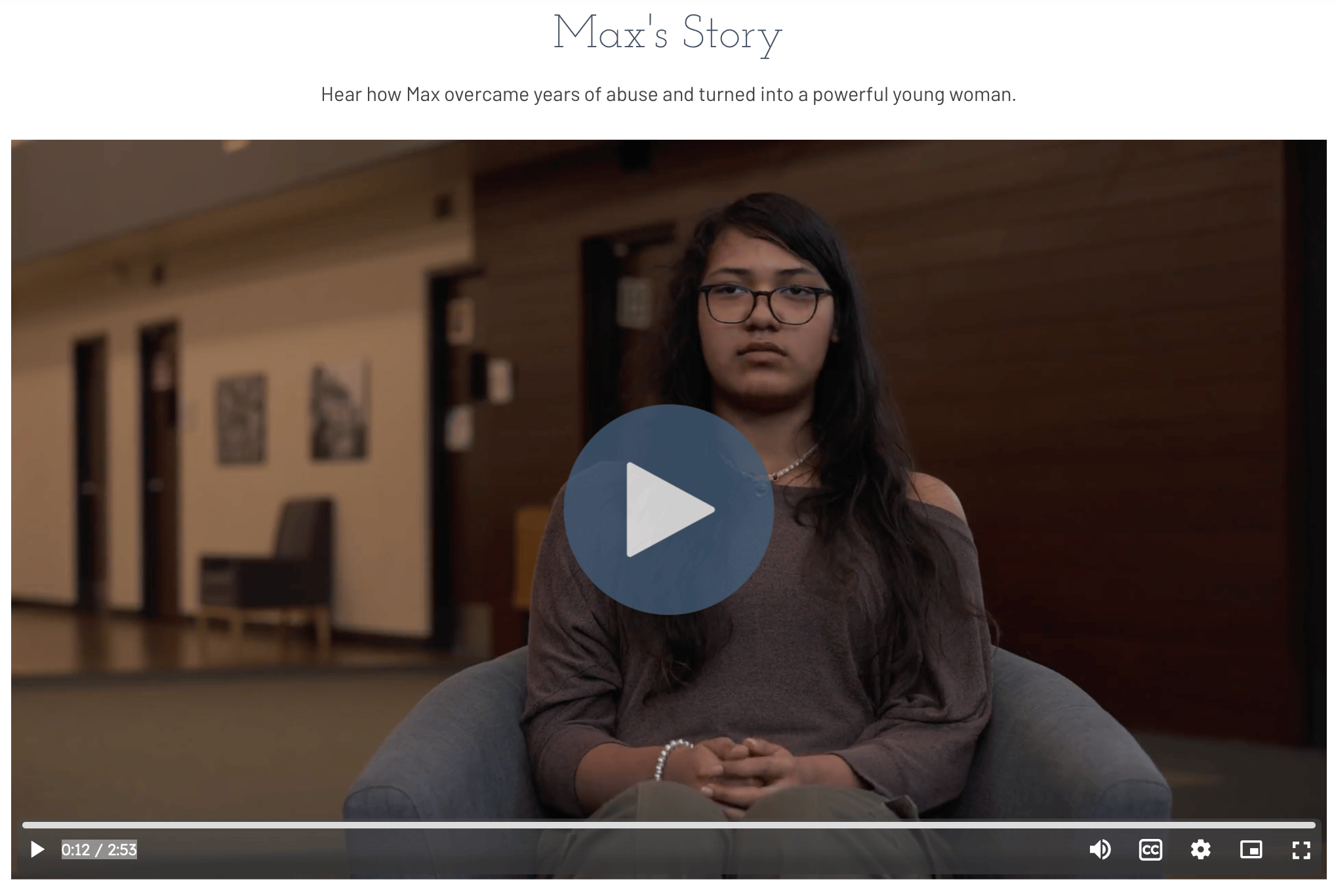
“The first cut of this video… was not emotional. It was a three-minute video all about Rawhide therapy services. And I said, stop. We don’t need to say any of those things… This is a story about Max, and this is Max’s story, and people are going to understand the impact of Rawhide by hearing her story.”
This framing allowed the video editor and the rest of the team to anchor in the fact that it was all about Max. By fully (and honorably) telling her story, the intended audience would also see Rawhide’s value.
While this insight is helpful, it’s not enough to consistently create emotional stories (i.e., marketing). The pull to make your brand the hero is strong. This is where Kaleb’s brief becomes useful: it’s a forcing function to keep the work from collapsing back into brand-speak.
This approach is not about completing a checklist, but about developing a discipline that keeps your marketing truly human and focused on real stories:
“When I punted on not doing that research, or I punted on not really trying to walk in their shoes, I think that’s when the story suffered.”
Before diving in, it’s important to note: this brief is not a cure-all. If you don’t invest real effort into understanding your customer, following this brief alone won’t deliver results.
As Kaleb shared in the session, “As I was looking at some of the creative briefs I’ve written, preparing for this, I was like, man, Kaleb, some of these suck. You did a really bad job on some of these. Because it’s really hard to get into the mind of your customer.”
The brief’s job is to help you focus on your hero: “What I love about this brief is it simplifies things and forces you to focus on the customer… The first three sections don’t let you talk about yourself. They let you talk about your customer and their world.”
As I like to say during my consulting engagements, I (we) don’t have the answer. The answer is out there.
“Out there” simply means a combination of qualitative insights from customers, prospects, those who switched to different solutions, and quantitative data from research or surveys. Only through synthesis does an answer (in the form of insights) begin to take shape.
Now, equipped with these insights, let’s break down the brief step by step, as Kaleb explained it.
And the first move is deceptively plain: You do not begin with the idea. You begin with their reality.
Seth Godin said, “The strategy closest aligned to reality wins.” The first step of Kaleb’s brief is to define that reality (for your customer).
“The key fact is going to be some kind of objective statement that your client, your customer, your patient is dealing with in their world… For MasterCard, people were really afraid of credit cards and the damage they could do to you if you’re not responsible with them. So the key fact, they said, is that credit cards have created a great deal of consumer debt. No one can debate that. That’s reality.”
To find this key fact, Kaleb suggested research as a key pathway. For the MasterCard example, it was likely easier to uncover. With the financial crisis of 08/09, the reality of how much damage (bad) debt can do was tangible. For you, the key fact is likely more buried.
When I joined a social media/content agency as Head of Growth, my first role was to shift our positioning. While slightly different than creating a campaign using this brief, I began with the reality of their work. The agency was currently targeting social media marketers as their #1 audience. Made sense until I uncovered a key fact:
Senior marketers (the ones who sign and hire the agency) have short tenures (2-8 years). When they switch companies, they want to bring in a trusted agency to prove their value. This was validated by a client who had worked for a manufacturing company and then joined Special Olympics. She worked with our agency before switching jobs and brought us into Special Olympics.
This key fact (about our customer) changed our entire go-to-market motion. Rather than pump out generic blogs and social posts, we switched to in-depth reports and in-person exclusive dinners. It all started with a fact from our customers' world.
The value in this step is that it anchors the work in the customer’s lived context rather than the marketer’s agenda. While we wanted to sell more social media and content, we instead framed our messaging around the challenges (for senior marketers) of starting a new role or proving social/content ROI to management.
But I’m putting the carriage in front of the horse here. The key fact is merely the first spark on the fire. What makes the fact useful is the pressure it creates in the customer’s world.
That’s what the next part of the brief surfaces: the problem the fact creates for our customer.
Sticking with the MasterCard example (sorry for jumping around!), Kaleb noted how they tied the key fact to their customer’s problem.
“The key fact leads to a problem for your consumer. The problem is consumers are afraid that the risk of high credit card debt outweighs the benefits of credit cards. Here’s the beauty — you’re only in step two, but you’re already focusing on your customer. You’re not saying what MasterCard is going to do about it.”
Kaleb still suggests using research (i.e., Reddit or online forums) for this stage, but also introduces the power of talking to your customer. Sometimes, to fully uncover what your customer is thinking or afraid of, you must sit with them and LISTEN. You must genuinely care to learn what is keeping them up at night.
Kaleb shared an example of this while working with a healthcare provider:
“What we discovered was the people who were considering bariatric surgery weren’t afraid of the medical side effects…What they were afraid of is that it would look and feel like they’re giving up, because they had spent years and years fighting… and now they’re going to do surgery, and it’s like cheating. It’s like just giving up.”
I loved that example as the surface problem was health, but the deeper problem was shame. And with that consumer problem (i.e., emotional insight), Kaleb’s could begin working on the next step, their New Belief.
Because once you have the right/better consumer problem (vs the surface one), the next question becomes: what has to change in the customer’s mind?
Good marketing does not just describe the problem. It creates a new way to interpret it.
That’s where the brief shifts from diagnosis to persuasion:
For most campaigns (or go-to-market initiatives), the endgame is a new (or old) action (rooted in shifted beliefs). At the lowest level of emotion, that shift is simply that I need to buy (i.e., I need new Nike shoes).
Using Kaleb’s healthcare example, the new belief was to combat the shame, “We were able to take that as an insight and create messaging that leverages you’re not giving up. You’re actually fighting… you’re actually winning through a different tactic.”
Through this new belief, potential bariatric surgery patients could see themselves in a better light. Rather than giving up (shame), they could lean into the message that they are fighting using a different tactic (courage). Marketing often works by changing the meaning of an action (rooted in belief) to lower the friction required to take it.
But understanding the key fact, the emotional consumer problem, and the new belief isn’t enough. You must strategically express that shift in a way your audience can feel.
That’s why Kaleb’s next step is the creative strategy:
“So how are you going to tell that {story}? That’s when you get to your creative strategy… the creative strategy is how you’re going to do it—what is that message that you’re going to say?”
How will this come to life? That’s what the creative strategy is for.
It’s not execution, it’s the choice of what kind of emotional frame you will use to tell the story. Along with the ways to distribute the story. Will it be a social-first campaign? Omni-channel approach?
One thing Kaleb didn’t touch on is the importance of thinking with a distribution-first mindset. Especially in 2026 and beyond, when the channels are almost infinite.
The MasterCard example Kaleb shared was from the early 2000s, when TV ads were the obvious distribution model. They had the luxury of focusing only on how to frame the story, not on where it would go or how to tell a story relevant to each channel.
You and I aren’t afforded that luxury.
We must consider distribution during customer research (where they spend time) and again when we define the creative strategy. Along with a unique and effective way to tell that story.
One simple way to think about this stage is in guardrails.
Rather than providing authoritative answers, aim to build guardrails for execution that allow flexibility while ensuring consistency. I’ll use Kaleb’s third example to illustrate this: He was working with the chair manufacturer, KI, and they wanted to tell a story about the good they do, using a chair.
Rather than having answers about how it will be executed, they had a simple guardrail: the red chair will be in the center, with different people sitting on it. They also likely had guardrails on who and what they’d say.
The goal is to have enough structure to make execution easier while enabling the conditions for innovation to create a better campaign.
Yet, strategy alone does not make the work resonate. There is still one more layer that gives the whole thing an emotional lift, before execution. Kaleb calls that layer the “reason why.”
The “Reason Why” for MasterCard’s campaign was the simple line, “There are some things money can't buy; for everything else, there's Mastercard.” That’s a priceless line.
“The reason why is the emotional punch line. This is the punch to the gut that says, ‘Oh yeah, I get it.’”
It’s not only a tagline. It could be at the heart of the piece. Using the KI example, the Reason Why was how long KI’s red chair has been around and all the good that people who sat on one have done for the world.
While there was a tagline that expressed this, the execution was guided by this underlying “Reason why.”
To make the next step more effective, you must gather together everything you’ve done into a coherent “Reason why.” Without that, execution can fall flat and not fully represent the previous parts.
But what about for B2B, where emotion is supposed to be null?
“B2B can be really hard because sometimes it’s not very emotional, but there are still strong emotions for buyers… my job might be on the line… what if we purchase this and the installation goes terribly? My reputation…”
B2B is still human-to-human. Someone must sign their name on the proposal. The key is to understand that person's (i.e., persona's) fears and goals, and speak to them with the “Reason why.”
For an AI company targeting marketers, that “Reason why” could be how it will make that marketer a supermarketer. “Don’t know shit about SEO? But your boss is demanding answers? Let {ai product} empower you with the thoughts and answers to develop the SEO plan your boss requires.”
This leads us to the final, and most critical, part of the process: The execution of your campaign. Because, as Kaleb shared, the brief can be right and the work can still miss the mark. Which is why execution is its own craft.
Let’s revisit the trap from the opening of this essay: We want to tell a story, yet we must resist that urge and tell their story. Kaleb shared earlier how the first cut of Max’s Story focused on cognitive-behavioral therapy rather than telling her story in full color.
“Did you hear the phrase cognitive behavioral therapy in there at all? That was what the first edit was… I was like, oh, man, no. This is about Max. This is a horrifying and triumphant story. And we need to make sure people feel that when they come out of it.”
Execution is where a solid brief comes to life and becomes tangible. Or it can be when you tell a selfish story, and the emotion (and the work you put in) evaporates, resulting in poor results.
Some tips Kaleb shared were using the hero’s journey, Donald Miller’s advice on the customer as the hero, and storytelling techniques like problem-agitate-solve. They all reinforce the same idea: execution has to make the story tangible.
Another trap specific to this part is the temptation to overcomplicate the story.
Whether it’s trying to tell a two-hour movie in a 30-second commercial or copying and pasting the story to social media without making it relevant/digestible for that channel. A simple takeaway: Say less.
“Donald Miller says, imagine that your customer is running on a treadmill, and you’re trying to talk to them, and they can’t breathe. They have no energy to pay attention to what you’re saying. So just say it. Just be stupidly simple, and say it really clear.”
Now that you have the knowledge of this powerful six-part brief, I want to touch on a dilemma many face: when and how to use AI to assist with this process.
Can we agree that we’re not going back to a pre-AI age? The power that AI can bring is here to stay.
“AI is a huge asset in this. I wish to God I had this tool 15 years ago when I was starting out in marketing. Being able to use AI to research reports, medical journals, anything that would help get the insight.”
The first and most obvious place AI can assist is in uncovering key facts and consumer problems. While talking to humans is my first choice, using AI to uncover adjacent info or even validate (or prove wrong) my current hypothesis is a close second. One thing to remember: FACT CHECK your AI research.
The problem is not whether AI can surface information. It is whether it can tell you what matters.
The next part of the brief is where AI becomes less helpful: The new belief and subsequent sections rely on human thinking. You can have AI brainstorm, but the breakthrough comes from being human. Synthesis is something AI is good at with data, but humans will rule at this skill. Pulling together all your research and insights into a coherent new belief is an art. No machine masters this (yet).
If you’ve kept the human in the loop (and use transcriptions from interviews for context), AI can still be helpful in the creative strategy phase. AI can help you either uncover new ways to create or channels you hadn’t thought of. I find it useful once you land on your center of gravity (main strategy and channel), and then have it adjust to other channels you need to be in.
Simply put, AI can be a killer assistant for research, refining, and giving contrarian feedback. Let’s now cover what it’s not as good at:
Parts 5 and 6 seem to be areas where AI has diminishing returns.
“While AI is a good tool to find and help mine data, don’t rely on it entirely. I think at the end of the day, we’re humans, and we have to use our human insight and our human gut to assess whether what we’re hearing from AI is valid or not, and figure out what is that nugget in the research that’s worth leveraging and jumping out to you, and just trust your gut on some of those things.”
Sure, AI can attempt to provide the Reason Why (i.e., emotional gut punch), but that’s where human ingenuity shines. Taking everything you have, creating prototypes of your Reason Why, and then having AI give feedback is useful. Just don’t expect it to come up with the breakthrough idea.
Can AI help with execution? Sure. It just can’t do it all, and you shouldn’t rely on AI-generated images or videos (yet). AI is strongest when it’s a thought partner, giving feedback on the execution, rooted in your brief’s context. It also can’t interview someone (which leads to great case studies/testimonial videos).
Kaleb discussed tips on how to pull out emotional and effective answers during case study interviews:
“Make sure you ask about emotions… ‘How did you feel when that was happening?’… and then… you shut up… If there’s an awkward silence, let that awkward silence linger because they will fill it, and that’s usually when you get something interesting too.”
AI is unable to have a human connection and create the conditions for the person to feel safe and share. Conversation is a skill only humans can cultivate (for now). This is where you can uncover so much useful fodder for the brief. AI can’t replace this.
“It’s definitely a skill that you have to learn… I try to come at things sideways, and I’ll ask a similar question in a different way, because they’ll answer it a little bit differently each time.”
I want to end this discussion on AI (and this essay) with a final limit Kaleb places on emotional storytelling, whether AI is involved or not. It is not just a question of effectiveness. It is also a question of ethics.
The final distinction he makes is maybe the most important one in the entire session:
Ever seen the The Vulture and the Little Girl photo?

It’s a photograph of a frail, famine-stricken boy, erroneously believed to be a girl until 2011, who had collapsed in the foreground with a hooded vulture eyeing him from nearby. While the child did survive, I believe that’s using emotion to manipulate rather than to give your hero dignity.
The constant question with using emotion in storytelling is how far can I go while retaining the dignity of the person/organization. It definitely helps to use Donald Miller’s framing: the customer is the hero, not a damsel in distress. That shifts you to honor and elevate your hero (not to diminish their agency).
Kaleb touched on this using Max’s story:
“I don’t think if you watched Max’s story… that we exploited this poor little girl. That was a part of her healing journey, in many ways, was her being able to tell that story. And the emotion was not meant to exploit. It was meant to connect.”
When amping up the emotion in your story, use it to connect, not to manipulate or exploit the viewer. When you honor your hero and preserve their dignity, the results will follow.
“If you use emotions to manipulate people, that’s a real challenge, but if you use it to build a connection with your customer, your audience, your employee, whoever it is, then you’re using it for good.”
Shall we agree to use this superpower for good?
Only then can we leverage emotion in storytelling effectively. Thank you to Kaleb for sharing, and thank you for reading. I hope you leave with practical insights to apply to your marketing.
You can reach me at jordano@hey.com with questions, pushback, and inquiries on future expert sessions.
Onward 🧡