

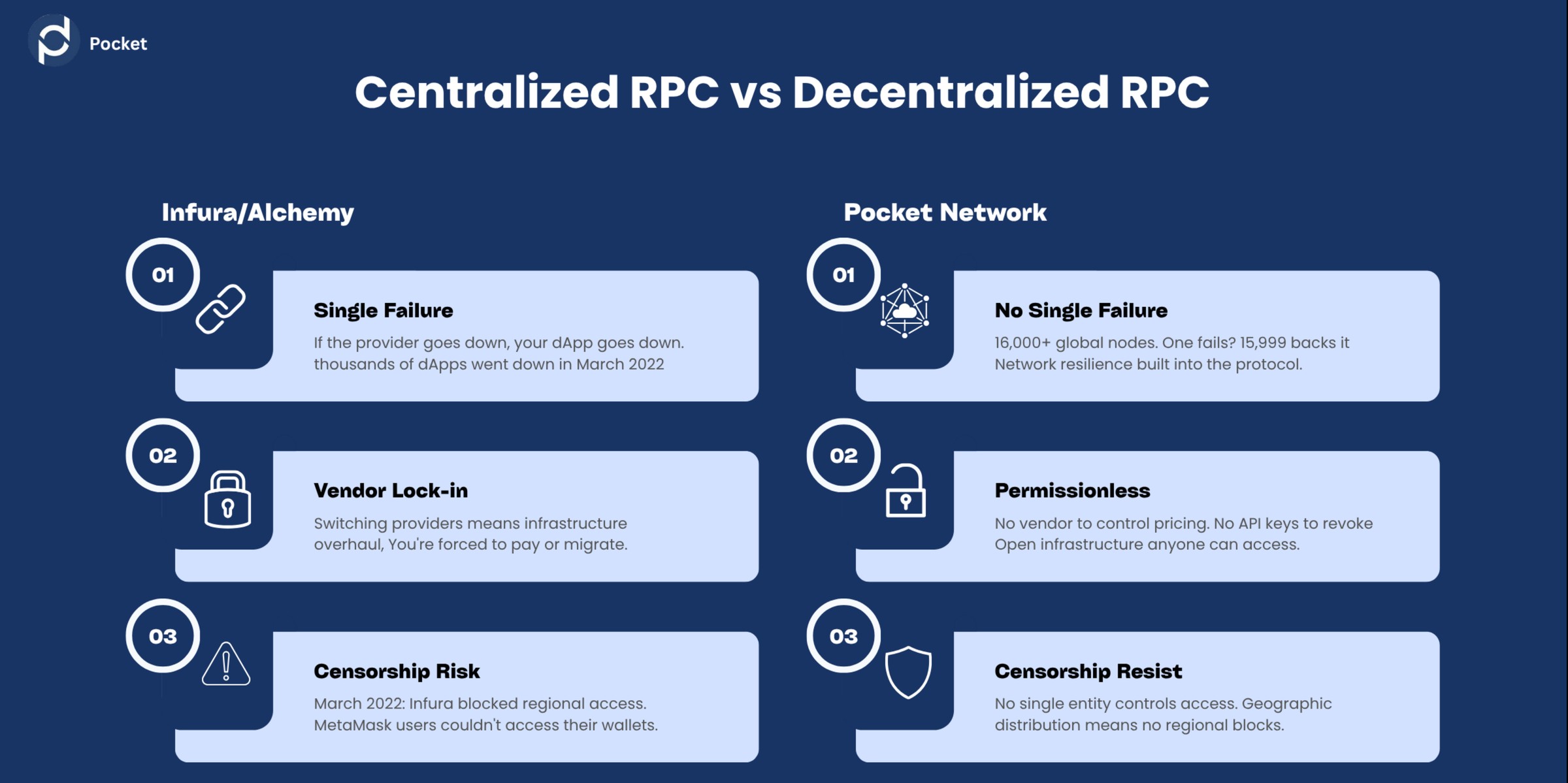
On March 3rd, 2022. Thousands of Ethereum users woke up to find they couldn't access their MetaMask wallets. DeFi traders were locked out of their positions. NFT collectors couldn't view their assets. Developers watched their dApps go offline.
The culprit? Infura — a centralized RPC provider that most of these "decentralized" applications relied on to communicate with the Ethereum network.
For compliance reasons, Infura had blocked access to users in certain regions. Within hours, the entire Web3 ecosystem felt the impact. Projects that had spent months building "decentralized" applications suddenly realized they had a centralized dependency they couldn't control.
This wasn't a hack. It wasn't a smart contract exploit. It was infrastructure failure at the most fundamental level.
And it exposed a truth most of the industry didn't want to admit: most Web3 applications aren't actually decentralized.
What is RPC (And Why You Should Care)
RPC stands for Remote Procedure Call. In simple terms, it's the bridge between your application and the blockchain.
When you check your wallet balance, send a transaction, or interact with a smart contract, your app isn't talking directly to the blockchain. It's making an RPC call through a provider that queries the network on your behalf.
Think of it like this: You want to check your bank account. You don't walk into the vault and count your money. You use an ATM that connects to the bank's system and shows you your balance. RPC providers are the ATMs of Web3.
For developers, using a centralized RPC provider like Infura or Alchemy makes sense. They're fast, reliable, easy to integrate, and handle the complexity of running blockchain nodes. Most projects use them without a second thought.
But here's the problem: if that ATM goes down, you can't access your money. And if the ATM operator decides you're not allowed to use it anymore, you're out of luck.
That's exactly what happened in March 2022.
The Three Critical Risks of Centralized RPC
Risk 1: Single Point of Failure
When your dApp routes all its traffic through one provider, that provider becomes your single point of failure.
If Infura experiences an outage (which has happened multiple times), every application relying on it goes down. It doesn't matter how well your smart contracts are written or how decentralized your token distribution is. If users can't connect to the network, your dApp is offline.
The March 2022 incident wasn't even a technical failure — it was a policy decision. But the impact was the same: thousands of applications went dark because they all depended on one company's infrastructure.
You can have the most innovative DeFi protocol, the most robust NFT marketplace, or the most secure DAO governance system. But if your users access it through centralized RPC, one policy change or technical issue can bring everything down.
Risk 2: Vendor Lock-in
Switching RPC providers isn't like changing your email client. It requires infrastructure changes, testing, potential downtime, and engineering resources.
This creates vendor lock-in. Once you've built your application around Infura or Alchemy, migrating to another provider becomes expensive and time-consuming.
And providers know this. When Infura or Alchemy raise prices, you have limited leverage. You either pay the increase or spend weeks rebuilding your infrastructure to switch providers.
There's no real competition when switching costs are this high. You're essentially at the mercy of your provider's pricing decisions and policy changes.
For early-stage projects with tight budgets, this can be the difference between survival and shutdown. For established projects, it's a hidden tax on growth.
Risk 3: Censorship and Compliance
This is the risk that Web3 was supposed to eliminate, but centralized RPC brings it right back.
RPC providers are companies. Companies must comply with regulations. When regulators demand that providers block access to certain addresses, regions, or smart contracts, providers have no choice but to comply.
March 2022 was a preview of what this looks like. Infura blocked users in specific regions for compliance reasons. MetaMask users in those areas couldn't access their wallets — not because of a blockchain issue, but because of a centralized gatekeeper.
Imagine building a censorship-resistant application on Ethereum, only to have user access blocked at the RPC layer. Your smart contracts are decentralized. Your token is decentralized. But if the access point is centralized, censorship resistance disappears.
This isn't theoretical. It happened. And it will happen again as regulatory pressure on Web3 infrastructure increases.
The Solution: Decentralized RPC Infrastructure
This is where Pocket Network comes in.
Instead of routing all traffic through one company's servers, Pocket Network distributes RPC requests across a network of over 16,000 independent node operators globally.
Here's how it solves each problem:
No Single Point of Failure
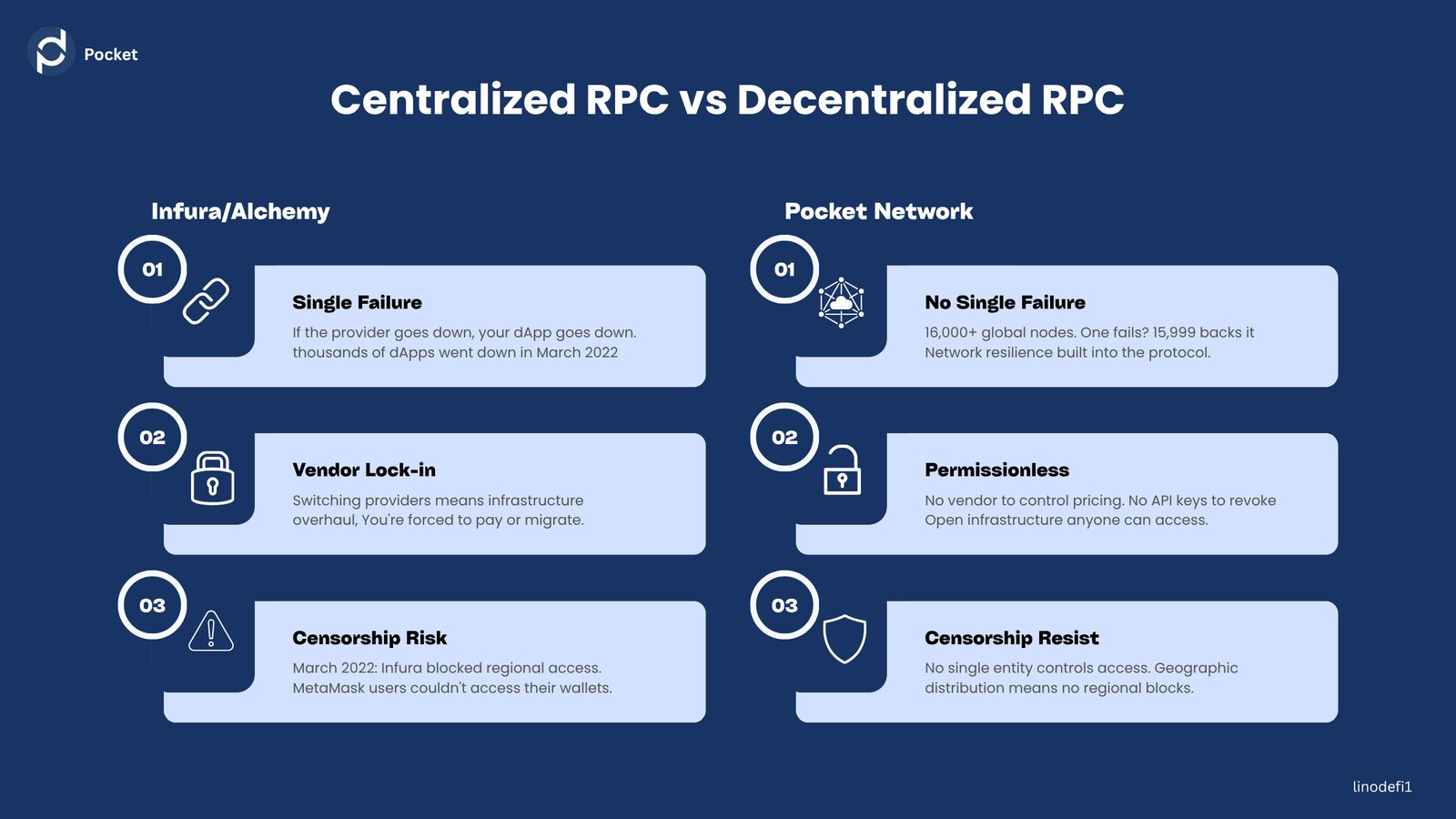
With 16,000+ nodes, there's no single server that can take down the network. If one node goes offline, 15,999 others handle the request. Network resilience is built into the protocol itself.
No Vendor Lock-in
Pocket Network is permissionless infrastructure. There's no single company controlling access or pricing. Developers can integrate directly with the protocol without depending on any centralized entity.
Censorship Resistant
Because the network is geographically distributed and operated by independent node runners, no single authority can block access. There's no company that regulators can pressure to implement region-based restrictions or address blacklists.
Why This Matters Beyond Infrastructure
The centralized RPC problem isn't just technical — it's philosophical.
Web3 exists because we wanted an alternative to centralized control. We wanted systems that couldn't be shut down by a single entity. We wanted censorship-resistant applications that gave users true ownership and control.
But if the access layer is centralized, we haven't actually solved the problem. We've just moved the centralization from one layer to another.
Your smart contracts can be perfectly decentralized. Your token distribution can be fair and permissionless. Your governance can be on-chain and transparent. But if users access all of this through Infura, you've created a decentralized system with a centralized chokepoint.
True decentralization requires decentralization at every layer
That includes:
-
Smart contracts (decentralized)
-
Token distribution (decentralized)
-
Governance (decentralized)
-
Frontend hosting (often centralized)
-
RPC infrastructure (usually centralized)
Most projects get the first three right and ignore the last two. Pocket Network addresses the infrastructure layer that most teams overlook.
What Developers Should Know
If you're building on Ethereum, Polygon, Arbitrum, or any EVM chain, you're likely using Infura or Alchemy. And that's fine for getting started — they're reliable services that let you move fast.
But as your project grows, you need to think about infrastructure resilience:
-
What happens if your RPC provider has an outage during your biggest product launch?
-
What happens if they raise prices when you're scaling and can't afford downtime?
-
What happens if they're forced to block users in regions where you have significant adoption?
These aren't hypothetical scenarios. They've all happened.
Decentralized RPC infrastructure like Pocket Network gives you an alternative. It's not just about ideology — it's about building applications that are genuinely resilient, censorship-resistant, and independent of any single point of control.
Turn Infrastructure Into Understanding
The best blockchain projects don't win on decentralization claims alone. They win when developers, investors, and users can see why it matters.
Pocket Network built the infrastructure — I built the explanation.
I'm Lino, a Web3 Visual Strategist helping infrastructure protocols turn complex systems into clear explainers that developers, investors, and communities can actually understand.
If this breakdown made decentralized RPC click, follow @linodefi1 for more weekly Web3 infrastructure deep dives.
Appreciate the support