DAO governance is not just clicking For, Against, or Abstain.
Every vote can move treasury funds, change protocol risk, approve new market listings, give emergency powers, select service providers, or shape the future value of a governance token.
Many DAO voters focus on one number. The grant amount. The APY. The TVL. The expected growth. Or the token price.
But a good proposal needs more than a good story.
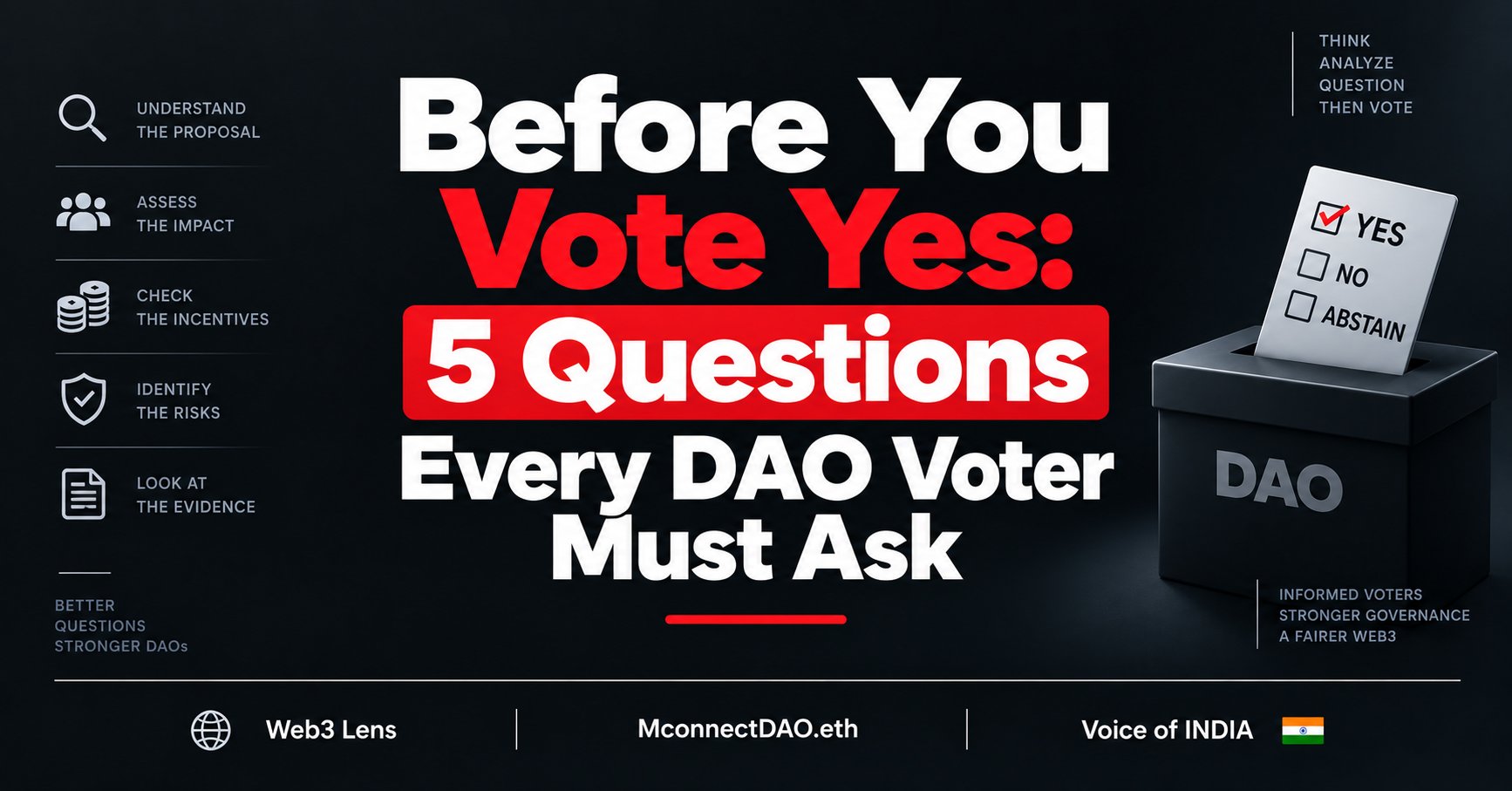
Before voting yes, every DAO voter should ask five simple questions:
Who is behind the team?
Where will the funds go?
Who has emergency rights?
Who is giving risk advice?
How does the token capture value?
These questions are not negative. They are responsible governance.
Recent events in Arbitrum, Curve, Compound, Aave, and other DeFi ecosystems show why these questions matter.
The first thing to check is the people behind the proposal.
A proposal may come from a project name, a foundation, a delegate, a service provider, or an anonymous account. But DAO voters need to know who will be responsible if the proposal fails.
Check the founders, core contributors, multisig signers, and main wallet owners. Look at their previous projects. Have they managed grants before? Have they been involved in an exploit, a failed product, a treasury loss, or a conflict with another DAO?
A past failure does not always mean a person should be banned forever. People can learn. But past events must be disclosed clearly. The DAO should decide with full information.
Curve DAO gives an important example. Curve approved yRisk as a risk provider for crvUSD and Llamalend. The vote received major support from veCRV holders. Later, people raised concerns that some yRisk contributors were connected to Resupply developers, linked to a past exploit. The key issue is not only the past event. The bigger issue is whether the proposal gave voters full context before they voted.
This is where many DAO systems are weak. Voters see a technical report, a known contributor, or a strong brand name. They may not check the full background.
Before voting, ask:
Who are the real people behind this proposal?
What projects did they work on before?
Were there past security incidents?
Do they have any financial interest that could influence their advice?
Are they connected to competitors, market makers, grant recipients, or large token holders?
If a proposal cannot answer these questions, it is not ready for approval.
The second question is simple but very important.
Where exactly will the DAO money go?
Many grant and incentive proposals use big words like growth, adoption, liquidity, community, ecosystem, and partnerships. These words sound positive. But voters need a real fund flow plan.
A proper proposal should show the complete journey of the funds.
How much money is being requested?
Which token will be paid?
Which wallet or Safe multisig will receive it?
Who controls that wallet?
Will the funds be sent in one payment or through milestones?
What result is expected at each milestone?
What happens if the team does not deliver?
Will unused funds return to the DAO treasury?
Arbitrum DAO provides a strong accountability example. Its Watchdog Committee proposed future program bans for Good Entry, Limitless, and APX Finance after identifying high severity grant misuse cases. The cases involved allegations such as ineligible incentive distribution, suspected self farming, unreturned funds, and moving grant funds outside the Arbitrum ecosystem.
The disputed total was reported as about 457,553 ARB. But voters must understand an important detail. This figure was not one single debt. It combined several types of issues across different projects. Clear reporting matters because unclear numbers can create confusion and damage trust.
The Arbitrum case proves that giving a grant is not the final step. Monitoring is the real work.
A DAO should use milestone based payments where possible. It should publish recipient wallets. It should define eligible users before incentives start. It should require regular reports. And it should have a clear recovery process if funds are misused.
If voters cannot follow the money, they should not approve the money.
The third question is about safety.
What happens if something goes wrong today, not after a seven day governance vote?
DeFi protocols can face hacks, oracle failures, stablecoin depegs, liquidation cascades, governance attacks, and sudden market stress. In these moments, a normal vote may be too slow.
This is why emergency controls are needed. But emergency control can also be dangerous if one person or one small group has unlimited power.
The goal is not to remove emergency powers. The goal is to define them carefully.
Voters should ask:
Can the protocol pause deposits, borrowing, or trading?
Who can trigger the pause?
Can they move treasury funds, or can they only change risk parameters?
How many multisig signatures are required?
Are the signers independent?
Does the emergency power expire after 24, 48, or 72 hours?
Does the DAO need to approve the action after the emergency ends?
Is every emergency action recorded publicly?
Compound DAO showed why this topic matters. Compound runs a major lending system with billions of dollars in value. Governance debate raised concerns around the lack of a clear emergency brake. A protocol with large TVL cannot depend only on slow governance when users may face real time losses.
At the same time, an emergency guardian should not have unlimited treasury access. The guardian should have narrow powers, such as pausing a risky market or reducing a borrow cap. The power should be time limited, transparent, and reviewed by the DAO.
Strong governance is not choosing between decentralization and safety. Strong governance builds safety without creating hidden centralization.
The fourth question is often ignored because risk reports can look technical.
But risk providers can influence almost everything in DeFi.
They may recommend a new collateral asset, borrowing cap, supply cap, interest rate, liquidation threshold, oracle setting, or isolation mode. One change can affect borrowers, lenders, liquidity providers, and token holders.
Aave and USDe show how important this is. Risk recommendations to increase USDe borrowing costs could make the popular sUSDe looping strategy less profitable. A user may see a high yield on sUSDe, borrow USDe through Aave, and create a leveraged position. But if borrowing costs rise above the deposit yield, the strategy becomes negative carry.
This is not just a technical change. It changes user behavior, demand for the asset, protocol revenue, liquidation risk, and market stability.
Before voting on a risk proposal, check:
Who wrote the report?
What data did they use?
Did they test a depeg, liquidity shock, oracle delay, or liquidation event?
Do they have any connection to the asset issuer or borrowers?
What happens in the worst case scenario?
Can the DAO revoke the provider mandate if results are poor?
Is there a public review schedule?
Risk providers should be independent where possible. Their methods should be open. Their assumptions should be easy to challenge. And their mandate should be revocable.
A DAO should never approve a risk parameter just because the report looks complicated. Complexity is not proof of safety.
The fifth question is about long term alignment.
What do token holders actually receive for taking governance responsibility?
Many governance tokens give voting power. But voting power alone may not create long term value. Token holders may approve treasury spending, manage risk, vote on upgrades, and carry reputation risk. But they may not receive a clear benefit if the protocol grows.
Voters should understand where protocol revenue goes.
Does it go to the treasury?
Does it support buybacks, burns, insurance, grants, or staking rewards?
Is there any legal reason why revenue cannot be shared with token holders?
Are token emissions too high?
When do insider and investor tokens unlock?
Does a small group control both treasury power and voting power?
Sky, formerly MakerDAO, is an important governance example because stablecoins, savings rates, collateral policy, and lending risk directly affect the whole ecosystem. In such systems, voters need to understand how risks and rewards are shared.
Ondo also raises a broader question for RWA governance. A token can provide governance rights, but if product growth does not connect clearly to token holder value, long term alignment can remain uncertain.
Every DAO voter should ask one direct question:
If the protocol becomes more successful, how does that success create measurable benefit for the token holder?
If the answer is unclear, the DAO may need a better value capture plan.
Before you vote For, Against, or Abstain, take ten minutes and check these points:
Do I know the real team and their past record?
Are conflicts of interest clearly disclosed?
Can I follow funds from the DAO treasury to the final wallet?
Are payments tied to milestones and measurable outputs?
Can unused or misused funds be recovered?
Who can act in an emergency?
Are emergency powers limited, time bound, and public?
Is the risk provider independent and transparent?
Does the proposal explain worst case risks?
How does token holder value grow if the protocol succeeds?
Good DAO governance is not about passing proposals quickly. It is about asking better questions before money, power, or risk changes hands.
Arbitrum shows why grants need monitoring and consequences. Curve shows why provider background checks matter. Compound shows why emergency systems need clarity. Aave shows why risk parameters can change real user economics. Sky and RWA protocols show why token value capture must be discussed honestly.
A DAO vote is not just a click.
It is a decision about trust.
Make it count.
Arbitrum Watchdog Committee grant misuse and proposed eligibility bans, September 2026
Curve DAO Proposal 1492 and yRisk mandate discussion, September 2026
Compound governance discussion on emergency brake and guardian mechanisms, September 2026
Aave USDe borrowing rate and sUSDe looping risk updates, September 2026
Sky and Ondo governance and token value capture discussions, September 2026