
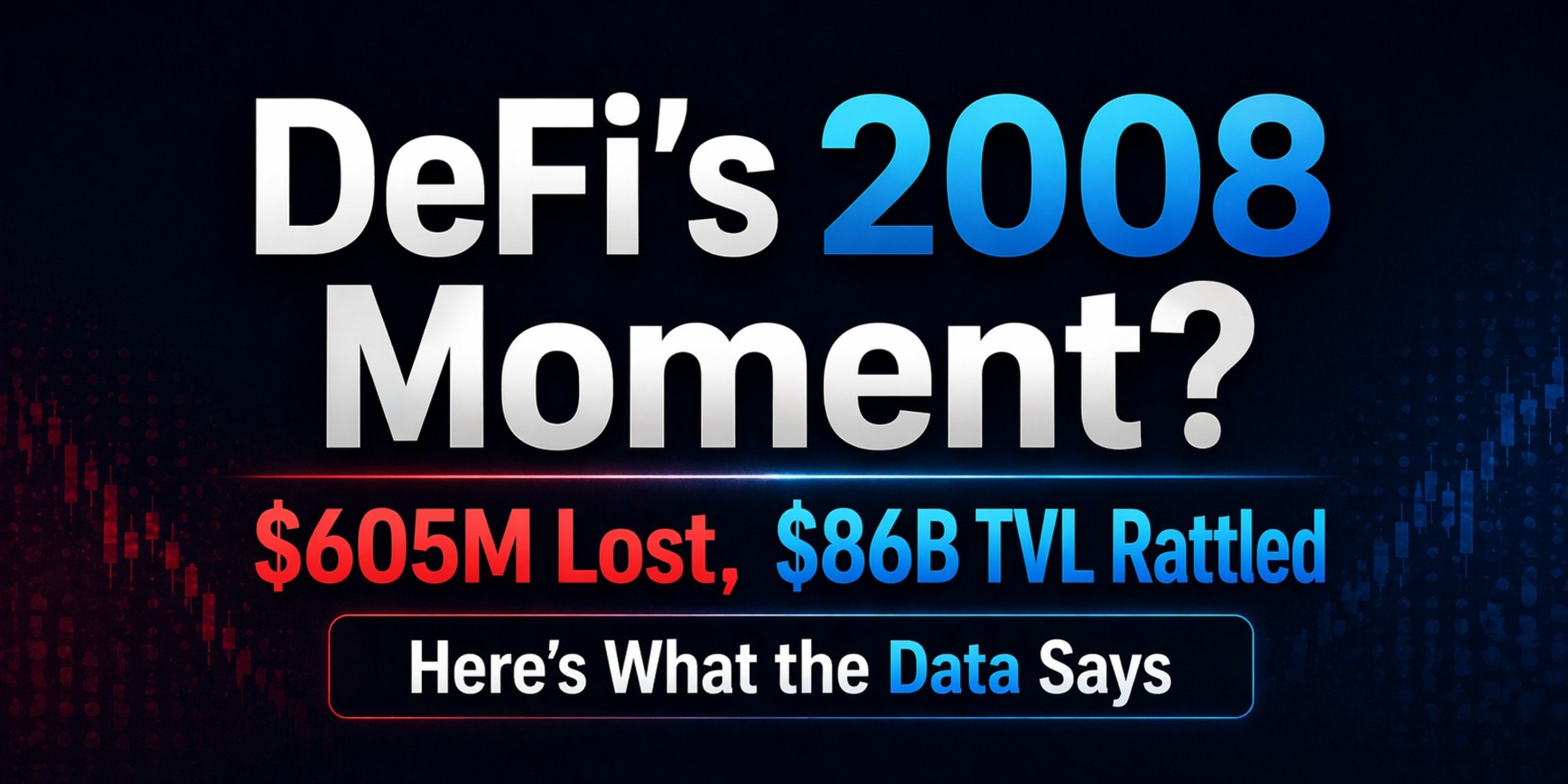
April 19, 2026. A single malicious call to a LayerZero contract function drained $293 million from Kelp DAO in minutes making it the largest DeFi exploit of 2026 so far. Within 24 hours, $13 billion exited DeFi. Solana Foundation's Seraphim Czecker wrote what many were thinking: "Feels like DeFi's Lehman moment."
As a DAO governance researcher who monitors Aave, Arbitrum, Lido, and Optimism forums daily I think he's closer to right than people want to admit.
April 2026 — DeFi's worst month in years:
$293M — Kelp DAO–LayerZero exploit, April 19 (2026's largest DeFi hack)
$286M — Drift Protocol exploit, April 1 (Solana-based)
$137M+ — Stolen across 15+ protocols in Q1 2026 alone
Total: $605M+ in under 20 days
The contagion effect:
Aave TVL: $26.4B → $17.9B within 48 hours
Ethereum DeFi TVL: -17.91% in 30 days
Solana DeFi TVL: -19.04% monthly
Arbitrum TVL: -16% monthly
DeFi hack incidents: +68% YoY — 28 to 47 incidents in the first half of the year
18 of the top 20 chains recorded TVL declines post-exploit
In 2008, Lehman Brothers didn't just fail it revealed how dangerously interconnected the global financial system had become. One institution's collapse triggered a cascade that froze credit markets worldwide.
The Kelp DAO exploit followed the same script. The hacker deposited stolen rsETH as collateral on Aave, creating a bad debt risk that sent $9B in withdrawals surging out of the protocol. Aave lost its position as the largest DeFi lending protocol to Lido. Panic spread across chains. The composability that makes DeFi powerful became the very channel for contagion.
But there is a critical distinction:
Lehman's collapse was caused by over-leverage hidden behind opacity the rules existed, but were buried.
Both crises share one thing: no one believed the roof was weak until the storm hit.
When Arbitrum Security Council executed a unilateral $71M freeze to recover stolen funds, the DeFi community fractured:
One side said: "Great — stolen assets recovered."
The other said: "This is centralized intervention. What was DeFi even for?"
From a governance research perspective, both reactions are valid and that's the problem.
The freeze was technically legal under Arbitrum's Constitution (Article IV emergency powers). But it was not community-ratified, not time-bound, and not pre-disclosed as a possibility to most users depositing funds.
Investor Simon Dedic put it bluntly: "DeFi was supposed to eliminate middleman risk, but we've achieved the exact opposite."
This is the governance gap I've been writing about for months — DAOs don't have pre-defined emergency governance frameworks. When a crisis hits, the response is reactive, opaque, and centralized the exact properties DeFi was designed to eliminate.
Post-Lehman, the world restructured finance around three principles:
Systemic risk must be monitored, not ignored
Interconnected protocols cannot be treated as isolated systems
Self-regulation fails — standards must be formalized
DeFi in 2026 needs the same reckoning:
Cross-chain bridges remain the most exploitable layer — both Kelp DAO and Drift Protocol were infrastructure-layer attacks, not basic smart contract bugs
TRM Labs' 2026 Crypto Crime Report confirms attacks are now targeting operational infrastructure, not just protocol logic
Security remains, as Simon Dedic said, "the most underfunded vertical in crypto"
The next phase of DeFi will be defined by:
Security-first architecture (Solana Foundation's STRIDE program is a start)
On-chain emergency governance protocols — transparent, time-bound, community-ratified
Cross-protocol risk standards — a DeFi equivalent of Basel Accords
Audit-before-deployment culture — not audit-after-exploit damage control
DeFi's Lehman Moment has arrived. But remember 2008 didn't end finance. It rebuilt it. With better risk frameworks, better oversight, better accountability.
DeFi will rebuild too. But this time, governance and security must be co-designed — not treated as afterthoughts.
By Manoj Kumar Desai | MconnectDAO.eth | DAO Governance Researcher | April 2026