
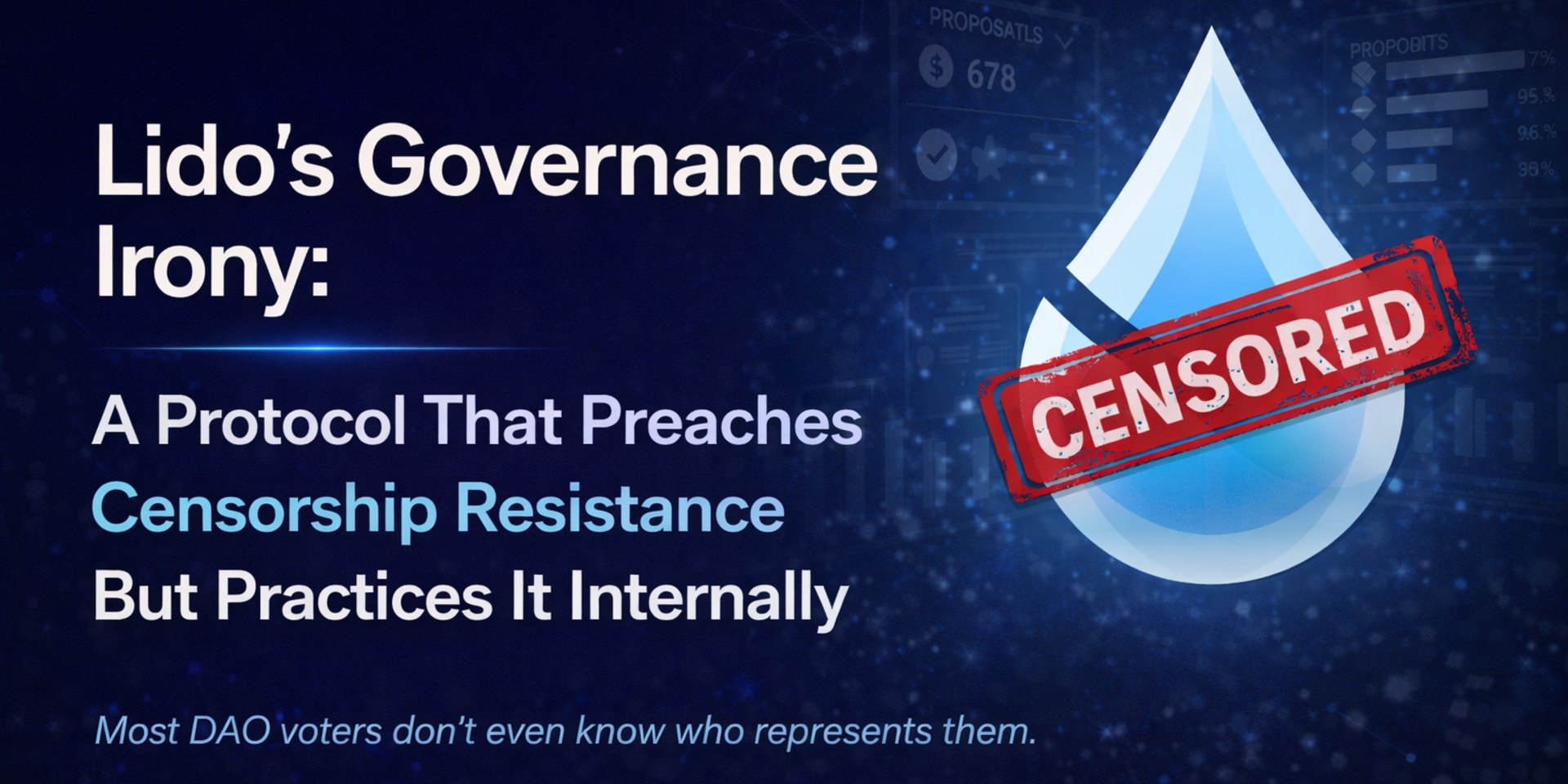
Across the Lido Governance Forum (research.lido.fi), a disturbing pattern has emerged users are getting their accounts deleted without prior warning, without explanation, and without due process.
Governance researchers, delegates, and community members who post factual analysis facts, figures, pros and cons of proposals are being flagged as "spam" or "promotional." No warning email. No dialogue. No chance to defend their content. Just: account deleted.
This is not one person's experience. This is happening to the community.
Before the irony, let's understand the scale:
🔷 Ethereum Staking Market Share: ~23% as of March 2026 — still #1 liquid staking protocol
🔷 Total Value Locked (TVL): ~$18.45 Billion
🔷 Monthly Protocol Revenue: ~$40.55 Million
🔷 2025 Annual Revenue: $40.5 Million — down 23% YoY
🔷 LDO Token Price (April 2026): $0.35 — down ~95% from its 2021 all-time high
🔷 LDO Total Supply: 1 Billion tokens
🔷 Unique LDO Token Holders: 55,000+
🔷 2026 Proposed Budget: $60 Million
🔷 Proposed LDO Buyback (March 2026): $20 Million — to rescue a token at historic lows
This is not a small experiment. This is the dominant force in Ethereum liquid staking. And its community deserves better governance.
Lido's official mission is unambiguous:
"Lido's mission is to keep Ethereum decentralized, accessible to all, and censorship-resistant."
They built a Dual Governance system in 2025 where stETH holders can delay contentious DAO proposals specifically to prevent governance capture. They proposed penalizing Node Operators who censor OFAC non-compliant transactions. They champion decentralization in every blog post.
And yet community members are being deleted for writing governance analysis.
No warning. No dialogue. No specific rule cited. Just automated deletion by a staff member.
Here is a data point Lido rarely highlights:
At launch, 64% of LDO tokens were allocated to founding members, investors, and team — locked for 1 year, then vested:
Holder CategoryAllocationDAO Treasury36.32%Investors22.18%Initial Developers20%Founders & Future Employees15%Validators & Signature Holders6.5%
When governance power is this concentrated, the same insiders who control the treasury also control forum moderation. Dissenting voices from the broader community are structurally disadvantaged.
Lido refused to self-limit its staking share below 33% the threshold beyond which a single entity could threaten Ethereum's consensus. Rocket Pool, StakeWise, and others voluntarily committed to staying below 22%. Lido did not.
At its peak, Lido controlled 32% of all staked ETH making it the single biggest centralizing force in Ethereum's validator set. The protocol that preaches decentralization became its biggest contradiction.
This is the uncomfortable truth about DAO governance participation:
Millions of researchers, contributors, and community members from India, Southeast Asia, Africa, and Latin America do not speak English as their first language. They translate their analysis. They use tools to refine their writing. They bring local perspectives and independent research.
But DAO forum moderation systems built on Western, English-first assumptions flag translated prose as "AI-generated" or "spam." The result?
Global South voices are systematically filtered out of governance conversations — not by explicit rule, but by biased infrastructure.
Lido says it is "accessible to all." But accessibility cannot mean only those who write like Western English natives. Facts are facts in any language.
Block Science's vulnerability analysis of Lido identified the core danger: "unacknowledged power is unaccountable power". Communication and coordination failures inside a DAO compound into bigger governance crises.
The market is already sending signals:
LDO is down 95% from ATH
Revenue fell 23% in 2025
Market share dropped from 32% to 23%
The DAO is proposing a $20M buyback out of desperation, not strength
A protocol that silences critics cannot course-correct. It cannot see its own problems clearly.
This is not about one user or one deleted post. The community deserves:
Debate on content quality — not on writing style or language origin
Due process before any account deletion — warning first, deletion last
Transparent moderation — which specific rule was violated, publicly stated
Inclusion of Global South contributors — independent researchers are governance's immune system
Human review — no account should be deleted by automated flags alone
Lido built infrastructure to keep Ethereum censorship-resistant. That work has genuine value.
But you cannot build a censorship-resistant protocol on a censorship-prone governance culture.
When community members are deleted for posting facts, when researchers are silenced for asking hard questions, when Global South voices are filtered out by biased systems the protocol loses the very diversity of thought that makes decentralization meaningful.
The community is watching. The governance record is permanent. And this conversation will continue with or without Lido's forum