

I entered crypto three years ago like most people:
with curiosity, greed, anxiety, and hope mixed together.
At first, I believed I was doing “investment.”
I learned to read charts, follow smart money, chase narratives.
I woke up for airdrops, slept with open positions, refreshed dashboards more often than social media.
My life rhythm was gradually synchronized with on-chain time.
Later, I told myself I was no longer naive — I was “speculating attention.”
I tracked what was trending, what was being discussed, what was being shilled.
Not because I believed in everything, but because I believed I could exit faster than others.
But something kept haunting me.
Why did I always buy certain types of memes —
even when I knew they were irrational?
Why did some tokens make me feel “this is stupid,”
while others made me think:
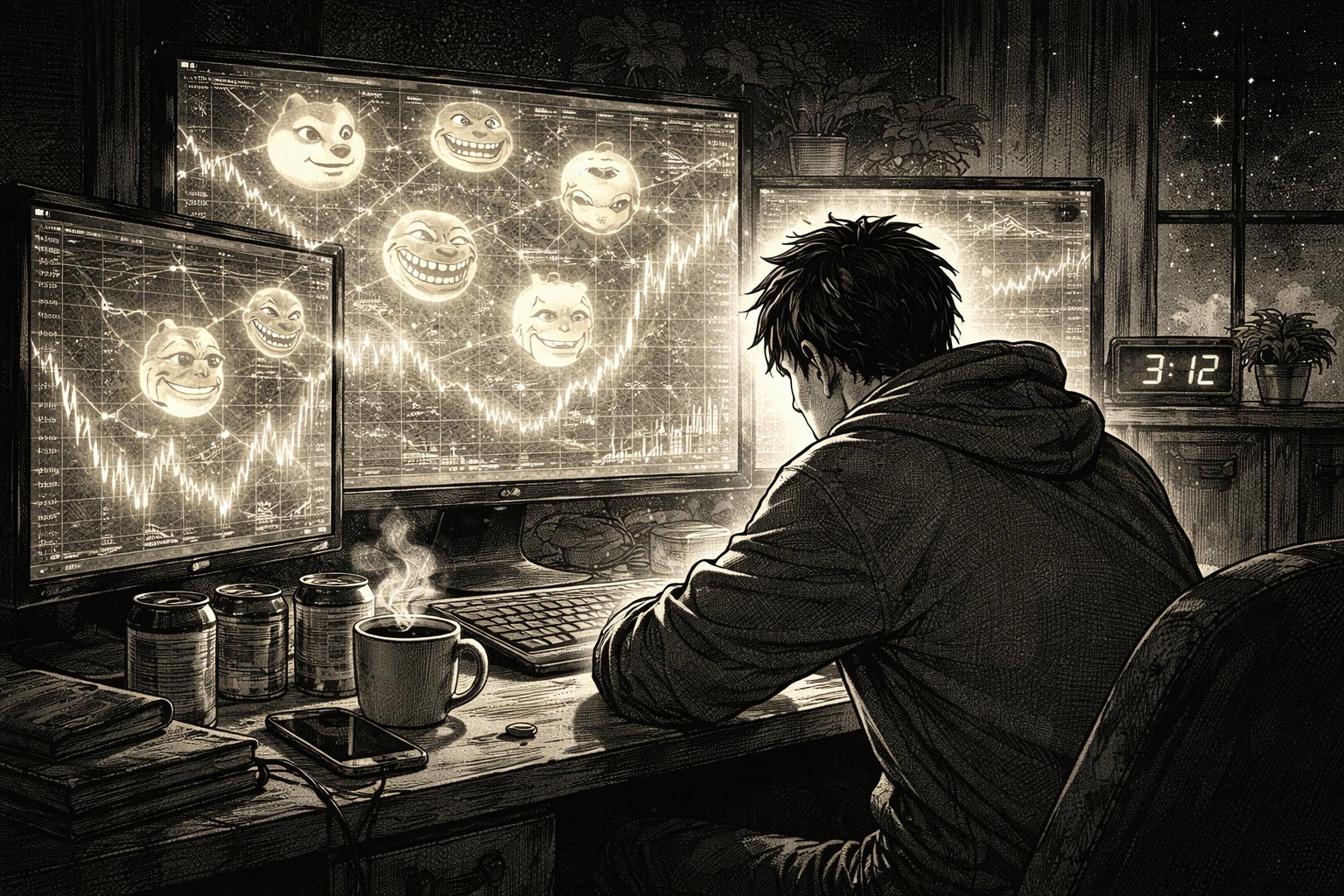
“This… somehow feels like me.”
One night, after selling a meme token at a loss, I didn’t feel regret.
I felt something closer to embarrassment —
as if I had just misunderstood myself.
That was when the realization arrived quietly:
I was not trading memes.
I was trading fragments of my own worldview.
And from that moment on, everything changed.
The more I looked back, the clearer the pattern became.
Every meme I bought aligned with something I believed:
Some mocked authority — because I distrusted grand narratives
Some celebrated absurdity — because I believed the world was fundamentally irrational
Some carried hope — because I refused to become purely cynical
Some embraced nihilism — because I could not fully escape doubt
I was not choosing assets.
I was choosing interpretations of reality.
Ludwig Wittgenstein once wrote:
“The limits of my language mean the limits of my world.”
Memes had become my language.
Through them, I was expressing how I understood power, fate, identity, and freedom —
often without consciously realizing it.
That was the first truth I uncovered:
Meme is me.
Not metaphorically. Literally.

Richard Dawkins described memes as cultural replicators.
On-chain, this idea takes a radical turn:
memes are not only replicated — they are priced.
When a meme becomes a token, belief becomes quantifiable.
Emotion becomes liquid.
Narrative becomes tradeable.
Every buy order is a declaration:
“This version of reality deserves to propagate.”
Nietzsche once said:
“Convictions are more dangerous enemies of truth than lies.”
Yet without convictions, we collapse into silence.
The meme market is precisely this paradox made visible:
a battlefield of beliefs in motion.
Here lies the second truth:
What circulates in meme markets is not capital —
but belief seeking survival.
Critics dismiss memes as jokes, distractions, noise.
But history tells another story.
When reality becomes unbearable, humans compress truth into symbol.
Once it was myths.
Then parables.
Then satire.
Now: memes.
Albert Camus wrote:
“The struggle itself is enough to fill a man's heart.”
Memes are the struggle made visible —
laughter carved out of absurdity.
A meme saying “This is fine” while everything burns is not denial.
It is clarity without surrender.
Blockchain did something extraordinary:
it allowed resistance to be owned.
Not just “I mock this world,”
but “I stake myself on this interpretation of it.”
Thus, memes are not the collapse of seriousness —
they are seriousness in its most condensed form.
Over time, I stopped seeing charts first.
I started seeing people.
From someone’s meme portfolio, you can often tell who they are:
Satirical memes → distrust of authority
Wholesome memes → longing for safety
Nihilistic memes → rejection of imposed meaning
Fanatical memes → hunger for certainty and belonging
Robert Shiller wrote in Narrative Economics:
“The spread of stories affects economic outcomes.”
In Web3, stories do not merely influence markets —
they are the market.
Thus:
What flows is not only value — but interpretation.
Blockchain is not just a financial machine.
It is a collective mind turned into infrastructure.
Satoshi did not begin with code.
He began with a story:
“Peer-to-peer electronic cash.”
“Don’t trust, verify.”
“Code is law.”
These were memes before protocols.
Vitalik Buterin once wrote:
“Blockchains are about coordination, not just computation.”
And coordination begins with narrative.
To reject memes as unserious
is to forget that every serious system began as a shared imagination.