
On August 26, 2026, CashCow Liquidity Protocol ($CCC) completed its Global Launch on BNB Chain, fully opening participation and deposits. In the days leading up to it, the protocol carried out a series of moves that look distinctly counterintuitive in commercial terms: burning the liquidity permissions covering 80% of total token supply to a dead address; leaving no mint function in the contract at all; handing the power to change the rules over to smart contracts and a timelock. The first thing it did upon going live was not to prove how much it could earn, but to remove its own capacity to do harm.
To understand this choice, one first has to see the fissure it responds to.
The core claim of DeFi is disintermediation — no banks, no custodians, everything executed automatically by smart contracts. But this narrative rests on a premise usually taken for granted, and it does not necessarily hold: code making decisions in place of people does not mean people no longer hold the power.
Open an actual contract and you will often find a number of administrative interfaces retained inside it. These interfaces have their engineering justification — patching vulnerabilities and adjusting parameters both require them. But once those permissions are concentrated, their character changes: whoever holds the contract permissions holds power equal to, and sometimes greater than, that of a traditional financial intermediary.
Such permissions fall broadly into three kinds: asset disposal (the ability to withdraw the liquidity pool), supply control (the mint function), and rule modification (parameter changes and contract upgrades). What the three have in common is this — exercising them requires breaching nothing; they are written into the code and they are lawful. The greatest risk a user faces, therefore, often comes not from an external attack but from lawful exercise on the inside.
The industry is of course aware of this problem, but the answers it has offered mostly stop at the level of promises: lock-ups, timelocks, third-party custody, more frequent audits. These approaches share one weakness — they merely move the object of trust from one place to another, rather than removing the need for trust. Around the circle it goes, and trust is never eliminated; it has simply changed creditors.
So the question becomes: is it possible for a system to fundamentally require no party to be worthy of trust?
That is precisely the question CashCow set out to answer at launch.
CashCow’s answer is not to argue that it will not act maliciously, but to make the capacity for it cease to exist.
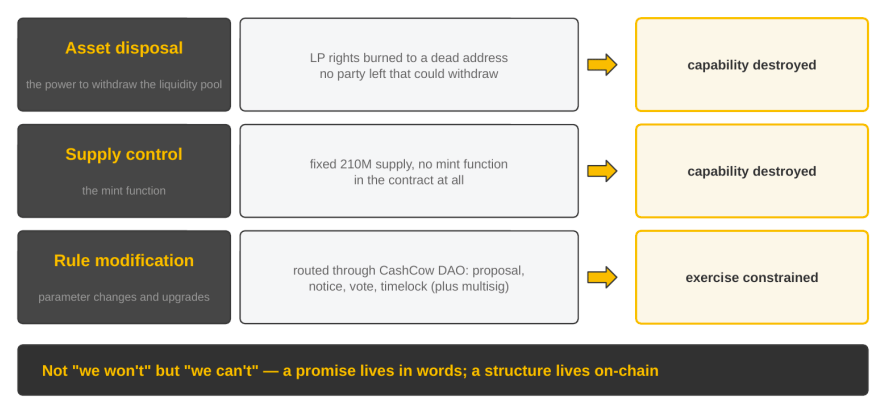
On asset disposal, it chose destruction. After the liquidity base representing 80% of total token supply (approximately 168 million tokens) was injected, its LP permissions were burned in full to a dead address — a public address known to have no corresponding private key, where transfers in are irreversible. The result is that the party capable of executing a pool withdrawal has disappeared from the system: not a promise not to withdraw, but the absence of any party that could.
On supply control, it chose omission. $CCC has a fixed total supply of 210 million tokens, with no mint function at the contract level. The difference in wording here is substantive: not “we promise not to mint,” but no capacity to mint — even if intentions change in the future, the operation itself cannot be carried out.
On rule modification, it chose constraint. This class of permission cannot simply be destroyed, because a protocol wholly incapable of evolving is equally unlikely to survive. CashCow’s approach is to bring it into CashCow DAO’s governance process: proposal, public notice, vote and timelocked execution, all on-chain, with material treasury movements carrying an additional multisig threshold.
The third layer deserves particular emphasis, because it is routinely underrated. Many protocols fixate on the visible locks — not withdrawing the pool, not minting — while overlooking this: if the act of modifying the rules is itself unconstrained, then every lock can be redefined. Bringing governance under constraint as well amounts to placing a meta-lock over all the locks that came before — what it guards is not any particular rule, but the fact that rules cannot be quietly changed.
The source of incentives is likewise bounded: the protocol’s rewards come from fees and profit tax generated by real trading rather than from token issuance; fees are distributed according to published ratios and traceable on-chain transaction by transaction, with a portion routed back to the treasury to accumulate BNB. On the other end of output sit buybacks and reserves — not new supply.
Taken together, these elements constitute its definition of verifiability: every key commitment must yield a definitive answer on-chain.
Put these moves side by side and you find they change more than one protocol’s security grade — they change the nature of security itself.
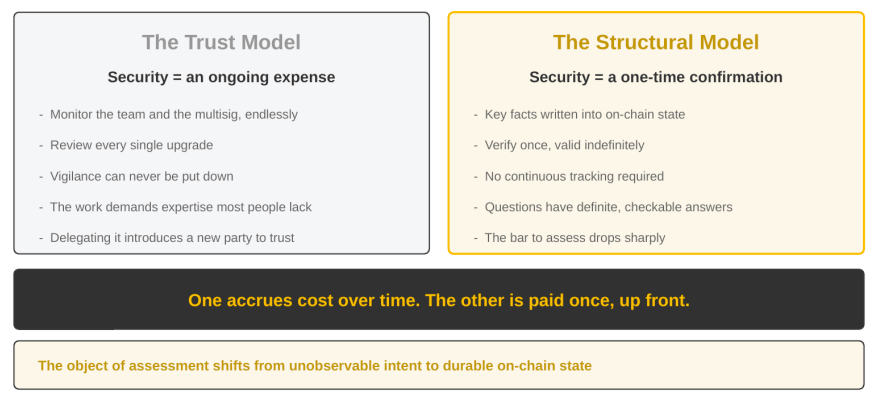
First, security shifts from an ongoing expense to a one-time confirmation. Under the trust model, users must continually monitor the team, track the multisig and review every upgrade, and that vigilance can never be set down — and worse, the work demands expertise, so most people can only delegate it, which amounts to introducing yet another party to trust. Once the capacity to act maliciously is structurally removed, security turns from a dynamic commitment requiring long-term maintenance into a static fact that need only be confirmed once. The cost of the former accrues over time; the cost of the latter is paid once.
Second, the bar to assessment drops sharply. “Have the permissions been burned?” “Does the contract still retain a mint function?” “Is there an execution delay on upgrades?” — questions of this kind have definite, checkable answers that ordinary participants can settle for themselves. The object of assessment moves from unobservable intent to durable on-chain state.
Third, the incentive structure is rebound. Once the fastest route to cashing out is sealed off by the team’s own hand, only one path to a return remains: make the protocol genuinely run and the treasury genuinely grow — depending on the same mechanism and the same on-chain data as every ordinary participant. This alignment is not held together by pledges; it is written into the contract.
Viewed from the industry’s vantage point, the significance of such practice may extend beyond any single project.
It moves the center of gravity in DeFi security from “how credible the party is” to “how certain the structure is.” For years, discussions of security have revolved around people: who the team is, whether it has backing, which firm did the audit — questions whose answers all have to be believed. When the discussion turns to structure, the questions become: do the permissions still exist, does the function exist, is there a delay on changes. The former remains a variant of trust; the latter can be verified by anyone.
It also provides a standard that can be applied laterally. Whether liquidity can be withdrawn, whether supply can be altered, whether distribution can be audited, whether governance can be executed — these four questions belong to no single project, and anyone can use them to examine themselves or to assess others. Once a tool of discernment is widely used, the beneficiary is not only the one who proposed it.
Looking further out, it points to a migration in the dimension of competition. The last cycle competed on who offered the higher yield, and that logic has been disproven by blow-up after blow-up; the next cycle will likely compete on something else — whose rules require the least trust. When verifiability settles from a safety property into a scarce competitive advantage, those who made the choice earlier are the ones positioned to benefit.
And so CashCow chose to do subtraction first at launch — sealing off, one by one, the routes by which it could do harm, before speaking of opening up for participation. The sequence looks somewhat clumsy, even like paying the price before seeking the reward. But it follows a plain logic: you cannot say “please verify” while withholding the conditions for verification.