
Quantum Execute (QE) is an AI-driven crypto execution-infrastructure company, built by a core team from leading North American quant and algo-trading firms, with cumulative volume approaching USD 10 billion. QE offers a full institutional-grade algorithm suite — TWAP, VWAP, POV, and Arrival Price — across major CEXs and DEXs including Binance, OKX, and Hyperliquid.
It serves institutions, quant funds, listed companies, family offices, and large traders, and has packaged its full execution stack into a standardized "trading Skill" callable directly by AI Agents via API/MCP — so mainstream LLMs like Claude can plug straight in.
QE is the designated execution provider for leading digital-asset institutions including LTP, BIT (formerly Matrixport), and Amber Group, serving their institutional clients and large traders, alongside many quant funds and DAT companies. As liquidity tightens and institutions move in, the need for algorithmic execution is being rapidly re-evaluated — and QE is fast becoming the crypto market’s execution standard layer.
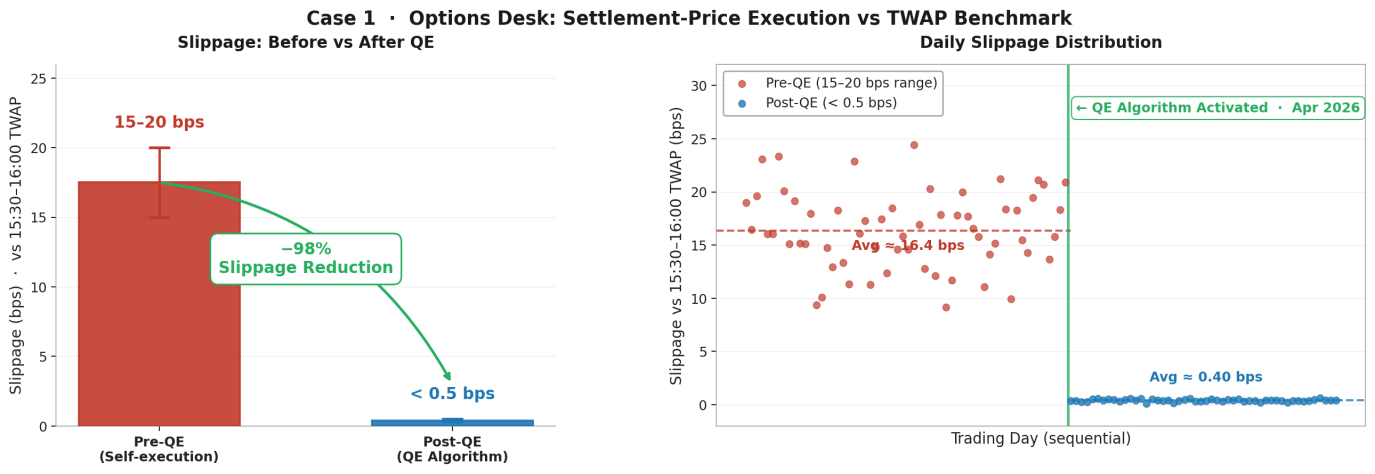
Scenario A crypto options desk needs to convert exercised dual-currency positions into spot/USDT, with settlement anchored to the daily 15:30–16:00 TWAP — demanding very high execution precision.
Result In-house scripts cost ~15–20 bps; after switching to QE’s TWAP algorithm in April 2026, slippage held within 0.5 bps, saving hundreds of thousands of USD a month at hundreds-of-millions monthly volume.
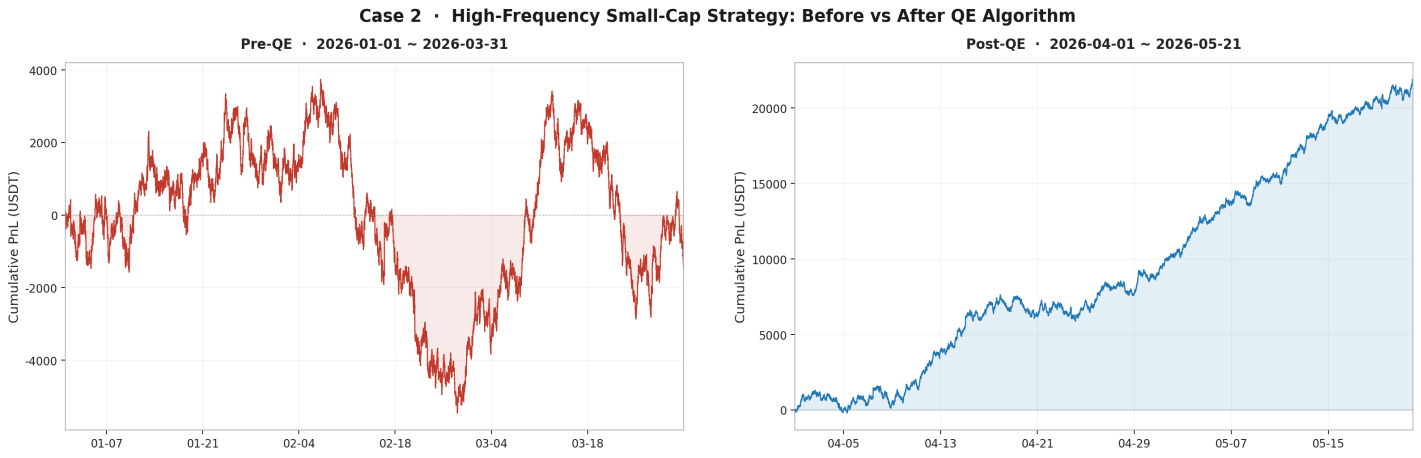
Scenario A quant fund runs a minute-level rebalancing strategy on small/mid-cap tokens, USD 60M–150M monthly. In illiquid, wide-spread markets, execution quality matters as much as alpha itself.
Result Before QE (Jan–Mar 2026) the same strategy ran near-zero to slightly negative PnL; after switching to QE in April (identical logic), it saved 3–5 bps, Sharpe rose sharply, and returns turned consistently positive.
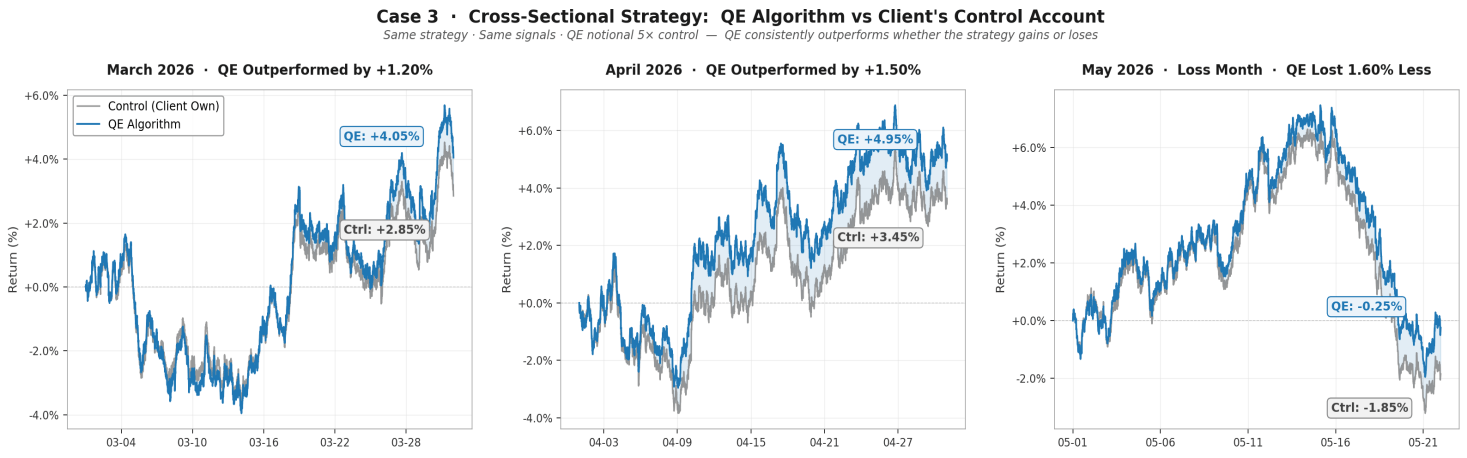
Scenario A quant fund ran two accounts on identical signals — one on QE’s algorithm, one on its own. The QE account traded over 5x the notional of the control, which should normally mean higher execution cost at scale.
Result Over three straight months, win or lose, the QE account always came out ahead — +1–2% more in up months, 1–2% less lost in down months, ~15% annualized excess return.
QE doesn’t run exchanges’ basic native algorithms — it runs intelligent algorithms built for institutions, with embedded Flow Alpha and high-frequency Alpha signals that time execution against real-time order-book liquidity and split orders smartly to cut market impact and improve fills.
This matters most for mid- to low-frequency strategies (trade windows of a minute or more — minute, hour, or day-level rebalancing); every such case to date has validated the gain. QE effectively adds a layer of Alpha at the execution stage itself.
This same institution-grade capability lets QE serve not just human trading desks but also the execution layer for the AI-Agent ecosystem. Trading is shifting from humans clicking a UI to machines calling an API; from trading bots to on-chain executors, more and more use cases need a standardized, high-quality execution channel.
With execution packaged as a standardized Skill, any third-party AI Agent can call QE’s interface for pro-grade execution — no trading infrastructure to build, no market microstructure to master.
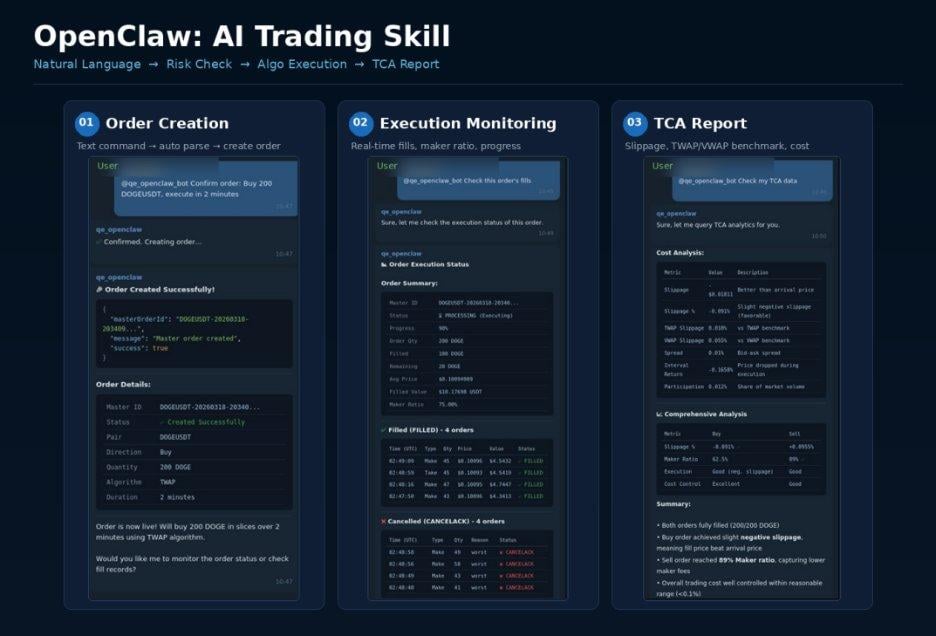
Serving many professional institutions, QE holds itself to institutional standards of security and stability:
▍ Risk control in the algorithm embedded abnormal-order-book handling auto-detects extreme conditions and triggers protection, eliminating single-point losses.
▍ Real-time transparency execution status, fills, and TCA reports sync live, with proactive alerts on key events.
▍ 24/7 operations a dual-timezone US–China team covers the market around the clock, stable through every extreme event of the past year.
Quantum Execute (QE) provides institution-grade algorithmic execution for institutions and AI Agents, with cumulative volume approaching USD 10 billion. New users get a 30-day free trial.
Website | |
Media | |
Telegram | t.me/QuantumExecuteGroup |