
When tensions rise, I struggle to separate noise from signal before it consumes my day. To solve this, I built a system to filter the chaos.
I built a small system to help. It is not a product. It is a verification step, a narrow model, and a rule for when to interrupt me.
Nothing goes into the system until I can verify it. I use Reuters, AP, or official sources. A claim from state media stays unconfirmed until another source corroborates it. A headline is not a fact. A viral post is not a fact. If I cannot trace a claim to a primary source, it does not count.
This is the step that matters most. A model fed rumors will give you confident rumors. Give it verified facts and you have something more useful to assess.
I send the verified facts to eu-jeff-latest, a small decision model on NanoGPT. It has one job: score direct risk from 0 to 4, then answer whether the situation is significant now.
It does not browse, summarize the news, or give opinions. It reads the facts I have checked and returns a score and a probability. That narrow scope matters. It is easier to judge a model with one job and clean inputs than one asked to do everything with material of uncertain quality.
Jeff is available on NanoGPT. The model is a helper, not the decision-maker.
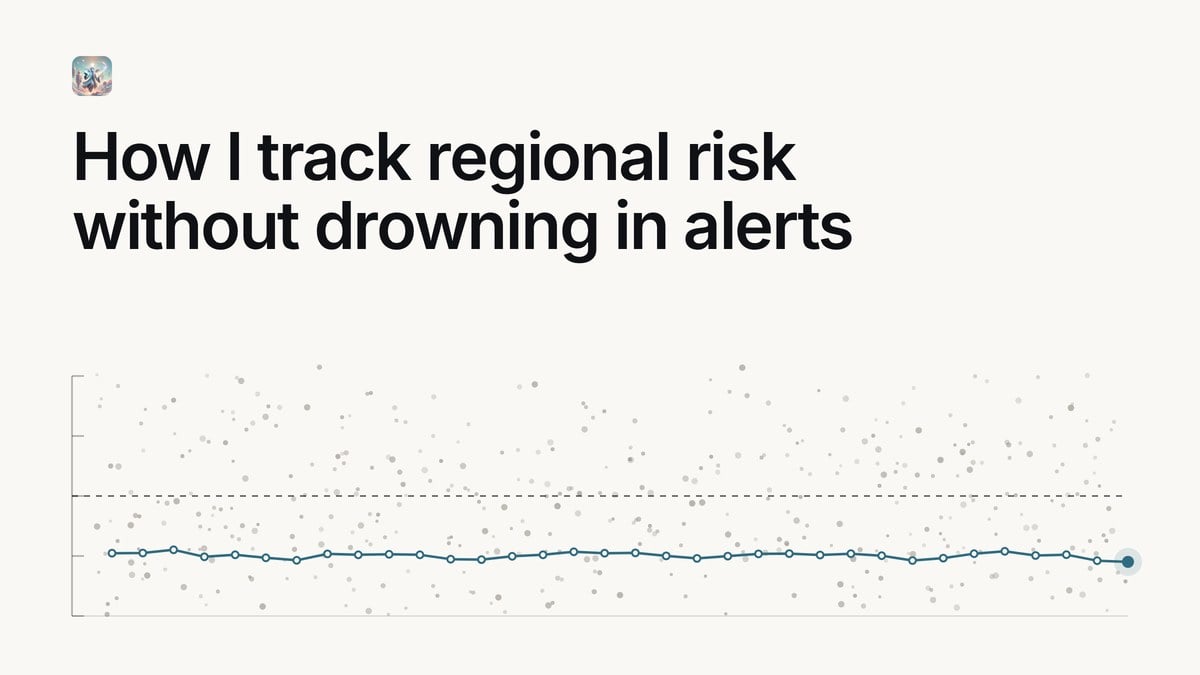
Most days, nothing changes. The score sits around 1 out of 4, stays stable, and the system stays quiet. Everything is still logged, so I can check the record without getting interrupted by every new alert.
A ping requires a material change or a score of 2 or higher backed by verified facts. A high score without verified facts does not ping. A verified fact that does not move the score does not ping either.
On the morning of November 17, a tanker incident north of Khasab was reported by UKMTO. There was no direct target in the area being monitored, and the pattern matched its baseline. Jeff scored it 1.00 out of 4, with a 1.4% probability of significance. The situation was stable, so there was no ping. Elevated, not a warning.
Two days earlier, the picture was similar: alerts in a neighboring state and intercepts nearby, but no direct target in the area being monitored. Jeff scored it 1.02 out of 4, with a 1.5% probability of significance. Same outcome. The system logged it and stayed quiet.
That is what a good day looks like. The news happened, the facts were checked, the score was low, and I got on with my work.
The model outputs a score and a probability. My decision rule is simple: I only act if the model's score exceeds 2.0 OR if my own review of the primary sources identifies a new target within my monitored area, regardless of the model's output. If the model returns a score > 2.0 but I see no corresponding factual basis for risk in the primary sources, I treat it as a model error and ignore the alert. The facts serve as the override; the model is just a filter.
Each score costs about $0.00003. The expensive part was the time I used to spend reading every alert, checking every claim, and wondering whether I had missed something. This system gives some of that time back.
The inbox stays quiet without leaving me blind. Everything is logged, and the threshold for a ping is explicit. If something changes, I can see which facts moved and when.
You do not need my exact setup to borrow the pattern. Verify first. Give a narrow model only checked facts. Decide in advance what should interrupt you. The tool is the easy part. The discipline is the work.


