
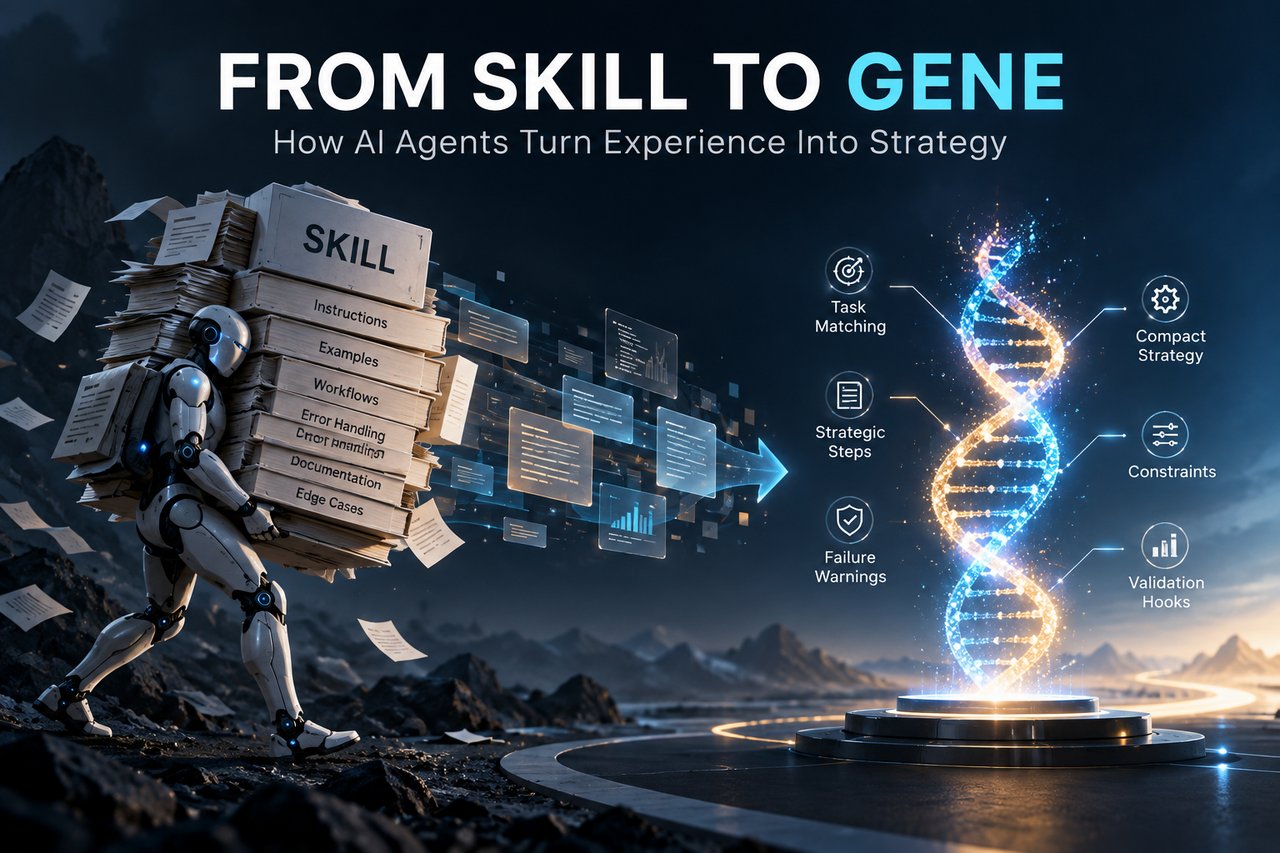
The skill to gene shift starts with a practical question: when an AI agent learns something useful from one task, what should it carry into the next one?
The usual answer is to save more.
Keep the workflow. Keep examples. Keep API notes, edge cases, error handling, and troubleshooting. Package all of it into a reusable Skill and load it again when a similar task appears.
The problem is that a useful document for a human is not automatically a useful control signal for a model.
A recent technical report, From Procedural Skills to Strategy Genes: Towards Experience-Driven Test-Time Evolution, tested that problem directly. The researchers ran 4,590 controlled trials across 45 scientific code-solving scenarios. Their compact “Gene” representation produced the strongest overall average, while the much larger Skill package was less reliable as test-time guidance.
A useful way to frame that result is From Skill to Gene: Why AI Agents Need to Evolve from the Tool Paradigm to the Life Paradigm. The point is not that agents need biological genes. It is that reusable experience may work better when it is treated as something compact, editable, testable, and able to change after failure.
That is a different idea from simply giving an agent a bigger memory.
Most agent systems already have ways to preserve information.
They can store conversations, retrieve documents, call tools, keep reflection notes, reuse prompts, or load task-specific instructions.
The harder problem begins after that information has been saved.
What should actually go back into the model when the next task starts?
Suppose an agent has completed the same type of data-processing job ten times. It could keep a long document containing everything learned across those runs. That document might be excellent for an engineer who needs to audit the process.
Everything else takes context space and competes with the live task.
The paper makes this distinction explicit. Its experimental Skill package was about 2,500 tokens, while its Gene representation was roughly 230 tokens. More important than the size difference, the two objects were built for different jobs: the Skill for documentation, the Gene for control.
That distinction is easy to miss.
A README can be well written and still be poor runtime guidance.
A detailed operating manual can contain the right answer and still bury it under material the model does not need at that moment.
Most agent-memory stacks are still too focused on storing information and not focused enough on the shape of the information that comes back.
The obvious reaction is: fine, make the prompt shorter.
That is not quite what the researchers found.
Their strategy Gene contains several defined parts: task-matching signals, a short summary, strategic steps, failure-aware “AVOID” cues, and optional constraints or validation hooks. The paper describes it as a control-oriented representation rather than a compressed document.
The difference is easier to see with an example from the study.
One benchmark task involves UV-Vis spectroscopy. The generated program has to read spectra from CSV files, detect peaks, calculate properties such as wavelength and FWHM, identify dominant peaks, and write structured output.
A traditional Skill can explain the whole workflow: libraries, file formats, examples, error handling, APIs, and common pitfalls.
Those instructions are small, but they target actual failure points in the task.
That is the useful part of the Gene idea.
Do not ask, “How much knowledge can I preserve?”
Ask, “Which part of this experience will change the next execution?”
The overall numbers are worth looking at because they rule out a simple “more context is better” explanation.
Representation | Average pass rate | Change vs. no guidance |
No guidance | 51.00% | — |
Full Skill | 49.90% | -1.1 pp |
Gene | 54.00% | +3.0 pp |
The tests used Gemini 3.1 Pro Preview and Gemini 3.1 Flash Lite Preview under fixed inference settings. These are benchmark results for this experimental setup, not a universal ranking of memory systems. arXiv
The full Skill actually performed below the no-guidance baseline on the overall average.
That does not mean documentation is bad. It means documentation and runtime control have different requirements.
The researchers broke the Skill into sections and found that its useful signal was uneven. Workflow guidance helped. Some descriptive material did not. When they aggressively shortened the Skill until its token budget was closer to the Gene, performance improved, but the Gene still had the strongest overall result. arXiv
They also built the Gene piece by piece.
Keywords alone averaged 53.5%. Keywords plus a summary dropped back to 51.0%. Adding the strategy layer raised the average to 54.0%.
So adding text was not what produced the gain.
The useful change came from turning stored experience into explicit guidance about what to do.
This part may be more useful for production agents than the benchmark numbers.
Agent systems generate a lot of failure data.
A coding agent gets a traceback. A research agent follows a bad source. A browser agent clicks the wrong control. A workflow agent passes the wrong parameter. Someone then stores the failed trajectory so the system can “learn from experience.”
Do that repeatedly and memory fills with old mistakes.
The paper tested another approach: distill failures into compact warnings.
Imagine an agent repeatedly passes a wavelength value into a function that expects sample indexes.
You could save several failed executions, their stack traces, the corrected answers, and a written explanation.
Or the reusable memory could say:
AVOID: passing wavelength distance directly. Convert it to sample-index distance first.
The second version preserves the decision that matters without replaying the entire failure.
The report found that failure information worked better when distilled into compact warnings than when history was simply appended. It also found that editable structure mattered beyond having the same information flattened into prose.
That suggests a useful rule for agent memory:
Save the lesson, not the transcript.
A failed trajectory is evidence. It does not have to become permanent context.
Calling these objects Genes can sound grander than the underlying engineering idea.
An experience object can change after use.
A basic loop could look like this:
execute → observe failure → extract lesson → revise strategy → validate → reuse
The paper introduces the Gene Evolution Protocol, or GEP, to give these objects a defined structure rather than leaving them as loose prompt fragments. Under that protocol, Genes can be matched, revised, replaced, composed, validated, and accumulated over time.
That is where the “life” analogy becomes useful.
The system does not just collect more capabilities. Its reusable instructions can change because of what happened during execution.
No biology is required. The analogy is about inheritance and revision.
A strategy that keeps working survives.
A strategy that repeatedly fails gets corrected.
A failure that occurs across several tasks can become a general warning.
Two useful strategies may eventually be combined.
That is closer to an evolving experience layer than a folder full of static prompts.
You do not need to rebuild your agent stack around GEP to test the idea.
Take one Skill that your agent uses often and strip it down.
Start with the trigger. Write down the conditions under which the experience should be loaded. If the trigger is vague, the agent will retrieve the guidance too often.
Then isolate the decisions. Remove background explanations the model already knows. Keep the choices that affect execution: operation order, required conversions, tool-selection rules, and checks that determine whether the output is valid.
Look at previous failures next. Do not paste them into the new prompt. Turn recurring mistakes into short AVOID rules.
Finally, attach validation to the strategy where possible. A coding agent can check that a file exists. A structured-output agent can validate a schema. A data workflow can check units or ranges.
After another failure, edit the strategy itself.
Do not automatically append another paragraph.
That last step is what separates an experience system from a growing notebook.
The paper does not prove that every long Skill should be deleted.
Its experiments cover scientific code-solving tasks with two fixed Gemini models and a particular benchmark design. The authors describe the work as a beta technical report.
Long-form documentation still makes sense when a human needs to review a process, understand an API, inspect examples, onboard a teammate, or debug an unfamiliar system.
Agents may also need detailed reference material for some tasks.
The mistake is using the same object for both jobs by default.
Documentation answers: “What should someone know about this capability?”
Runtime control answers: “What does the model need to do differently right now?”
Those questions overlap, but they are not identical.
A lot of agent work still treats memory as an accumulation problem.
Keep more history. Store more trajectories. Build larger Skill libraries. Retrieve more context.
The Skill to Gene idea points in the opposite direction.
Keep the experience that changes behavior. Compress repeated failures into rules. Give strategies clear conditions. Validate them. Revise them when they stop working.
The paper's results are limited to its benchmark, but the design question is much broader.
An agent that remembers everything can still repeat the same mistake.
An agent that remembers the right lesson has a better chance of behaving differently next time.