
In short, it depends entirely on where you start, and the honest number isn't "self-funding". It's "self-funding if you start close to the top of the Builder range, and a multi-decade math problem if you start at the minimum."
In this piece: the mechanics, the theoretical timeline, what a direct check of Seasons Terminal shows today, buying the gap vs. waiting, how this compares to compounding a Solana staking position, what the progression actually resolves to, what moves the timeline, the honest risks, and an FAQ.
What the Builder → Director progression is
Seasons runs a wallet-native yield system on Solana: hold $SEAS in a self-custodied wallet and the protocol pays yield against your balance, no staking contract, no deposit, no hardware. There are two tiers. A Builder Node opens at 1,000–9,999 $SEAS and earns 80% of the Network APY, paid in $SEAS, allocated weekly and claimed manually on Seasons Terminal. A Director Node starts at 10,000 $SEAS and earns 100% of the Network APY, paid twice weekly straight to wallet in a three-asset basket (30% wBTC, 30% Tether Gold (XAUt0), 40% Jupiter Lend USDC).
Because Builder yield is paid in the same token that unlocks Director status, the progression is technically self-funding, every claim nudges your balance toward the 10,000 line. That's the mechanic behind the Builder Node vs. Director Node comparison.
Because Builders are weighted only against other Builders, a whale entering the tier doesn't dilute a small holder's share, but it also doesn't change the raw math of how fast a small balance compounds toward 10,000. Those are two separate questions, and this piece is about the second one.
The theoretical timeline
The table below uses compound-interest math as a model: every period's reward is assumed to stay in the qualifying $SEAS balance and earn the same annualized rate thereafter, a projection under fixed-rate assumptions, not a forecast of actual returns. Network APY is documented as variable, ranging 6.58% to 21.07% historically. At 80% of that range, Builder's effective yield runs roughly 7.2% to 10.4% a year, 80% of the Network APY, not 80% APY flat.
| Starting balance | ~7.2% APY | ~8.8% APY (midpoint) | ~10.4% APY |
|---|---|---|---|
| 1,000 $SEAS | ~33 years | ~27 years | ~23 years |
| 5,000 $SEAS | ~10 years | ~8.2 years | ~7 years |
| 9,000 $SEAS | ~18 months | ~15 months | ~13 months |
Verdict: compounding alone is only a realistic path to Director if you start near the top of the Builder range.
What a direct check of Seasons Terminal shows today
A direct check of Seasons Terminal on September 20, 2026 showed a 12.23% trailing-30-day Network APY. That figure held identically across two separate checks made hours apart while writing this piece, even as the $SEAS price moved from $0.30 to $0.25 in the same window, over 16% in a few hours. The yield rate is a smoothed, slower-moving figure; the token's dollar value can move double digits in an afternoon. Not the same kind of risk.
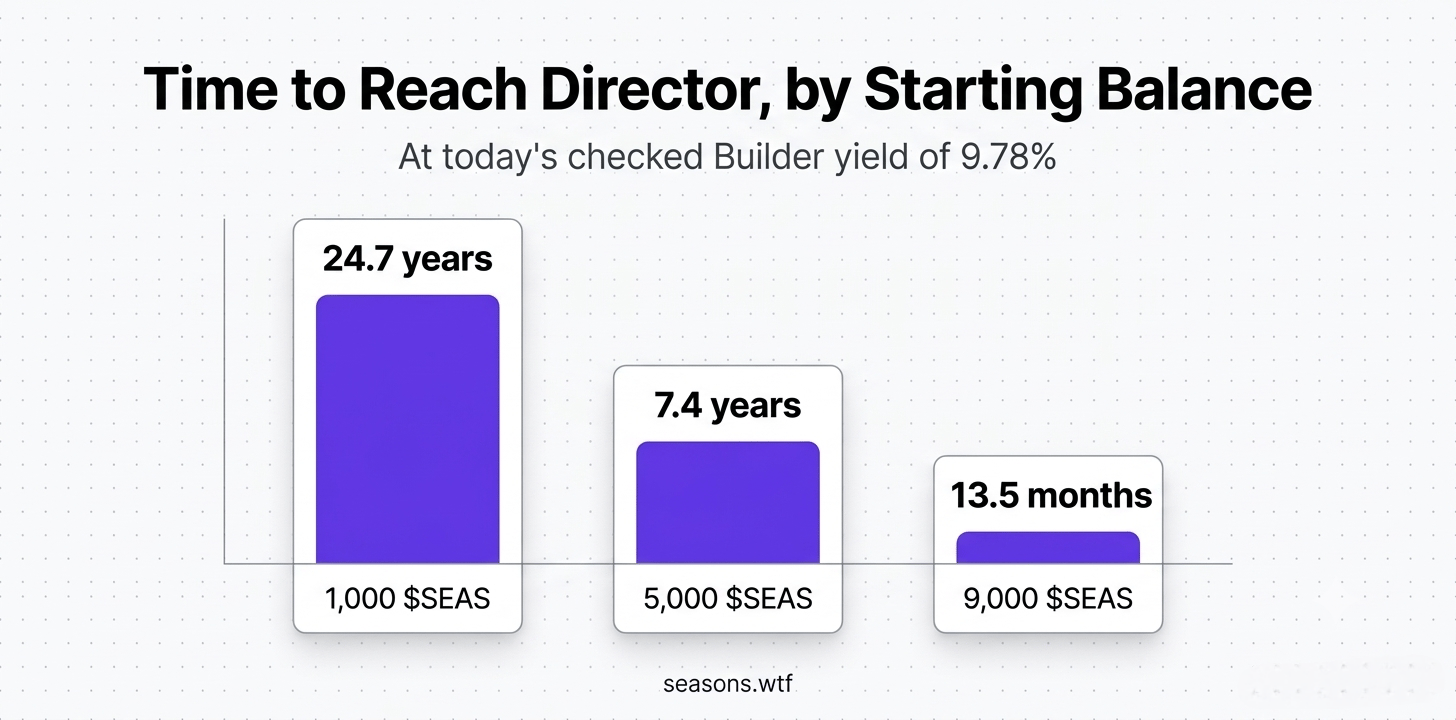
At 80% of 12.23%, today's effective Builder yield is about 9.78%. Running the three starting balances against that live figure: 1,000 $SEAS reaches Director in about 24.7 years, 5,000 $SEAS in about 7.4 years, 9,000 $SEAS in about 13.5 months, consistent with the table above.
Buying the gap vs. waiting it out
Buying to close the gap costs the 10% transfer fee, applied so net proceeds equal 90% of what's bought. To net 1,000 $SEAS, that means buying roughly 1,111 gross tokens (1,000 ÷ 0.9). To close a 9,000-token gap up to the 10,000 Director threshold, the math works out to roughly 10,000 gross tokens (9,000 ÷ 0.9). Seasons' own published figure for the smaller case is "roughly 1,112," which factors in typical slippage on top of the fee, so treat these as close approximations rather than exact quotes.
At today's price of roughly $0.25 (confirmed by both Seasons Terminal and a live Dexscreener check of the SEAS/USDC pair, which showed $0.2477): netting 1,000 $SEAS costs about $278. Closing the 9,000-token gap to Director costs about $2,500 before slippage. Both are snapshots of a moving price, not fixed costs.
Exit works the same way in reverse, a Builder or Director who wants out pays the same 10% fee on the way out that they paid coming in, a real cost a liquid staking token doesn't carry in the same form.
How this compares to compounding a Solana staking position
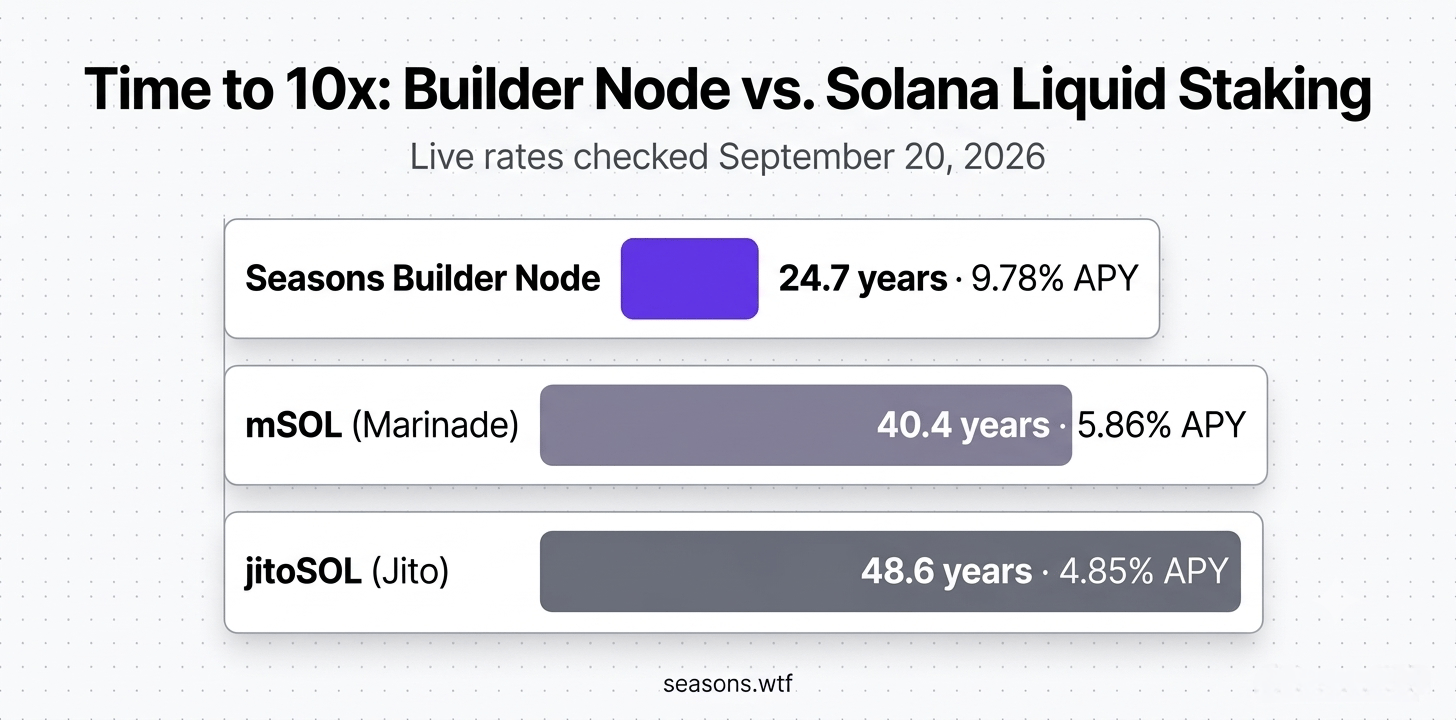
Solana liquid staking tokens work by converting staked SOL into a tradable receipt token that accrues rewards, jitoSOL and mSOL are the two largest. A direct check of Solana Compass's live stake-pool pages on September 20 showed jitoSOL at 4.85% and mSOL at 5.86%, against Builder's 9.78%.
| Position | Current APY (Sept 20, 2026) | Time to 10x via compounding alone |
|---|---|---|
| Seasons Builder Node | 9.78% | ~24.7 years |
| mSOL (Marinade) | 5.86% | ~40.4 years |
| jitoSOL (Jito) | 4.85% | ~48.6 years |
Verdict: at the checked rates, the Builder model reaches a 10x balance in less time than either LST would under the same fixed-rate compounding assumption, although even the Builder case takes decades from 1,000 $SEAS.
The rate isn't the only difference. Both LSTs trade against far deeper pools than $SEAS: Solana Compass shows roughly 10.36 million SOL staked through Jito and 2.32 million through Marinade, on the order of $1.1 billion and $250 million at SOL's current price, against the SEAS/USDC pair's own $979K in liquidity on Dexscreener (Seasons Terminal separately showed $1.22M, likely a different or aggregated measurement; both point the same direction). That's roughly 250 times $SEAS's liquidity for Marinade and over 1,100 times for Jito, not a rounding error.
What the progression actually resolves to
Reaching Director sooner comes down to two variables: capital available now, and appetite for immediate versus gradual $SEAS price exposure. Buying the gap converts a multi-year timeline into a single transaction at the cost of the fee and full exposure at that moment. Compounding avoids the fee and spreads exposure over time, at the cost of the years shown above. Someone near 9,000 faces a materially different decision than someone at the 1,000 floor, since remaining distance and not the yield rate dominates the math.
What Director adds over staying a Builder: 100% of Network APY instead of 80%, automatic twice-weekly payment in a diversified basket instead of a manually-claimed weekly $SEAS payment. Under the 9.78% model, that difference takes about 24.7 years from 1,000 $SEAS and about 13.5 months from 9,000.
What actually moves the timeline
-
Network APY. Historically 6.58–21.07%; today's 12.23% is near the top. Every calculation here is dated to the day it was checked.
-
Consistent claiming. Builder yield is allocated weekly and must be claimed manually on Terminal. Seasons' own documentation states unclaimed rewards don't expire and can be collected later in one transaction. The model used throughout this piece assumes rewards are claimed promptly and compound continuously — that's a modeling assumption, not something the documentation itself confirms about how a delayed claim affects subsequent rewards.
-
Selling along the way. Moving $SEAS off-wallet resets progress; moving it back triggers the fee again.
The honest risks
-
Network APY is variable, today's 12.23% could look very different next month.
-
The 10% transfer fee applies on entry, exit, and any top-up purchase.
-
$SEAS's price moved from $0.30 to $0.25, over 16% between two checks hours apart, while the 30-day APY didn't move at all. Against Seasons' September 4, 2026 entry-cost snapshot, today's price is roughly flat, down about 4%.
-
$SEAS trades against meaningfully less liquidity than the Solana staking tokens compared above.
-
"Self-funding" describes the mechanism, not the speed.
-
Tenure and governance requirements around Director status are still under revision.
Common Questions
How long to reach 10,000 SEAS? Anywhere from about 13 months to over three decades, depending on your starting balance and the yield environment at the time.
Is the Builder-to-Director progression a self funding crypto position? Mechanically yes. Practically, only realistic from near the top of the Builder range.
Is it faster to just buy the difference? If speed to 10,000 is the only goal, yes at the cost of the fee and full price exposure on the purchase.
Bottom line
The builder to director timeline is real, but "self-funding" is doing a lot of work in how it's usually described. Today's checked numbers put Builder yield near the strong end of its documented range, but even at 9.78%, a 1,000-token starting position is a multi-decade project. Check the current rate and price on your own balance before deciding whether to wait or buy the gap.