
You use a cross-chain swap aggregator — a platform that routes your trade directly between wallets on different blockchains, without ever depositing funds to a CEX. A documented August 2026 benchmark found one platform failing during a Tron-to-Bitcoin swap, while two others did not support that route at the time. Understanding why that happens is more useful than assuming every aggregator handles every route the same way.
This piece walks through the mechanism, then uses a real, publicly documented failure as a case study for what can go wrong — and how to avoid being the one who finds out the hard way.
The Mechanism: What "Without a CEX" Actually Means
Normally, moving crypto between chains without a centralized exchange requires either:
-
A bridge — moves or represents an asset across blockchain networks, using mechanisms such as locking and minting, burning and releasing, or liquidity-based transfers
-
An aggregator/DEX router — quotes your trade across multiple liquidity sources and executes it wallet-to-wallet, often combining a swap and a bridge step behind the scenes
A cross-chain swap aggregator can simplify this process by abstracting away bridge selection, combining swap and cross-chain execution, and settling the destination asset directly to your connected wallet — no KYC deposit, no CEX order book, no withdrawal delay.
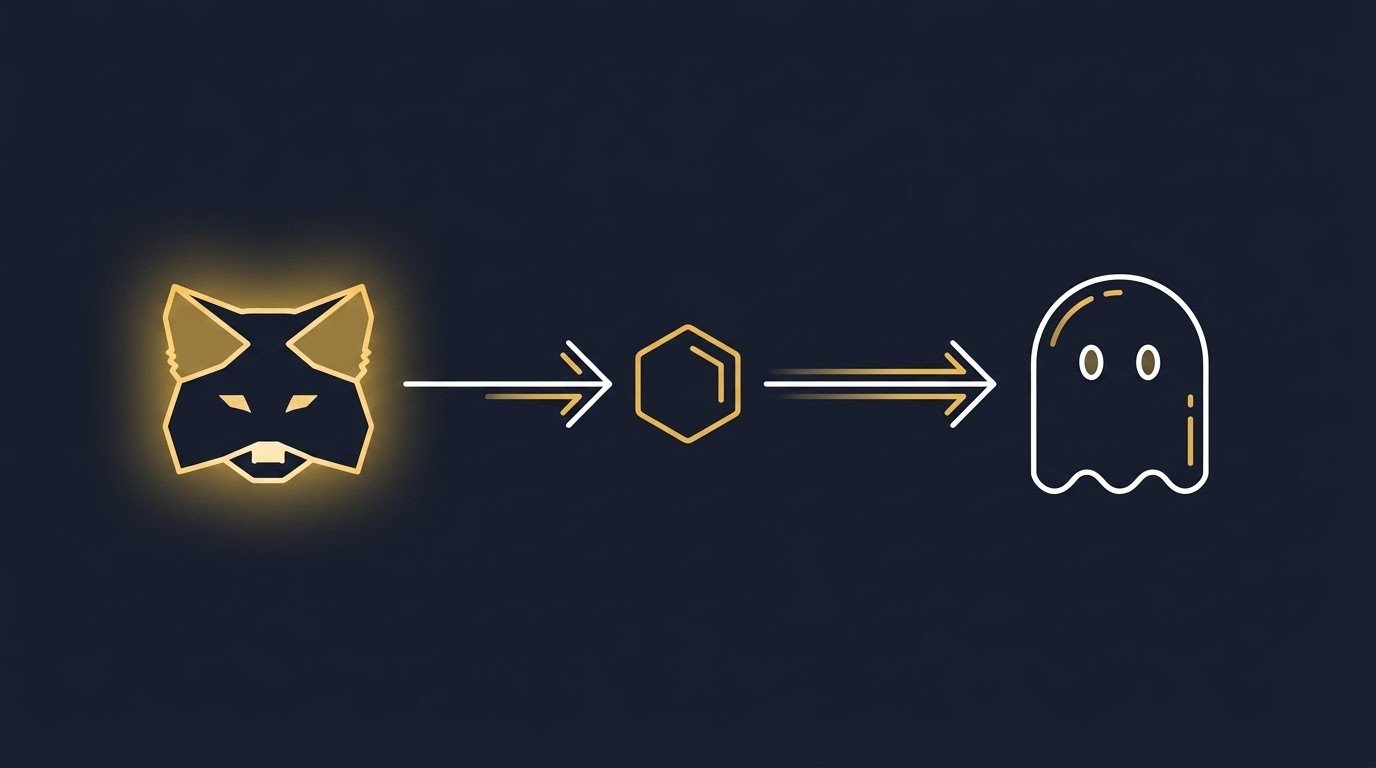
In practice, this is wallet-to-wallet: you connect a wallet like MetaMask or Phantom directly, and the aggregator routes the trade from there — you never deposit into an exchange account at any point.
That's the pitch. The gap between the pitch and reality shows up specifically on routes that are less traveled — non-EVM pairs, newer chains, or low-liquidity corridors.
A Real Failure: What Happened on Tron → Bitcoin
RocketX executed a route-execution test on August 24, 2026, comparing itself against Rango, deBridge, Across, and Jumper on four real swaps using actual transactions with published transaction hashes rather than simulated quotes, and published the results on August 31, 2026. One of the four routes was a USDT (Tron) → BTC swap — a pairing that crosses two non-EVM ecosystems, which makes it a meaningfully harder test than a typical Ethereum-to-BNB swap.
The result, per RocketX's published benchmark:
-
deBridge and Across did not support the pair at all. Their routing infrastructure didn't cover this corridor at the time — the swap wasn't attempted because the platforms wouldn't quote it.
-
Jumper attempted the swap, and it did not complete successfully. This is the more instructive failure mode: the platform accepted the trade, but it failed mid-execution rather than being rejected upfront.
-
Rango completed the swap in 1 minute 43 seconds, delivering 0.001268 BTC.
-
RocketX completed the swap in 7 minutes 38 seconds, delivering 0.0012803 BTC — about 0.96% more BTC than Rango, but considerably slower to settle.
Route Results
| Route | RocketX | Rango | Jumper | deBridge | Across |
|---|---|---|---|---|---|
| USDT (Ethereum) → BNB | ✅ 0.1432 BNB · 6m 19s | ✅ 0.1434 BNB · 7m 03s | ✅ 0.1433 BNB · 17s | ✅ 0.1429 BNB · 1m 22s | ✅ 0.1430 BNB · 2s |
| BNB → SOL | ✅ 7.3608 SOL · 1m 07s | ✅ 7.3640 SOL · 1m 26s | ✅ 7.3503 SOL · 4s | ✅ 7.3069 SOL · 3s | ❌ Not supported |
| USDT (Tron) → BTC | ✅ 0.0012803 BTC · 7m 38s | ✅ 0.001268 BTC · 1m 43s | ❌ Failed mid-swap | ❌ Not supported | ❌ Not supported |
| USDC (Base) → ETH (Robinhood Chain, private) | ✅ 0.1981 ETH · 2m 26s | ❌ Not supported | ❌ Not supported | ❌ Not supported | ❌ Not supported |
So on the Tron→BTC route specifically, only two of the five platforms tested completed the swap. Jumper attempted it but failed during execution, while deBridge and Across did not support the route at all — three distinct outcomes worth keeping separate. Zooming out across all four routes: RocketX completed all 4, Rango completed 3, Jumper and deBridge each completed 2, and Across completed 1.
Why "Didn't Support" and "Failed Mid-Swap" Are Different Risks
These are two distinct failure modes, and they carry different practical consequences:
-
Pair not supported. The platform's interface simply won't quote the route. This is the safer failure — you find out before committing funds, and you can go try another platform with zero funds at risk.
-
Failed mid-swap. The platform accepts the trade and something breaks partway through execution. Depending on where in the process it fails, funds can end up stuck, delayed, or in some cases require manual intervention to recover — a meaningfully worse outcome than a route simply being unavailable.
The Tron→BTC test is a real, documented instance of the second failure mode: a route that was quoted and accepted, but did not complete successfully. Jumper isn't a bad platform generally — it completed 2 of the 4 routes tested in this same benchmark, including the Ethereum-to-BNB swap in 17 seconds. But this benchmark shows that even a platform performing well on common routes can fail specifically on a non-EVM pairing. Depending on where execution fails, a cross-chain transaction can require additional investigation or recovery steps — but the benchmark only establishes that the Jumper transaction failed, not that funds were lost or required manual recovery. Those are different claims, and this piece isn't making the second one.
What This Means If You're Swapping Without a CEX
If you're avoiding a centralized exchange specifically to skip KYC deposits and custody risk, that reasoning holds up fine for common EVM-to-EVM routes, where this benchmark showed several platforms completing the same route, though final output and settlement time still varied. The risk profile changes once your route involves:
-
A non-EVM chain on either end (Bitcoin, Tron, and similar chains that need separate integration work not every aggregator has built out to the same degree — in this test, two platforms didn't quote the Tron→BTC pair at all, and one accepted it and failed)
-
A newer or lower-liquidity chain, where fewer platforms have live routing
-
A private or non-standard execution path, which fewer platforms have tested publicly at all
None of this means cross-chain aggregators are unsafe. It means the "wallet-to-wallet, no CEX" pitch is more reliable on some routes than others, and the failure mode that actually costs you something — a swap that starts and doesn't finish — is real and documented, not hypothetical.
Depending on your route, in this benchmark: for a common EVM-to-EVM swap, any of the five platforms tested completed it, with output differing by fractions of a percent. For the non-EVM Tron→BTC route, only RocketX and Rango completed the swap, with Rango faster and RocketX delivering marginally more BTC. For the private Base→Robinhood Chain route, RocketX was the only platform tested and completed.
How to Reduce the Risk
-
Check route support before committing. Most aggregators will show you a quote before you confirm — if a platform won't quote your specific pair, that's the safer failure to hit.
-
Test a small amount first on any pairing you haven't used before, especially non-EVM-to-non-EVM routes.
-
Compare two platforms on the same route if the amount is meaningful. Rango completed the Tron→BTC swap faster in this benchmark; RocketX delivered marginally more BTC but took longer. Neither is wrong, but neither is guaranteed to be your experience every time either.
-
Keep the transaction hash. If a swap does fail mid-execution, having the hash is the first thing you'll need to trace what happened and whether funds are recoverable.
Limitations of This Comparison
-
This is a single-day benchmark (24 August 2026) covering four specific routes, not a comprehensive audit of failure rates across these platforms generally.
-
One documented failure (Jumper on Tron→BTC) does not establish a general failure rate for that platform — it's one data point on one route on one day.
-
The benchmark data comes from RocketX's own published test. It includes transaction hashes for independent verification, which is a meaningful transparency signal, but it remains a self-published comparison rather than a fully independent third-party audit.
-
Platform reliability can change after a benchmark is published — routing infrastructure gets built out over time, and a route that failed or wasn't supported in August 2026 may work differently later.
-
USD figures in the original benchmark used approximate, unverified token prices; this piece sticks to token amounts and percentages for that reason.
The Bottom Line
Swapping crypto across chains without a centralized exchange works reliably on common routes — but "wallet-to-wallet" isn't the same guarantee as "always completes." A real, transaction-hash-verified test found a platform accepting a Tron-to-Bitcoin swap and failing partway through, while two others didn't support the route at the time. If your swap involves a non-EVM chain, a newer network, or an unusual pairing, checking whether a platform actually completes that specific route — not just whether it lists the chain — is the difference between a smooth wallet-to-wallet trade and a stuck transaction.