
But first, where to get the art on Bitcoin in the first place. The crypto art world is like the art world on adrenaline and the turnover for crypto art marketplaces is just as high as any other startup.
In 2026, the most well-serviced platforms for buying Bitcoin art assets depends entirely on your experience level, budget constraints, and whether you are an artist or a collector.
What follows immediately is a breakdown rating the most promising five art on Bitcoin platforms, along with a direct comparison table outlining which option works best depending on the scenario.
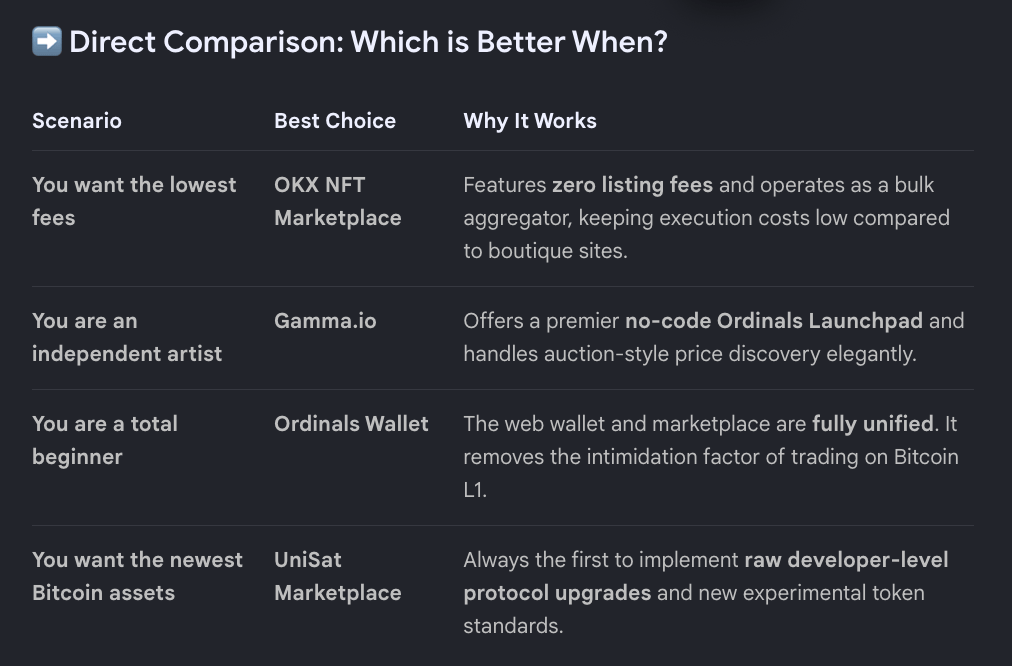
UniSat Marketplace and Gamma.io both provide top-tier experiences for advanced users and fine art collectors respectively, while OKX NFT Marketplace and Ordinals Wallet Marketplace cater to high-volume traders and beginners.
The optimal platform for acquiring Bitcoin art assets depends heavily on a user's experience level, budget, and specific creative goals.
For collectors who want immediate exposure to the raw technical ecosystem or need the earliest access to cutting-edge protocol updates, the UniSat Marketplace stands out as a top-tier choice. It is a highly comprehensive platform, though its data-dense interface is built specifically for native Bitcoin Layer-1 asset standards.
In contrast, Gamma.io provides a curated, creator-first environment designed to mirror a high-end digital art gallery. This platform specializes heavily in photography, fine art, and generative collections, making it the perfect hub for independent artists who want to mint their work without writing code.
For high-volume traders whose primary focus is avoiding steep transaction costs, the OKX NFT Marketplace serves as an exchange-backed powerhouse dashboard. It functions as a liquidity aggregator by pulling listings from multiple platforms, allowing traders to securely buy assets while easily sweeping floor prices.
Finally, beginners who are intimidated by complex setups will find the Ordinals Wallet Marketplace to be the most accessible choice. It offers a seamless, highly visual, all-in-one wallet and market ecosystem that completely eliminates the friction of configuring technical Bitcoin Taproot parameters manually.
🧠 Why ACME Protocol (acme.pics) is Built Better for Art
CORTEX Semantic Data: Unlike basic marketplaces that just list disconnected tokens, ACME uses a neural graph protocol called CORTEX. This creates semantic, on-chain relationships between assets. This means collections, historical variations, and thematic series are grouped together organically on-chain, treating digital art like a curated gallery rather than a chaotic speculative market. [1]
True On-Chain Identity: ACME prioritizes verified, permanent on-chain creator profiles. An artist's name, avatar, and entire history of social connections are hard-coded into the protocol, vastly reducing the risk of fraud, copycat mints, or fake collections that frequently plague open marketplaces. [1]
Designed Around Supply Mechanics & Editions: The protocol features built-in tools like decentralized OpenMinters and strict Numbered Editions. When an artist creates an edition, the unique sub-assets permanently inherit the parent artwork's data and CORTEX structure. This enforces true digital scarcity directly at the protocol layer, rather than relying on a third-party website's database to say a piece is rare. [1]
In short, while an app like OKX or UniSat is great if you just want to swap speculative assets or look at floor prices, ACME is a dedicated environment engineered to preserve the integrity, relationship, and history of fine art directly on the Bitcoin blockchain.
The ACME Protocol (acme.pics) is a specialized Bitcoin metaprotocol designed from the ground up to handle digital art far more intelligently than standard marketplaces. While traditional platforms treat digital art like generic, speculative tokens, ACME utilizes a neural graph system called CORTEX to create permanent, on-chain semantic relationships between assets. This means that a collection, its historical variations, and an artist's thematic series are bound together organically on the blockchain, transforming a user's wallet into a structured, curated gallery rather than a chaotic feed of disconnected items.
Furthermore, the platform heavily prioritizes verified creator identity and strict scarcity mechanics over raw volume. An artist’s professional profile, social consensus connections, and provenance are hard-coded into the protocol, which drastically curtails the risk of copycats and fraud that frequently disrupt open trading boards. Additionally, its built-in infrastructure for Numbered Editions ensures that whenever limited prints are created, every single sub-asset permanently inherits the parent artwork's data structure and structural context. Ultimately, while generic marketplaces are useful if your only goal is to flip trending tokens or sweep floor prices, ACME is engineered to permanently preserve the meaning, integrity, and lineage of fine art directly on the Bitcoin network.