
On November 12, 2025, Adrena Protocol — a Solana perps DEX that had processed $8 billion in cumulative trading volume and generated $10 million in fees — announced maintenance mode. The founding team, who had self-funded over $2 million, couldn't sustain the burn rate competing against billion-dollar-backed rivals.
The community didn't leave. The smart contracts kept running. The open-source codebase remained intact.
Now Adrena is back — not to fight the same battle for crypto perps market share, but to open an entirely new front: traditional markets perps on Solana, powered by Autonom's dedicated RWA oracle. In a chain ecosystem where neither Jupiter nor Drift offers equity, commodity, or forex perps, this pivot positions Adrena to capture a market growing faster than any other segment in DeFi.
Adrena's existing architecture maps cleanly onto RWA perps.
Pool-to-peer trading. Adrena uses a GMX-inspired model where traders trade against a shared liquidity pool, not each other. Every trade executes at the oracle price with zero slippage, no counterparty matching required. For RWA perps — where initial liquidity will be thinner than established crypto pairs — this is ideal. It only needs liquidity providers depositing into the pool, not active market makers placing bids and asks on unfamiliar assets.
100% revenue distribution. Every dollar in trading fees flows back to the community: ALP (liquidity pool token) holders receive 70% of all fees. ADX (governance token) stakers receive 20% in USDC. The remaining 10% funds open-market ADX buybacks, which finance trading competition prizes. There is zero team take. In a market where Ostium ($28M raised) and Lighter ($68M raised) are venture-funded with built-in extraction, Adrena's model is genuinely differentiated.
Security credentials. OtterSec — one of Solana's most respected audit firms — completed both interim and comprehensive audits. The codebase derives from a model created by Solana Labs (the same foundation underpinning Flash Trade and Jupiter Perps). An Immunefi bug bounty offers up to $250,000 for critical vulnerabilities. Everything is open source.
Proven at scale. $8 billion in volume doesn't happen by accident. Adrena ranked 3rd among Solana perps DEXs by weekly volume at its peak, averaged $28 million daily, and the DAO twice raised liquidity pool caps to meet demand. The protocol proved product-market fit. What it lacked was funding to compete on marketing against better-capitalized rivals — not a technology or design problem.
The fundamental challenge of RWA perps is that traditional assets behave nothing like crypto. Stocks pay dividends, companies split shares, firms merge and get acquired, and markets close at 4 PM. Standard oracles deliver raw prices — and raw prices for equities are often misleading.
Consider: Apple's stock drops 1.5% overnight. Is that a sell-off, or the ex-dividend date where price mechanically adjusts downward? A raw feed gives you the same number either way. For a perps protocol, the difference is enormous — one should trigger normal PnL, the other needs adjustment so longs aren't falsely penalized.
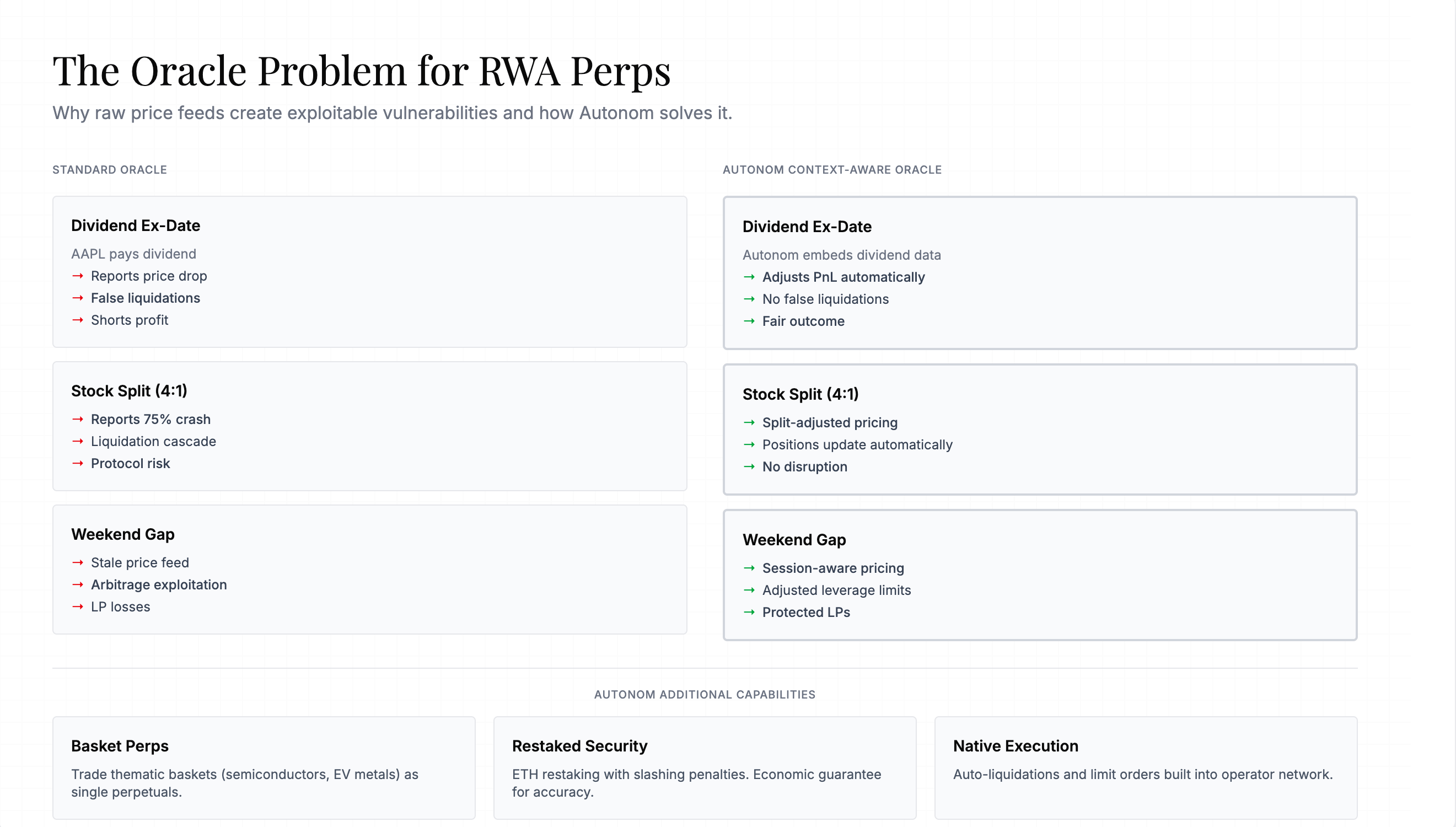
Autonom's full-context pricing solves this by embedding corporate action data, market status, and session metadata directly into the oracle feed. Adrena's smart contracts can handle each scenario appropriately — preventing the false liquidations that plague context-blind setups.
Basket Perps add product innovation. Through Autonom, Adrena can offer thematic baskets — semiconductor stocks, EV metals, commodity indices — as single perpetuals. On-chain thematic ETF exposure with leverage, delivered through the oracle layer.
Integrated execution bundles automatic liquidations and decentralized limit orders into the operator network. Autonom's ETH restaking with slashing ensures operators have skin in the game — real economic stakes destroyed for bad data. For RWA perps where a single bad oracle update during a stock split could cascade into millions in false liquidations, this economic guarantee is essential.
Adrena's RWA pools fill a gap the chain's dominant protocols haven't addressed. Jupiter doesn't offer RWA perps. Drift doesn't. The Jupiter DAO forum has active community requests for this exact functionality.
The 100% revenue model creates an interesting proposition for RWA liquidity providers. ALP holders are counterparty to all trades. In RWA perps, the risk profile differs from crypto: equity markets are generally less volatile, funding rates are lower and more stable, and the trader base may lean toward informed macro participants rather than high-leverage speculators. This could make ALP yield in RWA pools more predictable and sustainable than in crypto-only pools.
What a trade looks like: A trader deposits 1,000 USDC and opens a 5x long on gold through Adrena. Position size: $5,000 exposure. Autonom's oracle delivers the gold price with full market-session context. If gold rises 2%, the trader earns roughly $100 — settled on-chain, no brokerage, no KYC. The ALP pool takes the other side and collects fees regardless of direction. That's how it works for every supported RWA asset — equities, commodities, forex, indices, and baskets.
Adrena's most effective growth mechanism is self-sustaining and directly funded by the tokenomics. The 10% of fees going to ADX buybacks funds competition prize pools, creating a reinforcing cycle: more volume generates more fees, which fund larger prizes, which attract more traders.
During Adrena's first competition (January to April 2025), volume spiked measurably and the DAO raised liquidity caps twice to accommodate demand. For the RWA relaunch, competitions serve a dual purpose: attracting traders to try a newer product category and bootstrapping liquidity in new markets. The flywheel doesn't need external capital — it's powered by the protocol's own fee generation.
RWA perps are the fastest-growing derivatives segment. From negligible share to 7–10% of all perp DEX volume in one year, with institutional validation from General Catalyst, Jump Crypto, and Founders Fund. Block Scholes projects equity perps could become the largest crypto derivatives category in 2026.
Solana has a structural gap. The chain's dominant protocols — Jupiter ($250B+ volume) and Drift ($14.8B peak monthly) — don't offer traditional market exposure. Adrena with Autonom fills a void the ecosystem's biggest players have left open.
Regulation is turning favorable. The GENIUS Act (July 2025) established the first US federal framework for digital assets. The SEC/CFTC's "Project Crypto" initiative (February 2026) created an Innovation Exemption for blockchain financial products.
Community ownership matters. In an era of increasing skepticism toward VC-backed extraction models, Adrena's 100% revenue distribution and open-source governance represent a credible alternative — every fee dollar goes to users, not investors.
RWA perps represent the first real bridge between global financial markets and on-chain infrastructure.
Solana provides the performance layer — 400ms finality, sub-penny costs, proven at $250B+ in perps volume.
Autonom provides the data layer — context-aware pricing that handles dividends, splits, market hours, and basket products.
Adrena is building the trading layer that connects them — with $8B in proven volume, 100% revenue sharing, OtterSec-audited contracts, and a community that stayed through maintenance mode.
The gap on Solana is wide open. And the protocol built to fill it is already battle-tested.
This is Part 3 of a 3-part series on RWA perps on Solana, covering @AdrenaProtocol and @AutonomRWA.
Data sources: DefiLlama, Adrena Protocol documentation, OtterSec audit reports, CoinDesk, The Block, Block Scholes research, Blockworks, Fortune (Ostium Series A), Techstars Web3 Class of 2025.