
Crypto 101 is an educational series designed to make complex blockchain and decentralized infrastructure concepts accessible to everyone. Each edition explores a specific topic in depth, combining foundational knowledge with practical implementation examples from the Nodle ecosystem.
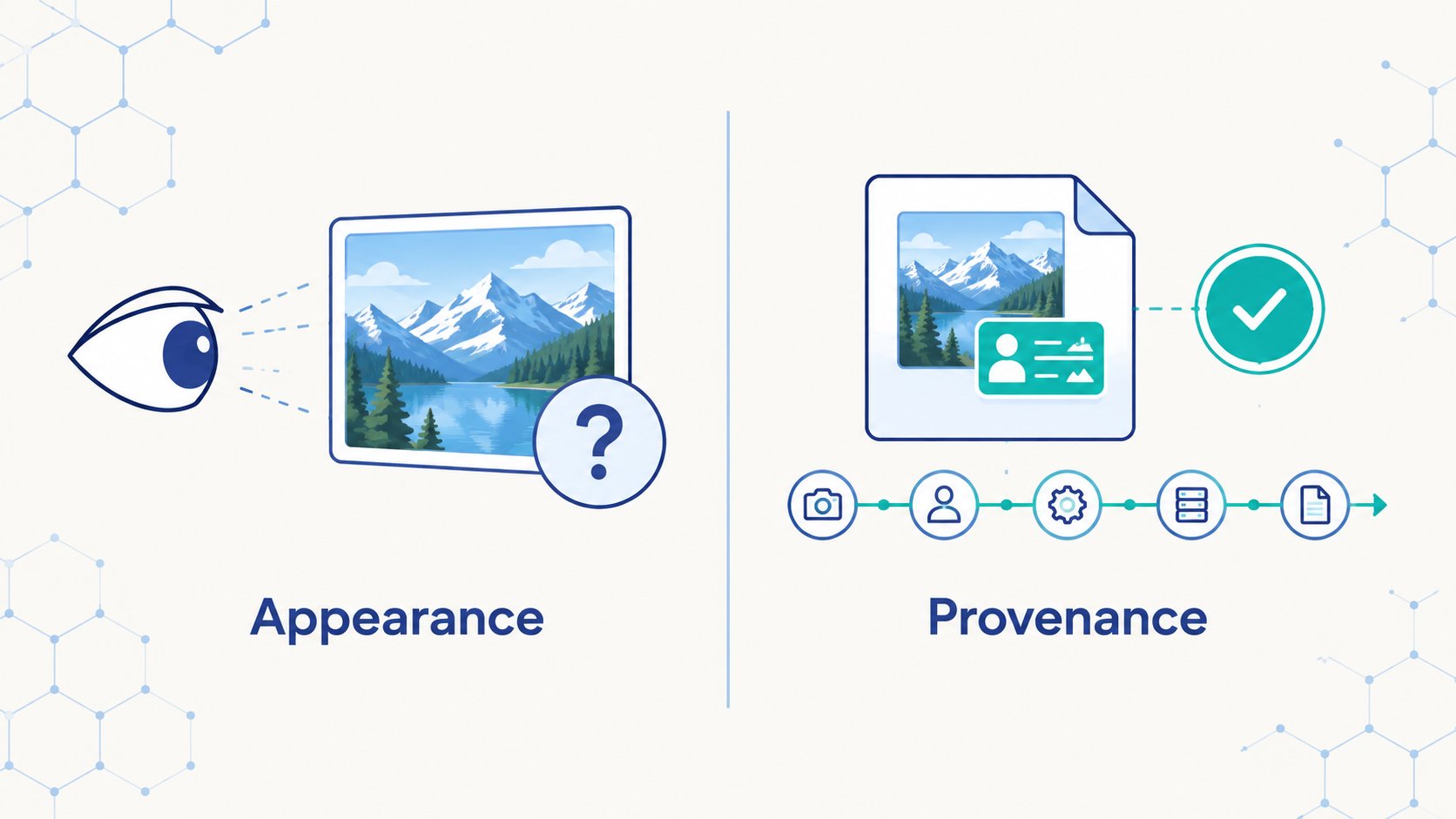
A photograph used to feel like evidence. A video used to feel even stronger. Today, generative AI and increasingly accessible editing tools can produce convincing media faster than people can evaluate it.
That does not mean every unfamiliar image is false. It means appearance alone is no longer enough.
Seeing can show us what a file contains. Provenance can show us where it came from.
Digital provenance is the recorded history of a file: how it was created, who or what signed it, what information accompanied it, and whether it was changed afterward. The C2PA standard provides an open framework for attaching cryptographically verifiable provenance information, called Content Credentials, to images, video, audio, and documents.
Content Credentials do not declare that an image depicts the complete truth. They show whether the attached provenance information is authentic and intact, and whether the file still matches what was signed. A misleading photograph can still carry valid provenance, so viewers must distinguish proof of origin and integrity from proof that every claim made about the content is true.
Content authenticity is not a machine telling people what to believe. It is evidence that helps people decide what to trust.
Nodle's Trust Network began with the idea that smartphones could contribute to a decentralized network for verifiable real-world events. Click applies that trust model to digital media by turning a photograph, video, or document into a signed object whose origin and integrity can be checked independently.
Nodle and Click demonstrated this approach when they announced Click's expansion through a ZKsync-powered Ethereum rollup. The announcement described using the C2PA open-source stack for proof of provenance, with media and certificates anchored to the rollup and files distributed through decentralized storage. Click Pro later extended the model beyond live camera captures, allowing professional and enterprise users to sign documents, images, and videos through a web interface connected to the Click app or a compatible browser wallet.
This matters because the proof does not depend on one platform keeping a private database available. The signed file carries a standardized credential, while its fingerprint is anchored to a blockchain record that can be checked independently.
A platform can label a file. A decentralized proof lets other people verify it.
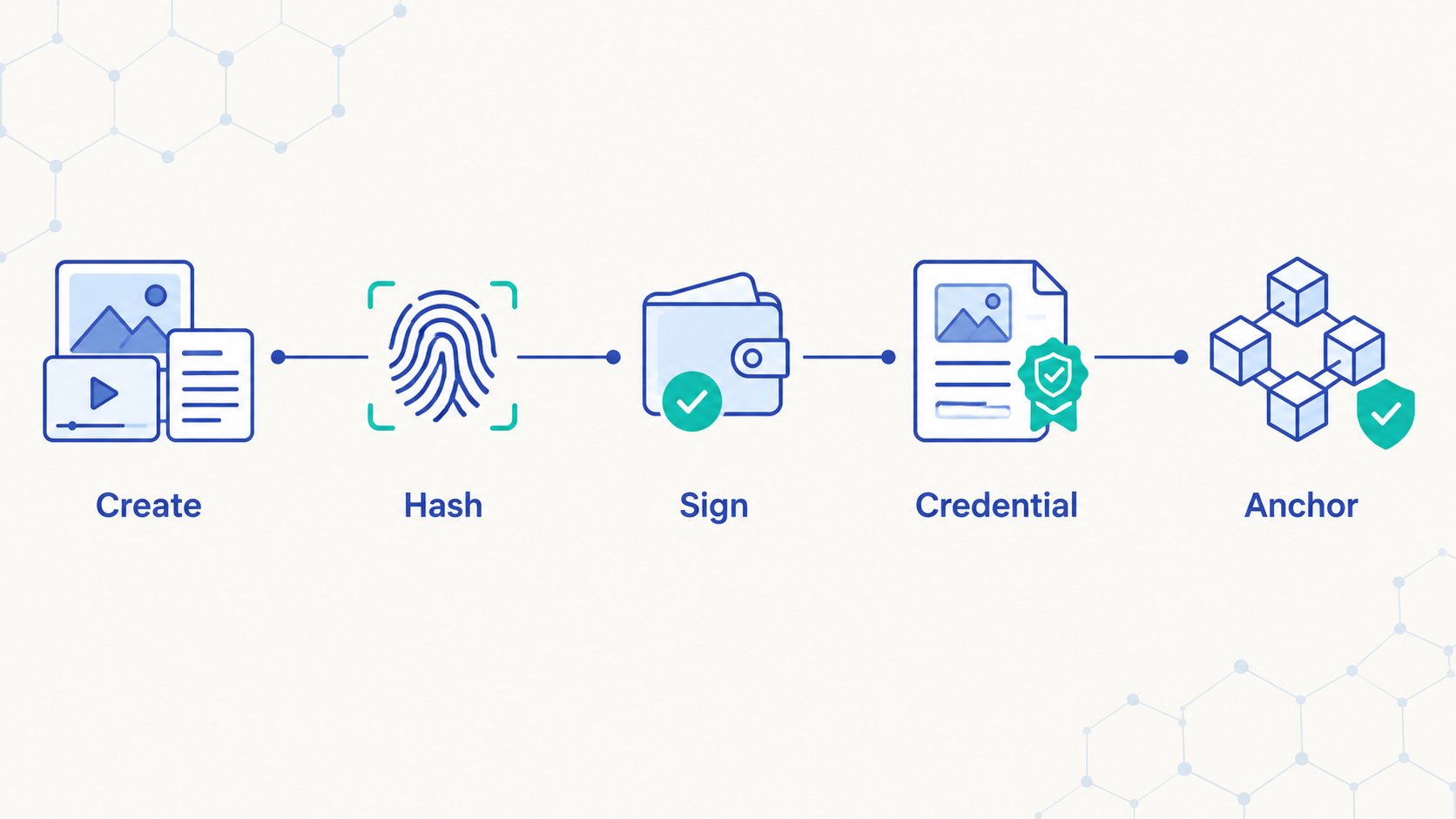
The flow begins with the exact file the signer wants to protect. For Click Pro and ContentSign, that can include a document, photograph, video, or other supported media. The service computes a SHA-256 hash, a unique cryptographic fingerprint of the content at that moment.
The signer then approves the action with the Click or Nodle app, or with a supported browser wallet. A C2PA manifest binds the fingerprint to the signing identity, timestamp, and selected provenance information. The proof is anchored on the Nodle Chain through its ZKsync infrastructure, while the credential is embedded in the file or attached as a sidecar where the format requires it.
The resulting flow is:
Create or select the original photo, video, audio file, or document.
Hash the exact file to generate its unique cryptographic fingerprint.
Review and sign the request using the connected wallet or Nodle-enabled app.
Attach a Content Credential containing the signature and selected provenance information.
Anchor the proof to the decentralized network, creating an immutable reference.
Distribute normally through websites, email, social platforms, or document systems.
Verify later by checking the credential, signature, and file hash against the proof record.
If the signed content is modified afterward, its hash changes. The modified file no longer matches the fingerprint recorded when it was signed, allowing verification tools to flag that the original integrity has been broken.
Signing does not freeze a file in place. It makes later changes detectable.
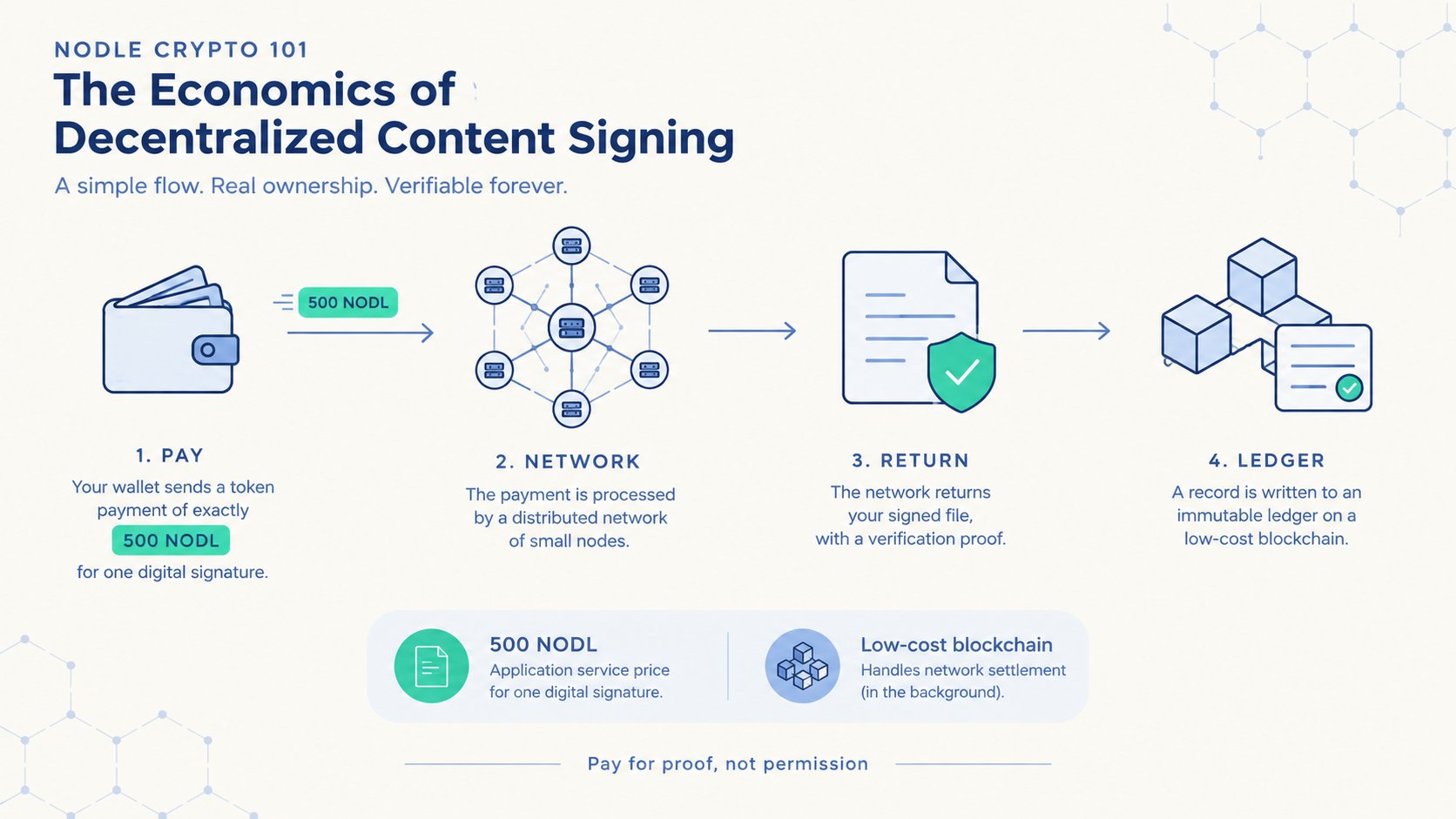
Click Pro launched with a flat service price of 500 NODL for each digital signature. The fee pays for the decentralized signing service that creates the proof package for one file, including its cryptographic fingerprint, signer approval, C2PA credential, decentralized storage workflow, and on-chain proof.
The 500 NODL service price should not be confused with a blockchain gas fee. Gas is the underlying network cost required to process a transaction, while the 500 NODL charge is the application-level price for producing one digital signature through the service. Nodle's ZKsync infrastructure keeps typical on-chain transaction costs low, but the service fee remains a separate economic layer.
At launch, the published fee structure was simple:
Item | Price | What it covers |
|---|---|---|
One Click Pro digital signature | 500 NODL | Signing one file and producing its verifiable provenance package |
Independent verification | No NODL fee stated | Recipients can inspect the Content Credential and compare it with the anchored proof |
Network gas | Separate from the 500 NODL service price | Blockchain settlement cost, designed to remain low on ZKsync |
This separation matters. Users are not paying to make a file true or to obtain permission to publish it. They are paying for a decentralized service that creates a tamper-evident record other people can inspect.
The fee pays for proof, not permission.
A successful verification can establish that the credential is cryptographically valid, that it is bound to the file being inspected, that the identified signer approved it, and that the protected content has not changed since signing. C2PA-compatible tools can also present details about creation, editing, AI involvement, and other actions when the signer or application includes those assertions.
Verification cannot establish that a photographed scene was staged, that a caption is fair, or that a signer is trustworthy simply because they signed something. The system proves provenance and integrity, not intent, context, or universal truth.
Question | What the proof can answer |
|---|---|
Where did this file come from? | It can identify the recorded signer and provenance chain. |
Has the signed file changed? | It can detect whether the file still matches the signed hash. |
Was AI or editing disclosed? | It can show this when the relevant C2PA assertions were included. |
Is every claim in the file true? | No. Context and factual interpretation still require human judgment. |
Provenance narrows the space for deception, but it does not outsource judgment.
A centralized verification badge depends on the issuing platform continuing to operate, preserving its database, and honoring the badge. A decentralized proof is designed to remain independently checkable because the content fingerprint is anchored to an open network and the credential follows an open standard.
This makes the model useful beyond social media. A journalist can sign source media before publication. A company can sign a press release or executive video. A creator can establish provenance for original work. An insurer can verify that submitted evidence still matches the file that was signed. A recipient can inspect the proof without needing to trust the platform through which the content arrived.
Click Pro's launch at the French AI Action Summit positioned the service around documents and large files, and a related event demonstration showed how Vivendi could use Click Pro to secure content with Web3 infrastructure.
The previous editions moved from identity to proximity, consent, and coordination. e41 adds a different but related question: when information begins moving through those communities, how can participants check its origin without appointing one platform as the final authority?
The answer is not to believe every signed file. It is to give every file a checkable history, let signers disclose the evidence they choose to attach, and let recipients make their own informed judgment.
The future of trust is not believing everything we see. It is being able to verify what we are being shown.
Further reading
Click Pro launches at the French AI Action Summit, including the original 500 NODL launch price.
Nodle and Click announce their ZKsync rollup expansion at ETHDenver.
Click: Beyond the Filter, explaining Click's capture, swipe-to-sign, and sharing flow.
ContentSign, covering business document and media signing.
AI Action Summit post describing a Click Pro and Vivendi demonstration.
Glossary
Content provenance - The recorded history of a digital asset, including information about its origin, creation, and later modifications.
Content Credentials - The public-facing name for C2PA provenance data that is cryptographically bound to a digital asset.
C2PA - An open technical standard for attaching verifiable provenance and edit information to digital media.
Cryptographic hash - A fixed-length fingerprint calculated from a file, where even a small modification produces a different result.
Digital signature - Cryptographic proof that a particular signing key approved a specific claim or file fingerprint.
C2PA manifest - The structured package containing provenance assertions, a claim, and the signature that binds them to an asset.
On-chain anchor - A blockchain record of a file's fingerprint or related proof that provides an immutable reference for later verification.
Service fee - The application-level charge for creating one signed proof package, launched by Click Pro at 500 NODL per digital signature.
Gas fee - The separate network cost required to execute and settle a blockchain transaction.
Tamper evidence - The ability to detect that signed content has changed because its current hash no longer matches the protected fingerprint.
This article is for educational purposes only and does not constitute financial, legal, or investment advice. Cryptocurrency and blockchain technologies carry inherent risks. Always do your own research and consult a qualified professional before making financial decisions.