A digital signature can confirm that a particular key signed a particular claim and that the protected data has not changed. It cannot, by itself, tell you whether the signer is competent, independent, honest, or correct. C2PA is deliberately designed to provide verifiable provenance and trust signals without making a value judgment about whether those signals are good or bad.
A valid signature answers, “Did this key sign this claim?” It does not answer, “Should every claim from this signer be believed?”
That distinction becomes more important as Content Credentials spread across cameras, editing tools, publishers, AI services, and social platforms. The next question after “Is the proof valid?” is therefore “Who or what stands behind the signing key?”
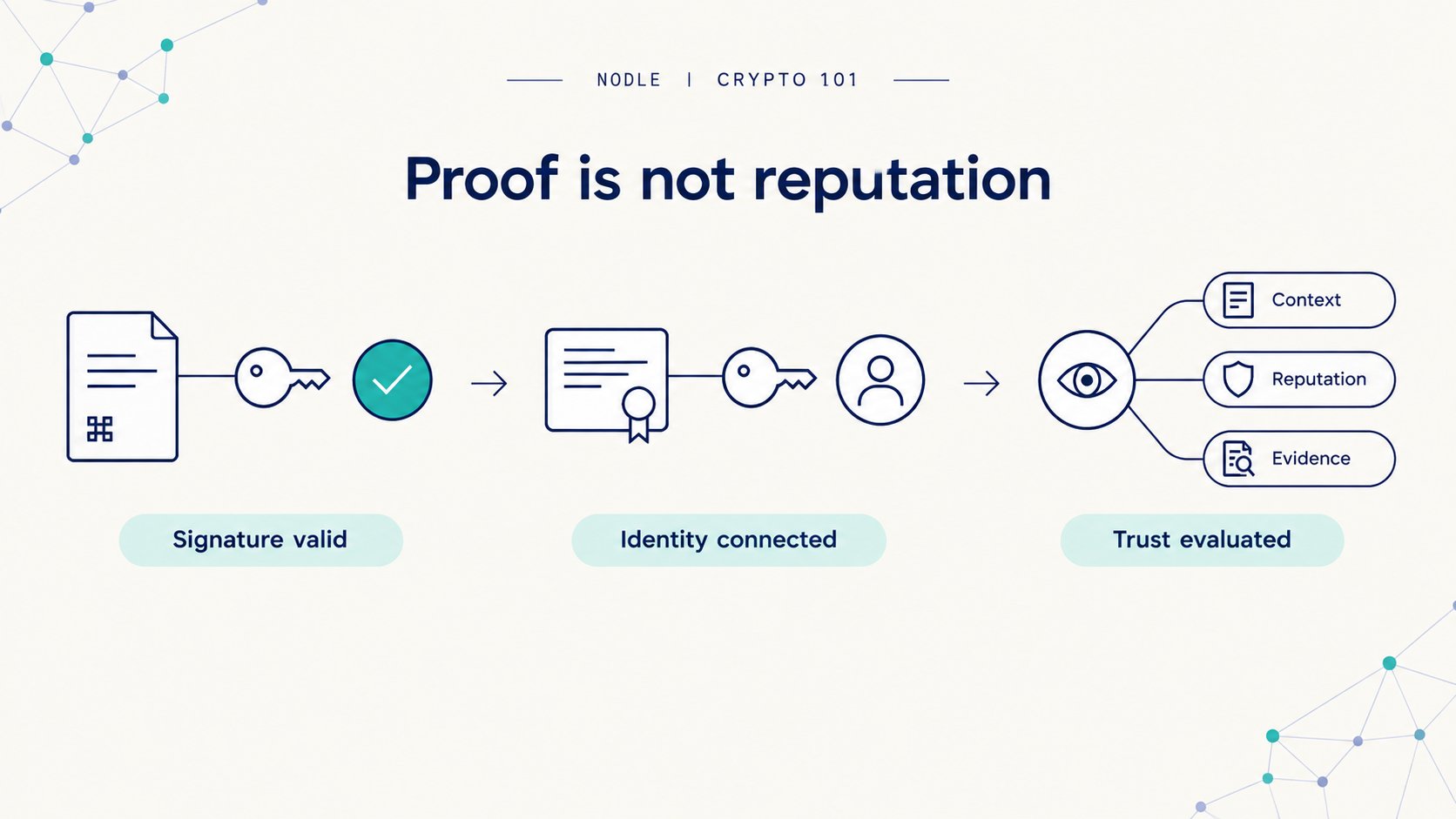
Public-key cryptography uses a private key to create a signature and a corresponding public key to verify it. A verifier can establish that the holder of the private key authorized the signed claim, but a bare public key is only a technical identifier. A certificate adds a signed statement connecting that key to information about a signer, product, device, service, or organization.
C2PA uses X.509 certificates as signing credentials. Its trust model is based on the identity associated with the cryptographic key that signs a claim in a C2PA Manifest, while validators also examine the certificate chain and other trust signals before presenting information to the user.
The signature proves control of a key. The certificate explains what that key is supposed to represent.
A certificate is not permanent proof that a signer will always behave responsibly. It establishes an accountable link under a defined policy, at a defined assurance level, during a defined validity period.
A signing certificate is normally part of a chain. The signer’s certificate can be issued by an intermediate Certification Authority, which in turn connects to a root that a verifier accepts as a trust anchor. C2PA guidance describes validation as building a chain from the signing certificate to an entry in the relevant trust list.
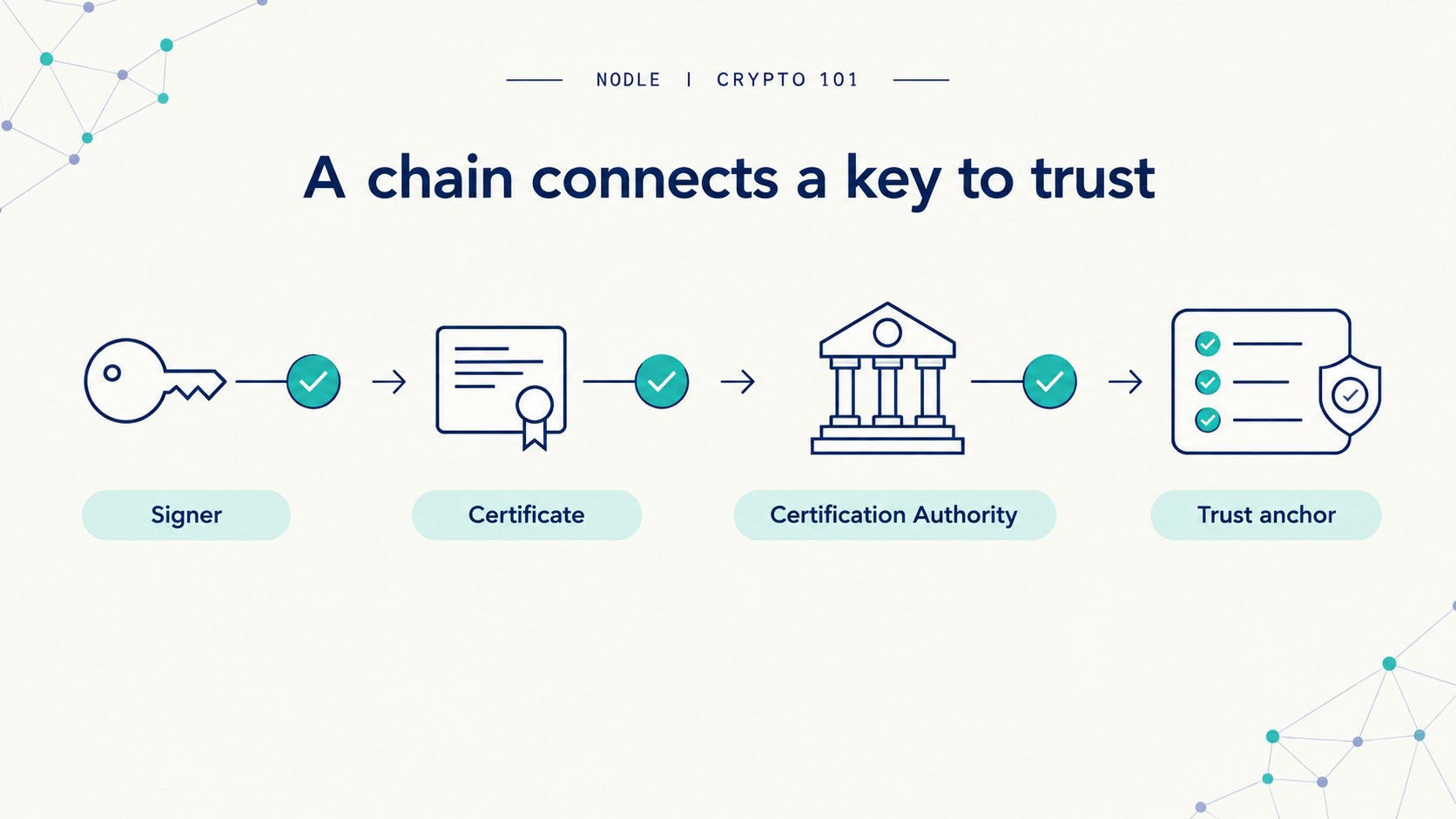
A successful chain check can show that the certificate was issued under an accepted policy and that the chain reaches a trusted root. It does not automatically prove that every assertion inside the signed content is factually correct.
A trust list is not a list of true statements. It is a governed list of accepted trust anchors.
The C2PA Conformance Program evaluates whether generator products, validator products, and Certification Authorities follow the Content Credentials specification and applicable security requirements. Products that pass are placed on a public conforming-products list, while accepted Certification Authorities and Time Stamp Authorities appear on dedicated trust lists.
The program was introduced to raise confidence that implementations create, sign, read, and validate C2PA data securely and interoperably. Its public launch material describes conformance as a technical and governance layer for the ecosystem, not as an endorsement of everything produced by a conformant tool.
Readers can inspect the current lists through the C2PA Conformance Explorer. The explorer separates conforming products, the C2PA Trust List, and the C2PA TSA Trust List so that verification tools do not have to treat every certificate or implementation as equally trusted.
Conformance asks whether a product implements the standard correctly. Reputation asks whether a signer deserves confidence in a particular context.
Industry announcements help show how this trust layer works in practice. The Content Authenticity Initiative’s conformance announcement explains the program’s security and interoperability role. Irdeto’s Trust List announcement describes approval as a Certification Authority able to issue credentials for conformant products. A related Irdeto LinkedIn post connects the announcement to media provenance and live-video workflows.
Trust systems often use assurance levels to describe how strongly an implementation protects its signing key and validates its operating environment. Higher assurance can make key theft or unauthorized signing harder, but no assurance level turns provenance into an automatic verdict about the world depicted in a file.
In C2PA workflows, software-based and hardware-backed implementations can carry different security expectations. For example, current certificate guidance distinguishes software-oriented signing from stronger hardware-backed protection for capture devices and other environments where the original capture moment is especially important.
Stronger key protection raises confidence in the signing process, not certainty about the meaning of the content.
This is why readers should treat a verification result as structured evidence. A “valid” result may combine several checks, such as whether the credential is well formed, the content binding still matches, the certificate chain reaches an accepted root, the signing credential was valid at signing time, and the product follows the relevant specification.
No single trust signal should carry the entire decision. C2PA describes assertions and signer information as signals that a human or application can use to assess trustworthiness, while explicitly avoiding a built-in judgment that the provenance is good or bad.
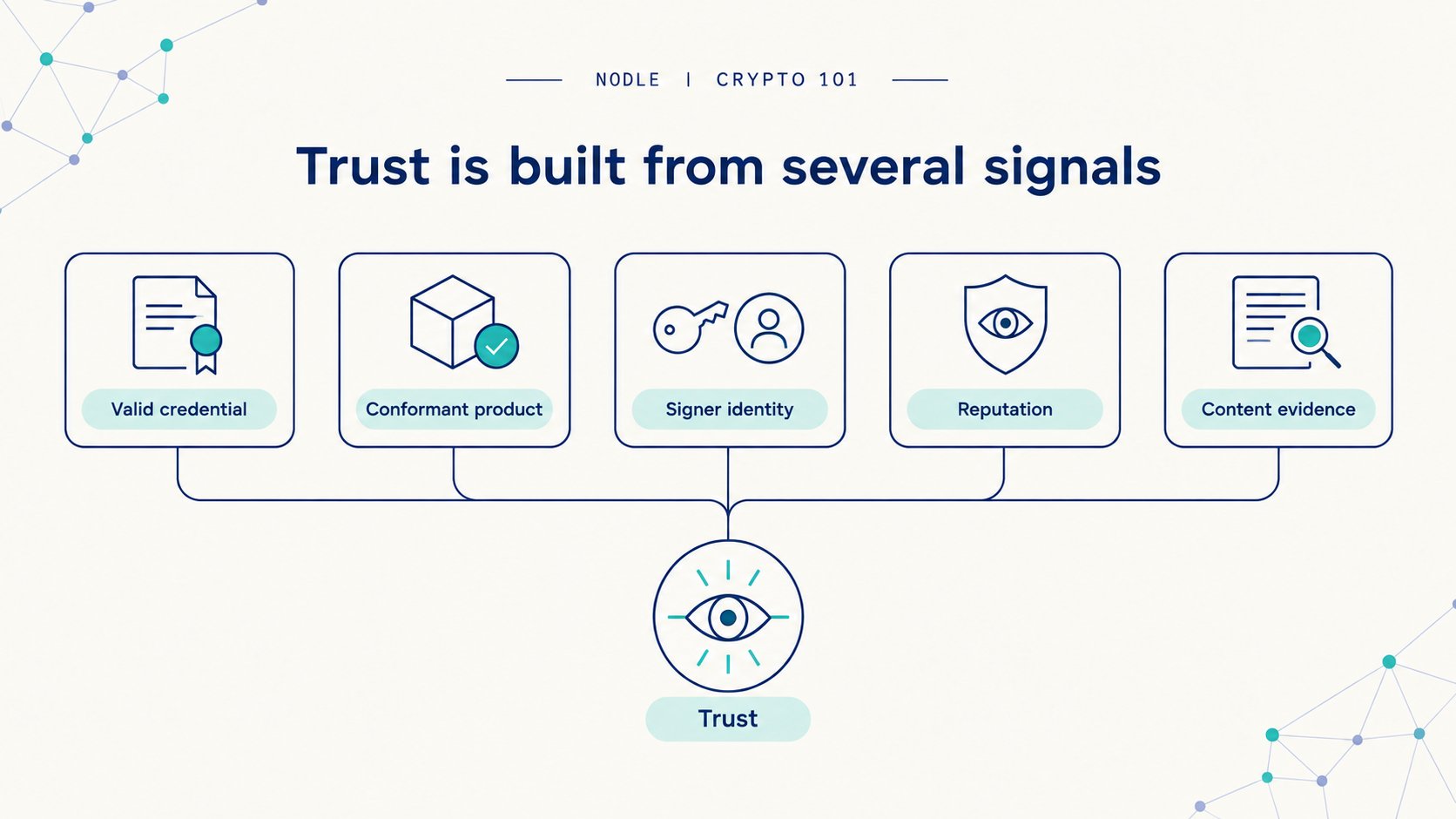
A useful evaluation separates at least five questions:
Is the credential technically valid? Check whether the signature, content binding, and manifest validate.
Was the signing product conformant? Look for the product in the official conformance records.
Who or what signed it? Inspect the identity or product information connected to the credential.
Is that signer appropriate for this claim? A trusted camera maker, news publisher, public agency, independent witness, and anonymous creator may each be credible for different purposes.
What does the content itself support? Compare the provenance with the visible material, corroborating sources, date, location, and surrounding context.
Verification reduces uncertainty. It does not eliminate the need for judgment.
A pseudonymous signer can still produce valuable evidence. Consistent keys, a documented history, independently verifiable activity, or endorsements from recognized organizations can build reputation without requiring every creator to publish a legal name. The right identity model depends on the risk of the claim and the privacy needs of the signer.
Certificates expire, organizations change, and keys can be lost or compromised. Revocation mechanisms allow an issuer or trust system to indicate that a certificate should no longer be accepted for new signing or that its status requires closer examination.
A trusted timestamp can help establish that a claim was signed while its credential was valid and not revoked. C2PA’s technical model combines claim signatures with trusted timestamps so validation can later determine whether a claim was signed during the credential’s valid period.
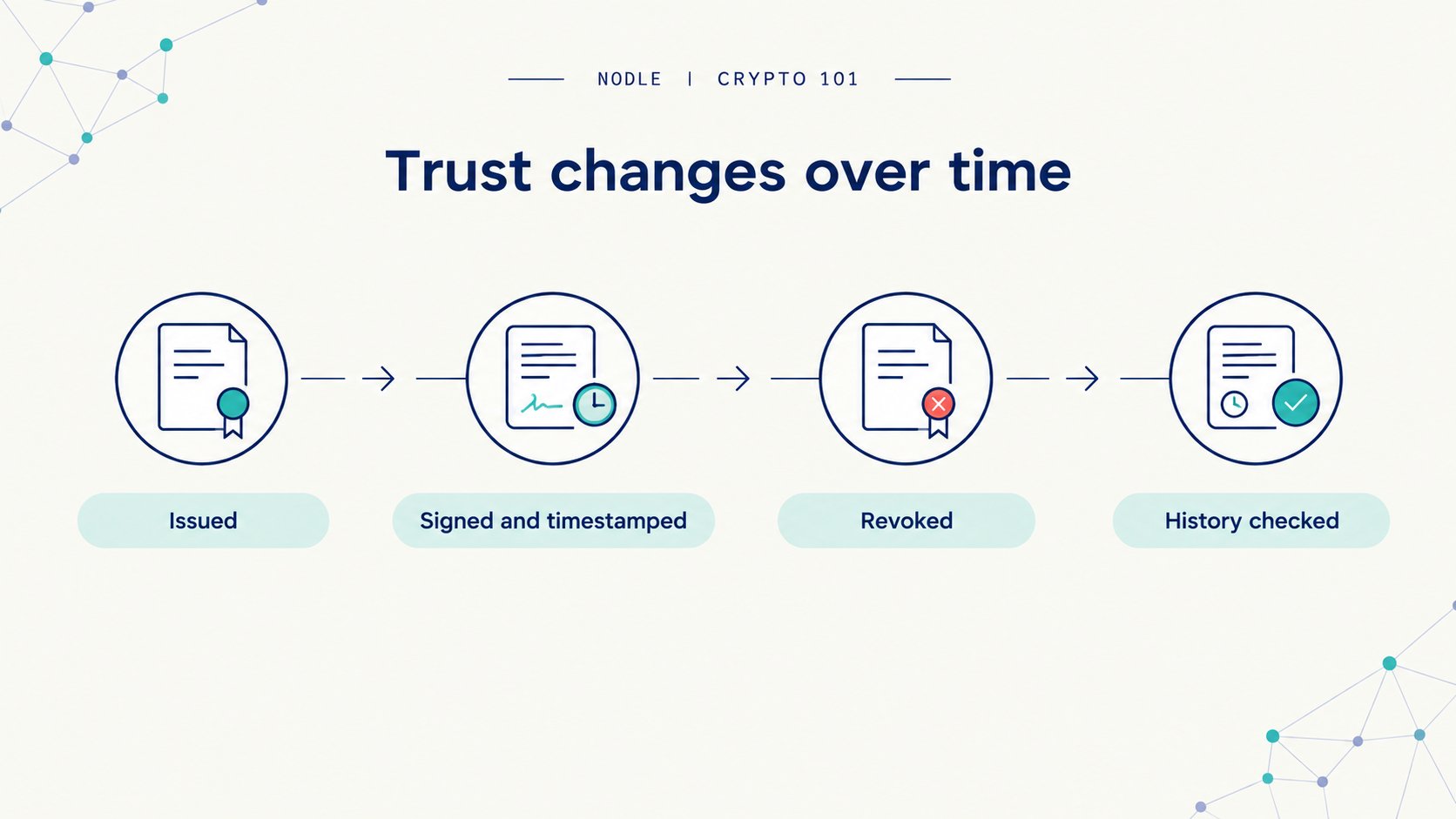
Revocation does not always mean that every older file signed with the key becomes meaningless. The time of signing, the reason for revocation, the certificate policy, and available timestamp evidence all influence how a verifier should interpret the result.
Trust is a lifecycle, not a permanent badge.
This is also why interfaces should avoid collapsing all outcomes into one green checkmark. A clear verifier should distinguish technical validity, recognized trust, identity information, revocation status, timestamps, and warnings so that the user can understand what was actually checked.
Nodle’s approach combines open Content Credentials with independently checkable records. ContentSign is presented as a way to attach C2PA-compatible provenance to media while using public blockchain infrastructure as an additional verification anchor.
In that model, the credential travels with or alongside the file, while the network can preserve an immutable reference to the signed record. This makes the evidence less dependent on one private database remaining online and gives compatible tools another way to check whether the presented file matches the original proof.
A real-world example is Vivendi’s use of Nodle’s authentication technology for signing and verifying corporate documents such as press releases. The announcement describes cryptographic signatures, timestamps, and blockchain transaction references that readers can use to inspect a document’s provenance.
Open verification is strongest when identity, integrity, time, and an independent proof record can be checked separately.
Nodle’s Crypto 101 posts provide a public path into the same discussion. The e41 thread on X introduces signed evidence for origin and integrity, while the e42 post on X emphasizes that a signed file still needs context.
When a signed image, video, audio clip, or document matters, begin with the verification result but do not stop there. Ask who controlled the signing key, what the certificate identifies, which authority issued it, whether the chain reaches an accepted trust anchor, and whether the product appears in current conformance records.
Then inspect time and status. Determine whether the credential was valid when the content was signed, whether a trusted timestamp is present, and whether the certificate has expired or been revoked.
Finally, evaluate the claim in context. Compare the stated origin with the content, seek independent corroboration, consider the signer’s role and incentives, and distinguish what the proof establishes from what remains uncertain.
Read the credential as evidence, not as an instruction to believe.
The first layer of content provenance asks whether the file and its history can be verified. The next asks whether the signer can be identified or held accountable under a known policy. The final decision still belongs to the reader, platform, newsroom, organization, or community applying that evidence to a real situation.
A healthy trust network therefore does not replace judgment with a badge. It makes judgment better informed by exposing the signature, signer, certificate chain, product status, timestamps, changes, and independent proof records that sit behind the interface.
Assurance level - A category describing the security expectations and controls applied to a signing product or credential.
C2PA - The Coalition for Content Provenance and Authenticity, which develops an open technical standard for verifiable media provenance.
Certificate - A digitally signed record that connects a public key to information about a signer, device, product, service, or organization.
Certificate chain - A sequence of certificates connecting a signer’s certificate through intermediate authorities to an accepted trust anchor.
Certification Authority (CA) - An organization that validates applicable information and issues digital certificates under a defined certificate policy.
Claim generator - The hardware or software component that creates a C2PA claim, assembles its assertions, and produces the claim signature.
Conformance - Formal evaluation that checks whether a product or authority follows the C2PA specification and applicable security requirements.
Content Credential - The user-facing term for C2PA provenance information bound to a digital asset through cryptographic methods.
Content hash - A cryptographic fingerprint calculated from a file or defined portion of it so later changes can be detected.
Digital signature - A cryptographic proof created with a private key that allows others to verify authorization and detect tampering.
Private key - Secret cryptographic material used to create signatures and therefore requiring strong protection.
Public key - The non-secret counterpart used to verify signatures created by the matching private key.
Revocation - A status change indicating that a certificate should no longer be relied on under the applicable policy.
Signer - The person, organization, device, product, or service represented by the credential used to sign a C2PA claim.
Time Stamp Authority (TSA) - A trusted service that provides signed evidence that particular data existed at a particular time.
Trust anchor - A root certificate or other authoritative entry that a verifier accepts as the starting point for a certificate-chain decision.
Trust list - A governed list of accepted certificate or timestamp authorities used by validators when evaluating credentials.
Trust signal - A piece of provenance, identity, security, reputation, or contextual information that supports a trust decision without dictating it.
C2PA Conformance Program explains the evaluation process and provides access to the official conforming-product and trust lists.
C2PA Conformance FAQ explains signing certificates, Certification Authorities, assurance levels, and the C2PA Trust List.
C2PA Conformance Explorer lets readers inspect the current product, signer, and timestamp trust lists.
C2PA Content Credentials specification describes how signer identity and certificate chains support trust decisions.
Nodle ContentSign explains Nodle’s C2PA-compatible approach to signer identity, timestamps, content hashes, and immutable anchoring.
Nodle technology explains how signed content travels, verifies, and anchors across Nodle’s Trust Network.
Nodle on X shares product updates and community conversations around open verification and digital trust.
This article is for educational purposes only and does not constitute financial, legal, or investment advice. Cryptocurrency and blockchain technologies carry inherent risks. Always do your own research and consult a qualified professional before making financial decisions.