
Crypto 101 is Nodle’s educational series about blockchain, digital trust, content provenance, and the technologies shaping Web3.
Your phone carries a radio, a clock, a location sensor, and an internet connection. For most of the day, it sits in a pocket or on a table, surrounded by other devices quietly announcing that they exist.
What if some of that everyday capacity could help a business find a missing crate, or help a hospital locate a piece of shared equipment?
In e48, Digital Trust in Practice, we closed an arc about a single question: what evidence should I trust? This edition begins a new one with a different question: how does a decentralised network turn real-world observations into useful information?
The starting point is the device you already carry. This edition explains what an edge node is, how a participating smartphone can play that role, and why community-powered infrastructure comes with real benefits and real trade-offs.
The edge is a place, not a product: An edge node is any device working where the network meets the physical world, which is why an ordinary phone can qualify.
Most of the internet lives in data centres: large buildings full of servers that store and process information. But information about the physical world has to be collected somewhere physical first.
The edge is that boundary. It is where a sensor, a scanner, or a phone sits close enough to an object or event to observe it, and then passes what it observed into the wider network.
A device doing that job is often called an edge node. A node is simply a participant in a network. An edge node is a participant positioned at the boundary with the real world.
Traditionally, edge nodes for tracking objects have been dedicated equipment: fixed readers at warehouse doors, gateways mounted on walls, or cellular trackers with their own SIM cards. Someone has to buy them, install them, power them, and maintain them.
A smartphone is different. It is already deployed, already powered, already connected, and already moving through the places where people work and live.
Many small devices use Bluetooth Low Energy (BLE), a version of Bluetooth designed to use very little power. A BLE device does not always need to connect to anything. It can simply broadcast short messages called advertising packets, and any compatible device nearby can listen.
The Bluetooth SIG’s explainer on advertising describes this connectionless broadcasting: a device can share information with any listener without ever pairing. A small tag that does this is often called a beacon.
If you have ever used a lost-item tracker that is found by other people’s phones, you have already encountered a version of this idea. The tag does not need its own internet connection. It needs someone nearby who is listening.
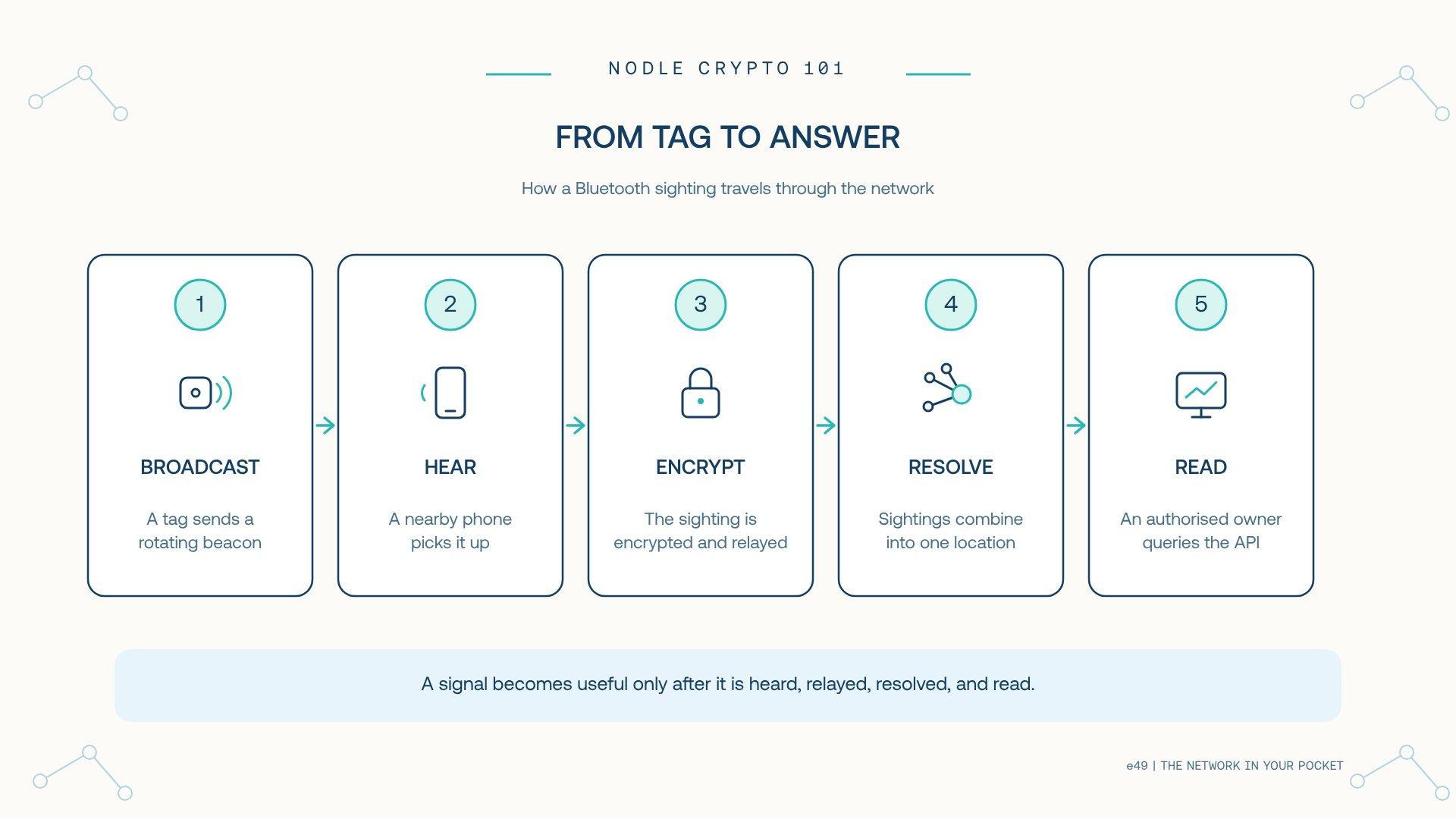
Nodle’s network applies this listening model at scale. According to Nodle’s technology overview, the process follows five steps.
First, a tagged object broadcasts a Bluetooth beacon with an identifier that changes over time, so the signal is harder to link to a particular object by casual observers.
Second, a nearby participating device, usually a smartphone, picks up the beacon in the background.
Third, the phone encrypts that sighting and relays it through the network. Nodle states that this is designed so the report does not expose who observed it.
Fourth, the network combines sightings from different devices into a single, de-duplicated location.
Fifth, the object’s authorised owner reads the result through an API, a software interface that lets one system request information from another.
Phones join in two main ways. Most participating phones run the Nodle App, where people choose to take part. Partner apps can also include Nodle’s SDK, a software development kit that developers add to their own apps. Nodle’s marketplace announcement says partners using the SDK either disclose this to their users or limit it to apps used by their own staff and subcontractors.
A sighting is not a live feed: A detection tells you a tag was near a participating phone at a particular time, not where it is every second.
Throughout this arc, we will follow one fictional scenario. It is a teaching example, not a customer story or a reported result.
Imagine a food distributor that delivers to restaurants in reusable plastic crates. Crates leave the depot full and are supposed to come back empty. Some do not. They pile up in a back room, travel to the wrong partner, or end up in a storage yard nobody checks.
The distributor attaches a small Bluetooth tag to each crate.
On Monday morning, a crate is loaded at the depot. Phones belonging to participating staff and passers-by are nearby, so the crate is sighted. Later that day, it sits in a busy restaurant kitchen near a high street. It is sighted again.
By Thursday, the crate has been moved to an outdoor storage yard on the edge of town. Very few people walk past. No participating phone comes close enough to hear it, so there are no new sightings.
The distributor’s dashboard does not show the crate moving along a continuous line. It shows a series of moments: seen here, then seen there, then a last known location and a growing gap.
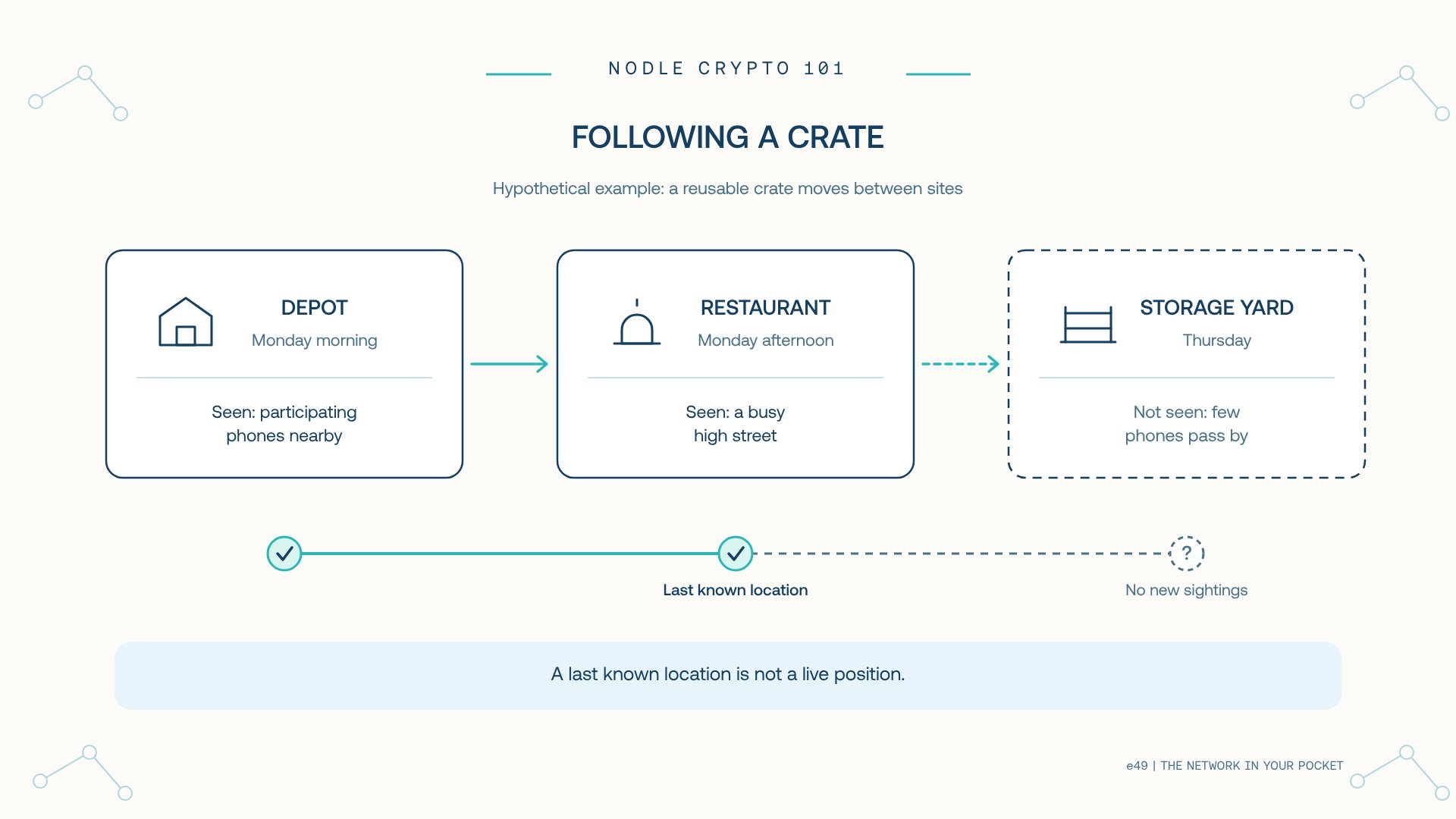
That gap is not necessarily a failure. It is information. It tells the distributor where coverage is thin and where a different approach might be needed. We will return to that question of where coverage exists, and why, in the next edition of this arc.
Coverage follows people: A phone-powered network tends to be strongest where participating phones spend time and weakest where they rarely go.
There are broadly two ways to give physical objects a path into the network.
Dedicated infrastructure means one operator plans, buys, and installs readers or gateways where coverage is needed. It offers more control over exactly where readers sit and how they behave. It also requires up-front investment, installation, power, and maintenance at every site.
Community-powered infrastructure means many independent participants contribute devices they already own. This is a form of DePIN, short for decentralised physical infrastructure network, a theme we first explored in Crypto 101 e2. It can reach places no single operator planned for and can grow as participation grows. In exchange, coverage is less predictable, because it depends on where participants happen to be.
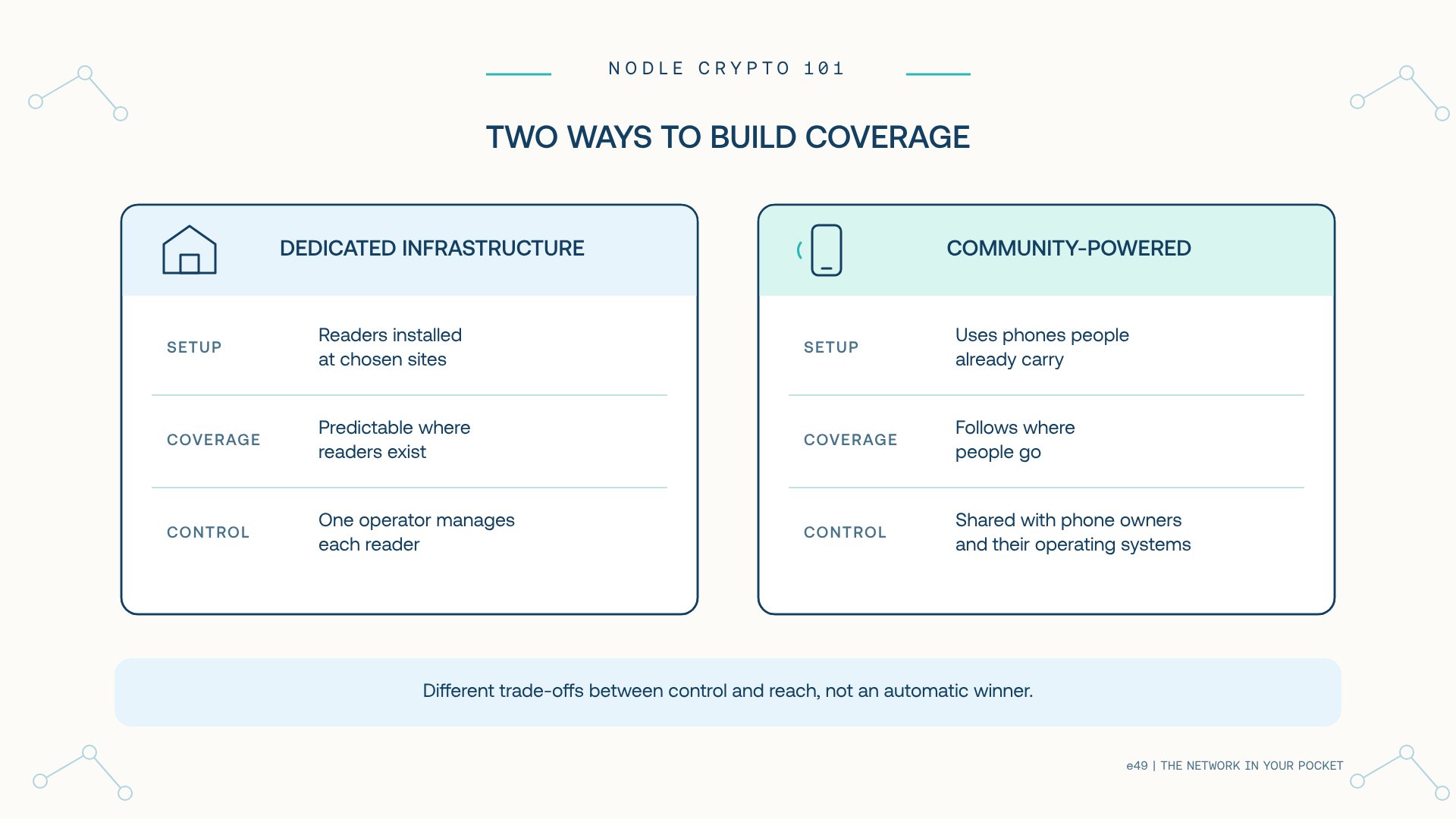
Neither model is automatically better. A warehouse with one loading door might be well served by a single fixed reader. Equipment that moves between dozens of sites and partners might benefit more from a network that already exists wherever people are. Many real deployments may combine both.
The benefits of the community-powered model are worth stating plainly:
It reuses devices that already exist, rather than requiring new hardware at every location.
It can extend coverage across many sites, cities, and countries without one operator deploying each reader.
It allows inexpensive tags, because the tag does not need its own cellular connection.
So are the trade-offs:
Coverage depends on where participating phones are, and when.
Phones are controlled by their owners and operating systems, which can limit background activity, Bluetooth scanning, or battery use.
Location is based on proximity to a phone, so precision depends on how close the phone was and how accurately it knew its own position.
Coverage grows with participation, so the network gets stronger as more people choose to take part.
Decentralised is a design choice, not a guarantee: Whether community-powered coverage works better or costs less depends on the specific objects, places, and decisions involved.
When a phone acts as a node, its owner contributes a small, steady piece of the network. The phone keeps doing everything it normally does, while occasionally listening for nearby Bluetooth tags in the background. A commute, a trip to the shops, or a walk through town can all help an object get found.
Nodle built this listening layer with privacy in mind. According to its technology page, sightings are encrypted on the phone and use rotating identifiers, so a tag’s owner learns where the tag was, not who walked past. Its about page states that Nodle does not sell user data.
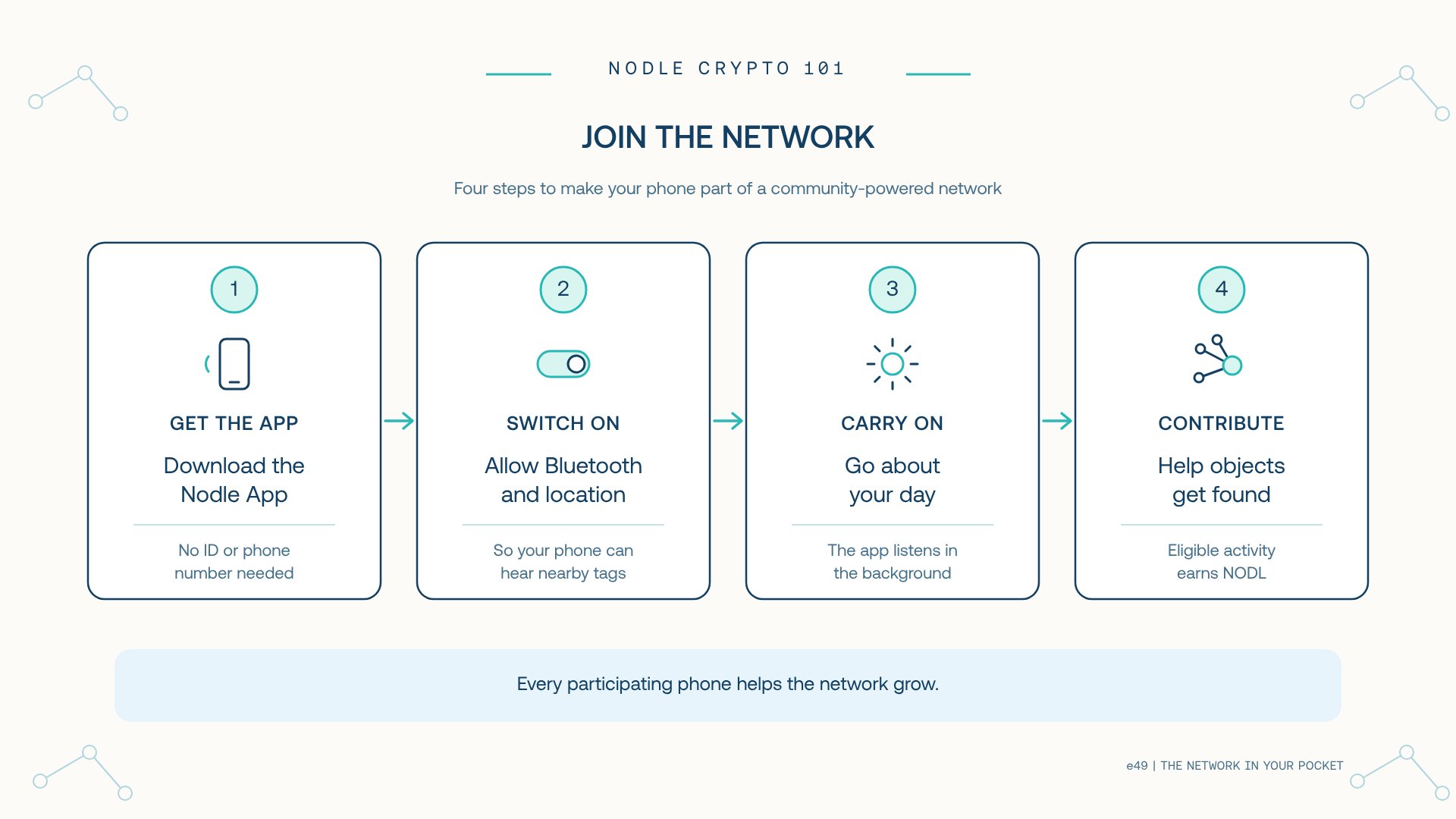
Getting started is simple. Install the Nodle App, allow Bluetooth and location access when asked, and let the app run in the background. Phones treat Bluetooth scanning as location-related, which is why location access is part of the setup.
People who run the Nodle App can earn NODL, the network’s token, for contributing. Rewards follow Nodle’s current rules and depend on eligible activity, so they are a thank-you for participation rather than a promise of value or income.
A quiet contributor: The Nodle App works in the background, so taking part fits into the routine you already have.
How does this look outside a hypothetical example? Nodle’s September 2026 marketplace announcement describes construction-tool tracking as in production, supply-chain tracking as live with enterprise customers, and mobile medical equipment tracking as being tested in hospital pilots. It also lists hardware makers whose tags can be ordered and set up for the network, a topic we will explore later in this arc.
In May 2026, Nodle announced a partnership with iONLINE in South Africa. The announcement describes a first deployment targeting roughly 500,000 active end-user devices. That figure is a stated target, not a reported result.
Nodle’s about page reports more than 2.4 million active devices across 175 countries. That figure covers both phones running the Nodle App and devices onboarded through enterprise customers’ apps.
The bigger point is about the connectivity market. For decades, connecting objects at scale usually meant one operator building dedicated infrastructure. Community-powered networks test a different idea: that some of that coverage can come from devices people already carry. The value of that idea will be decided case by case, by whether the objects get found and whether the information leads to better decisions.
Next time you are in a café, on a train, or in a busy street, open your phone’s Bluetooth settings. Many phones show a list of nearby devices that are announcing themselves. Each one is a small reminder of how much is already broadcasting around you.
Then think about the objects in your own routine that would be easier to manage if they could be found: a bike, a toolbox, a suitcase, or a box of equipment shared between friends.
If you already run the Nodle App, your phone is part of this listening layer as you go about your day. If you have not tried it yet, it is the simplest way to experience the network in your pocket first-hand.
Small contributions add up: One phone hears only what is nearby, but many phones moving through a city can cover far more places than any single reader could.
A smartphone can act as an edge node because it already sits where the network meets the physical world. When it hears a nearby Bluetooth tag and relays an encrypted sighting, it helps turn a small radio signal into information an authorised owner can use.
That model can extend coverage without installing readers everywhere. It follows the patterns of human movement, and it grows stronger with every person who takes part.
The useful question is not whether community-powered infrastructure is better in general. It is whether, for a particular object and a particular place, enough of the right devices are nearby at the right time.
Where in your daily routine do you think a phone-powered network would be most useful? And if you already run the Nodle App, what tip would you give a friend who is just getting started?
Thank you for starting this new Crypto 101 arc with us and for being part of the Nodle Network.
Next time, we look at why coverage has a geography. Hot Zones are Nodle’s experiment in temporarily boosting participation in particular places, and they can serve local communities as well as business coverage, as the current Hot Zone in Paraguay shows.
This article is for educational purposes only and does not constitute financial, legal, or investment advice. Cryptocurrency and blockchain technologies carry inherent risks, and the tools and services discussed may have technical, privacy, security, coverage, and availability limitations. Token rewards are not guaranteed and token values can change. Always do your own research and consult a qualified professional before making financial decisions.
API: A software interface that lets one system request information or actions from another in a defined way.
Beacon: A small device that repeatedly broadcasts a short Bluetooth signal so nearby listeners can detect it.
Bluetooth Low Energy (BLE): A low-power version of Bluetooth designed for small devices that send short bursts of data.
Community-powered infrastructure: A network built from devices contributed by many independent participants rather than deployed by one operator.
Coverage: The places and times in which a network can detect or reach the devices it is meant to serve.
DePIN: Short for decentralised physical infrastructure network, a model in which participants contribute real-world hardware or capacity to a shared network.
Edge: The boundary where a digital network meets the physical world through sensors, readers, or other nearby devices.
Edge node: A device at the edge that observes something in the physical world and passes that observation into the network.
Encryption: A technique that transforms information so that only parties with the right key can read it.
Node: Any device that participates in a network by sending, receiving, or relaying information.
NODL: The token used by the Nodle Network, including for rewarding eligible participants.
Rotating identifier: An identifier that changes over time so a broadcast signal is harder to link to a specific object by casual observers.
SDK: A software development kit that developers add to their own apps to use a particular service or feature.
Sighting: A record that a participating device detected a particular tag at a particular time and approximate place.
Crypto 101 | e48: Digital Trust in Practice - The finale of the previous arc on evaluating digital evidence.
Crypto 101 | e2: Web3, DePIN and the Power of Real-World Utility - Where the series first introduced DePIN and real-world utility.
Nodle: Technology - Nodle’s overview of how tags, phones, and the network work together.
Nodle: About - Company background, network figures, and Nodle’s stated approach to privacy.
Nodle Network Explorer - A live map of Nodle App activity, including current Hot Zones.
Nodle launches a marketplace for Bluetooth tags and trackers - Hardware partners, onboarding, and current use cases.
Nodle and iONLINE turn South Africa’s phones into a trust network - A partnership announcement describing a planned deployment.
Bluetooth SIG: Bluetooth Low Energy, it starts with advertising - A clear introduction to how BLE devices broadcast.


