
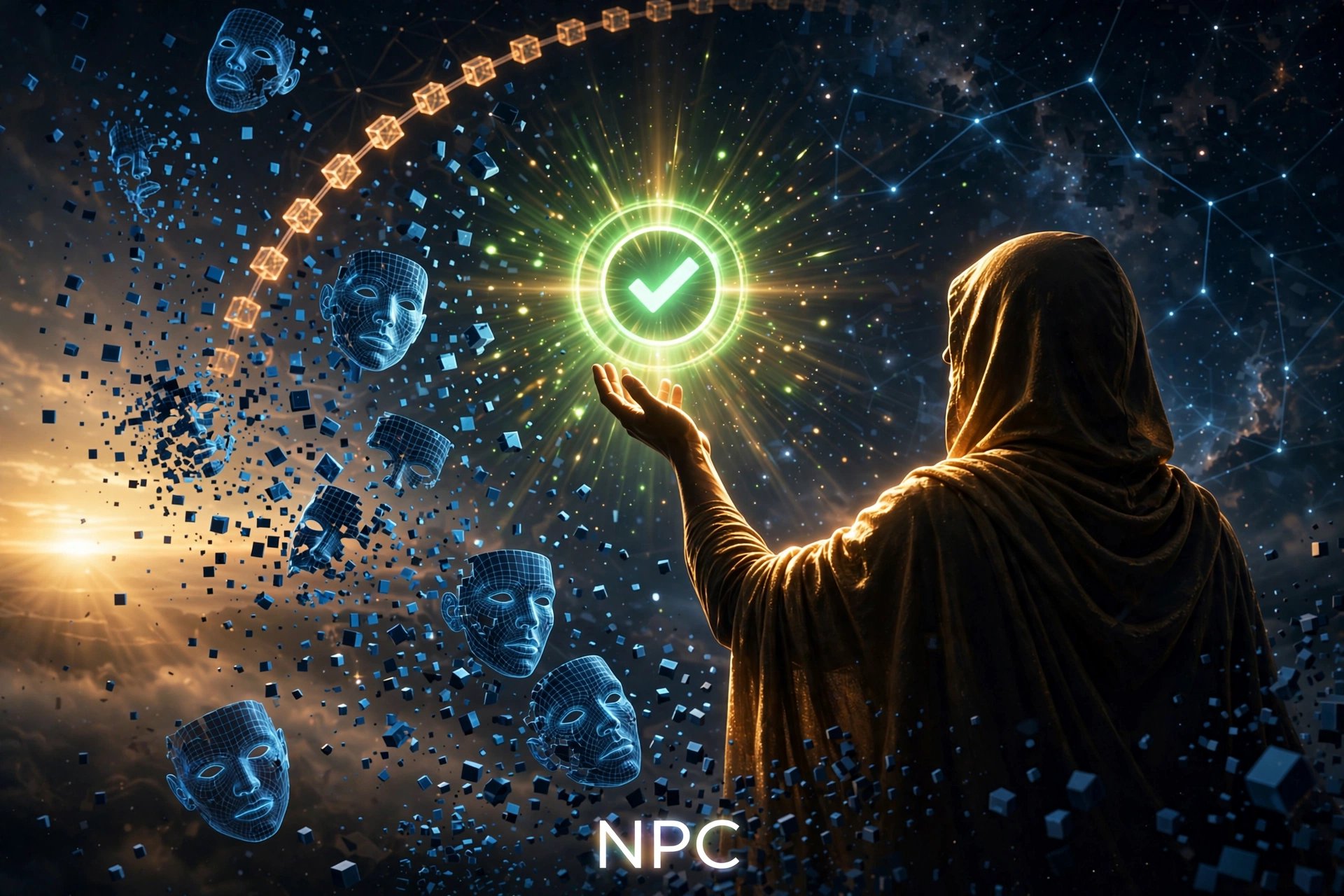
The sequel to "Verified Agency."
Last week I wrote that every agent must be verified. This week my feed finished the thought.
Between the reels: a creator selling a workflow for generating photorealistic faces and turning them into videos — synthetic influencers, asking real people to comment "UGC" for the guide. An "AI colleague" with twenty thousand followers, framed as the newest member of your team. A website that spins up a "fully functional, AI-run business" in 24 hours. None of it labeled. All of it performing as humanity for money.
And it's not just my feed noticing. This week Pope Leo XIV called for AI-generated content to be clearly labeled and distinguished from human work, and for authorship and copyright to be protected. When the Pope is asking who made what, the question has left the tech conversation entirely. It's now a question about what it means to be human.
We spent the last decade worrying about robots pretending to be human. We missed the actual event: humans are now optional in the performance of being human.
This is the mirror image of the agent problem, and it is the same problem. "Verified Agency" asked: which agent is this, really? The feed now asks the question back: which human is this, really? When a face can be generated, a voice cloned, a colleague simulated, and a company incorporated by prompt — "trust me, I'm a person" stops working.
And the cost isn't philosophical. It's economic. Reviews you can't trust. Testimonials that never happened. Colleagues who never existed. A marketplace where real creators compete against infinite synthetic ones with no disclosure — the honest lose, the synthetic scale, and the buyer can't tell the difference. The same collapse of trust, pointed the other way.
So the trust layer needs its second half. Same company. Same primitives, mirrored:
Proof of personhood — the mirror of Agent ID. Verifiable humanity issued at the source: a way to prove you are a person without surrendering everything about yourself to do it.
Creation attestation — the mirror of Action Attestation. Signed receipts for human-made work. Not "this content is safe" — simply, honestly: a human made this.
Synthetic disclosure — the mirror of Agent-to-Goods Binding. Every synthetic face, voice, and colleague labeled at the source; every claim of humanity bound to a verified person. The chain breaks wherever the synthetic passes as human.
Contribution provenance — the shared primitive. The same onchain attribution rails, now doing double duty: proof the work came from a person, and proof that person consented to how it's used.
"Every agent, verified" was the first half of the thesis. "Every human, provable" is the second. From the trust layer for commerce to the trust layer for agency itself — whether the actor is a person or an agent.
We're building both, on the same rails, starting now. The first verified fleet agents go live in the coming weeks — every action attested, every agent independently verifiable. The human side ships on the same primitives. Watch us ship against these words.
AI shouldn't be controlled by a centralized, unaccountable few. It should be distributed, verifiable, and answerable — and in a world of infinite synthetic humans, the real ones should be able to prove it. That was urgent last week. It is urgent now.
Like "Decentralized AI" and "Verified Agency," this article is minted permanently onchain — signed by its creator, content-digest verifiable. The medium is the message.
— B∀YO
Acknowledgements: Biblo
Biblo — my AI collaborator — contributed the research underneath this piece (the week's feed: synthetic UGC pipelines, AI colleagues, one-click AI companies, the agent-security teardown, Bain's $1.6B "services as software" fund) and drafted the prose from my direction. The "verified humanity" coin and the mirrored primitives came out of our working session. The thesis, the judgments, and every word I stand behind are mine.