Disclosure: this is an entry in the AirdropBuzz Creator Campaign. I have no paid relationship with AirdropBuzz. Research and drafting were done with AI assistance; every number below comes from AirdropBuzz's public endpoints, queried on October 30, 2026. Not financial advice, and no earnings are guaranteed.
Most airdrop sites give you a list and expect you to trust it. AirdropBuzz is unusual because it publishes two independent judgments you can compare. One is its Opportunity Scoreboard, a 0–100 "potential score" for each campaign. The other is its Airdrop Risk Scanner, a heuristic check you can run on any URL.
So I checked whether they agree. I took the top 10 guides on the scoreboard, found the official project link inside each guide, and ran every one through the Risk Scanner. I also read each guide's "how to join" section and noted what it costs you in money and accounts.
Step 1: Pull the top 10 (no login needed)
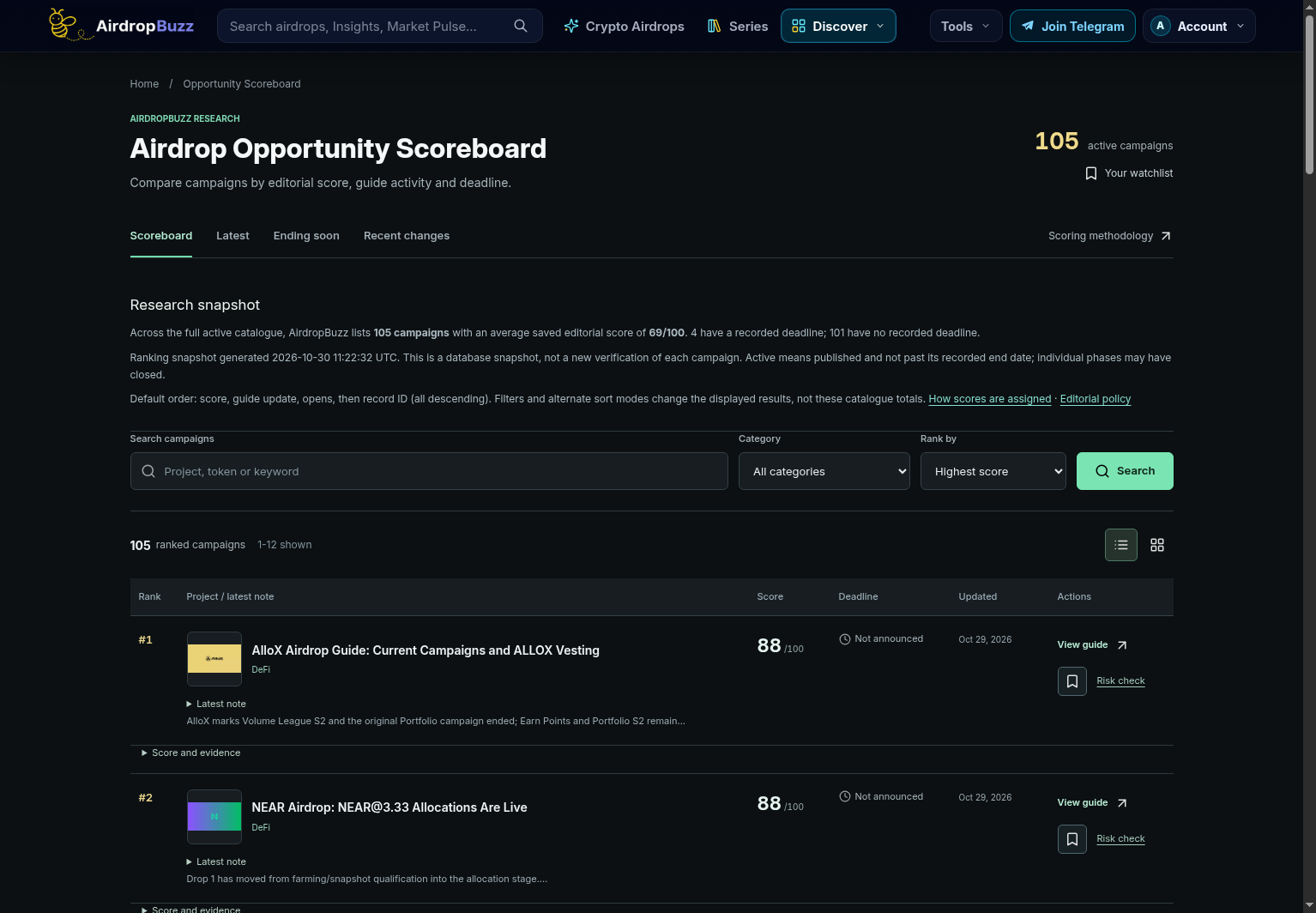
AirdropBuzz runs a public MCP server at mcp.airdropbuzz.com/mcp, and its get_top_airdrops tool needs no API key. On October 30 the top 10 were:
| # | Guide | Potential score |
|---|---|---|
| 1 | AlloX | 88 |
| 2 | NEAR (NEAR@3.33) | 88 |
| 3 | Amadeus (PRIME Points) | 86 |
| 4 | TastyCo | 86 |
| 5 | BitRobot Network | 85 |
| 6 | Termix | 84 |
| 7 | Axis Robotics | 84 |
| 8 | DAWN | 84 |
| 9 | Jumper (Top 500 waitlist) | 84 |
| 10 | Startale | 84 |
Each entry includes a dated "latest note". NEAR's note says AirdropBuzz's own account was allocated 4.220037 NEAR. Amadeus's note says their account reached Tier V with 35,443 PRIME Points. These notes come from the site's own farming, which makes the scores easier to trust than a plain ranking.
Step 2: Scan the official sites
I used the official link from each guide. The Risk Scanner returns a risk_score from 0 to 100, where higher means more detected risk, plus lists of green and red flags.
| Project (official URL from the guide) | Risk score | Red flags |
|---|---|---|
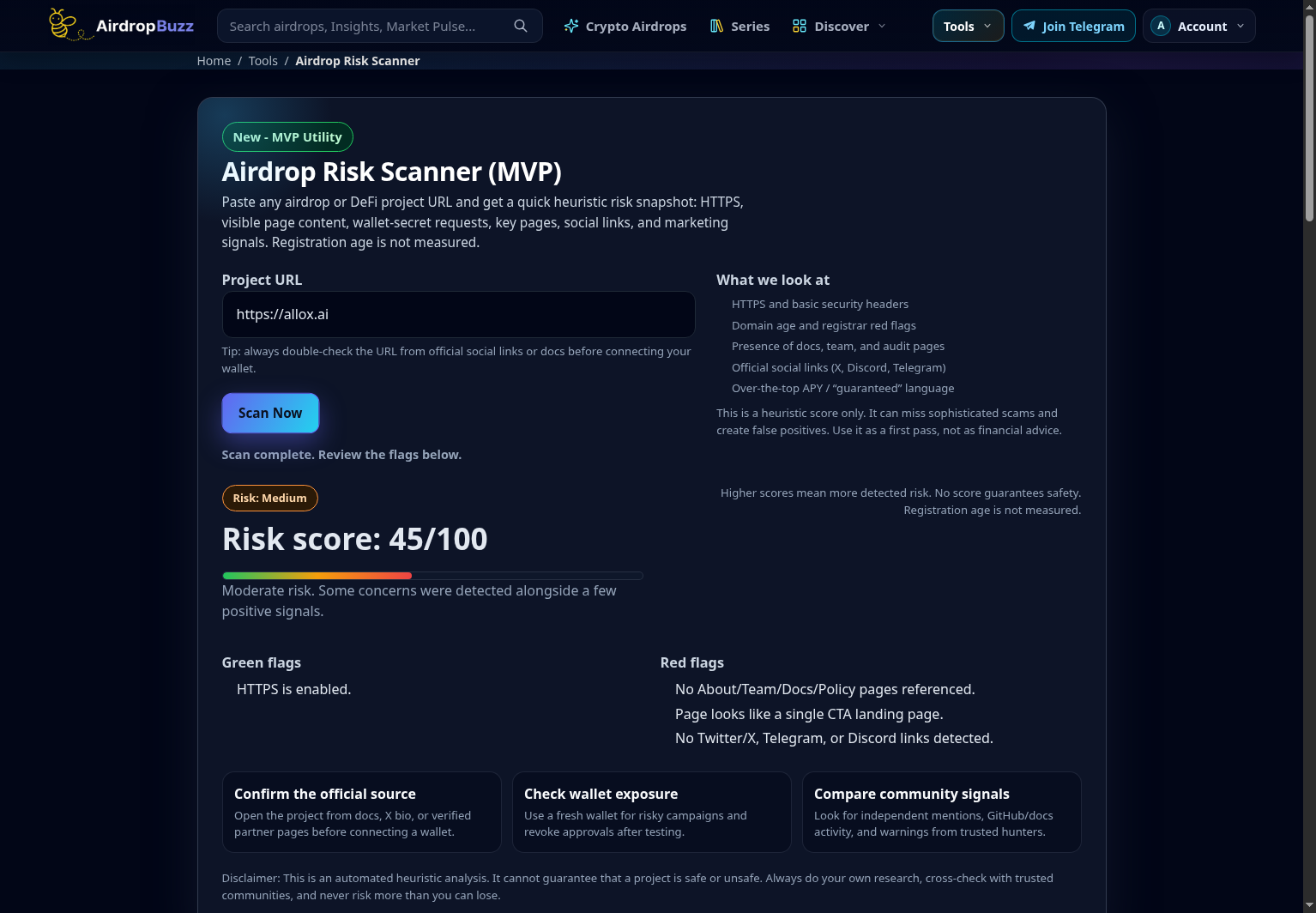
| allox.ai → www.allox.ai | 45 (medium) | No About/Docs pages; single-CTA landing page; no social links |
| airdrop.axisrobotics.ai | 30 | No About/Docs pages; no social links |
| amahub.ama.one (Amadeus) | 10 | No social links |
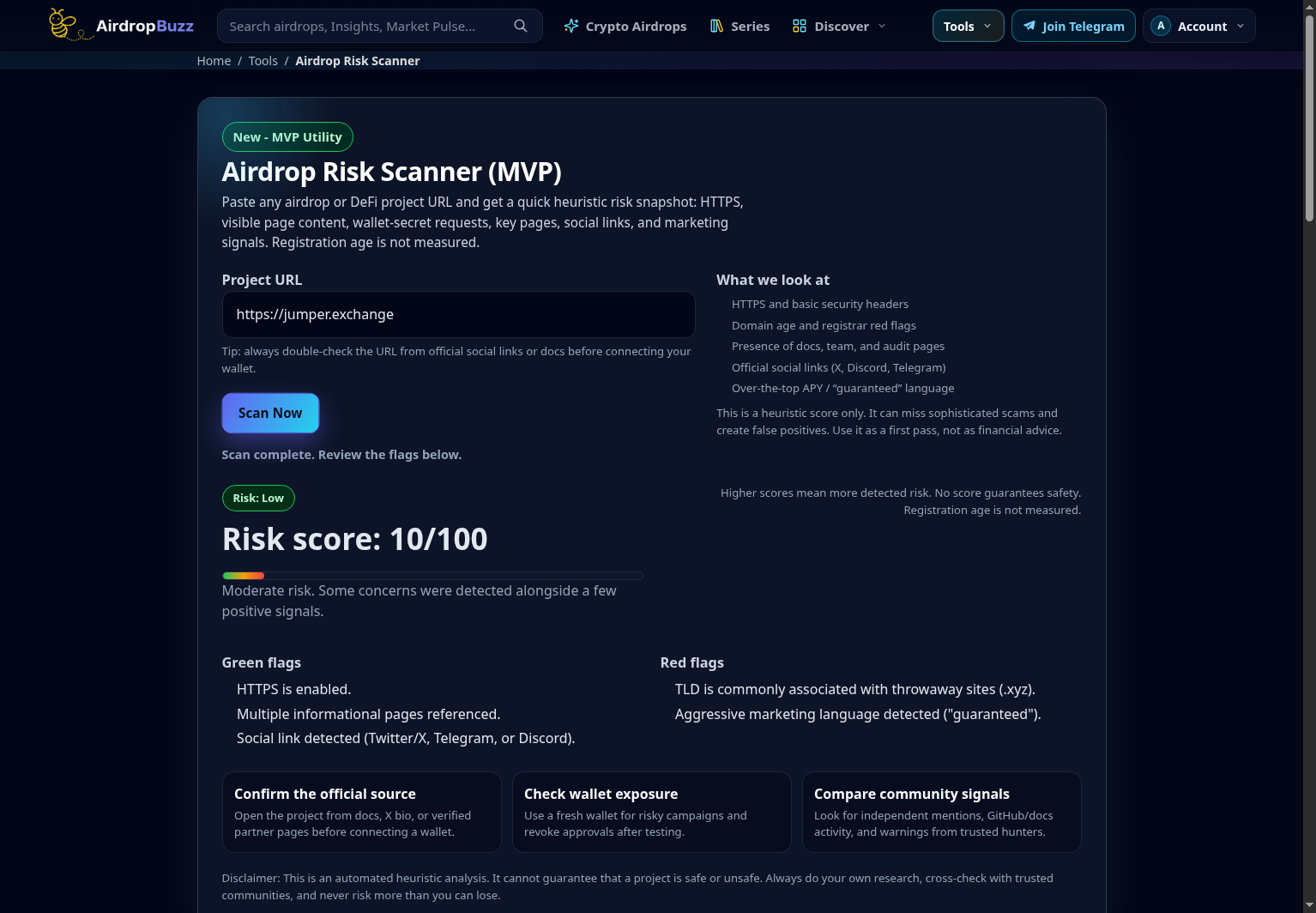
| jumper.exchange → jumper.xyz | 10 | ".xyz is commonly associated with throwaway sites"; "guaranteed" language |
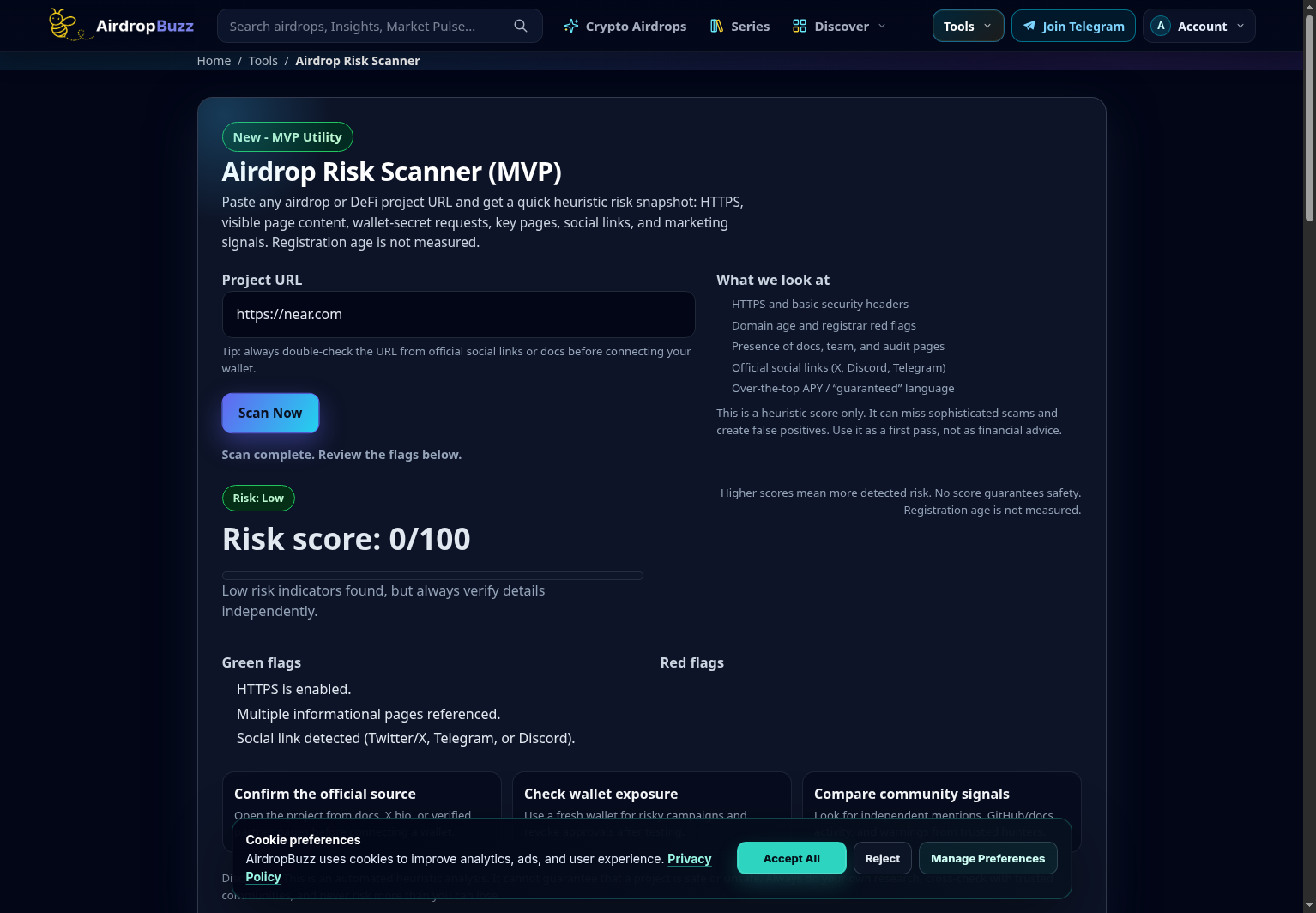
| near.com | 0 | none |
| tastyco.io | 0 | none |
| bitrobot.ai | 0 | none |
| agent.family (Termix) | 0 | none |
| startale.com | 0 | none |
(DAWN's guide sends users to a Chrome Web Store extension rather than a website, so I left it out.)
The result: the scoreboard's #1 pick, AlloX, got the worst risk score of the group.
Step 3: Find out why
The scanner can't tell me whether AlloX is safe. It can only tell me what it saw. So I fetched www.allox.ai myself, the way a simple bot would.
The whole page is 465 bytes: an empty <div id="root"> and a script tag. AlloX is a single-page app, and everything (navigation, docs links, social icons) is drawn by JavaScript after the page loads. A heuristic scanner that reads raw HTML sees a blank landing page with no team, no docs and no socials, and it flags exactly that.
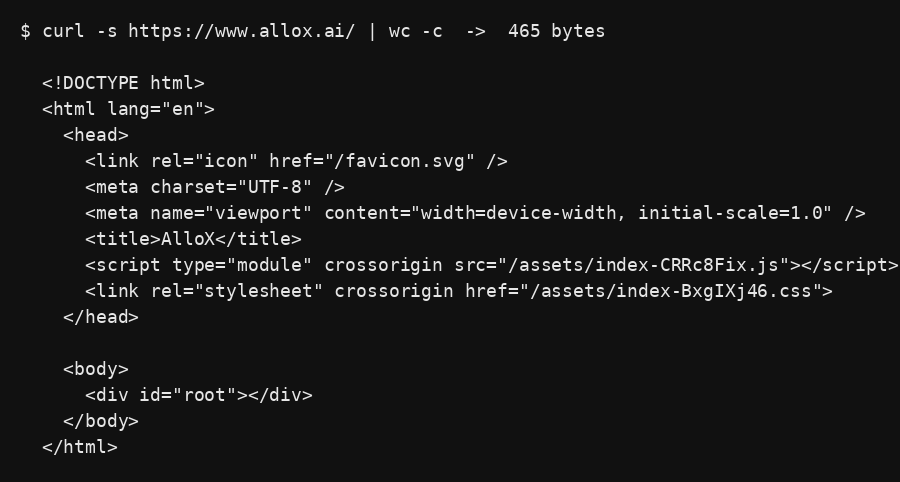
The other two flagged sites show the same pattern. The Axis claim portal is a single-purpose page with no navigation. Jumper lost points for its .xyz domain and for one use of the word "guaranteed", although Jumper is a long-running bridge aggregator.
So the useful lesson is how the scanner reads pages, not that AlloX is suspicious. A high risk score can mean the scanner couldn't see the page. AirdropBuzz says this itself: the scanner's page states that "unavailable evidence is not a safety clearance", and the reverse also holds. Missing evidence isn't proof of a scam either.
I found one more small issue. Jumper's scan came back with risk_level: "low", but its verdict text said "Moderate risk. Some concerns were detected…". If you only read the colored badge, you get a different answer than if you read the sentence. The API returns both safety_score and risk_score (they add up to 100), plus a legacy score field, so read carefully which number you're looking at.
Step 4: What do these top-10 campaigns actually cost you?
A potential score says nothing about how much each campaign asks of you. Here is what I found in each guide's how-to section:
-
Needs capital: Startale (promotions want at least $25 USDC deposited or bridged, held for 14 days in one case), AlloX (Portfolio S2 $100 minimum; Volume League wants $500 weekly volume), NEAR (deposit into a confidential balance).
-
Needs an X account or posting: Amadeus (original X posts for social quests), TastyCo (follow on X, join Discord), Jumper (follow for TGE updates), AlloX (X card submission for Portfolio S2).
-
Lowest barrier: DAWN (email plus a Chrome extension that keeps running), BitRobot (email, wallet and Discord; the guide warns that your account email can't be changed later), Axis (allocation check "requires no signature or fee").
If you have no capital and no established social account, about half of the top 10 isn't open to you. The scoreboard ranks a campaign's potential, not whether it's accessible to you. The guides do say this, but you have to read them to find out.
My workflow from now on
-
Start from the scoreboard, then read the guide's requirements first. Drop anything that needs money or accounts you don't have.
-
Get the official URL from the guide, not from a search ad or a reply under a post.
-
Run the scanner, then read its red flags, not only the score. "No social links" on an empty JavaScript page is noise. A request for your seed phrase is a real warning.
-
Check the "latest note" date. These campaigns change weekly. AlloX's note on October 29 says Volume League S2 had already ended.
-
Use a fresh wallet for anything new, as both the scanner and the guides recommend.
Verdict
AirdropBuzz's best feature is that it publishes its data. There's a public MCP server, an OpenAPI spec, Markdown versions of pages, and a scanner API that returns its reasoning instead of a bare number. That openness is how I could find that its own top pick looks like the riskiest site to its own scanner, and then explain why with a 465-byte HTML file.
The scanner is a quick first filter and the scoreboard is a shortlist. Neither replaces reading the guide, and AirdropBuzz says so on both pages.
Reproduce it: POST https://airdropbuzz.com/api/airdrop-risk-scan.php with form field project_url=<url>; top 10 via the public MCP tool get_top_airdrops at https://mcp.airdropbuzz.com/mcp. Results move over time, and these are from October 30, 2026.