Disclosure: this is an entry in the AirdropBuzz Creator Campaign. I have no paid relationship with AirdropBuzz. Research and drafting were done with AI assistance. Every result below came from AirdropBuzz's public checker on October 30, 2026 (around 11:30 UTC). Not financial advice.
Airdrop farming ends in a token. Whether it's a TGE claim, a "bonus" token sent to your wallet, or a meme coin a campaign tells you to buy, you'll eventually be holding a contract address and wondering whether it's real.
AirdropBuzz has a free tool for this: the Meme Coin Legitimacy Checker at airdropbuzz.com/memechecker. You choose a chain (Base, BSC, Ethereum, Polygon or Solana), paste a contract address, and get a 0–100 score with a short list of checks that passed or failed. I wanted to understand how it scores, so I gave it three groups of tokens: well-known large caps, blue-chip meme coins, and four Solana tokens that showed up on DEX Screener's "latest profiles" feed the same morning.
The checks it runs
Every result lists the same six signals:
-
DEX pair detected
-
Liquidity ≥ $50,000
-
24h volume ≥ $25,000
-
Pair age ≥ 14 days
-
Contract source verified (Etherscan V2); on Solana this shows "N/A" and counts as passed
-
Known project proxy, a combined "strong liquidity and age" flag
The score and a band (SAFE / CAUTION / HIGH) are based on these signals. Everything comes from market data. It doesn't simulate a sell, check holder concentration, or read contract permissions.
Results
-
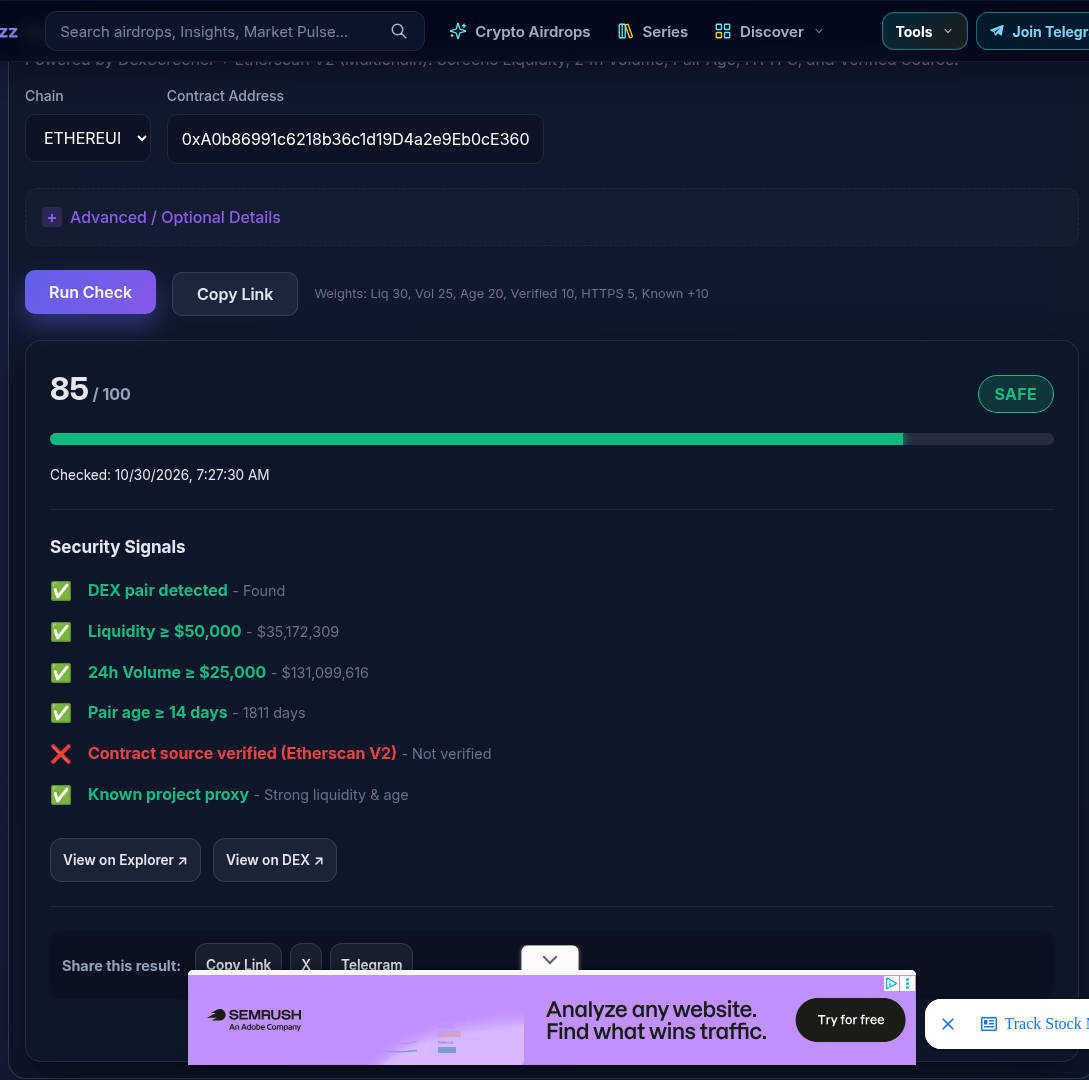
USDC (Ethereum): score 85, band SAFE. $35.2M liquidity, $131M volume, pair age 1,811 days; source "Not verified"
-
PEPE (Ethereum): score 85, band SAFE. $32.3M liquidity, $104M volume, 1,294 days; source "Not verified"
-
WIF (Solana): score 85, band SAFE. $5.2M liquidity, 1,074 days
-
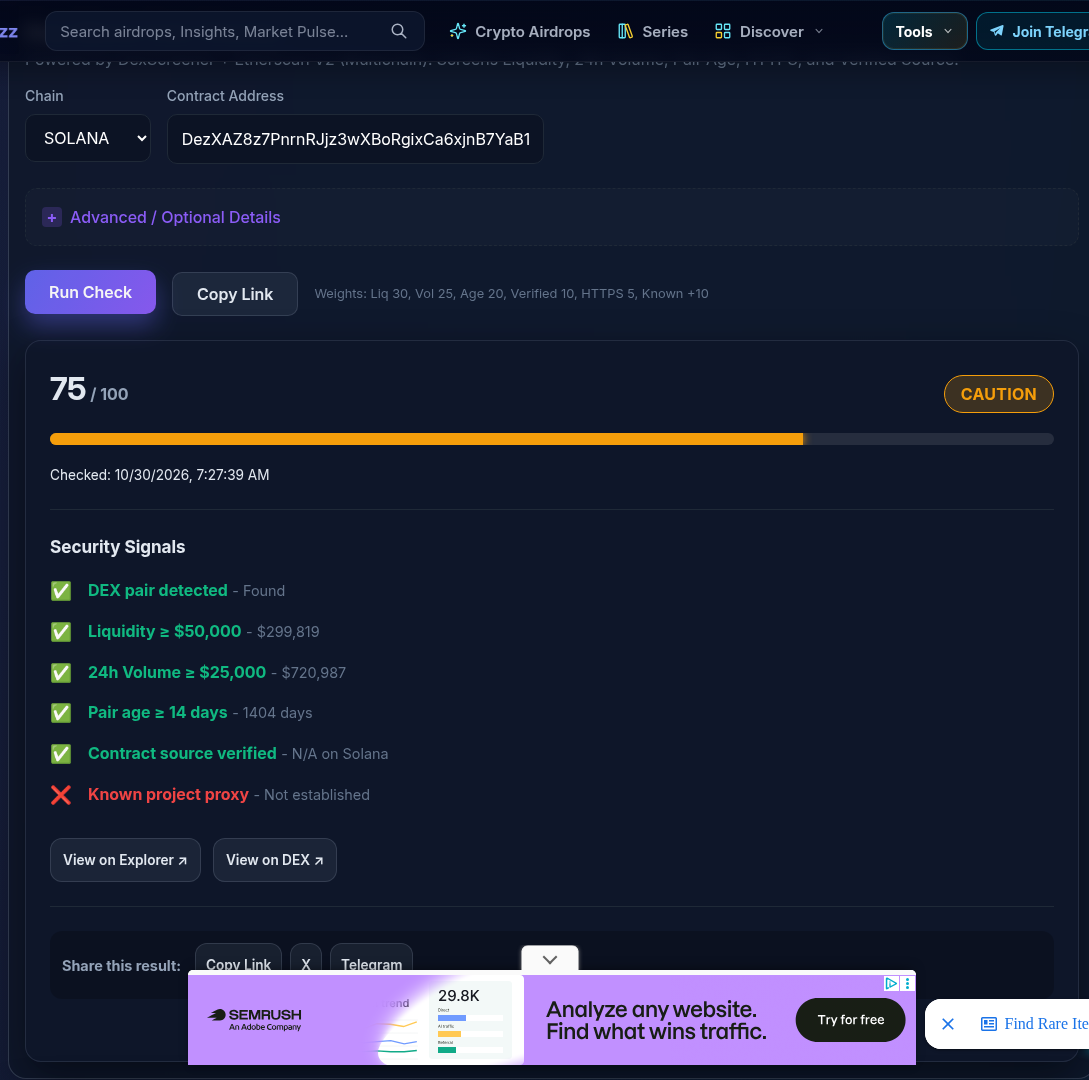
BONK (Solana): score 75, band CAUTION. Liquidity read as only $299,819; "Known project proxy: Not established"
-
BRETT (Base): score 60, band CAUTION. $1.06M liquidity but 24h volume $8,042 (fail); source "Not verified"
-
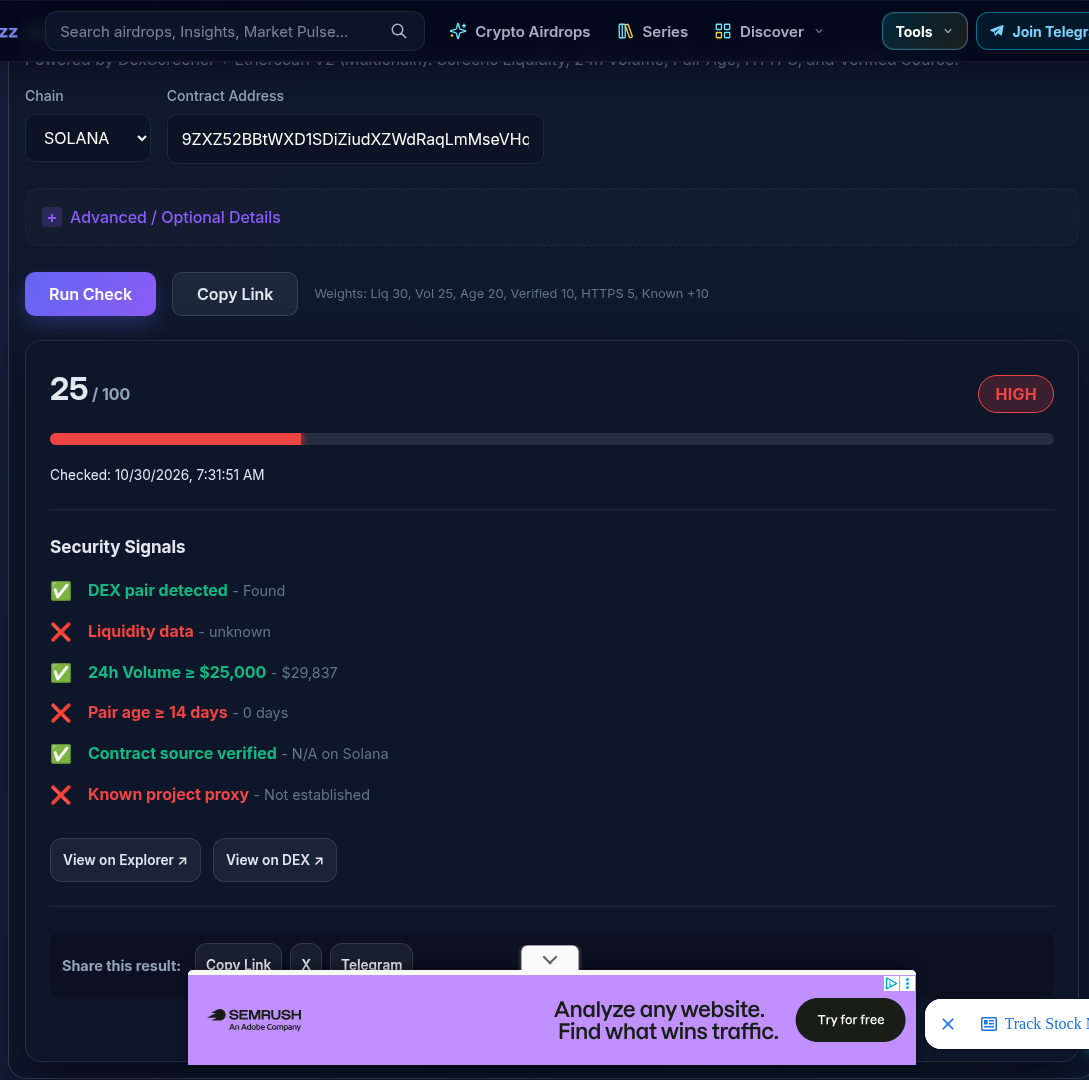
Fresh pump.fun token #1: score 25, band HIGH. Pair age 0 days; liquidity "unknown"
-
Fresh pump.fun token #2: score 25, band HIGH. 0 days; liquidity $10,334; volume $220,870
-
Fresh pump.fun token #3: score 25, band HIGH. 0 days; liquidity $40,255; volume $474,185
-
Fresh pump.fun token #4: score 0, band HIGH. 0 days; volume $7,765
-
Ethereum burn address
0x…dEaD: score 0, band HIGH. "No active DEX pair found" -
The basic ordering makes sense. Tokens that have traded for years with deep liquidity score high, same-day launches score low, and an address with no trading at all scores zero. Several smaller details are worth knowing before you trust the number, though.
Five things I learned
1. The field is called risk_score, but higher is safer
The JSON response puts the number in a field called risk_score, but 85 means SAFE and 0 means HIGH risk, so in practice it's a safety score. AirdropBuzz's other tool, the Airdrop Risk Scanner, works the opposite way: its risk_score goes up as risk goes up. If you use both tools, or build on the API, check which direction each number runs.
2. "Not verified" on USDC and PEPE tells you about the lookup, not the token
Both USDC and PEPE have verified source code on Etherscan and have had it for years. The checker still showed "Contract source verified: Not verified" for both, and for BRETT on Base. The likely cause is a failed or rate-limited source-code lookup rather than anything wrong with those tokens. It didn't cost them much, since both still scored 85. A brand-new scam token would also show "Not verified", so this signal can't separate the two cases right now.
3. On Solana, verification is a free pass
Solana has no Etherscan-style source verification, so the check reads "N/A on Solana" and counts as passed. All four same-day pump.fun tokens therefore started with one check passed before anything was measured. That's a reasonable design choice, but it means a Solana score rests on four market signals instead of five.
4. Volume can be high while liquidity is thin
The most useful pattern was in the fresh tokens. Token #3 traded $474,185 in 24 hours on about $40,255 of liquidity, roughly 12 times its liquidity in a single day. Token #2 traded $220,870 on $10,334, about 21 times. Volume that large relative to the pool usually means bots, wash trading or a fast pump, which is exactly when late buyers get hurt. On its own the volume check passed for both tokens. The low liquidity and the 0-day pair age are what pulled them to 25. Read the failed checks first, and compare volume with liquidity yourself.
5. Established tokens can still get CAUTION
BONK, a large Solana meme coin, scored 75 / CAUTION because the checker reported only $299,819 of liquidity. That's far below what BONK has across all its pools, so the checker is probably reading one pair rather than combining them. BRETT got CAUTION because volume on the pair it picked was only $8,042. Use the "dex" link in the result to see which pair was measured. If it isn't the main pool, the CAUTION may come from which pair the tool picked, not from the token.
A 60-second routine for tokens from airdrops
This is how I'd combine the checker with a few manual steps when an airdropped or "bonus" token shows up:
-
Get the contract address from the project's official channel, such as the docs or a pinned post. Never use an unknown token's own website, because fake airdrop tokens often point to wallet-drainer sites.
-
Run the memechecker. A score of 0 with "No active DEX pair found" usually means you couldn't sell it anyway, so ignore it and don't interact with it. Approving or "claiming" an unknown token is how drainers work.
-
If it scores 25 or below, open the failed checks. A 0-day pair plus volume many times its liquidity means you're looking at a pump in progress.
-
If it scores 60–75, click the DEX link and confirm the checker measured the main pool.
-
Even at 85, the checker says nothing about holders or contract permissions. Check the top holders on the explorer, and look up mint or freeze authority (Solana) or owner functions (EVM) before you buy any meaningful amount.
-
Use a separate wallet for claims and new tokens, as AirdropBuzz's guides recommend.
Verdict
The memechecker is quick, needs no login, and is honest about how it works. Every score shows the checks behind it, which is better than most "rug checkers" that return only a colored badge. Its limits come from its design: it reads market data, not contract code. Its current weak spots are a source-verification check that fails on obviously verified tokens and a field name that runs the opposite way from the site's other scanner.
Use it as a quick first filter on tokens you didn't ask for, and read the failed checks before the score.
Reproduce it: POST https://airdropbuzz.com/services/scan_token.php with form fields chain and contract (the endpoint behind the public memechecker form). Results change with market data. These are from October 30, 2026.