

Nye's Digital Lab is a weekly scribble on creativity in an age of rapid change.
This week I'm looking at the exuberant people having the most fun with AI, starting with one who just fell.
Last Sunday, Jensen Huang emailed Nvidia's employees to admit an affair. "I was unfaithful to my wife," he wrote. The New York Times had already reported that U.S. intelligence believed the woman, a former executive at one of Nvidia's own chip customers, may have been working for Beijing. China denies it, and Nvidia's board said it had no reason to believe any secrets were compromised. Three days later, the CEO of the company that sells the shovels for the entire AI gold rush resigned.
Two months ago he was the most confident man in tech. In September, he was on stage at the All-In Summit in Los Angeles when his phone rang. It was President Trump. Jensen put him on speaker. The President called the fear around AI a "hoax," and Jensen thanked him for seeing through it. This is the same CEO who heard last year that some of his managers wanted their teams to use less AI and asked, "Are you insane?"
The man who had the President on speakerphone in September was gone by November, and it wasn't a chip that did it. One of the most valuable companies on Earth just found out its biggest risk wasn't a model.
It was a person.

Then there's David Heinemeier Hansson, lovingly known in the Twitter-X-verse as DHH. The manic (and politically controversial / polarizing) programmer built Ruby on Rails and spent twenty years as the patron saint of handcrafted code.
At Rails World this year he announced that writing code by hand is now the exception at his company. He says running a pack of agents feels like "wearing a mech suit."
A year ago he was a skeptic.
I watch DHH, and I watched the Jensen of September, and I feel two things. The first is an eye roll. The second is recognition. Oh man, are we too far down the agent hole? Am... I really like these guys? (Sure, hope not.)
The exuberance of libertarian agentic builders has a philosophy behind it. Marc Andreessen wrote it down in his Techno-Optimist Manifesto: the villains are bureaucracy, regulation and stagnation, and the hero is the free market! (Because, of course it is to these guys.) I've made the stagnation argument myself, in Godlike Tools, Creative Stagnation. But I was talking about ideas, the film or the game we haven't seen yet. They're talking about economic activity. We use the same word, and their cure for both is speed.
More activity is not more creativity.
I should know. I've been producing a lot of activity lately.
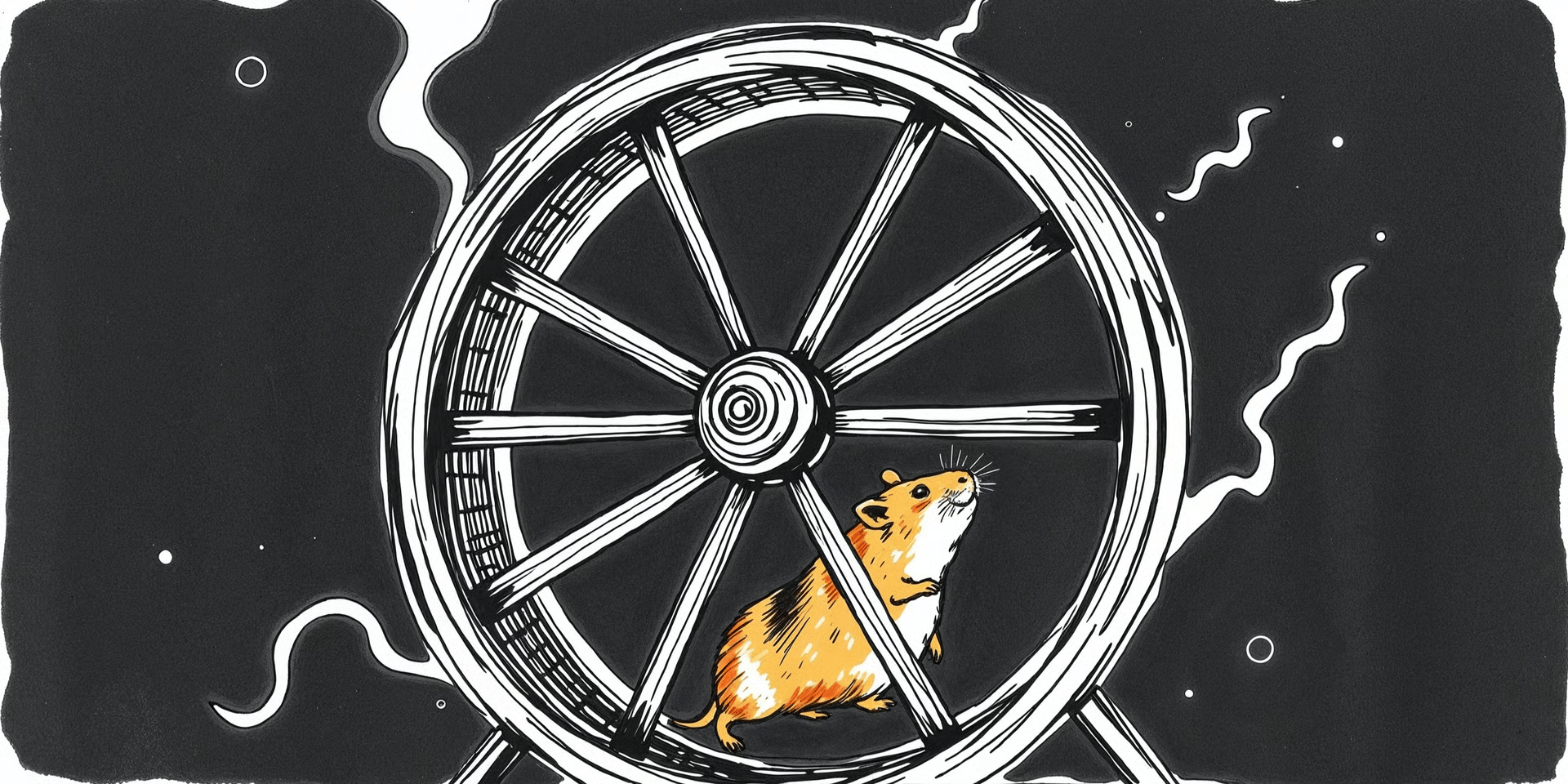
Confession...
Early every morning my wife gets up early to go for a run. I roll out of bed just behind her, grab a coffee and go into the office. Then I open Obsidian with the terminal and start a swarming agent cloud into my writing, code and now... 3D modeling with Blender. By the time I have to refill my coffee I've prototyped a browser game. By the time I get up to wake my kids, I'm modeling a space ship with a chat window while another agent chases a research thread on edge computing across forty sources. Things I used to need a team and a quarter for now take and hour and a half and a strong coffee.
It does feel like Iron Man. I'm not going to pretend it doesn't.
Then I have to drop the boys off at school, and I'm an academic manager again. There's a meeting, a form, an approval chain, and a calendar with other people's names on it. Everything moves at human rate. After an early morning with the swarm, a person asking a reasonable question at a reasonable pace feels like slow motion.
And the bureaucracy I'm grumbling about? It's mostly other people. Their concerns. Their turn to talk. It's slow because consent is slow. It's sloooowwwwww.....
The Industrial Revolution took the load off our bodies. Mostly a great trade. But today about 40% of American adults are obese. The machines did exactly what we asked, and we all got physically unhealthy because of it.
Now the machines are taking the load off our minds, and the early reports sound familiar. Developers keep reaching for the same comparison: the slot machine. Type a prompt, pull the lever, see what comes out. One well-known programmer described the habit like this: "It feels good, we barely sleep, we build amazing things."
So at 5:30 AM, am I building a game? Or am I staying in the zone? I have a lot of prototypes and not many finished things. I already wrote an essay called Does It Make You Faster, Or Just Busier? Apparently I didn't take my words to heart. (Linked Below)
We think we've all been given magical powers the likes of Harry Potter. E.O. Wilson had the better description: Paleolithic emotions, medieval institutions, and godlike technology.
A monkey with a wand, feeling very magical.
DHH admits the dopamine of shipping with agents is intoxicating, and he protects eight hours of sleep with no alarm clock. The most exuberant guy in the room has a rule. I actually find that more interesting than the mech suit comment.
After the body problem showed up, we invented the gym. It's a ridiculous institution, and I hate them. We pay monthly to lift heavy things that don't need lifting. It's also the only thing that works (and I should go more often.) I suspect the mind needs the same ridiculous thing. You'll go to some branded Orange-Theory type place and check out library books with a personal mind-trainer. Your AI doctor will tell you to draw your ideas three times a week to stop your cognitive decline.
Will we accelerate until the wheels come off? I don't know. I'll be back in the swarm tomorrow morning. But I've stopped thinking the wheels that come off first belong to the economy. They belong to us, one early morning at a time.
And for now, (and I mean, for now) I welcome the bureaucratic sand traps. It's slow and it's full of people, and right now it's the only brake I've got.
Thanks for reading.
Make it Happen.
This essay was researched and drafted with generative models while the author built a racing prototype. It was then revised by a human editing and tapping on a keyboard.
Nye Warburton is an artist and educator from Savannah, GA.
For more information: nyewarburton.com
Godlike Tools, Creative Stagnation — Despite all this magical tech, humans are stuck in an endless loop.
Does It Make You Faster, Or Just Busier? — Everyone's measuring AI in tokens burned. Almost no one is measuring whether the work got better.
Fast and Slow — What happened when I tried to write without the machine.
Iron Man, Agents & TechnoGuilt — My favorite super hero feels weirdly prophetic and why we probably should be careful with agents.
In the order they appear in the essay.
The Mech Suit
"Trump and Huang unite against AI doomers in surprise on-stage call" — Axios, Sept 14, 2026 — https://www.axios.com/2026/09/14/trump-jensen-huang-nvidia-ai-all-in-summit
"Nvidia's Huang Appears To Take More Nuanced Stand..." (the "hoax" call) — IBTimes, Sept 2026 — https://www.ibtimes.com/nvidias-huang-appears-take-more-nuanced-stand-ai-leaders-calling-pacing-frontier-development-3807456
"Nvidia CEO Jensen Huang tells Trump he agrees the AI doomsayers are perpetrating a hoax" — PC Gamer — https://www.pcgamer.com/hardware/nvidia-ceo-jensen-huang-tells-trump-he-agrees-the-ai-doomsayers-are-perpetrating-a-hoax-you-saw-through-all-of-that/
"'Are you insane?': Jensen Huang blasts Nvidia managers who are 'telling their people to use less AI'" — Fortune, Nov 25, 2025 — https://fortune.com/2025/11/25/nvidia-jensen-huang-insane-to-not-use-ai-for-every-task-possible/
"DHH at Rails World 2026: Pencils Down, Agents, and Rails" (keynote recap) — https://www.ai.joaoqueiros.com/blog/rails-world-2026-dhh-ai-agents-pencils-down-cli
"DHH on Agentic Engineering" (Lex Fridman #501 recap) — Pragma-Code, Sept 2026 — https://www.pragma-code.de/en/blog-dhh-agentic-engineering-future-programming
"DHH's new way of writing code" (Pragmatic Engineer recap; mech suit, sleep rule) — https://thepixelpioneers.blogspot.com/2026/04/dhhs-new-way-of-writing-code.html
Marc Andreessen, "The Techno-Optimist Manifesto" (Oct 2023) — explainers: https://ca.news.yahoo.com/quick-explainer-silicon-valleys-newest-152827225.html · https://innovationorigins.com/en/techno-optimist-manifesto-focuses-on-technologys-liberating-force-against-stagnation · https://www.nonzero.org/p/marc-andreessens-mindless-techno
Midnight
Lord Acton, letter to Bishop Mandell Creighton (1887): "Power tends to corrupt, and absolute power corrupts absolutely."
"Nvidia's Jensen Huang admits to affair after allegations of romance with Chinese spy" (Huang's Nov 8 email; board investigation; board saw no reason to believe secrets compromised) — Yahoo Finance, Nov 9, 2026 — https://finance.yahoo.com/markets/article/nvidias-jensen-huang-admits-to-affair-after-allegations-of-romance-with-chinese-spy-report-205122263.html
"What's a honey trap? The spy tactic that helped topple Jensen Huang" (NYT reporting on U.S. intelligence; China's "smears" response) — NPR, Nov 12, 2026 — https://www.npr.org/2026/11/12/nx-s1-6039266/jensen-huang-china-honey-trap-nvidia-spies-sex-alice-huang
"NVIDIA Announces CEO Transition" (resignation; Colette Kress interim CEO) — NVIDIA Newsroom — https://nvidianews.nvidia.com/news/nvidia-announces-ceo-transition · SEC Form 8-K, Nov 11, 2026 — https://www.sec.gov/Archives/edgar/data/0001045810/000104581026000082/nvda-20261111.htm
"Nvidia's Jensen Huang resigns, CFO Colette Kress named interim CEO" — Fortune, Nov 11, 2026 — https://fortune.com/2026/11/11/nvidia-oust-jensen-huang-spy-affairs/
The Gym
"Good and Bad News on the Obesity Front in the U.S." (CDC: 40.3% adult obesity, 2021–2023) — Gizmodo — https://gizmodo.com/good-and-bad-news-on-the-obesity-front-in-the-u-s-2000502586
"AI psychosis is real, and you probably have it" (Armin Ronacher quote; slot machine loop) — Vellum — https://website.vellum.ai/blog/ai-psychosis-is-real
"Why coding with AI feels like pulling a slot machine lever for dopamine" — Boing Boing, March 2026 — https://boingboing.net/2026/03/19/why-coding-with-ai-feels-like-pulling-a-slot-machine-lever-for-dopamine.html
"The Slot Machine" (on Schüll's machine zone) — https://shapes.exe.xyz/book/the-slot-machine
Natasha Dow Schüll, Addiction by Design: Machine Gambling in Las Vegas (Princeton, 2012)
E.O. Wilson on "Paleolithic emotions, medieval institutions, and godlike technology" (Harvard Magazine debate, 2009)