
Nye's Digital Lab is a weekly scribble on creativity in an age of rapid change.
This was adapted from advice I give around this time of year. (Graduation is only a few weeks away.)
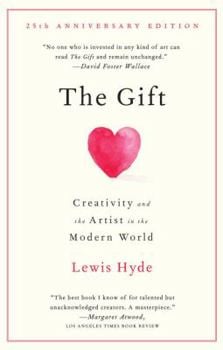
Lewis Hyde wrote a book called The Gift in 1983 that most people in creative fields have never read. They should. I discovered it from an interview with David Foster Wallace where he articulated a life transformation from reading it.
Hyde's argument is simple and will take you years to fully understand:
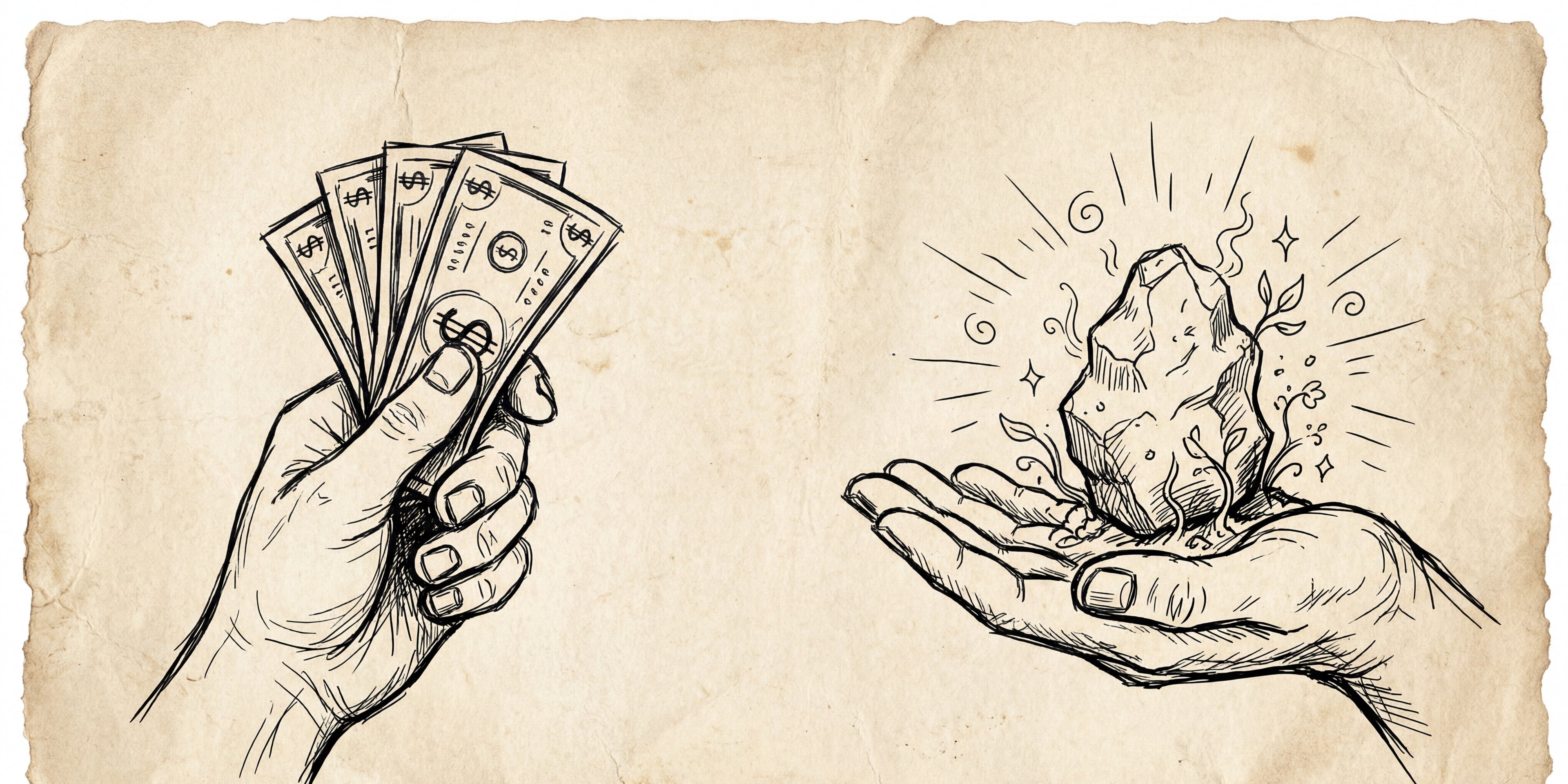
creative work exists in two economies simultaneously...
the market economy
&
the gift economy
...and these two economies obey completely different rules.
Confuse them, and you will destroy yourself. Learn to hold them both, and you might actually survive.
Here's what that has actually meant, from living it.

I. Money
When I was contracting in Los Angeles, I had a rate.
I worked to the hour. To the week. To the deliverable.
And at the agreed upon limit we set, I took my hand off the mouse. Another revision? I'm sorry. You pay.
I showed up to meetings vocalizing that with a kid and a mortgage, I had no time for free-bees. I learned that if you don't establish the rules of the money game before you start playing, the other person establishes them for you. You lose.
The moment you accept payment, (any payment) you have accepted that money is the unit of value. The person across the table is doing math on you. You need to walk in already knowing that math.
It took me twenty years to get there. Twenty years of agonizing over the "great opportunity" that paid nothing. Of making rent choices in early days that I'm not proud of. Every one of those was tuition for the learning. I'm telling you the lesson so maybe yours costs less.
The money game has one rule:
know your rate, hold your rate, and never let anyone reframe the conversation when money is what's on the table.
The moment you start talking about passion or exposure, or "a chance to work with you," you've already lost. You've brought gift economy language into a market negotiation. That's a category error, and it will cost you.
Hyde is clear about this.
The market economy is not evil. It is simply a different system with different rules. The problem isn't money. The problem is applying money logic to everything.

II. Value
Here's the other side. Harder to hold, especially at 19, especially when you have rent.
The thing you are building. All of them. The short film, the game team, the reputation, the relationships, the community, the book night. These are not being measured in dollars. Hyde calls it the "gift economy." I call it value. You might call it soul. Whatever you call it, it operates on completely different logic.
In the gift economy, the gift must keep moving.
Hyde traces this through indigenous cultures, through potlatch ceremonies. If a gift hoarded becomes worthless, then a gift circulated becomes more valuable the further it travels. A game on itch.io, a tutorial, a post in a Discord server, a solution to a problem someone else was stuck on. You don't pay for these. These are gifts from a community who cares. And gifts compound differently than money compounds.
This is how reputation works. Especially in creative technology and open source development.
This is how trust accumulates. Show up every day and contribute something real to the community you want to belong to. Build the hackathons. Solve the problem in the Discord at midnight. Answer the question nobody else answered. None of this pays immediately. All of it is building the invisible substrate. What matters is the craft, the intuition, the trust and all the things that makes everything else possible later.
The market cannot measure this. The market cannot see it. That does not mean it isn't real. You give without knowing what you'll get back, and you trust that the circulation itself is the point.
As my kid's baseball coach likes to say:
"It's so easy to forget, what you give is what you get."
III. The Confusion
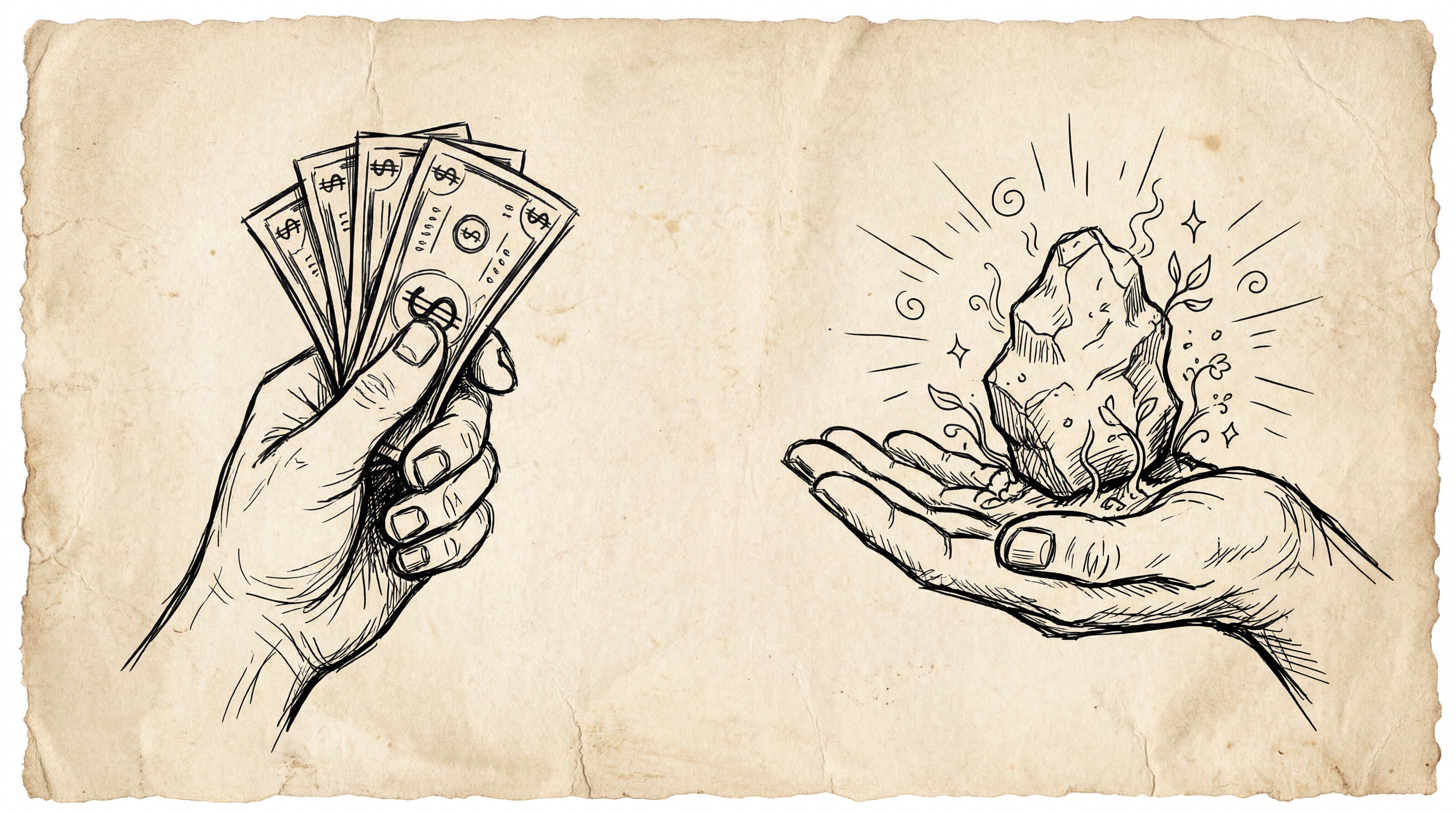
The trap is applying market logic to your creative practice and gift logic to your contracts.
Go into a paid negotiation thinking about how much you love the project, how meaningful the team is, how this might be your big break. You are doing gift economy thinking in a market situation. You will get paid less than you are worth. You will resent it. The resentment will poison the love you had for the work.
Go into your creative community with market thinking, like calculating what you'll get back, treating every relationship as a transaction, only showing up when there's something in it for you, and that will destroy the thing that makes the community valuable.
You will be the person nobody wants on their pirate ship.
I have watched people with enormous talent flame out because they could only operate in one economy. Ruthless contractors with no community and no one who believed in them when the work dried up. Or generous, beloved people who couldn't pay rent because they never learned to hold the line when money was on the table.
You need both.
Not alternating. Simultaneously.
The same week you are building your game for free and showing up to the jam with nothing to gain, you also know your rate and hold it without apology. These are not contradictions. They are two economies running in parallel, each with its own logic, each requiring a different version of you.
Hyde says that certain things we care about are not well organized by the marketplace. I agree with him entirely. And I know the marketplace is real and rent is real and you need to play that game without flinching.
Know which game you're playing. Play each one by its rules. Never mistake one for the other.
That's the lesson. Internalize it.
Make it Happen.
I highly recommend you read The Gift yourself. It's available at the author's site: https://lewishyde.com/the-gift/
If this resonated, here are some other scribbles from the Digital Lab that are worth your time:
The Art of Not Making It — on what it costs to stay in the creative life
Authenticity Arms Race — on keeping your voice when the tools get too good
Projects with Purpose — on building things that mean something
That’s it for this time. I do this every week; if you vibe to the ideas I express, consider subscribing or sharing with friends. If you like tech-detoxing with a book like I do, I crammed some of last year’s best essays into a printed collection.
My essays begin as an improvisation on a morning walk, that become a voice note in Otter.ai, take shape in Obsidian, and are finished in collaboration with several agentic versions of Claude Sonnet 4.6.
For more about me: https://nyewarburton.com
We’ll see you next time.