
The sunlight was thin and lazy, slipping between the blinds in dull stripes. I woke to the faint hum of the air conditioner, the bed creaking where it had absorbed my weight. Across the room one hand flopped over the edge of her spent pillow, the other tucked under her head. Two separate beds. Same room. Too small for each other, but the motel had been full, every door locked with cash-paid ignorance. Fortunate for us. Some people didn't look at faces, just the texture of paper. Luck isn’t a strategy. It just happens to you.
I stared at the ceiling and thought about the ride here, the quiet stretches of asphalt between this town and the forest. Small glimpses of her life surfaced, barely enough to catch on to. A mother who left early. A father who drowned his promises in bottles. A failed attempt to leave the small, worn-out world behind and the decisions that followed. People treat the past like a map. As if knowing the road explains how you end up on the curb with scraped hands and bruised knees. It doesn’t.
Celina. That’s the name she’d given me. Like she kept only what was necessary and left everything else behind. Short, clean and practical. A name you can yell in a crowd and not trip over. She was asleep now, exhausted in a way that spoke of nights spent alert and days spent surviving. The kind of heavy, hollow sleep that comes from running on nothing for too long. It showed in the way her shoulders settled, the way her hands flexed against the pillow. That complicates things.
The thoughts were pushed aside. Names, pasts, reasons. Necessary to note. Not things you dwell on. What she'd said in the forest last night was harder to dismiss. She hadn’t known me well enough to trust me, but she'd heard enough to know something was there. Murmurs from people who loitered where food was handed out, or in corners where the night was more dangerous than the day. Real or not, she’d picked it up somewhere. Enough to shape caution into a concept.
I let my gaze slide to the closed door. There was work to do. The car wouldn’t last. It was an expiring asset. Unreliable, and eventually, a beacon for the law. Scrap yard was the first stop. Make it someone else’s problem. Then supplies. Food for the road. Water. Things that didn’t make noise. Oh, and bullets—ideally the caliber that actually fits the gun this time. Cash. Always cash. The city had chewed through it faster than I expected.
The underground here? A possibility. Could buy information, maybe something more. Could compromise me, though. Half a day’s drive from the previous city. Loose connections and old enemies introduce new uncertainties. Too risky, maybe. Maybe not. And her. Leaving her here made life simpler. Reduced risk. Fewer questions. But she was alive, and leaving her alone, especially in a small motel a mile from the road, carried its own costs. The next city made more sense. Somewhere that swallowed people whole. A shelter that asked fewer queries. A little money. A quiet goodbye.
The air was dry, faintly carrying the grit of the air conditioner, dust motes drifting in shallow arcs through the pale morning light. I rose from the bed, careful not to wake her. Outside, the world waited. Unbending and indifferent. The door clicked shut behind me, sealing the room away. And just like that, the day started asking questions again. A gas station stood across the road with one pump taped off. Beside it, a diner advertised breakfast all day. Which usually meant nothing was fresh. Further down, a hardware store sat under a blistered sign with a pickup truck parked crooked out front like it had arrived drunk and never corrected itself. No police cruiser or cameras worth mentioning. No one paying attention to anything except their own routines. A single loop around the perimeter confirmed the status. Car untouched. No fresh footprints around it but mine. The motel office window was open an inch, television droning inside. The clerk didn’t look up when I passed. He was already bored with the day. The crossing was brief, leading to a money counter tucked between a pawn shop and a check-cashing place that pretended not to be the same thing. Cash came through after a wait that felt intentional. No questions. No interest. The kind of transaction designed to be forgotten by everyone involved.
Clothes were harder. The store smelled of industrial starch and plastic optimism. Practical things came first. Dark and durable. A jacket meant for weather she hadn’t seen yet. Jeans a size too big, because guessing was safer than getting it wrong. Shoes with thick soles. No labels that meant anything or colors that asked to be noticed. Breakfast came next. Something hot. Something that didn’t demand anything of you. Eggs and toast. Coffee strong enough to scrape the inside of your skull clean. The order was to go; staying invited conversation. I didn’t. Back at the motel, the door opened to find her awake. She was sitting on the edge of the bed, hair still tangled with sleep, watching the room like it might rearrange itself if she blinked too long.
“Food,” I said, setting the bags down. “And clothes.”
She didn’t smile or thank me right away. She looked at the jacket, then at me.
“They’ll fit,” I added. “Mostly.”
That did it. A small smile, quick and gone. My wound was dressed one last time. It had healed the way it should have—stubbornly, without complications. It wouldn’t slow me down anymore. By the time the work was finished, the room smelled like antiseptic and coffee. She was already dressed, jacket sleeves pushed up, standing like she was still deciding where to put her weight.
“Eat. Then we move.”
She didn’t bother with the pleasantries. I’d seen it before. That specific way of eating where you aren't tasting the food, you're just winning a fight against an empty stomach. I gathered what mattered and left the rest for the maid to ignore. A step outside led the way, letting her follow at her own pace.
“Wait here,” I said once we rolled into the supermarket lot. I parked far enough from the entrance to avoid the attention but not hugging the edges. Middle ground. Another dent in the row.
“Center of the lot. I’ll be back.”
She didn't move. Her fingers curled around the edge of the seat and calculation filled her eyes. “If you… come back?”
A few notes came from my pocket, sliding across the seat. “Buy what you need for the road. Water. Snacks. Wipes. Nothing loud.” I met her eyes. “I’ll return. Promise.”
Her eyes flicked to the cash, then back to me. She didn’t ask why and simply took it, folded the money carefully into her coat, like it mattered, and walked to the entrance of the supermarket. I drove the old car east, engine rattling like it still remembered yesterday’s fight. The junkyard was on the edge of town, a maze of rusted hulks and broken dreams. I told the guy it was at the end of its life. Plates off and sold for scrap. A transaction of mutual silence exchanged cold metal for untraceable cash and the car’s story ended there. Two blocks over, a secondhand lot. Rows of cars like tired animals. No flags or music. The owner sized me up, decided I wasn’t trouble worth inviting, and pointed toward something pedestrian and dependable. Not pretty but reliable in the way that never gets noticed. Cash changed hands. Paperwork stayed minimal and a name went nowhere it mattered. Keys warm in my palm, quiet proof the car had already lived long enough to keep its secrets. I drove it once around the block. No rattles. No lights complaining. That was enough.
Next stop: the hardware store. It was a space defined by stagnant air and the heavy sediment of sawdust and oil. The scent of inventory waiting decades to be useful. A quick scan of the counter revealed exactly what was expected. Almost right. For people who didn’t care about precision, it was close enough. A second count confirmed the flaw. It was a compromise that wouldn't be made again. Wrong grain. Wrong caliber. It would work—technically. But ‘technically’ was how the forest had almost finished the job. Instead, a small survival kit went on the counter. Fire starter, basic first aid, water purification tablets. Enough to get through the next stretch without screaming for help.
Back at the supermarket lot, she was waiting. Eyes on the road, back straight, like she’d rehearsed patience all her life. “Everything?” I asked, setting the bags in the trunk.
“Enough,” she said with a faint smile, like she’d noticed the car swap and decided it wasn’t worth mentioning. The seat gave as I shut the door, sealing the noise away.
“Next leg’s a long stretch. We won’t stop for several hours. If your body needs something, now’s the time.”
She looked at me. “A bathroom break would be nice.”
A few minutes later, a small café appeared behind an old sign with a lone parking spot. Nothing fancy, just a place to pause without attracting anyone. The car rolled into the slot. Celina stepped out first, moving with a quiet caution. She slipped inside and as I followed her, my eyes performed an automatic scan of the room without obvious movement. The air in the café breathed of roasted beans, warm flour, and faintly of old leather boots. We finished the stop quickly. A coffee each and a snack to go. No unnecessary conversation. Celina didn’t ask. She didn’t need to. The silence carried enough lessons. Something shifted before we reached the door.
A faint tug slid through the space, sudden and electric, catching the back of my neck before I even looked up. Protective instinct, tension, and a sharp edge of irritation flared all at once. Enough to feel, but not enough to betray panic. I turned to my left and green eyes met mine. Her presence was measured and calm in a way that didn't ask for notice, and yet, it was terrifyingly precise. The recognition was immediate. A single acknowledgment of what each knew.
Celina stiffened beside me. She didn’t know what had shifted, only that something in the room had. The blonde’s gaze darted toward Celina, then back at me. She sifted through the silence. Enough to test—to taste the edges. That touch was all it took. Celina’s presence became visible to that specific, hidden world, without a word being spoken. Then she was gone. Out the door before anyone else noted her. But the pull remained, a faint echo felt in the chest, in the thoughts, in the weight of a responsibility that could no longer be denied. Celina, by proximity, by choice, now had a shape.
In the car, I started the engine and felt the vibration through the wheel. The variables hadn’t just shifted; I’d given them something to settle around. The road ahead was a long stretch of unknowns, but the situation was simple now: leaving her behind was no longer an option. The rearview mirror offered one last look at the café as it receded. Celina watched the road, her posture alert, trying to harden into something solid. The next destination loomed. Whatever questions it held, the answers would be dealt with when they arrived. By the time the city took shape around the car, evening had fully settled. Late enough that the lobby was almost empty, except for the smell of lemon cleaner and tired ambition. Polished floors reflected quiet lighting, creating the kind of atmosphere people didn't plan for but simply ended up in. No families. Only a staff that understood the value of forgetting a face before a shift change. The check-in was handled under a name that wasn’t mine. ID cards and a thin stack of paper moved across the counter. Celina stood half a step behind, hood down, her neutral posture a shield. The clerk’s glance was a flick of the eyes, long enough to register age, too short to invite a memory, and the typing accelerated after that.
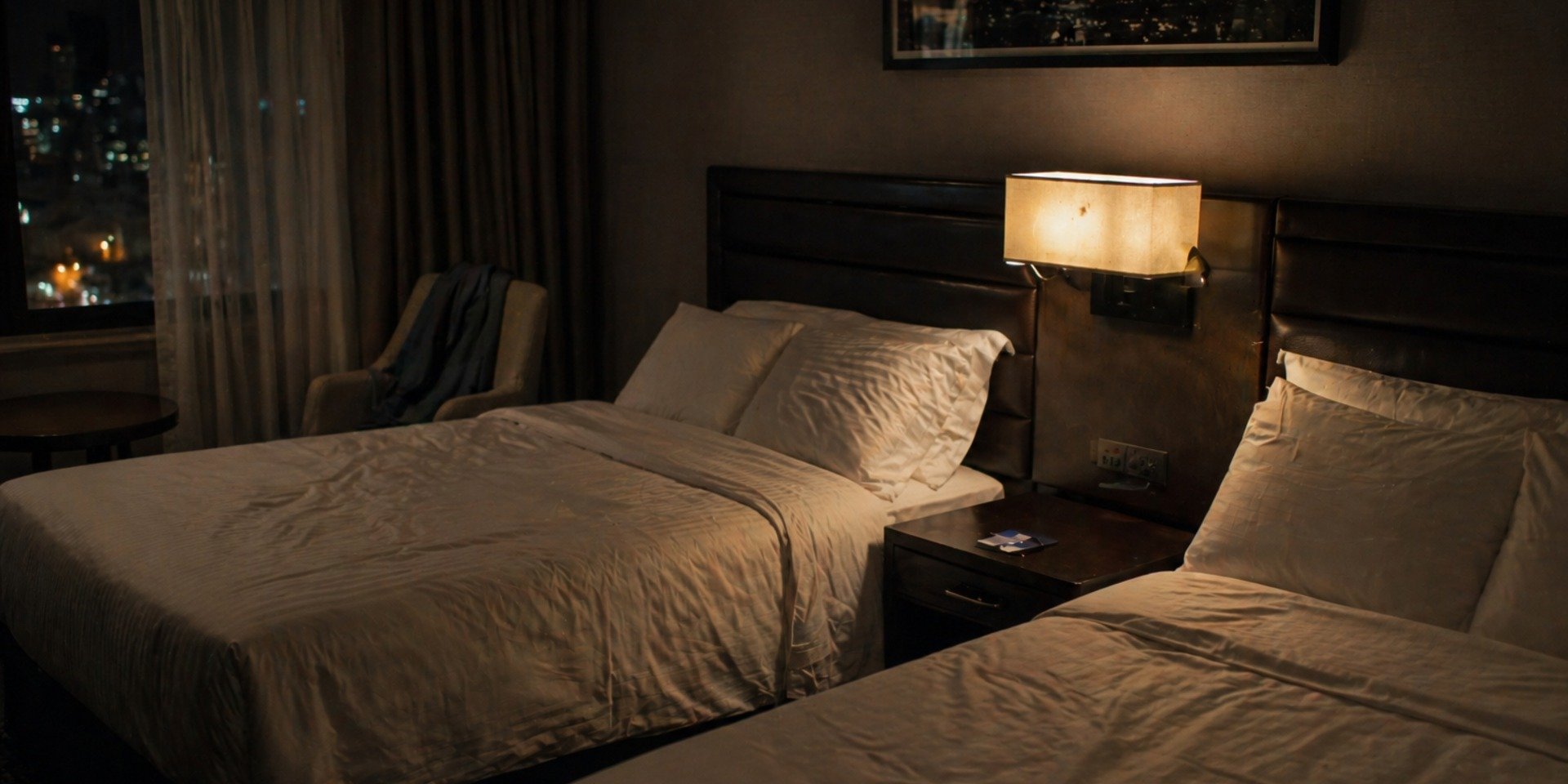
Confidence passes. Hesitation lingers. A silent elevator ride carried us to the seventh floor. There, the carpet swallowed sound like it had been trained to. The room sat at the far end of the hall, where not many people passed and fewer cameras bothered to track movement. Inside, two beds waited. Larger this time. Cleaner. With curtains hung heavy enough to keep the city on the other side of the glass. Celina sat on the edge of the bed furthest from the door and exhaled slowly, as if only just realizing she’d been holding her breath. A check of the bathroom, the window latch, the adjoining door—routine practiced until it was muscle memory. I walked to the door, engaged the lock, and flipped the security clasp. The metal clicked into place, a sound that separated us from the hallway. The stop earlier had gone as expected. No delays or conversations worth remembering. Money changed hands. Plastic came out warm. The weight in my jacket felt familiar again. A quiet relief that went unacknowledged.
“You don’t ask for much,” she said finally.
“Hotels don’t either.”
She watched while I unpacked the essentials. But not in the way someone watches a stranger. The way you watch someone who has already decided something and hasn’t told you yet.
“That woman,” she spoke after a moment. “At the café.”
I didn’t look at Celina. “What about her?”
“She didn’t stay.”
“She didn’t need to.”
“But she wasn’t normal.”
I set my jacket over the chair and took the time answering. “There’s no such thing as normal anymore. Not where you look long enough.”
Stillness stretched. She didn’t move to fill it. “Something happened when she looked at me. It felt like… I was being considered.”
“You noticed.”
“It wasn’t pain.” Celina searched for the distinction. “At first, I thought it was just the café. You know, how a space can feel different all of a sudden.”
“I understand.”
“Then it got quieter.”
“The café?”
“No.” She frowned. “Me. It was strange. I knew I was afraid, but for a few seconds I didn't really feel afraid.”
“Are you afraid of me?”
“I still don't know what you are.”
“That's not what I asked.”
“Then yes.” She considered it. “A little.”
“Good.”
“You don't mind?”
“Fear keeps people observant.”
“Are you afraid of me?” She asked.
“Should I be?”
“I haven't decided yet.”
“Let me know when you do.”
She almost smiled, then seemed to think better of it. Her attention drifted for a moment before returning to me. “What did you feel when she looked at us?”
“Similar. Just without the fear.”
“You felt quieter inside?”
“Something like that.”
She considered the answer. “You said there was no such thing as normal anymore.”
“You’re reconsidering something.”
“Last night, in the forest, I thought you were stringing me along.”
“About what?”
“The stories.” She looked back at me. “I hoped that maybe you didn’t know enough of them to make it sound convincing. Yet you knew there was something behind them.” She went quiet again. This time I could see her working backwards through something. “There were other stories when I was living on the street.” I waited. “People who suddenly felt different around someone or at a particular place, though there was always some ordinary explanation.” She paused. “But once, at a shelter, I met a guy.” She shifted, the springs of the bed groaning under the movement, a sound that felt louder than it should have. “He told me he had spent an evening with a woman.” Her voice dropped as she tried to piece it together. “He'd been furious about something right before he met her. A few hours later, he couldn't feel much of anything at all. Just completely empty. He was convinced she’d literally taken it from him.” Celina paused. “He called it the Drain.”
“That’s close enough.”
Her eyes flicked up. “Close enough?”
“People name things when they feel them. Not when they understand them.”
“But that's what happened in the café, isn't it?” She pushed.
“Yes.”
“Those stories... were they about her?”
“Stories usually survive because they brushed against something real.”
Celina looked toward the window, her voice dropping. “The way she moved through that café... the way it felt when she looked at you. It reminded me of what that guy described. Like the air itself was thinning out.” I nodded while feeling a pulse in my own neck. A dim reminder from the café. Celina stayed quiet for a while as I finished unpacking. “And those restless people I told you about last night.” She looked at me. “There's something behind that too, right?”
“Yes.”
She waited for more. I gave her none. “Are they dangerous?”
“Some.”
“That's a very small answer.”
“It's a very broad question.”
“Fine. Should people be afraid of them?”
“Were you yesterday?”
“Yesterday I didn’t know.”
“Knowing doesn't make them more dangerous.”
She looked down at her hands. “I spent years hearing things like this. Everyone had a story. Nobody ever knew where it started.” A pause. “In the end, you stop listening.” Her eyes came back to me. “How long have you been living around things like this?”
“Long enough.”
“And people just end up involved?”
“Sometimes.”
“By accident?”
I looked at her properly then. “Usually, it starts with someone making a choice.”
The room went quiet. Outside lights pressed faintly against the curtains. “I thought you were going to leave me in this city,” she said quietly.
“I was.”
“And now?”
“After today, I have reasons to reconsider.” No comfort. Just the fact of it. She didn’t smile, but didn’t look trapped, either. She leaned back, letting the mattress claim her full weight for the first time, her gaze fixed on the door. It was the look of someone marking a turn in the road they hadn’t planned for. “You can walk away.” I said, setting our key cards on the nightstand between us. “The door is locked to keep them out. But the mechanism works from this side.”
“And if I stay?”
“Then tomorrow gets narrower.”
“How?”
And that was the part I hadn’t solved. “Because you won't be watching for your own mistakes anymore.” That was enough for her to understand without asking more. I eased down onto the bed. She reached out and stroked the edge of one of the key cards with her thumb, a slow, deliberate touch that required space. She just sat there, weighing the narrow path against the open dark, while the city droned outside—oblivious to the choice being made.
________________________________________
Chapter VI — June 28
The Geometry of Choice: Book I of The Equilibrium Strain.
©️ 2026 Bob Roland. All rights reserved.