
The next day that hotel room felt more temporary after the outreach center. This was always the sign when a place stopped feeling like shelter and started settling into a pause. The morning dragged. We spent the middle hours moving around each other without needing to speak. I watched the street through a gap in the curtains, recording the rhythm of the traffic and looking for the one car that didn't belong to the neighborhood's beat. Celina didn't fidget. I spent an hour teaching her how to turn a heavy glass ashtray into a blunt-force equalizer and how to find a man’s throat without needing to look him in the eyes. It wasn't about mastery, but removing her hesitation. Later, while I cleaned the weapon, Celina watched the pieces accumulate on the table.
“I've never understood how those work.”
“Most people don't.”
“That's why I'm asking.”
I looked at her for a moment, then shifted enough to make room. She sat beside me while I walked her through the internal mechanics. The way the springs hold tension, how the metal finds its seat. Not to make her a marksman, but so she’d understand the weight of the take-up and the finality of the sear. We ordered room service when the afternoon finally began to tilt toward evening. We didn't put up with the usual traveler's desperation. We had steaks that were actually seasoned, and a side of greens that tasted like they’d seen the sun. For twenty minutes, the room felt less like a bunker and more like a reprieve. We ate in a silence that wasn't heavy for once—just a shared appreciation for a moment that didn't require looking over our shoulders.
By the time the shadows reached the far wall, Celina sat by the window, knees drawn up, watching a city that didn’t know it was being evaluated. She hadn’t asked questions since we came back. She was sorting them. And didn’t rush it. Most people would have.
“They weren’t after me,” I said at last.
She didn’t turn. “You said that already.”
“I know. This is the part where I explain why.” That got her attention. She shifted, still facing the window, but listening now. “In the forest,” I continued. “Two things happened at once. I only saw one of them.”
“People who tried to kill you.”
“Yes.”
She waited. That was becoming her habit. Letting it play out without saying anything. “But the sniper... I was not the reason why he was there.”
She turned then. “So…why was he there?”
“I don’t know. But it might have something to do with the blonde. Things moved differently once she showed up.”
“The same woman from the café?”
“Yes.”
“And after the forest. What happened to you in the city. That doesn’t feel separate.”
“It might. I’m not sure.”
She gave me a look and frowned slightly. “That’s a lot of guessing without knowing where it ends.”
I took the wall's weight against my shoulders and crossed my arms. Stillness has its own way of clearing the static. “It’s a working theory. In the outreach center… they weren’t confirming a hit. Professionals don't leave that much air in a room if they’re looking to finish it. They were checking what I knew. Whether I was connected to someone or something they need.”
“And you’re not.”
“No. But I know where people talk when they think no one’s keeping score.”
“So this city...”
“Has a way of remembering things other cities forget.”
“And the people from the center? They’re not coming after you right now?”
“They will be watching. Which means the space around us is shrinking.”
She didn’t flinch but held herself just a little more carefully. “Which puts me where?”
“Close enough to the problem that someone will eventually start asking the wrong questions.”
“That sounds… worse.”
“It’s messier,” I corrected. “Different complication.”
“Then what do you want from me?”
That question had been there since the forest. “Yesterday changed everything. If that alters your stance from staying, now's the cleanest moment you'll get.”
She studied me, weighing the odds I wasn't giving her. “I didn’t ask where the door was.”
I accepted that. The silence lasted just long enough to make it official. “You don’t stay behind. Not anymore. This part isn’t about walking quietly. It’s about listening correctly. And knowing when not to exist.”
She looked down at her hands, miming the grip I’d taught her. “So…I’m not cargo.”
“You’re not backup either.”
“What am I, then?”
“You’re context. Which means you’ll be noticed. But not for the reasons they’re looking for.” My reply wasn't sentiment. Some decisions don't improve by caring.
“That sounds dangerous.”
“It is. But everything past the forest comes with consequences.” Celina let out a slow, controlled exhale from deep within her lungs as if she were shedding an edge she’d been carrying since she fleetingly disappeared between the trees. “Before we go anywhere,” I added, “you need to understand what I mean when I say ‘underground.’” She turned her head just enough to signal she was waiting for the translation. “It’s not a place. And it’s not a community either. Nobody lives there.”
“Then what is it?”
“Think of them as blind spots. Built by people who couldn’t afford to be seen failing.”
“Sounds like a mess.”
“They're structured. But not unified. They keep moving. Same idea, different locations. The whole system only holds together because everyone inside believes they’re just passing through.”
“And… are there criminals?”
“Some. Mostly leftovers. Not because it’s welcoming. Daylight is an expensive habit. This is for the people who didn’t fit the mold cleanly enough to stay visible.”
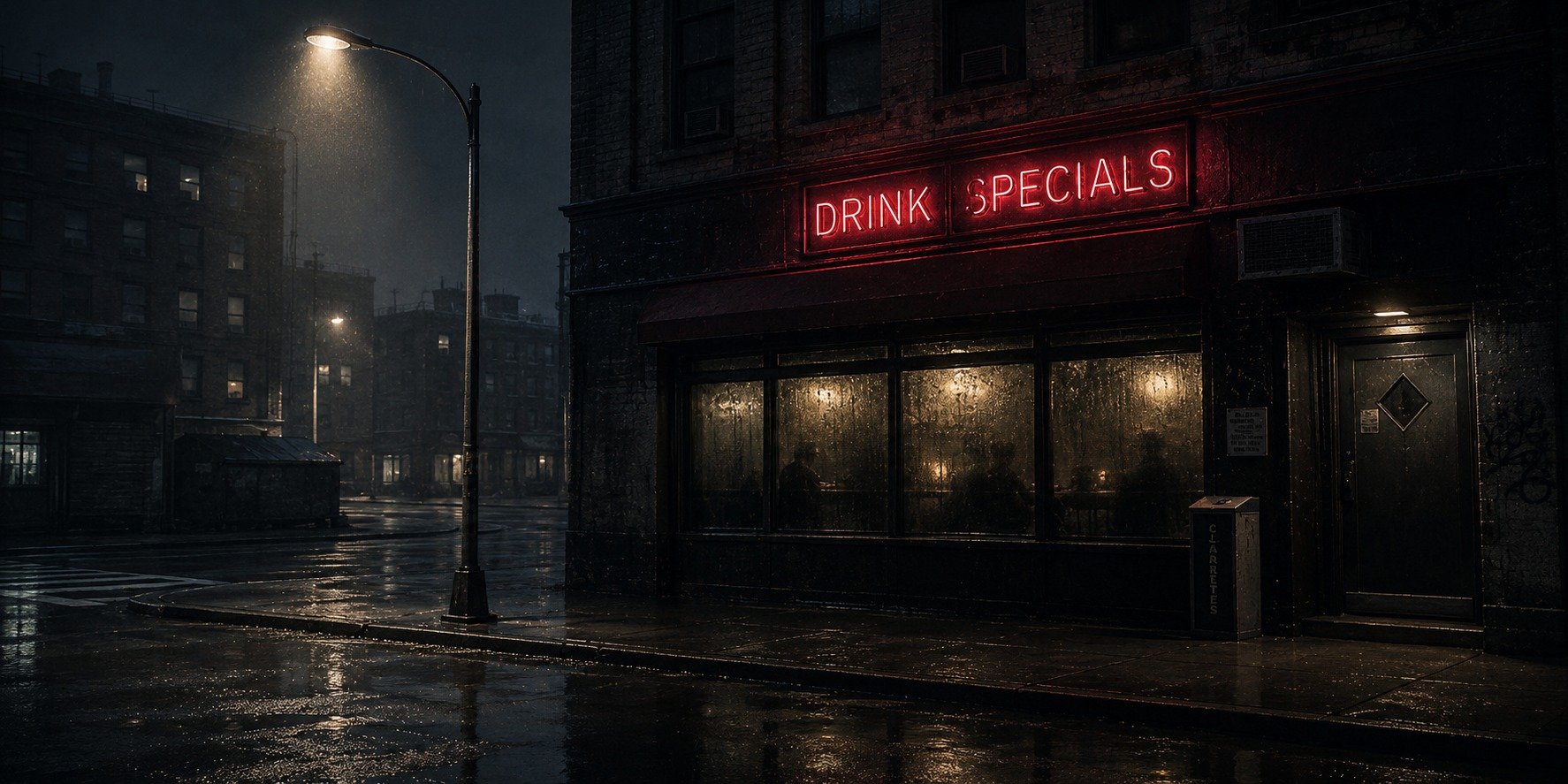
We stood there for a moment. I checked my watch. Early evening. Good enough. I grabbed my jacket and motioned for Celina to do the same. The door clicked shut, after checking the room one last time to make sure we hadn't left a stray receipt behind. The elevator ride was a brief descent back into the gray pulse of the sidewalk. We moved with a pace that discouraged curiosity. Cities don’t hide things well. They bury them under function and let people stop asking why they’re there. If you know where to look, the underground isn’t underground at all. It’s the space between places, built by those who learned early that standing still gets you catalogued. I’d been here before. Not in this city, but the route was familiar. Urban areas repeat themselves when you strip away intention. We walked three blocks past where anyone would think to stop. Then another half-block back, toward a tavern that advertised drink specials like it was proud of them. We stopped across the street. The neon sign was buzzing and windows were fogged with fingerprints that didn’t belong to anyone inside.
“You’re sure?” she asked.
“No. But this is where the noise ends. It’s a filter, not an entrance.”
She watched people come and go. A blur of the unmemorable, parading faces designed to be forgotten.
“If someone speaks to you,” I continued, “they’re either bored or measuring. Answer like you don’t care which.”
“What if someone asks my name?”
“They won’t. But if they do—you give the first one you ever stopped answering to.”
“And you?”
“I already have one. It’s just not useful.”
She glanced at me. “What if I make a mistake?”
“By the time you know you made a mistake, it’s already decided. Don’t wait for that. If something feels off, you leave before it explains itself.”
“And if someone follows?”
“Then you’re no longer background. Fix that.”
“This isn’t where people hide,” she said quietly.
“No,” I agreed. “It’s where they pass through.”
“Last thing,” I added, “Nothing in there is kind. But most of it is fair.”
She pulled her jacket tight like armor for a world that didn't care and stepped off the curb with a stride that claimed the street. “I can do fair.”
I let her lead, following a few paces behind. Inside, the bar was loud enough to be useless. Music too old to be nostalgic, too new to be trusted. Tables scarred by things dropped on purpose. The people here didn’t have a look; they had a lack of one. A room full of muted expressions. Men and women who looked like they’d spent twenty years in a cubicle before the world stopped recognizing their paperwork. The barkeep moved with blind efficiency, treating every customer like an afterthought that hadn’t quite finished passing through. We didn’t sit and restraint paid off quickly when a man at the counter settled his tab. I moved into his space without comment. Celina followed, half-step behind, scanning without staring.
The bartender’s eye didn't settle on a face; it tracked hands. A folded note slid across the wood. Not for a drink, but for the permission to exist without one. He didn't look at Celina, but he accounted for her. Something he hadn't priced yet. I felt her shoulder brush mine when she reached for a discarded coaster and began turning it over in her fingers like she was bored with the local scenery. She was doing it right. The barkeep didn’t nod toward anything obvious but shifted his stance slightly and let his gaze drift past my other shoulder toward the far end of the room where the wall broke around a recessed shelving unit stacked with liquors no one ordered. To anyone else, it was storage. Dusty labels and dead inventory.
I moved to that direction without signaling I’d understood, passing a man in the corner who methodically peeled the label off his bottle while his eyes stayed fixed on a point somewhere at the door. I didn't have to look back to know Celina was counting to five before following. Behind the shelving unit, the wall didn’t quite meet the corner. There was a cramped service corridor. Barely wide enough for two people to pass without negotiation. The hum of a fuse panel drowned out the music from the front. At the end of it, there was a door the same color as the wall. No handle on the outside. Just a push plate worn down to dull metal. It would have blended in if it hadn’t been used that often. The push was a deliberate silent haggle with the hinges. The door opened wide enough to slip through before the shadows inside could reset.
The back room was smaller, and intentionally unwelcoming. A single strip of amber hung above the bar leaving most of the patrons as shapeless figures against the walls. The door sealed with a heavy thud, cutting the bar’s music down to a vibration in the floorboards. It didn't just shut out the noise; it swapped the smells. Spilled beer and cheap sweat changing into old spirits and floor wax. A vintage jukebox sat in the corner, unlit and silent, but a small radio on the bar counter hissed with low-volume static and jazz that felt like it was being played in another decade. It provided enough of a cushion to keep a conversation from traveling more than a meter. No windows. Chairs arranged so no one had their back to the door. Drinks were placed down without ceremony and glasses never refilled unless someone asked twice. This wasn't a refuge; it was where mistakes were evaluated. A place to decide if you were truly going under, or just passing through the dark.
Celina paused inside for a moment. She felt the difference immediately. People didn’t come here to talk to the room. They came to wait in the corners. A woman with mismatched eyes sat close at the entrance, her coat still buttoned up, nursing a drink that looked like it had been sitting there for an hour. Near the center, a man sat whose breathing didn’t quite line up with the rest of him; he leaned forward, elbows on knees, gaze fixed on nothing in particular. Someone else stood near the sealed fire door at the back, leaning into the frame with their heels slightly off the floor, tracking the door but never lingering. Others occupied the fringes. Half-seen. Deliberately forgettable.
I took the seat with the best line of sight to the door. Habit. Celina took the one beside me without asking, then stopped herself from turning her chair. She noticed that too, how even movement felt like declaration here. A drink appeared, clear, garnish-free, and holding the temperature of the room. It was served in a thick-walled glass with a faint blue line circling the rim. Celina went without. In this space, an empty hand was part of the initial assessment. Patience was the only currency that made a difference. Eventually, a man drifted over—not directly. He leaned against the wall, close enough that conversation did not need volume. He didn’t look at me when he spoke.
“You’re late.”
“I wasn’t invited.”
“That’s late.”
I set a crumpled cigarette pack on the table between us. One end was torn open, exposing the foil, but there was a distinct stiffness to the cardboard that didn't come from tobacco. He didn't touch it but looked at the logo on the box like he was trying to remember the flavor.
“You bring anyone who talks.”
Celina didn’t cut the eye contact. Her expression remained unyielding across the table. “No,” she said. “I listen.” That earned a revision. He updated the room’s outline to include her while he sat on the edge of the spare stool. The cigarette pack vanishing into his pocket like it was returning home.
“Recently there's a hum coming off outreach centers,” he said, looking at me. “Noise that turns a place into either a gold mine or a landmine.”
“Which one?”
“Depends who's digging.”
A sip of my drink confirmed the quality. Stale and tired. “I’m not looking for opinions. I’m looking for a schedule.”
He smiled, a faint, cynical twitch. “That’s above my weight.”
“Then I’ll settle for direction.”
He hesitated, then shrugged. “People with opinions don’t announce themselves anymore. They outsource belief into groups or committees. You know, things that can survive individual guilt.”
Celina shifted slightly. He noticed.
“Your friend should hear this,” he added.
“She is,” I said.
He leaned closer into the radio’s static. “They don’t call themselves anything consistent. That’s on purpose. They used to be a reaction. Then a support circle. Now… they’re starting to form groups.”
“To what end?” Celina asked.
“Change.”
“That’s vague,” she said.
“Exactly.” He glanced at her. “They talk like power’s stolen,” he continued. “You don’t hear hate from them. Not out loud, but that doesn’t mean it’s not there. They’ve convinced themselves they’re just symptoms.”
“Of what?” I asked.
“Of a world that stopped asking permission.” We let the jazz from the radio handle the gap while we sized each other up, measuring what hadn't been said yet. “They’re not looking to cause scenes,” he went on after sipping from his drink. “That’s the part people like.”
“And who decides that?”
“Those who sleep better when responsibility is abstract.”
“In an outreach center. For example.”
The glass stopped halfway to his mouth. “Heard one of those centers had a difficult afternoon. They say somebody interrupted a session yesterday.”
“Nobody seems to know who?”
He gave a slight, dismissive hitch with his shoulders. “Maybe whoever walked in wasn't the interesting part. Or maybe the shadow cast by the intruder matters less than what got interrupted.”
“They’re not asking who interrupted the session?”
“It doesn't seem to matter.”
“Why not?”
“It feels like they think something failed.” He tapped the rim of his glass before continuing. “And whoever it was already left. The weakness that let them in is still there.”
That sat badly. It was supposed to. I finished my drink and stood. That was the end of that exchange. He didn’t stop me. That was affirmation. We left the same way we came in. No one followed. Outside, the evening had cooled just enough to pretend it was forgiving. The street carried on. Traffic lights arguing with no one, footsteps passing without memory. The tavern receded behind us, devoid of ceremony. That was how those places survived. They didn’t stick around. We walked for a while without direction. Not lost. Just untracked. Celina broke the silence first.
“He said ‘change’. But not like politics or money.”
“No,” I agreed.
“He meant those stories, didn't he?”
“Possibly.”
“You don’t think so?”
“I don't know enough yet.”
“But those stories aren't new. I heard them growing up. People older than me heard them growing up.” She looked at me. “Two days ago, I would've said none of it was real.”
“That's different from saying every story is right.”
“But if you find out one story was true, wouldn’t you start wondering about the others?”
My pause was deliberate. Not from a lack of answers, but because saying it wrong mattered. “Finding something real doesn't make everything said about it true.”
She squinted at the sidewalk, as if stone might offer a more literal translation. “And the woman in the café? Do you think they would know what she is?”
“Maybe.”
“Would she know about them?”
“I'd be surprised if she didn't.”
The sidewalk narrowed with metal shutters of closed storefronts tagged until the ink looked like scar tissue. Celina was quiet for a few steps. “What he said about yesterday. Their session being interrupted.”
“I heard it.”
“He was talking about you.”
“Yes.”
“But it didn't sound like they cared much about who walked in.”
“That's what bothered me.”
“Why?”
“I think I was useful.”
“For what?”
“I don't know yet. Hence the bothering.”
“So they won't come after you?”
“That's one interpretation.”
The street began to taper, the buildings started leaning in until the lights failed and the shadows took over. Somewhere ahead, the city folded in on itself again. Celina hugged her jacket closer. “I feel sorry for the woman.”
We walked on and by the time the city reduced into concrete and echo, Celina had stopped asking questions. Not because she was satisfied but she’d understood enough to know when answers would start costing more than they clarified. The streetlights spaced themselves farther apart. The noise of traffic above shifted into something hollow. Ahead, the structure revealed itself slowly. An old service corridor running beneath a transit spur, built decades ago and abandoned in stages. The city had ceased repairing long before it stopped needing it. No signage marked the surroundings and no visible fencing discouraged trespassing. It simply existed in that bureaucratic blind spot between demolition and improvement.
People moved through it anyway. There was a night market. Or something close enough to function as one. Not the kind with traditional stalls and advertisements for the goods on sale. Here, transactions happened without eye contact. Prices shifted with the temperature of the air and nervousness set the rate more reliably than supply. You didn’t browse here. You arrived knowing what you needed—or you left. Celina stayed close without clinging. She watched everything and nothing. She noticed how no one used names. How conversations stopped mid-sentence and resumed elsewhere. How kindness existed only as long as it was efficient. A man handed something wrapped in medical gauze to someone else, then disappeared into a maintenance hatch that closed behind him like it had never been open. A woman traded a sealed container for a vial she didn’t check. Someone else handed over a list of names and got one crossed out in return. Near the far edge, a transaction stalled in a way the others didn’t. Something passed between hands. Nothing came back. The buyer didn’t argue and stepped aside, like absence was part of the deal.
“This place feels temporary.”
“It is. That’s why it lasts.”
We met my second contact near a concrete pillar that still bore a faded municipal warning. He wore a green jacket and was younger than I expected. His hands were nervous.
“There’s talk,” he said.
“There always is.”
“Not after this long.” He passed me a folded scrap of paper. It stayed sealed in my grip. I gave him an envelope in return, a quick trade that left his hand heavy and mine light. “The dust from an operation still hasn't settled yet, and everyone's trying to figure out why.”
“What's the narrative?”
“Depends which part survived.”
“Give me the version that's travelling furthest.”
“Nobody seems to agree on what disappeared.”
Recognition hit slowly, like the clicking of a lock. “Go on.”
“A job. About a year back. Unregistered assets. No client. It involved a small band of people who saw an opening.”
“And?”
“Then the story splits,” he continued. “One version says somebody engineered a diversion and led the team into a room that wasn't on the map.”
Celina looked at me, but didn’t interrupt. “And where do I supposedly fit into all that?”
“Whatever disappeared in that room disappeared with you.”
I finally unfolded the paper. It wasn’t a name. It was a date. The chamber came back to me. Not clearly, but enough. The corridor that shouldn’t have existed. The door without markings. The smell of stale ventilation. The way one of them had grabbed something small and dismissed it as a bonus. How I hadn’t stopped it because stopping it would have cost time. “Are they certain?” I asked.
“Enough to kill first and search later.”
That was impatient. Which meant someone wasn’t thinking. “Why not capture?”
“Because the easiest version is that you're holding back the last piece. And dead men don’t move assets.”
“Who started the story?” Celina asked.
He shook his head, refusing to meet her eyes. “Doesn’t matter. It spread because it fit.”
“That’s all?”
“That’s all I have.”
I paused for a moment. “The laundromat still running?”
His eyes flicked up briefly. “Last I checked, the light was still on.”
We left before anyone noticed us staying too long. Above ground it felt the patience of the streets were finally wearing through. Before we reached the hotel, it had started raining just enough to erase footprints. Celina sat on the edge of her bed, jacket still zipped to the chin. A detail that didn't need explaining.
“They weren’t after you,” she said. “They were after a story you’re in.”
“Yes.”
“But now—”
“Now I’m convenient.”
She watched me for a long moment. “You didn’t even notice when it happened.”
“No. That’s why it spread.”
She shook her head. “No. That’s why it stays. Truth needs time. That doesn’t.” The air in the room went quiet, leaving the rattle of rain against the glass. The ceiling provided a blank canvas for the sharpening memories. The room. The grab. How easily it had happened and the way I’d thought nothing of it at the time. Opportunity rarely announces the bill until you’re already holding it.
Chapter VIII — July 26
The Geometry of Choice: Book I of The Equilibrium Strain.
©️ 2026 Bob Roland. All rights reserved.