
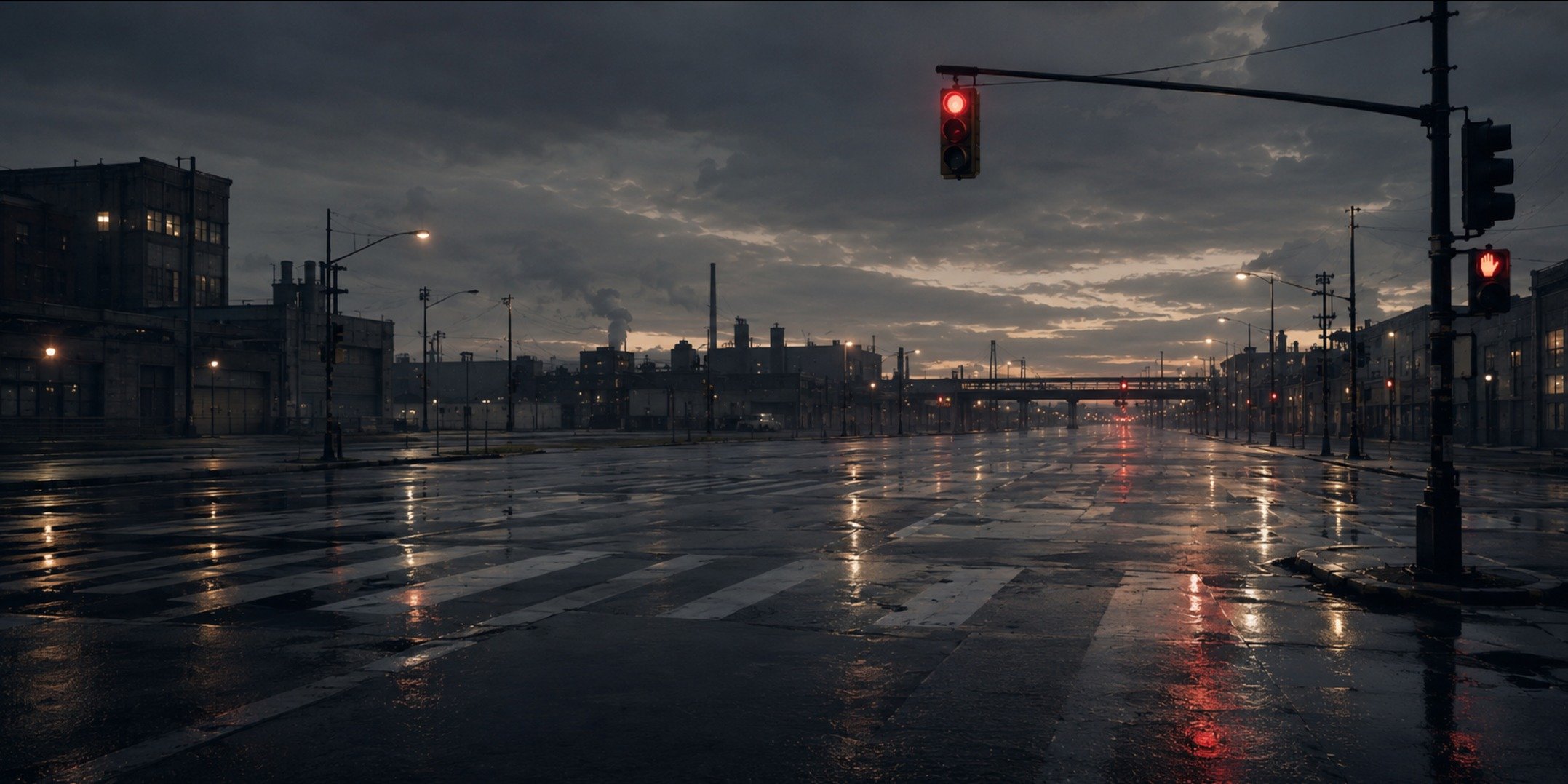
The city was in its transitional hour. That grey, liminal space between shifts, where the night’s debts were being tallied and the morning’s interest hadn't yet begun to accrue. The humid air pressed against the windshield like a physical weight. Ilya lay across the back seat, folded wrong. His head rested against the door, mouth slightly open. His breath was shallow and uneven. The rhythm was erratic, caught in the gap between a gasp and a stable pulse. Celina strained against her own seatbelts, her spine stiffening as she forced her torso around to look at him. She had one arm braced against the dashboard, as if the car itself might sway sideways into something irreversible. Her swollen eye made the movement awkward; she had to angle her whole head to compensate.
“Is that normal?” she asked.
“There’s no normal. There’s baseline. He’s above it.”
“Above is good?”
“Above means active.”
She turned back to the front, the motion jerkier this time as if the muscles in her neck were refusing the weight of her head. “You keep using words that sound useful until someone needs them to mean something.”
A quick adjustment of the mirror showed the rise and fall of his chest. A faint hitch marred the exhale. The brand on his hand was no longer glowing, the skin around it looked inflamed, as if something underneath still hadn’t finished.
“He’s not dying.”
“You sound very sure.”
“I sound occupied.”
My grip shifted on the wheel, the skin over my knuckles white as small joints remembered they had been clenched too long. The streets were defined by the silhouettes of delivery trucks moving like cautious predators between the hushed warehouses. A few windows were lit in buildings that preferred not to ask why. A nod directed Celina toward the glovebox. “Dashboard. Lower drawer. Release the catch on your left.”
She pulled the kit from the lower dashboard drawer and set it on her lap. Opening the seal took longer than it should have. Her wrists were raw from the ties, and her injuries had swollen enough to make depth judgment an unreliable partner. “First aid?”
“Field kit with standard trauma supplies. Antiseptic, gauzes and a local numbing agent. Use it. The bleeding needs to stop.”
She didn't argue and pulled out a plastic-wrapped compress, her fingers awkward and trembling slightly as she tore the seal with her teeth. She began to dab at her split lip, a sharp inhale through the nose followed when the alcohol bit. Then she moved the pad down to the raw, red rings where the plastic zip-ties had bitten deep into her wrists. The gauze came away pink twice before it stayed clean. I watched her in the peripheral of my vision. She wasn’t shaking; every movement was precise. After finishing her wrists, she reached across the console and pressed a fresh square of wet gauze directly against the drying blood near my temple. The sting was cold and sudden. I hadn’t noticed the cut. Probably due to the headache.
“You're a mess,” she said softly.
“I'm a casualty report. Just keep the blood off the seats.”
“That’s not the same as fine.”
Her hand stayed there a second longer than necessary. Then she taped the pad down with more care than the situation had earned and left the roll on the dashboard. “The blood on the seat is the least of your problems,” she said. Celina stayed quiet for a mile, her gaze fixed on the dark contours of the night passing us by. When she spoke again, her voice had regained its biting edge. “Tomorrow they were going to move me.”
I didn't turn my head. “Where?”
“They didn’t know yet. Or wouldn't tell. Different people kept saying different things.”
That tracked. This outreach group, or whatever the message boards were calling them this week, weren’t centralized yet. You could feel the lack of cohesion in the warehouse. Too organized to be a random mob, too sloppy to be a movement.
“And they kept arguing about me,” she continued.
“In what way?”
“One of them said I was clean. Another said nobody survives exposure that long without carrying something.”
“They were looking for a line.”
“What line?”
“The point where they could stop calling you human and feel justified about it.”
“They were treating me like I wasn’t human,” she countered. “But you... you didn't solve anything back there, did you? You just broke their chalkboard.”
“I removed the immediate threat and cleared the room we were standing in.”
“No,” Celina answered, turning in her seat to face me. “You solve the next thirty seconds and ignore the next thirty days.”
“The next thirty days don't matter if you're dead in the next thirty seconds.”
The silence following the snap felt like a thick layer of insulation that dampened the sound of tires cutting through the asphalt. I kept my eyes on the road, using the pressure in my skull to sharpen my concentration. A total reassessment was required—not just the route, but the entire survival margin. The current situation narrowed the options towards one specific kind of shelter.
*
The car slipped under an overpass where concrete pillars wore layered declarations of territory. The paint looked fresh in some places. Someone had claimed something overnight. Claims are signals. Signals travel. I avoided the main arteries, the toll roads and predictable exits. The circumstances favored older streets with their inconsistent traffic patterns and cameras that lacked the maintenance of civic pride. Celina watched me take three consecutive turns that appeared random.
“They’ll look for us near the warehouse,” she said.
“They’ll look for a familiar shape.”
“And you think this doesn’t have one?”
“It has one. It just doesn’t advertise.”
“You think they’ll go to the hotel?”
“Eventually.”
“And?”
“And they’ll check the room.”
“Which means we shouldn’t?”
“That’s not how hotels work.”
She looked at me sideways, unimpressed.
“If we don’t check out by eleven, they’ll assume we overslept,” I continued. “The system flags the room. Housekeeping knocks. No answer. They open and see our luggage is still there. They call the desk. The desk calls the number on file. They’ll store the bags, clear the room for the next guest and make it available.”
“And our things?”
“Tagged. Logged. Moved.”
“And that’s better?”
“It means the room isn’t a static target. We allow the hotel’s bureaucracy to process the mess for us.”
She was quiet for a moment. “And what if they’re already there?”
“Then they’re early.”
“That’s not an answer.”
“No,” I said. “It’s called constraint.”
*
Two delivery trucks, a garbage lorry and three sets of traffic lights later, the city had begun pretending it was morning. Ilya’s breathing shifted. The rhythm lost its mechanical regularity. There was a subtle drag on the inhale now, like something was resisting expansion. Celina caught the change. “Stop.” The deceleration was gradual; sudden braking invites the wrong kind of attention. She twisted again, leaning over the seat. “Ilya.” No response. Her hand started toward him, then stopped halfway. The movement had pulled against bruises she was only now beginning to notice.
"Careful."
She glanced at me. "Why?"
"Because I don't know what state he's in."
The answer hung there and after a second, she reached forward anyway and pressed two fingers against his neck. “He’s cold.”
“He was cold before.”
“Colder.”
I changed lanes without signaling. A minor breach of protocol I’d never have tolerated in anyone else.
“You said he’s not dying.”
“I said he wasn't dying.”
“That’s not comforting.”
“It wasn’t meant to be.”
She pulled her hand back slowly. “His skin feels wrong.”
In the passing lights I saw the brand had darkened. The lines no longer glowed, but they seemed deeper now, as if the mark had settled further into him while nobody was looking. We were roughly twenty minutes from the hotel. Another twenty from the doctor. No indication we were being followed. Which wasn't the same thing as being alone.
“Where are we going?” she asked.
“Not the hotel.”
A dry, abrasive exhale was the only reply.
*
“You didn’t hesitate,” Celina said after another block of silence.
“About?”
“Not going back.”
“I don’t hesitate about exposure.”
“You hesitated about him.”
A quick lane change bought me three seconds, yet left me no closer to an answer.
“When he collapsed,” she added.
“He was caught.”
“That’s not what I mean.”
“Ilya borrowed too hard for too long,” I said. “That leaves residue. Reflexes that don’t belong to him. Fear that arrives from somewhere else. Men like that become unreliable when the pieces stop sorting themselves.”
“And that’s why you caught him?”
“That’s why I had to.”
“That’s not why you caught him.”
“That’s exactly why.”
“No.” Her voice went quiet now, which made it worse. “That’s why you can explain it.”
I kept my eyes on the road that had opened up in a long, wet strip of service lights.
“You don’t lie badly,” she said. “You hide behind useful things. What people are. What they cost.”
“That keeps people alive.”
“Sometimes,” she said. “Sometimes it just keeps you from admitting they matter.”
*
A delivery truck cut across two lanes ahead of us without signaling. Deceleration was the only response and letting it commit to its bad decision. Incompetence is easier to model than intent.
“Where are we going? For real this time.”
“A doctor.”
“What kind?”
“Licensed and board-certified. He keeps his malpractice insurance updated and his taxes filed.”
“That doesn’t answer the question.”
“He's a general practitioner who did his dissertation on radiation pathology, specializing in the solar-exposure outliers left by the bad cycles.”
She went quiet, her gaze shifting to the blurred landscape outside. “Does he know about… that?” She nodded toward the unconscious weight in the back.
“He knows enough to know what not to ask. He treats the symptoms, not the history.”
“And if he asks?”
“Then we’re in a different market.”
“And what’s the risk?”
“He’s neutral.”
“That’s not risk,” she countered while shifting in the seat. A small wince breaking through her composure as the seatbelt dragged across bruises that hadn’t finished forming yet.
“Neutrality is always conditional,” I said, taking the off-ramp. “It lasts as long as the payment outweighs the liability.”
*
A police cruiser idled near a gas station where an officer sat illuminated by the pale glow of a phone screen, posture loose enough to suggest the city had survived another night without requiring his participation. The light bar caught the windshield as we passed, dragging a slow blue-white smear across the cabin. For a heartbeat, everything became visible. Celina’s split lip. Ilya’s slack jaw. The dried blood near my temple. Then the darkness reclaimed ownership. I kept the speed steady and my focus elsewhere. The cruiser disappeared behind us without expressing interest.
“Will they connect it?” she asked.
“Recent events?”
“Yeah.”
“Not immediately. It’s a newsprint facility in an industrial zone. Violence there reads as a labor dispute before they consider anything more complicated.”
“And the bodies?”
“They complicate that.”
“That's one word for it.”
“Which makes it intentional.”
She looked back at her reflection in the windshield for a moment. “And intentional draws attention.”
“Yes.”
“And attention invites…?”
“Questions.”
“Questions from who?”
“People who suddenly think they're looking at the same thing.”
A corner of her mouth twitched despite the swelling. “You found a longer way to say it.”
“It’s more accurate.”
*
The car started to smell of cold sweat and the chemical tang of the antiseptic gauzes. The city became blur of charcoal-grey buildings and streetlights that had lost their purpose. Ilya’s breathing hitched again. This time, the subtlety was gone. A sharp, fractured intake followed by a pause. Then an exhale that carried the dry sound of friction. Celina reached back again, steady this time.
“Ilya,” she said in a whisper. Nothing. “Talk to me.”
His eyes remained fixed, unmoving. But a brief, tight contraction in the jaw signaled a flicker of awareness before the muscles went slack again. I caught the tell in the rear-view mirror.
“He’s not unconscious,” I said.
“What is he?”
“Occupied.”
“With what?”
“I don’t know.”
That was the first honest uncertainty I’d voiced since we left the warehouse. Celina heard it.
*
The intersection ahead was a bottleneck of red lights and three idling cars. A sharp right turn before the line was the only move.
“That’s not faster,” she said.
“It’s less visible.”
“You’re assuming they’re scanning traffic.”
“They’re scanning everything.”
“That’s paranoia.”
“No. It’s discipline.”
Celina leaned back in her seat. “You know what I think?”
“I’m sure you’ll tell me.”
“I think they wanted this.”
“Wanted what?”
“The noise,” she continued. “Nothing about tonight was exactly subtle.”
I didn’t answer immediately. “They didn’t anticipate intervention.”
“But maybe they anticipated reaction.” Her gaze drifted to the passing buildings—shuttered storefronts, a 24-hour diagnostic kiosk flickering to life, the flat glare of a franchise where early-shift workers queued for synthetic coffee. “Or maybe they anticipated something else,” she added.
My eyes stayed on the road, tracking the mirrors. “What?”
“The mark,” she said. “What if it wasn't just punishment?”
“What else would it be?”
“I don't know. But if they wanted information, they got it.”
“In what manner?”
“They touched him and suddenly everyone around him started moving.” Silence settled between us until Celina broke it again. "You didn't leave him behind."
"He wasn't behind."
"You know what I mean."
“You were there too.”
“That's not my point.”
A sharp, wet gasp erupted from the back seat. Ilya’s hands spasmed, his fingers clawed at the seat like he was trying to climb out of the car.
“Don’t touch him unless he starts coming over the seat. We are almost there"
Celina reached over, her hand hovering over Ilya's forehead. She held the position, her fingers trembling with the urge to bridge the gap, but she didn't close it. Another ragged breath followed. Then the tension seemed to bleed out of him in stages. The clawing fingers loosened. His shoulders settled. The brand had started pulsing again. Enough to suggest it wasn't done. She withdrew her hand and sat back without saying anything.
*
The doctor’s clinic was in a converted townhouse on a street that once pretended to be residential. Now, it was a row of professional skin. Dentists, therapists, and insurance adjusters. A neighborhood of high-deductible secrets. And one discreet plaque that read:
Dr. H. Weiss, MD.
No specialty listed. I drove past it once. Then again. Parking was found two buildings down. Eventually you stop waiting for certainty and settle for acceptable risk. The deserted street offered nothing worth remembering, not even a parked car with an occupant or a pedestrian pretending not to wait. We were not followed in any obvious way, but obvious is a dangerous word.
“We carry him in,” I said.
“That’s subtle.”
“Subtlety ended at the warehouse.”
She unbuckled. “You’re sure about this?”
“No.”
A pause preceded the opening of the car door. “Good,” she said. “Because if you were, I’d be worried.”
The back door opened to the stagnant chill of the cabin. Ilya’s head lolled as my arm slid under his shoulders. His skin was colder now. The brand had darkened further; it wasn't glowing anymore, but absorbing the light around it. Celina took his other arm without being asked. “He’s heavier than he looks,” she muttered.
“He’s not resisting gravity.”
“That’s not funny.”
“Then we're both disappointed.”
Movement up the stone steps was a synchronized struggle. To any observer behind the curtains, the scene was an unsuccessful night out. A man and a girl helping a drunk home before the sun made the failure official. In this district, a drunk was a nuisance; a liability a police report. We leaned into the nuisance. The bell rang once. Then again. A delay followed, long enough to make people reconsider how badly they need what's on the other side of the door. Then… A light switched on behind frosted glass. Locks disengaged one after another and a moment later the door opened a few inches. One eye. A sliver of face. Assessment before hospitality. Then the opening widened enough for the rest of him. Dr. Weiss was older than the plaque suggested. White hair, thin glasses and a posture that implied endurance rather than vitality. He looked at Ilya first. Noticing his hand before the face. Then his gaze settled on Celina. The swollen eye. The split lip.
“You’re bleeding,” he said to her.
“Not mine.”
Only then did his attention shift to me. “Car accident?” he asked.
“No.”
His eyes drifted back to Ilya. “Worse?”
“Yes.”
A sigh of pure recognition preceded the door swinging wide open an instant later. “Inside.”
No more questions yet. That was a good sign.
Chapter XII — September 20
©️ 2026 Bob Roland. All rights reserved.
The Geometry of Choice: Book I of The Equilibrium Strain.