
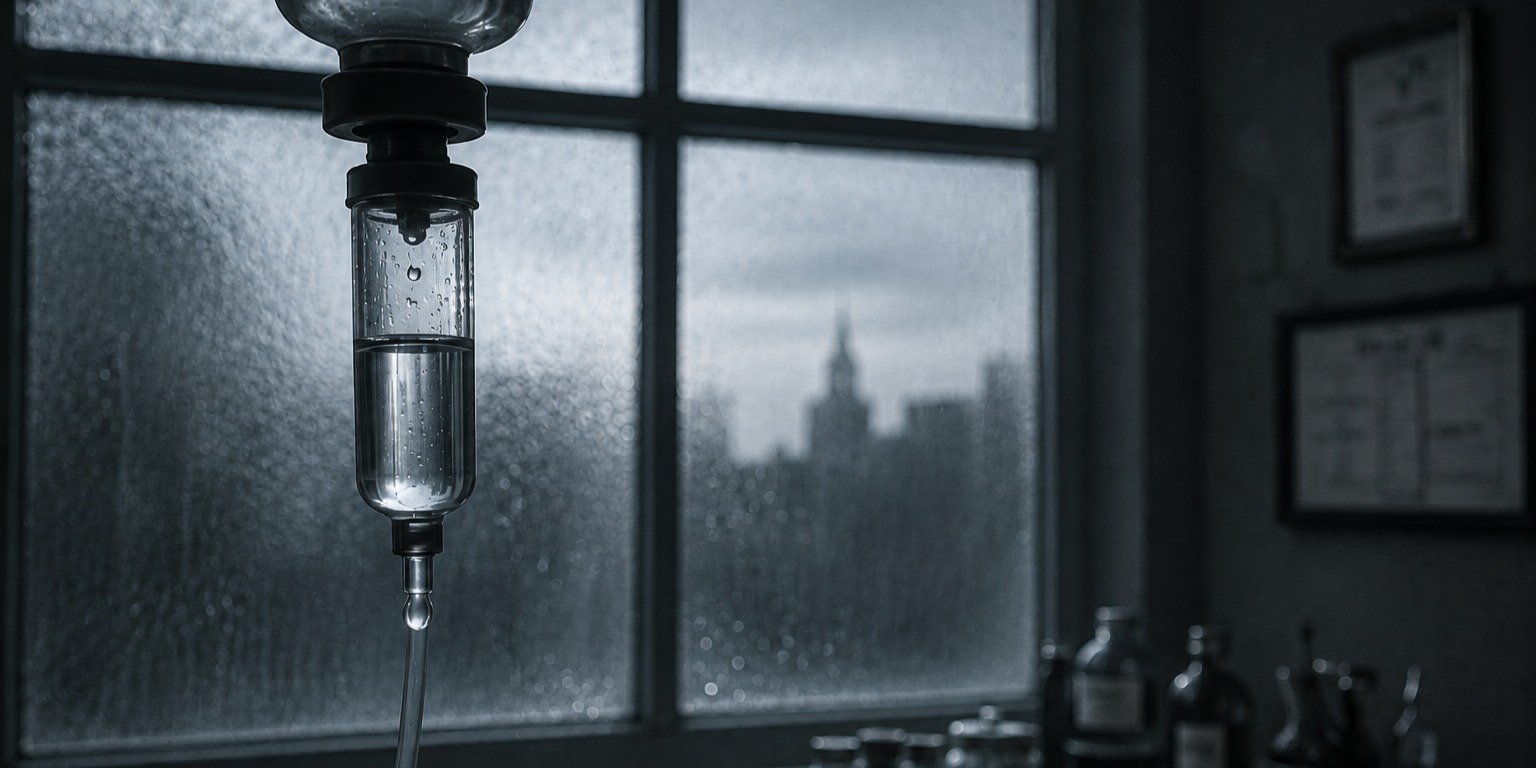
The townhouse didn't smell like a home but faintly of disinfectant and old books. Not the aggressive antiseptic of a hospital corridor, but something quieter and more controlled. The air of a place that preferred order over spectacle. The door closed with a soft, deliberate click, sealing the night away. Dr. Weiss stood back, his eyes tracking our movement with a surgical alertness. He pointed a thin, liver-spotted finger toward an elegant flight of stairs that was designed for grand entrances, now reduced to a steep logistical nightmare.
“Upstairs. Exam room two.”
He kept his voice softly restrained and watched the struggle unfold from a distance, offering no assistance to help carry the burden. The staircase was narrow and carpeted in a muted grey that had survived decades of shoes without complaint. Ilya was maneuvered between the two of us. He was a dead weight in the technical sense, uncooperative with gravity. His boots dragged once against a step before I adjusted the angle. Weiss walked ahead, switching on lights as he moved. The targeted kind of illumination from a man who understood that clarity didn’t always require brightness.
Exam room two was modest. An adjustable examination table occupied the center of the room. Cabinets labeled in precise handwriting lined one wall, while a stainless-steel tray stood ready beside the table, laid out with syringes, alcohol swabs and an unopened suture pack. Two high-backed wooden chairs waited in the corner, positioned close enough to the examination table that bad news wouldn't need to travel far. Nothing unusual. Everything prepared. The room carried the quiet confidence of someone who experienced emergencies often enough to stop dramatizing them.
“Lay him down.”
We did. Ilya’s head rolled slightly to the side. His breathing hitched once, then resumed its strained rhythm. Weiss removed his jacket, folded it neatly over the back of the rolling chair, and washed his hands. Taking his time with every deliberate step, he went through the hygiene ritual with a calm, unhurried air entirely devoid of paranoia. “Tell me what happened,” he said without looking at us.
“Collapse after a release. It started at the mark,” I said. “Irregular respiration since.”
“What kind of release?”
“The kind that left him unconscious.”
Weiss dried his hands slowly, then pulled on gloves without ceremony. “Release from him,” he clarified. “Or into him?”
“Yes.”
That earned me a brief glance over the rim of his glasses. “You’re not one of my usual patients.”
“Indeed.”
He stepped closer to the table, examining the brand without physical contact. He did not recoil. “You’re sure you want me involved?” he asked quietly.
“Not particularly. But here we are.”
Weiss acknowledged that with a slight inclination of his head and leaned closer to Ilya’s hand. He studied the pattern longer than I expected. “This has nothing to do with solar exposure,” he observed.
“I didn’t say it was.”
“No. You didn’t.”
“You recognize it?”
“I've seen sketches.”
“Where?”
“Buried within old papers that held forgotten fringe theories from the recovery years.” His fingers hovered above the mark without touching it. “Most of them were nonsense.”
“Most?”
“Did he consent to this?”
“No.”
“You're certain?”
A pulse of pain tightened behind my eyes. Apparently the headache had found another gear. “That's what no means.”
“Then I won't assume it was intended to help him.” Weiss finally looked away from the mark and focused on Celina. “Wait in the other room.”
“I’m not leaving.”
His look shifted back to me.
“She stays.”
The glove snapped against his wrist. “Fine.” He reached into a drawer beside the examination table and removed a small penlight to examine Ilya’s pupils. “They’re reactive,” he noted. “But slow.”
“Is he dying?” Celina asked.
Weiss placed a sensor on Ilya's finger and frowned at the reading. “He’s under stress,” he said finally. “Neurological.”
“Can you stabilize him?” I asked.
“An attempt can be made.”
“What's the risk?”
Our eyes met across the table. “Everything is risk.” Weiss lifted the marked hand carefully, rotating the wrist beneath the examination light. The intersecting lines looked less like a wound now and more like a diagram. Thin channels intersected beneath the skin with the uncomfortable precision of something deliberately constructed. “Interesting.” He touched the skin just beyond the mark with two fingers. The light pressure made Ilya flinch. “Responsive. That’s good. How long has he been unconscious?”
“Approximately forty minutes.”
“Any seizure activity?”
“One episode in the car. His hands started clawing at the seat. Then it passed.”
“Periods of lucidity?”
“None.”
Weiss nodded once, then stepped to the cabinet again. “Before we continue,” he said conversationally as he selected a stethoscope from a sterile tray, “am I correct in assuming that the obvious question regarding post-Sunray has already been answered?”
“Your assumption is correct,” I said.
His attention shifted briefly toward Celina. She looked up from the chair. “I know what you're asking.” Weiss waited. “But I don't know what that has to do with what happened to him.”
Weiss glanced at Ilya’s jacket. “Help me with this.” A minute later the diaphragm settled against bare skin. He listened for several seconds. “During the exposure, the atmosphere behaved strangely. Afterward we started seeing people whose bodies no longer settled where they were supposed to.” His eyes flicked briefly toward Ilya. “They were simply different.”
Celina glanced at me. Judging by her expression, she understood every word individually and none of them together. “Different how?” she asked.
Weiss now placed the stethoscope against Ilya’s underarm. “That's been the hushed argument for the past thirty years.” Weiss repositioned the diaphragm closer to the armpit and listened briefly in silence. “The body is constantly adjusting itself. Thousands of small corrections every hour. Most of them happen without permission.”
“And Sunray changed that?”
“In some people.” Weiss removed the stethoscope and listened to Ilya breathe for another moment. “Something pushed him far past whatever his normal limits are.”
“And what does that leave us with?” I asked.
“It means his body is trying to re-establish balance and failing.” His eyes moved toward the mark. “At least for now.”
“Can you treat it?”
“Possibly.”
“And?”
He removed the earpieces and let them rest around his neck. “It comes with a cost.” Of course it did. Weiss hesitated briefly before opening the lower cabinet. “During the Sunray events most patients could be managed with familiar medicine. Treat the symptoms and let the body correct itself.” A small metallic case emerged. “Most physicians had little reason to go further. The established treatments worked often enough.” He flipped the catches and opened the lid. “But then, during the recovery years, people arrived with problems modern medicine wasn't built to solve and literature filled with observations long before anyone could agree on what they meant.” Inside sat a device no larger than a thick smartphone. Matte black with two circular contact pads on one side. He turned it over once in his hands with the same expression people reserve for old mistakes. “Induction modulator. This is experimental. I do not advertise it.”
“You’re not licensed for that,” I said.
“I am licensed for many things,” Weiss replied calmly. “This is adjacent.”
“What does it do?” Celina asked.
“It gives the body somewhere else to place the strain.”
“Externally?” I asked.
“Yes.”
“Into what?”
Weiss looked at me. “Someone has to carry part of that correction.”
I understood that immediately. Celina did not. “Correction?” she repeated.
“It requires sustained physical contact,” Weiss said. “With someone whose body still has room to compensate. This device prevents the body from trying to solve everything in one place.”
“What happens to the volunteer?”
Weiss considered the question. “Imagine a severe flu compressed into an afternoon. Possibly with minor scarring.”
“Possibly?” Celina echoed.
“It’s not predictable.”
“And that's the optimistic version?”
“Yes.”
Ilya’s breathing hitched with a sharp, fractured sound. Weiss looked at the monitor again. “We do this now,” he said, “or his heart continues improvising until it fails.”
“I’ll do it,” I said.
Celina looked at Weiss. “He's already concussed.”
“Celina—"
“You can barely stand upright,” she shot at me.
“You are both injured,” Weiss said while looking at her.
“And you're still saying he's the best option?”
“I'm saying he's the available option,” Weiss said while holding the induction device between his fingers like a scalpel. “Someone has to absorb the excess.”
“I’ll do it,” I repeated. This time nobody mistook it for a suggestion.
“You’ve had head trauma,” he said to me. “Keep in mind that your tolerance threshold may be reduced.”
“So may his.”
Ilya’s breathing shuddered—a thin, strained sound of a body running out of options. Weiss pressed two fingers against the side of Ilya's neck. “His heart appears committed to making this decision for us.”
I stepped forward to close the discussion. “What happens if contact breaks?”
“Then we're back where we started, except faster,” Weiss said while adjusting the device. “Take his wrist.”
“The marked one?”
“The other one. I'm not interested in creating additional problems.”
I took Ilya’s right hand in mine. His skin was cold and damp. The strength that had broken men an hour earlier was gone. Weiss pressed one contact pad over the brand and placed the second on the back of my hand. “Firm contact. Do not let go. It will take about three minutes.”
Celina moved closer, a silent orbit that didn't interfere. Weiss activated the device after a small calibration tap in the manner a man might strike a dying watch to remind it of its duty. The first sensation wasn't heat. It was pressure. It felt as if the bone density itself had shifted. Weiss watched the monitor. Then—
“There.”
"What?" Celina asked.
“The body is starting to remember where it's supposed to be.”
Ilya’s back arched against the table, a broken breath tearing from his lungs. The brand flared up into a deep, internal glow. Then the heat arrived underneath the skin while my vision tightened at the edges until the world narrowed into a slit.
“Hold,” Weiss said.
Time lost its shape while pressure intensified. At some point the trembling in Ilya's arm eased. Weiss said something while sweat found its way into my eyes. I didn't hear it. A vibration crawling up my arm, across the shoulder, into the chest and for a brief second, the logic of Ilya’s body failure became clear. Correction layered on correction until it could no longer find its own center. Ilya gasped. The vibration spiked into white static flickering behind my eyes as the knees began negotiating with my weight. Three minutes is not a philosophical concept; it is a duration. It ends. The device emitted a sharp, final click. The vibration stopped, and the sudden absence of it felt like a vacuum. I took a half-step back, an involuntary concession to the fatigue. Celina caught my elbow this time. “You’re pale.”
“I’ve been pale before.”
Weiss ignored both of us and removed the pads. His attention remained fixed on Ilya. Two fingers settled against the side of his neck while his eyes tracked the monitor. He waited through several breaths, listening to something the rest of us couldn't hear. “That's more like it.” The brand had flattened. Its glow was gone. Ilya's breathing eased into a slower rhythm, each breath reaching a little further than the one before it. Only then did Weiss look up. “How do you feel?”
The room swayed once, then reluctantly agreed to stay where it was. “Standing.”
“That wasn’t the question.”
“Present,” I said softly.
“That will do.”
Weiss turned his attention back to Ilya and began stabilizing him with efficient movements. An IV line followed. Then he administered medication and monitored the respiration. “You should expect symptoms within the hour,” he said to me. “You'll know when they arrive.”
“I already have a headache.”
“This one will be different.”
“Helpful.”
“You may even stop appreciating sarcasm for a few hours.”
Celina handed me the ice pack without comment. I took it. Not because I wanted it. Because she was right.
“He will live,” Weiss noted. Celina closed her eyes briefly. “But he needs rest,” he continued. “Twelve hours minimum. Preferably twenty-four.”
“It’s morning,” I said.
“I am aware.” He stepped out of the room after checking Ilya’s vitals. His voice carried clearly through the open door. “Yes,” he said. “Cancel today’s appointments. All of them.” A pause. “No, I am not ill. I simply feel unwell.” Another pause. “Yes. Tell them we will reschedule next week.”
“My secretary will not come in,” he said as he reentered. “She values routine. I value discretion.”
“You don’t know us,” I said.
“No.”
“Why help?”
Weiss adjusted the IV flow and checked Ilya's pupils again. “In the early years, we assumed it was a disease. Radiation exposure that resulted in cellular corruption. We treated it as contamination.” His fingers found Ilya's pulse. “But contamination spreads. This selected.” Only then did he peel off the gloves and drop them into the waste bin. “Most people couldn't accommodate the exposure. Their bodies exhausted every correction they had. We called them Incompatibles because it was easier than admitting we didn’t understand what was happening.” He listened to the breathing for a moment. “Most people died. Others recovered. But a minority adapted.”
“Adapted?” Celina repeated.
“Their bodies stopped trying to correct the damage and learned to live with it.”
“And that makes them what?” I asked.
“Persistent,” Weiss said. “After enough patients, you develop an academic interest in persistence.”
His eyes shifted toward Ilya. “You are not criminals.”
“How would you know?”
“Because criminals rarely spend this much effort keeping each other alive.”
“That sounds like experience.”
Weiss adjusted the IV flow by a fraction. “Most people acquire some if they live long enough.”
“And if we bring attention here?”
“Then I will deny you existed.” Weiss opened a drawer and produced a digital thermometer. “Open,” he said to me.
“What?”
“Your mouth. This isn't a negotiation.” The thermometer was deposited with all the ceremony of a parking ticket. “Keep it there.” I considered arguing and decided the effort exceeded the potential reward. Weiss had already turned his attention toward Celina. “Look at me.” She did. He studied the swelling around her eye for a moment before raising two fingers. “How many?”
“Two.”
“Follow my finger.” Her gaze tracked the movement left and right. “Any double vision?”
“No.”
“Now cover your good eye and tell me if you see any light.”
“A little.”
“All right. Does it hurt anywhere else?”
Celina raised a hand and carefully traced the edge of the swelling. Her fingers moved across the cheekbone, then stopped. “Mostly here.”
“Sharp or dull?”
“Sharp.”
“Any numbness?”
“No.”
“Could you press there?” She winced slightly. “Enough.”
“That's it?” Celina asked.
“You don’t have a fracture.”
“That's nice.”
“No. It’s convenient.” His attention dropped toward her wrists. “Let me see those.”
Celina hesitated, then held out her hands. Weiss turned one wrist beneath the light, examining the dressing before checking the other. The surrounding skin remained chafed and red.
“You cleaned these?”
“Yeah.”
“You did that properly.”
“I know.” Weiss looked at her over his glasses. Celina gave a small shrug. “You learn quickly when your father keeps losing arguments with furniture.”
Weiss's eyes moved toward me. His expression remained professionally neutral, but neutrality had limits, and somewhere behind it a perfectly ordinary question was beginning to take shape. I decided to intercept that before it became conversation. “Whatever conclusion you're arriving at, I recommend a different route.”
Celina looked between us. “He's not my father.” She nodded toward Ilya. “And before you try again, neither is he.”
Weiss released her wrist and handed her a small packet. “Clean bandages and anti-inflammatory tablets. Use the ice packs for the contusions.”
She accepted them, then cleared her throat. “Could I... use your bathroom?”
“Of course. Restroom is down the hall.”
“And... do you happen to have any tampons?”
He reached into a lower cabinet, pulled out a small cardboard box, and set it on the counter. “Help yourself.”
Celina rose, took the box, and headed down the hall. “Thanks.”
Weiss turned to me and held out his hand. I removed the thermometer from my mouth and passed it over. The reading held his attention longer than I liked. It was deposited into a metal tray beside the sink before he finally looked back at me. “Try to stay horizontal for at least an hour.”
“I don’t have that luxury.”
“You do if you want to continue thinking.” Weiss checked the monitor one last time. “He will wake. Disoriented. Possibly agitated.” He removed his glasses and wiped them clean. “If he wakes before I return, don't let him stand.”
“You're leaving?”
“I'll be in my office downstairs. Someone still has to pretend this is a medical practice.” We held each other’s gaze a moment longer. “Rest. The fever will be here soon.”
Then he left me alone. The back of my hand held a faint, red ghost of a mark where the contact pad had been. I ignored Weiss's recommendation until the pain made me abandon the wooden chair and slide down onto the floor, where I continued to wait for the heat to arrive and the world to fade.
*
When I opened my eyes again, the room was brighter. Morning light bled through the frosted windows. The grey had shifted toward a pale, sickly ivory. For a few seconds I remained on the floor, inventorying the damage. Headache. Fever. Muscles that felt as if they belonged to someone else. Eventually I pushed myself upright and reclaimed the wooden chair. It remained exactly as uncomfortable as I remembered. Ilya slept while the IV dripped steadily. Celina sat opposite me; the ice pack pressed against her eye. For a while, neither of us spoke.
Then—
“About what happened in the car,” she said.
“I understand. Stress-response. Just let it—...”
“Can you shut up for a moment.” Her voice was quiet. That made it harder to ignore. “I need to say this out loud.”
I stopped talking. She stared at the floor, tracing the lines in the linoleum. “If they moved me, I would have disappeared.” Celina hesitated for a moment before continuing. “You found me because they were still local and building something.” She looked up. “If they handed me over to people who knew what they were doing, I would have been gone.” The ice pack shifted against her cheek. She winced and adjusted it. “You can’t rescue what you can’t locate.”
“True,” I said in a dry agreement.
“I wasn’t angry because of what you did to them. I was angry because you made noise and I didn’t want them reacting.” The room stayed quiet long enough for the point to land. “And there’s something else. That night. Before you.” I knew instantly what she meant. “I thought I was going to die,” she said evenly. “Or worse. And there was nothing I could do except wait for somebody else to decide what happened next." Her fingers white-knuckled the armrests, as if she were trying to hold herself to the present. “I promised myself I would never sit still like that again.” The silence lingered. Long enough to understand where she went in her mind. “So when they tied me up. I talked and pushed. I made it hard for them.”
“That could’ve gotten you killed.”
“Yes.” She met my eyes. “But it meant I was still choosing.” A trace of amusement slipped through despite everything. “I wasn’t ungrateful. Back in the car.”
“I didn’t think you were.”
“You did.”
Maybe I had. “I misread it.”
She studied me, surprised by the admission. “I don’t want to survive because you’re efficient. I want to survive because I have a say.”
I glanced toward the breathing form of Ilya, then back to her. “You do.” She waited for the rest. “I’m used to thinking alone. That works when it’s just me.”
“And now?”
“Now it isn’t.”
She leaned back slightly and gave a faint, tired smile. “That’s all I needed to hear. Because I’m not sitting quietly in the next chair.”
A trace of a smile flickered in return. It was a rare, unbudgeted impulse that went unsuppressed. I pressed the melting ice against the back of my neck. The fever hadn't left. Neither had the headache. Both were simply waiting their turn to become the most important thing in the room.
Chapter XIII — October 04
©️ 2026 Bob Roland. All rights reserved.
The Geometry of Choice: Book I of The Equilibrium Strain.