

The Stablecoin Disruption No One Sees Coming
The global stablecoin market has quietly become one of the most important sectors in all of crypto.
Two projects dominate it:
Tether
USD Coin
Approximate supply today:
Stablecoin Supply USDT~$185B USDC~$78B
Together they represent over $260 billion in digital dollars circulating across the global crypto economy.
But there is a structural problem.
These stablecoins rely on off-chain collateral such as:
U.S. Treasury bills
bank deposits
money market funds
The tokens live on blockchain.
The collateral does not.
Which means users must trust:
banks
issuers
auditors
regulators
For years the crypto industry has accepted this tradeoff because stablecoins solved an important problem: they created digital dollars that move instantly across the internet.
But what if there was a better way?
Imagine a stablecoin backed entirely by collateral locked directly on a blockchain.
No banks. No custodians. No opaque reserve reports.
Just math.
In this model, the collateral asset would be:
DigiByte
Stablecoins — called DigiDollar — could be minted by locking DigiByte as collateral.
Example framework:
$2 of DGB locked → mint $1 DigiDollar
This is known as 200% over-collateralization.
Unlike USDT or USDC, the collateral would be:
publicly visible
cryptographically secured
verifiable by anyone
No bank statements required.
Just blockchain transparency.
Rather than comparing DigiDollar to the entire stablecoin market, the real benchmark is USDT, the largest stablecoin in the world.
Current supply:
~$185 billion
If a decentralized system required 200% collateral, supporting a USDT-scale ecosystem would require:
$370 billion in collateral.
Now consider the maximum supply of DigiByte:
21 billion coins
If DigiByte were fully used as collateral for a USDT-scale decentralized stablecoin system, the equilibrium price would mathematically be:
$370B ÷ 21B ≈ $17.60 per DGB
This is not a prediction.
It is simply the mathematical equilibrium required to support that scale of collateralization.
A new monetary system does not need to replace USDT overnight.
Even capturing a small portion of the market would be enormous.
Even 1–5% of the USDT market would represent a massive decentralized stablecoin ecosystem.
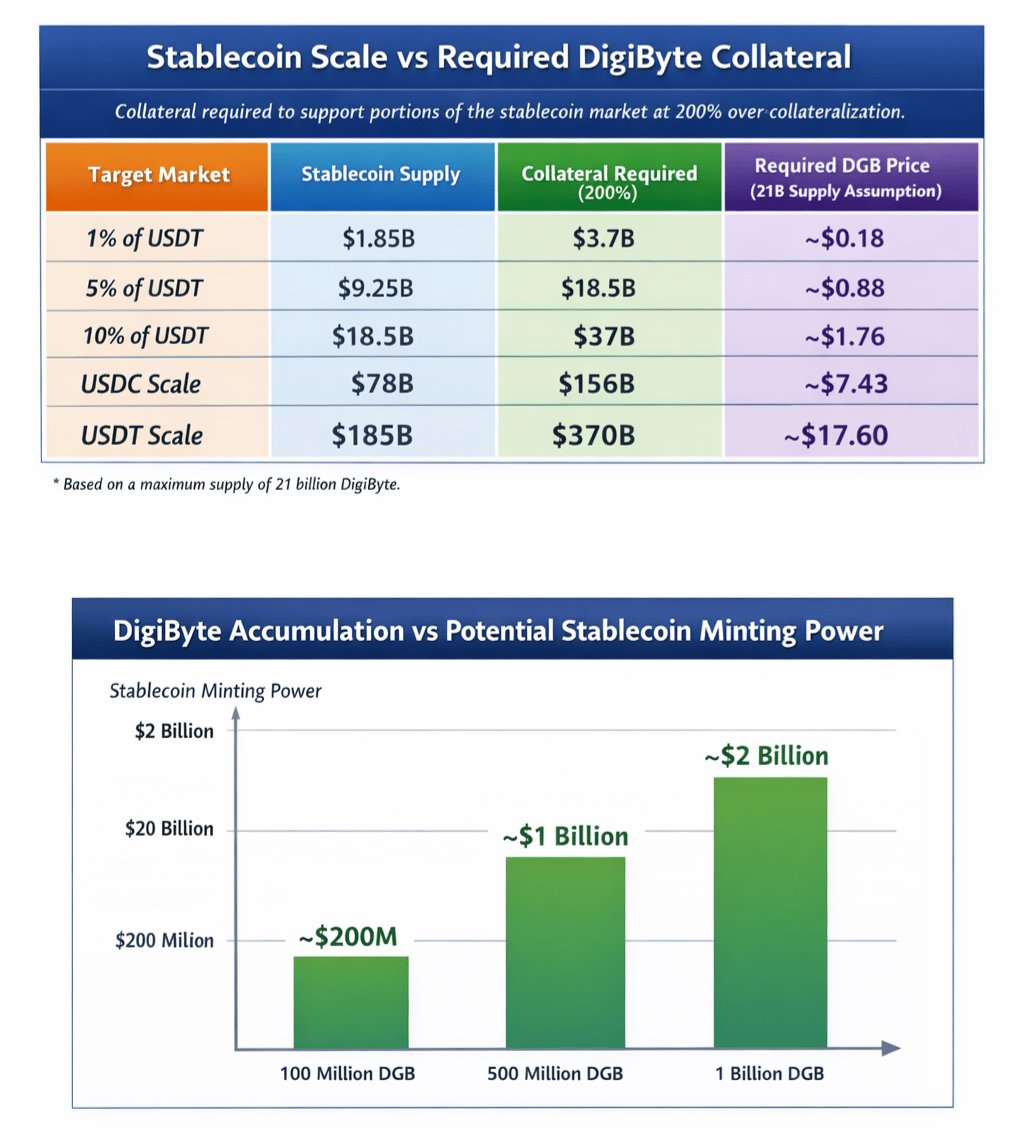
The following chart illustrates how much collateral would theoretically be required to support portions of the stablecoin market using a 200% collateral model.
Target Market Stablecoin Supply Collateral Required Required DGB Price (21B supply assumption)
This chart highlights how collateral demand could potentially scale with stablecoin adoption.
The Quiet Accumulation Strategy
DigiByte currently trades around $0.0041 per coin.
Because of this, a company, investment fund, or even a country could begin quietly accumulating a strategic position in DigiByte today.
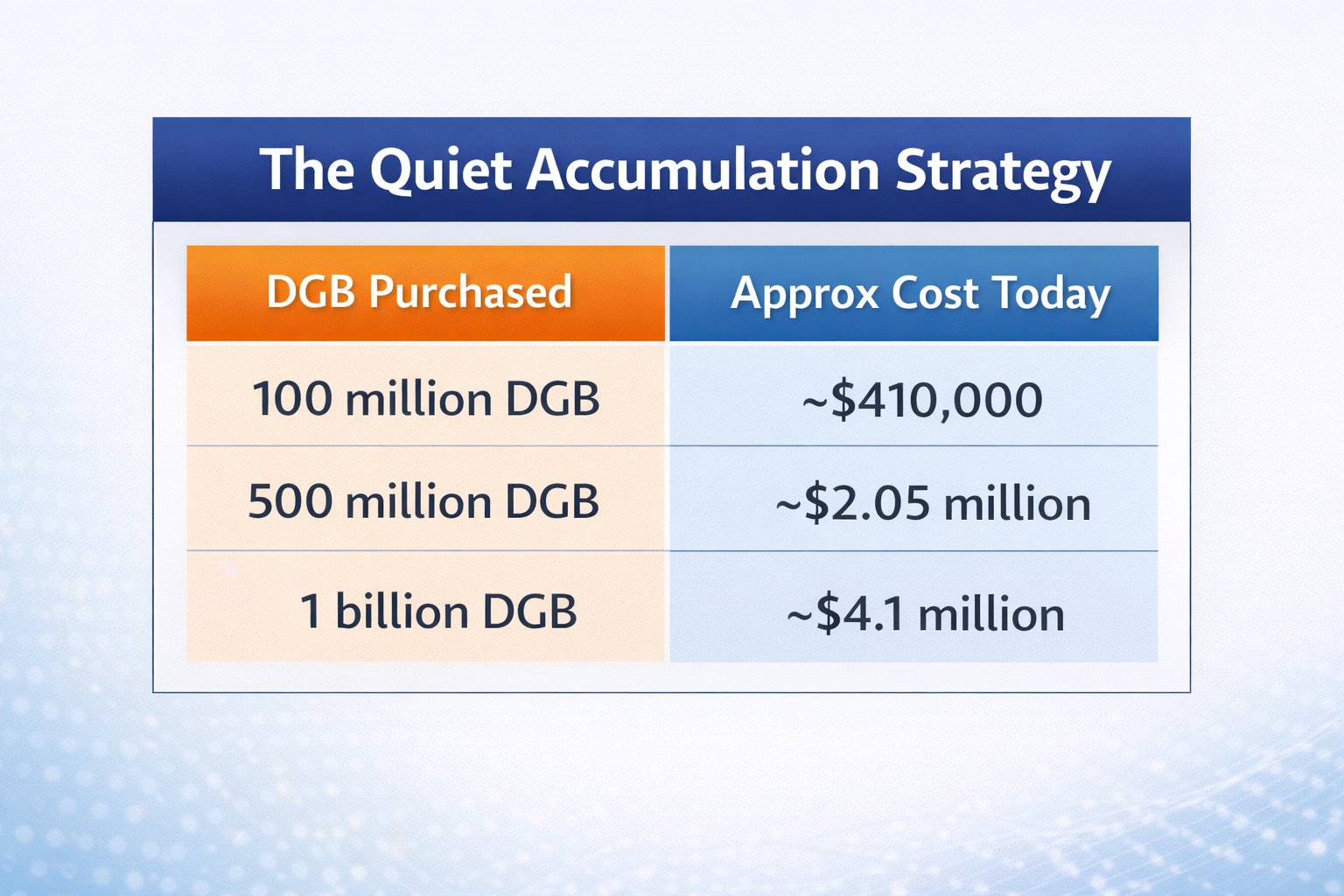
DGB Purchased Approx Cost Today 100 million DGB~$410,000500 million DGB~$2.05 million 1 billion DGB~$4.1 million
Compared to the capital normally required to launch a global financial system, these numbers are extremely small.
But the key insight is this:
Stablecoin minting power depends on the value of the collateral — not the price when it was acquired.
Digital Gold Foundation (@DigitalGoldOrg) and their Digital Gold Standard Benchmark & Crypto Fair Value Formula.
Using this framework, the current Crypto Fair Value (CFV) estimate for:
DigiByte is approximately: $1.96 per coin.
The research was developed by @JohnWGotts and @RealMarkFinchem
and will be explored further in the upcoming book:
“Beyond Bitcoin.”
Importantly, this valuation model does not account for potential demand created by decentralized stablecoin collateralization, which could significantly alter economic dynamics if such systems emerge.
Jared Tate (@jaredctate) described the DigiDollar concept this way:
“This is the most exciting presentation I have ever done in my 13 years in blockchain and crypto technology. What if there was a way to tap into crypto without ever selling or giving up your private keys? This is exactly the idea behind the DigiDollar — the world's first truly decentralized time-locked over-collateralized stablecoin built natively on a UTXO blockchain.”
Crypto commentator Johnny Law (@Johnny_DGB) summarized an important reality:
“Price and value are not the same thing in crypto. Markets can move on hype, but long-term value is determined by utility. When a network becomes critical infrastructure, its price eventually reflects that reality.”
Imagine the island nation of Madagascar taking a different approach to the future of money.
Instead of issuing debt or accumulating foreign reserves, it quietly began accumulating DigiByte.
At today's approximate price of $0.0041, Madagascar could purchase 10 billion DigiByte for roughly:
$41 million.
Now imagine time passes and DigiByte becomes widely used as collateral for decentralized stablecoins.
If DigiByte eventually reached $15.60 per coin, Madagascar’s holdings would be worth:
$156 billion.
Under a 200% collateral model, that reserve could mint approximately:
$78 billion in decentralized DigiDollar stablecoins.
That would make the system larger than USDC today.
A small country by geography…
Yet suddenly home to one of the largest financial systems on Earth.
Madagascar was chosen purely as a thought experiment. With a population of roughly 30 million and a GDP of around $16–17 billion, it represents a relatively small economy on the global stage. The example illustrates how even a smaller nation could theoretically build a globally significant financial system if blockchain collateral and decentralized stablecoins become widely adopted.
The same concept could apply to any nation, sovereign wealth fund, or institution capable of accumulating blockchain collateral.
“Markets don’t always ignore new ideas because they’re wrong—sometimes they ignore them because existing investments make them uncomfortable.” - Adam Ogilvie
Stablecoins are becoming the financial rails of the digital economy.
But the next generation may look very different.
Instead of trusting institutions, systems could rely on transparent blockchain collateral verified in real time.
If that future arrives, the most valuable part of the system may not be the stablecoin itself.
It may be the collateral network beneath it.
“The first generation of stablecoins was built on trust in institutions. The next generation may be built on transparent blockchain collateral. If that shift happens, the networks securing that collateral could become some of the most important financial infrastructure on Earth.” — Adam Ogilvie
This article presents a hypothetical thought experiment exploring how decentralized stablecoin systems might function using blockchain collateral.
All numbers used are illustrative calculations, not price predictions or financial advice. Cryptocurrency markets are volatile and involve substantial risk.
The scenarios described here are intended for educational and conceptual discussion only regarding potential economic models for decentralized financial infrastructure.
Readers should conduct their own research and consult qualified professionals before making financial decisions.