

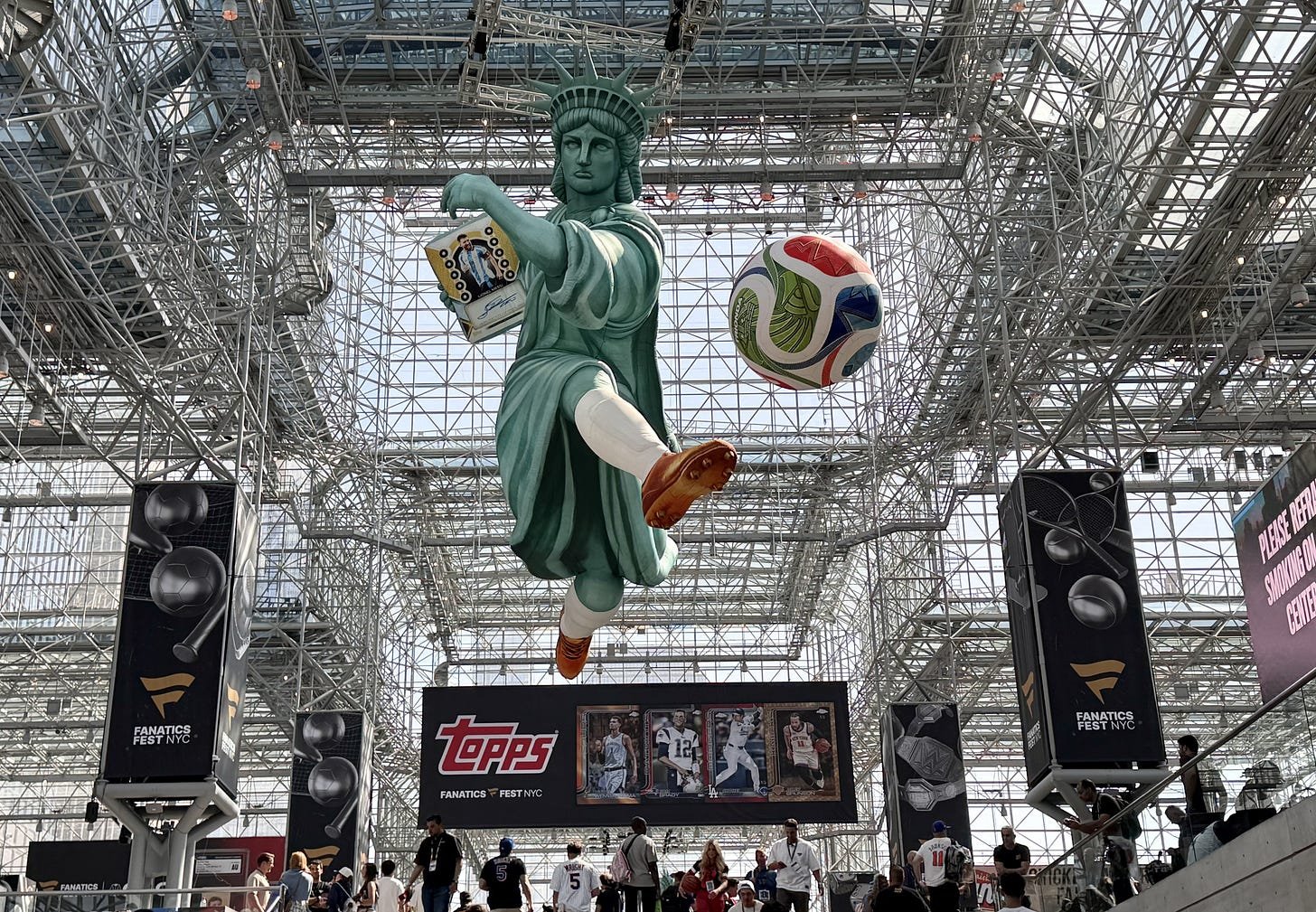
Two hundred thousand people walked into the Javits Center a few weeks ago because of sports memorabilia.
I went in skeptical. I’ve never liked Fanatics merch. The quality is poor and the prices are insane. Fanatics Fest changed my mind about the company. For four days there was everything from card dealers to limited edition sports merch, activations where anyone could take a free throw or attempt a field goal, and stars from LeBron James to Tom Brady wandering the venue.
Walking by the vendor tables is what got my attention. Jeter. Griffey. Shaq. Cards I’d chased as a kid were all there. I mostly collected baseball, especially Yankees players, because I played the game and watched the dynasty teams. Sometimes I’d go to local card shows, which usually had a few dozen dealers and were never too organized or crowded. I never sold my collection, but I also didn’t keep seriously collecting.
A little over a week after Fanatics Fest came the National Sports Collectors Convention, right outside Chicago. It’s the hobby’s independent annual convention, running since 1980, and this year it drew hundreds of dealers and over a hundred thousand collectors. I didn’t go in person, but I watched countless videos through social media from card influencers who have amassed huge followings.
Attending Fanatics Fest and then seeing all the buzz around the National right after woke me up to the fact that card collecting isn’t a niche hobby anymore. It’s mainstream. The crowds look like the crowds at a music festival, professional athletes have launched their own card retailers, and pulling a pack on camera is a lucrative career.
Three things changed in the last several years to propel the industry.
First, ownership. Fanatics bought Topps in 2022 for roughly five hundred million dollars. Then in April it took the exclusive NFL license from Panini, having already secured MLB and the NBA. One company now controls the official cards of all three major American sports, and Fanatics, a marketing machine, has the resources to sell cards to the masses.
Second, live selling stopped being a niche. Whatnot did more than eight billion dollars in gross merchandise value last year, roughly double the year before, and sports cards are a top category. More than six million cards a month are sold there. Streamers with millions of followers rip boxes on camera every night across Whatnot, Instagram, Twitch, and Fanatics Live, and each big pull is free marketing for the whole industry.
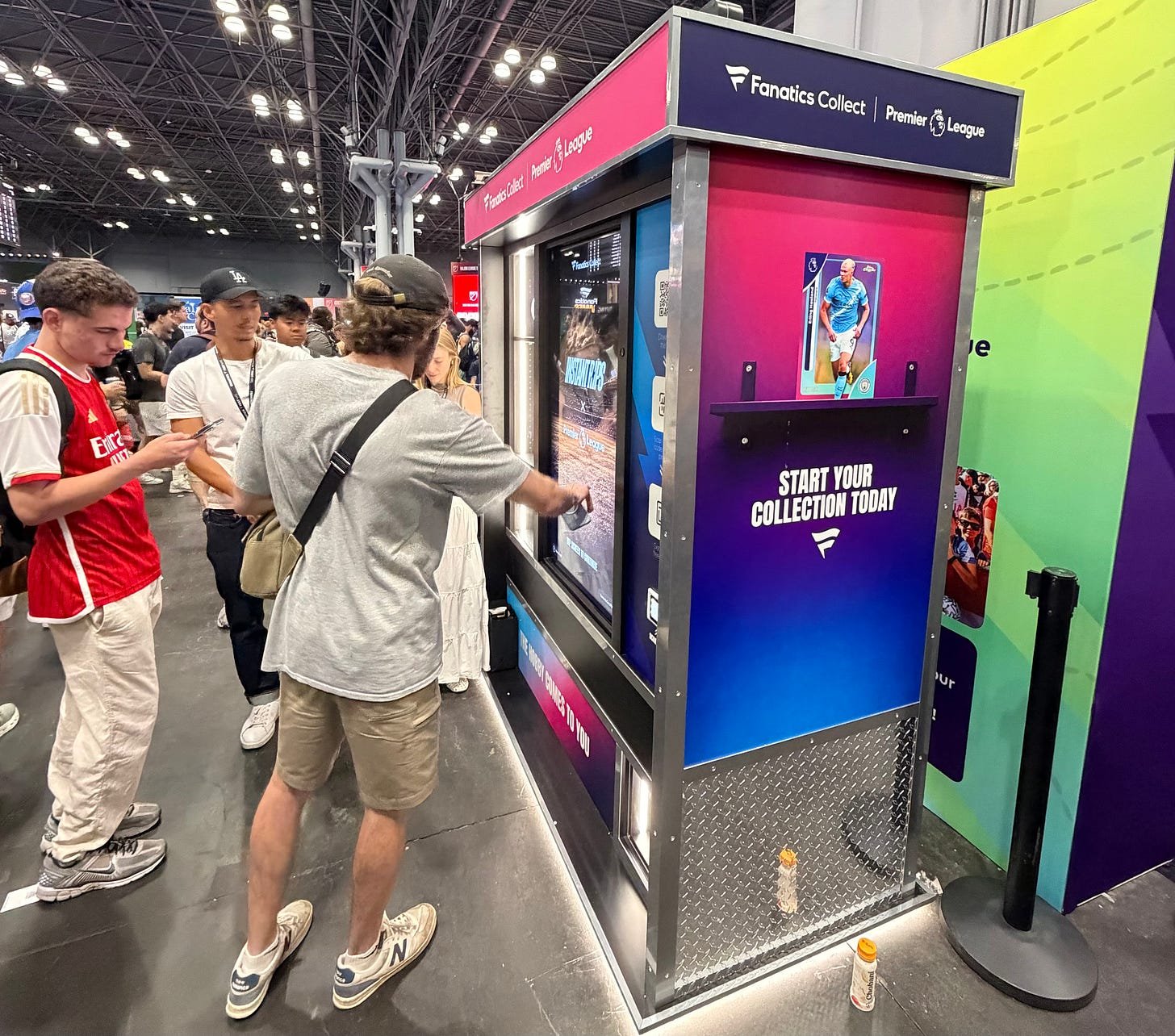
Third, the physical card became optional. At Fanatics Fest I opened a pack at a vending machine by scanning an app. It was free, to give people a taste of trying it themselves. The card landed in my account as proof of ownership with the physical version sitting in a vault, insured and mine to claim or sell without ever touching it. I pulled nothing worth keeping, but their tactic worked. I walked away wanting to buy more virtual packs.
A wave of startups now runs some version of this model. Courtyard, which operates similar machines, reports around fifty million dollars a month in volume ripping digital packs of vaulted, graded cards. These companies stock their packs by buying graded cards on the open market, which means every digital pack ripped is backed by a real card they had to go buy. They’re building the custody and settlement infrastructure for cards, creating a market where demand has almost no friction and the buyer never needs to go anywhere. All of it bids up prices across the whole market.
I don’t think this boom is an accident of timing. I think it’s partly a response.
I’ve written before that as AI makes cognition cheap, the things that hold value are the ones you have to be present for in the physical world. Collecting is exactly that. Walking into a card shop, holding a card, watching someone’s face when they pull something big. As more of what we read, watch, and make gets generated, the hobbies where people gather around something physical stop being pastimes and start being where the connection actually happens.
And look at what’s on the cards too. Athletes are among the last cultural icons AI can’t touch. AI can write a song and create a film. It can’t hit sixty home runs in a season. Sports run on human limits, which is exactly the thing everything else is losing. A card is a small claim on a real person’s physical accomplishments. That’s what makes it worth holding, and it’s why the faces on the cardboard still mean something decades later.
Fanatics Fest got me back into collecting. I came home looking for my old cards in storage for the first time in years, and I’ve been buying again, even with prices where they are. Mostly young players I think are underpriced, and all-time greats like Ohtani and Judge, whose cards I think hold long term.
Every generation decides what it treats as a store of value. This one is making a different set of choices than past generations, partly by preference and partly because other asset classes got priced away from them. Fewer people my age and younger will ever own a home. The money that used to go into a first house is going somewhere else. Watches, art, fashion, and cards. Collectibles are becoming an asset class the way art became one, except the entry price is much more accessible.
Sports cards have crashed before, and at the moment the hobby felt strongest. The early nineties were the last golden age. Cards were everywhere and prices were climbing. The card companies responded by printing more and more. When collectors eventually understood the print run, prices crashed quickly. The crash didn’t happen because people stopped loving sports. It happened because people finally understood the total supply of what they were buying.
Those card shows I went to as a kid were the aftermath, and the industry had to work itself back up to what it is today.
The structural problem from then still remains, and it’s already happening all over again. Demand is at all-time highs and Topps is printing into it with more products and more inventory with each release. It’s not just the flagship sets anymore. There’s Topps Now printing cards daily of every latest sports moment, plus limited edition drops with new chase cards, some of them artist collabs like Travis Scott, KAWS, Murakami, and Bob Ross to name a few. The KAWS set dropped the week of Fanatics Fest with Ohtani and Judge one of ones as the crown jewels. There are just more drops than ever and the print runs on ordinary base cards are still undisclosed.
The other thing that changed is who’s opening the boxes. When I was a kid, cards got played with. I took mine to school to trade with friends, and my baseball and Pokemon cards had the bent corners to prove it. That carelessness is why a high-grade vintage card is rare. A 1952 Mantle was printed once and most copies were beat up or lost in someone’s attic. Today the boxes are opened by professionals who know there’s money in them. Even the kids at Fanatics Fest were walking around with their cards in silver metal briefcases, each one in a protective slab. Cards go from pack to sleeve to PSA instantly, and there is a newfound importance around condition because of PSA that did not exist in the vintage era.
Despite knowing all of this, I still bought a box of 2026 Topps Chrome, the marquee Topps box for baseball, the week it dropped. I knew the odds. I got no rare cards and the price of the box was more than the cards inside are worth, which was the expected outcome. A pack is a loot box and the thrill of opening packs and chasing rare cards is the point.
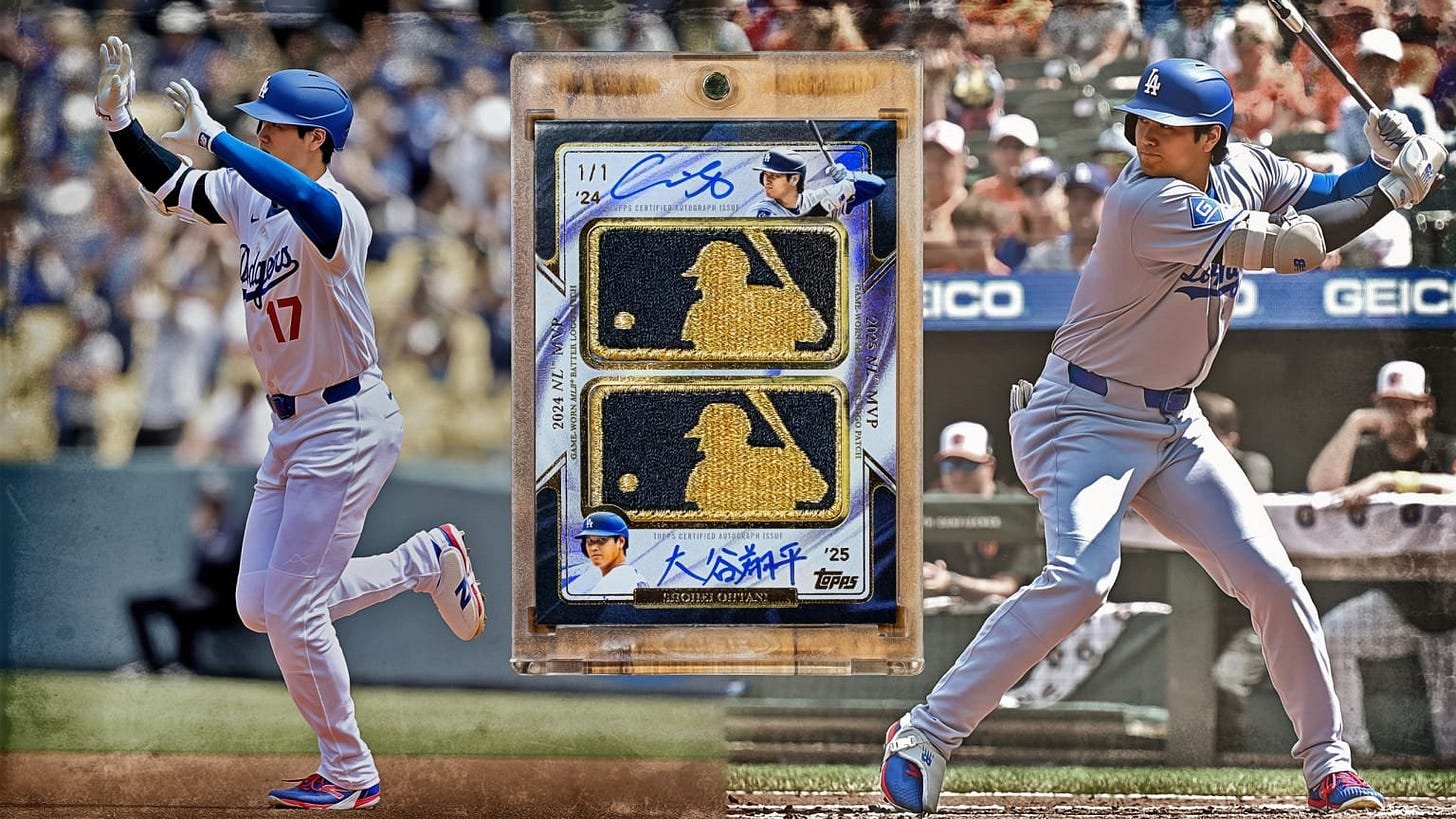
Topps built the entire hype around several rare cards, above all a one of one Ohtani with two gold logoman patches and two autographs, one in English and one in Japanese. Before anyone found it, collectors publicly offered bounties for it that climbed to ten million dollars. Someone pulled it in Boca Raton the day the National started and soon sold it for eleven million. What he pulled wasn’t even the card itself, just a redemption slip to be sent to Topps for the real thing. One card carried most of the hype for every box sold, and the company that set the odds is the same one that decides how many boxes exist for the release.
Then there’s the other problem. The gap between the prices of a raw card and a PSA 10 of the same card is enormous. For example, take 2026 Topps Chrome. A base rookie can cost a few dollars raw, but the same card in a PSA 10 fetches hundreds, with a supply of maybe three to five thousand graded copies. And that market is not small. Collectors moved over 1 billion dollars of single sports cards on eBay in the first half of this year alone, the first time it has ever crossed a billion, and up two thirds from the same time last year. Most of it prices off the PSA grading. eBay even integrates directly with PSA, showing population data on listings so buyers can see exactly how many copies exist in each grade.
Right now, the process of grading cards through PSA is broken, and as a result it’s limiting the supply of graded cards for the time being. The backlog hit roughly fourteen million cards in June after PSA paused its four cheapest tiers, and by late July it was back above twelve million even as the company spent two hundred million dollars on capacity and opened its fifth facility. Just to grade one card is eighty dollars, which prices many collectors out of grading.
One obvious fix is automation, and machine grading already exists and is already cheaper. Some companies have even started using AI to grade cards. But once the speed of grading is solved, it creates another problem. The supply of graded cards rapidly expands, and the graded cards that fetch high prices become less scarce.
The nineties crash taught several lessons, and perhaps the most important one is that not every card became worthless. The common cards of players who did not have longevity in their careers became worthless. The cards of all-time greats held, because their scarcity was real and their meaning was real, and neither depended on the hype in the market.
I think the same sorting happens this cycle. Verifiable scarcity, provenance, and condition are one filter. But the deeper filter is the story. The cards that truly last belong to players who turn into legends future generations keep telling, the way people still trade myths about Babe Ruth a century later. The Messis, the Jordans, the Gretzkys, the Bradys. Ohtani is writing that kind of story right now, which is why I think even his base card in a PSA 10 holds. The same card of a player nobody remembers won’t, no matter how perfect the grade. Even when grading gets faster and the slabs multiply, a legend has the demand to absorb them. Condition and provenance protect the value. The legend is the value.
The culture doesn’t need the speculation to survive. People will keep coming back to connect with others who share their love of collecting, and to hold onto human cultural moments that withstand the test of time. And me, I’m holding the legends, and hunting for the players who might become them.
Thanks for reading Mixed Realities by TJ Kawamura! Subscribe for free to receive new posts and support my work.
Subscribe