
This year has been the year of the agent.
A lot of people I know have been experimenting with them to streamline parts of their work. The one that has been most useful to me deals with information consumption.
I read a lot of newsletters, articles and posts every week. The problem was never finding more things to read. It was remembering what actually mattered after I read them. So I built an agent that pulls out things it thinks are relevant to me and organizes them in Notion, where I can connect them to other ideas and come back to them later.
It didn’t take long to build.
A few years ago I probably would have searched for a SaaS product that did the job, paid for the subscription and adjusted my workflow around whatever it could do. Now I can increasingly describe what I want and have an agent put the pieces together.
Until recently that wasn’t really an option for most people. Even simple automations meant figuring out APIs, integrations and what to do when something broke.
Muse, Grok Bot, Hermes, OpenAI’s Dots and others are moving toward something closer to a personal assistant that carries context and can work across different tools.
Which raises an obvious question. What happens to all the software we already pay for?
Earlier this year, plenty of people seemed to have an answer. SaaS was dead.
I’m not so sure.
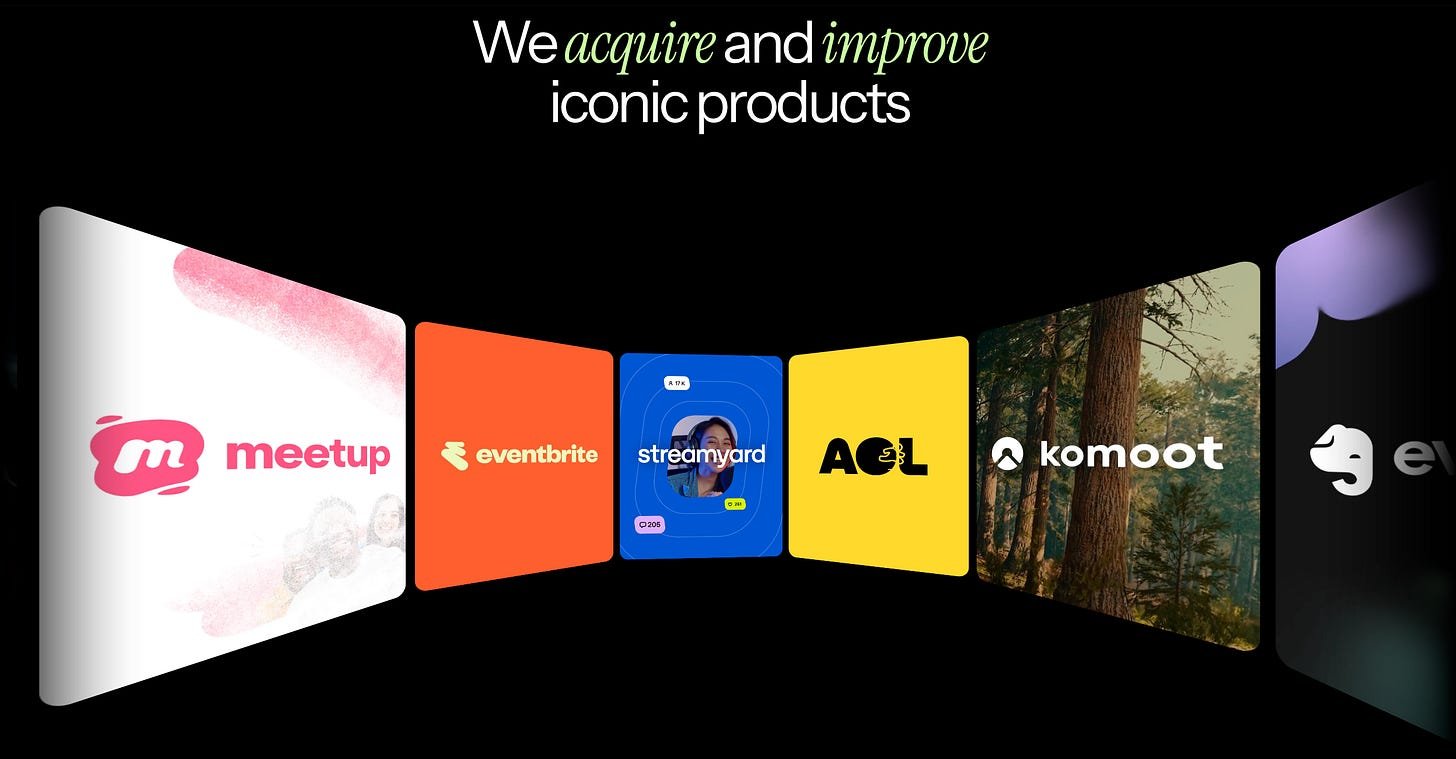
Bending Spoons is an Italian technology company that has built its business around acquiring established software brands and running them much more efficiently.
While everyone has been talking about AI replacing software, Bending Spoons has been spending billions buying companies such as Vimeo, AOL, Eventbrite, Airtable and Miro.
Airtable was valued at more than $11 billion in 2021. Miro reached $17.5 billion in 2022. Bending Spoons recently closed on Airtable and has agreed to buy Miro, each for roughly $1.3 billion in enterprise value.
If AI is making software easier to build, why buy software companies whose best growth years may already be behind them?
I think the answer is that Bending Spoons isn’t really buying the software. It is buying what already exists around it. The customers, the data, the workflows, the integrations, the distribution and the fact that people already know the product and trust it to work.
If your company has spent years building workflows inside Airtable, moving away isn’t just finding another database. Someone has to migrate the data, rebuild automations, reconnect integrations and make sure nothing important gets lost.
The same is true personally. I don’t spend time wondering whether Notion is still the best notes application. My work is there, I know how it works and it does the job.
Ironically, building my own agent has made Notion more useful to me, not less. It is now the place where the agent’s output connects with everything I already have there.
Building another Airtable is getting cheaper. Building Airtable’s distribution and customer base isn’t.
One thing that has bothered me about this AI cycle is how much attention goes to ARR without anyone asking what is underneath it.
Every week another AI company announces it hit ten, fifty or a hundred million in ARR faster than any software company before it. Some of these companies will clearly become enormous. But those numbers can tell you more about velocity than stickiness.
Users are still jumping between AI products constantly. One model gets better at coding, another gets better at research, and part of someone’s workflow can move almost overnight. Trying something new costs almost nothing.
Some fast-growing companies also quote run rate off a strong recent month. Do a million dollars in your best month and you’re running at twelve million. That shows demand. It says less about whether those customers will still be there in a year.
Traditional SaaS can have the opposite problem. Growth is slower, but the revenue can be much harder to dislodge.
A company doesn’t casually replace Salesforce, Airtable or Miro. Years of data, integrations and processes live inside those products.
There is real value in boring software that just works.
Ten million dollars from users who discovered an AI product three months ago is not the same asset as ten million dollars from companies that have built their operations around a product for ten years.
If one customer can leave in five minutes and another would need months to migrate, growth alone doesn’t tell you what the revenue is worth.
I also don’t think the end state is one giant chatbot replacing every piece of software, or all of us vibe coding every tool we need from scratch.
Vibe coding has made it much easier to create software that would have taken far more time and technical knowledge a few years ago. I’m already doing some version of that.
But getting something to work once is different from building a product that thousands of people can rely on every day.
The underlying models are also getting more interchangeable. A product can use one model today and another tomorrow, and the intelligence underneath will keep getting cheaper and better.
As that happens, the harness around the model starts to matter more. The tools it can access, the memory it carries, the permissions it has, the data it can pull from and the interface built around the job are what turn the underlying intelligence into something useful.
Two products could use the same model and still feel completely different depending on what has been built around it.
Most people don't really want a model though. They want something that gets the job done.
A sales team wants something built around accounts, customers and pipeline. An accounting firm needs software built around documents, approvals, deadlines and all the strange exceptions that come with doing the work.
ChatGPT or Claude might provide some of the intelligence underneath those products. That doesn’t mean everyone wants to do all of their work inside a blank chat box.
The application packages the intelligence around the job. The interface, workflow, integrations and data still matter. So does the context that builds up as people use the product.
Brand and distribution matter too, especially as agents ask for more access to our lives.
Muse is a good example. Meta is asking people to give an agent access to more personal context and let it take actions on their behalf. Meta also comes with years of privacy baggage.
It doesn’t seem to have stopped people from trying it. Muse passed 2.5 million downloads within about two weeks and reached the top of U.S. app charts.
That doesn’t mean people blindly trust Meta or no longer care about privacy. But familiarity and distribution clearly matter. Meta doesn’t need to introduce itself before asking someone to try a new product.
A new startup has to earn that relationship from zero.
As the underlying technology becomes easier to reproduce, getting people to actually use your product, give it context and trust it to do the job may matter more than ever.
For individuals, I can imagine agents replacing more standalone software pretty quickly.
My agent only has to understand me. It can learn what I read, what I save, which companies interest me and how I organize information. Over time, I can imagine needing fewer individual tools because the agent can create or coordinate more of the workflow itself.
Enterprise is much harder.
An agent inside a company has to understand hundreds or thousands of people. It needs to know who is responsible for what, which document is current, who can approve something and what was promised to a customer six months ago.
That context is spread across Slack, email, Salesforce, Notion, Airtable, meetings and people’s heads. Companies also have years of unwritten rules and decisions that never made it into a database.
Vibe coding an Airtable replacement is one thing. Recreating six years of how a company actually uses Airtable is another.
Eventually agents may solve more of that problem too.
If an enterprise agent can understand what is happening across Salesforce, Slack, email, Airtable and everything else, then the individual applications start to matter less. The agent becomes the layer that understands how the company actually works.
But to replace those applications, it first needs access to the years of information and workflows that made them valuable in the first place. Today’s SaaS companies already sit on a lot of that history.
That may be where the next real competition happens. Not over who builds the better CRM or database, but over who owns the customer relationship and where the context around a company ultimately lives.
Today that context is fragmented across individual applications. Over time, more of it could move into an agent sitting above them. If that happens, switching gets easier.
We are much closer to that world for individuals than we are for enterprises.
Bending Spoons is making a bet on what happens in the meantime.
Buy these businesses for a fraction of what they were once worth. Keep the customers, distribution and workflows that took years to build. Use AI and a much leaner organization to make the companies more efficient.
The bet is that the costs can change much faster than the customers do.
There is a risk to pushing that too far. Cut support, stop improving the product and keep raising prices, and eventually the trust that made the business valuable starts to disappear.
But if Bending Spoons gets the balance right, it may end up proving something that sounded almost unfashionable this year.
SaaS wasn’t dead.
A lot of it was just too expensive to run.
Thanks for reading Mixed Realities by TJ Kawamura! Subscribe for free to receive new posts and support my work.