
As private credit moves onchain, allocators encounter two dominant structural models that look similar on the surface - both offer yield from institutional lending, both settle on public rails - and behave very differently underneath.
In a multi-borrower vault, sometimes called a pooled credit facility, deposits from every lender flow into one shared pool, and a manager allocates that capital across many borrowers at once. In a single-borrower vault, the credit facility stands alone: one named borrower, one set of loan terms, one segregated base of lender capital.
The choice of structure determines four things every allocator should understand before deploying capital:
what a deposit actually represents
how potential losses propagate
how risk gets priced
who controls diversification
A note on scope: both models here are credit vaults - onchain credit facilities, where deposited capital is lent out to borrowers under MLAs - Master Loan Agreements. Strategy vaults on DeFi money markets, where a manager allocates deposits across lending markets rather than underwriting borrowers, are a different product and sit outside this comparison - as are tokenized funds and notes, where the token tracks a managed portfolio rather than a loan. Exit terms are a separate axis too: both models can involve notice periods or redemption queues, and how each handles liquidity deserves its own treatment.
A position in a multi-borrower vault / pooled credit facility is a share of a changing basket: many borrowers, a blended yield, and exposure decided by the vault's manager. A loss on any borrower in the basket is shared by all depositors
A position in a single-borrower vault is a claim tied to one named counterparty under one loan agreement: legible exposure, counterparty-specific pricing, and risk contained within the facility
Portfolio diversification is available under both models. The difference is who builds it. A multi-borrower vault hands you a ready-made portfolio you can't edit; single-borrower vaults let you construct your own
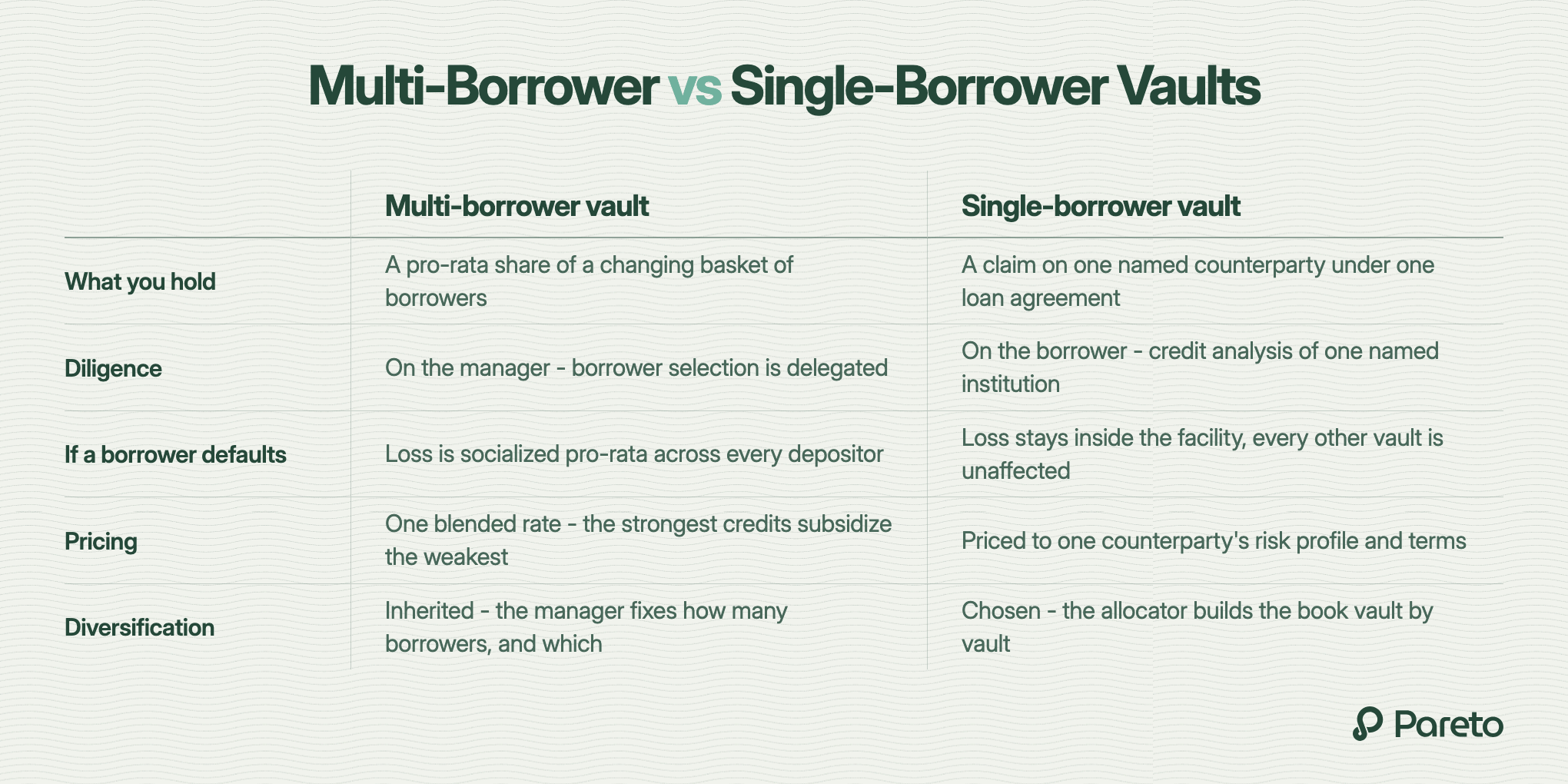
In a multi-borrower vault, your deposit represents a pro-rata share of everything the vault holds. That composition shifts as the manager originates new loans, rolls old ones, and rebalances between borrowers - so your effective exposure changes over time without any action from you. Diligence in this model means diligence on the manager: their track record, their process, their mandate. Borrower selection is delegated entirely.
In a single-borrower vault, the position maps to one counterparty. The loan documentation, the borrower's business, and the facility's terms are specific and inspectable before you commit capital. Diligence means credit analysis of one named institution - the work professional lenders already know how to do.
A practical test: ask a lender "who owes you money?" In a single-borrower vault, the answer is one name. In a multi-borrower vault, it's a list someone else compiled, and it can change tomorrow.
In a multi-borrower vault, a borrower default is socialized. Every depositor absorbs a pro-rata share of the loss, including those who would never have approved that borrower on their own. And because the vault is a shared balance sheet, stress propagates: withdrawals triggered by one bad exposure can strand or dilute everyone else. Some of onchain credit's most painful episodes in 2022 followed exactly this path - depositors exposed to borrowers they never chose.
Crypto Investment Firm Blockwater Technologies Defaults on DeFi Loan
The South Korea-based crypto investment firm failed to make a payment on a $3.4 million loan to TrueFi, a decentralized lending protocol.

In a single-borrower vault, a default stays inside that vault, and the lenders who chose the exposure bear the outcome.
Pooled structures can wall their pools off from one another too. What differs in the single-borrower model is the unit being walled off: one credit, selected by the lender. Risk isolation becomes a per-counterparty property - something that can be assessed, priced, and monitored one name at a time.
A multi-borrower vault pays one blended rate across borrowers of different quality. By construction, the strongest credits in the basket subsidize the weakest. Credit markets have a name for what happens next: adverse selection. The best borrowers, who can obtain tighter pricing elsewhere, gradually leave, while the vault retains those content to pay the blended rate. Quality drifts, and the headline yield rarely shows it.
A single-borrower vault is priced on its own. The rate reflects one counterparty's risk profile and one facility's terms. That lets an allocator ask the precise question every credit decision comes down to: does this yield compensate me for this specific risk? In a multi-borrower vault, that question often has no answer. In a single-borrower vault, it can be answered with precision.
The strongest argument for the multi-borrower vault is fast portfolio diversification: one deposit, instant spread across many counterparties, and no need to underwrite each one.
But portfolio diversification has two components - how many borrowers you are exposed to, and which ones. A multi-borrower vault fixes both on your behalf. You inherit its concentration choices, its sector tilts, and its worst line item.
Taken alone, a single-borrower vault is a concentrated position: all of that exposure sits with one counterparty, and nothing inside the vault offsets it. That is why diversification moves to where institutions normally keep it: the allocator's own portfolio. An allocator selects vaults, sizes positions, sets weights, and rebalances under their own mandate. The result can be just as diversified as any multi-borrower vault - spread across multiple named exposures - while every position stays transparent and independently priced. This is how institutional credit books are run in every other market.
Diversification you choose, rather than diversification you inherit.
The multi-borrower vault is built for convenience - one deposit and immediate exposure to multiple borrowers. For capital that intends to delegate selection, those are real advantages. The costs sit deeper in the structure: exposure that changes without the depositor's decision, a rate that corresponds to no single borrower's risk, and usually no boundary around losses when a borrower fails.
The single-borrower vault asks more of the lender: real diligence, deliberate allocation, ongoing monitoring. In exchange, it preserves the three disciplines institutional credit has always depended on - knowing your counterparty, containing your losses, and pricing your risk.
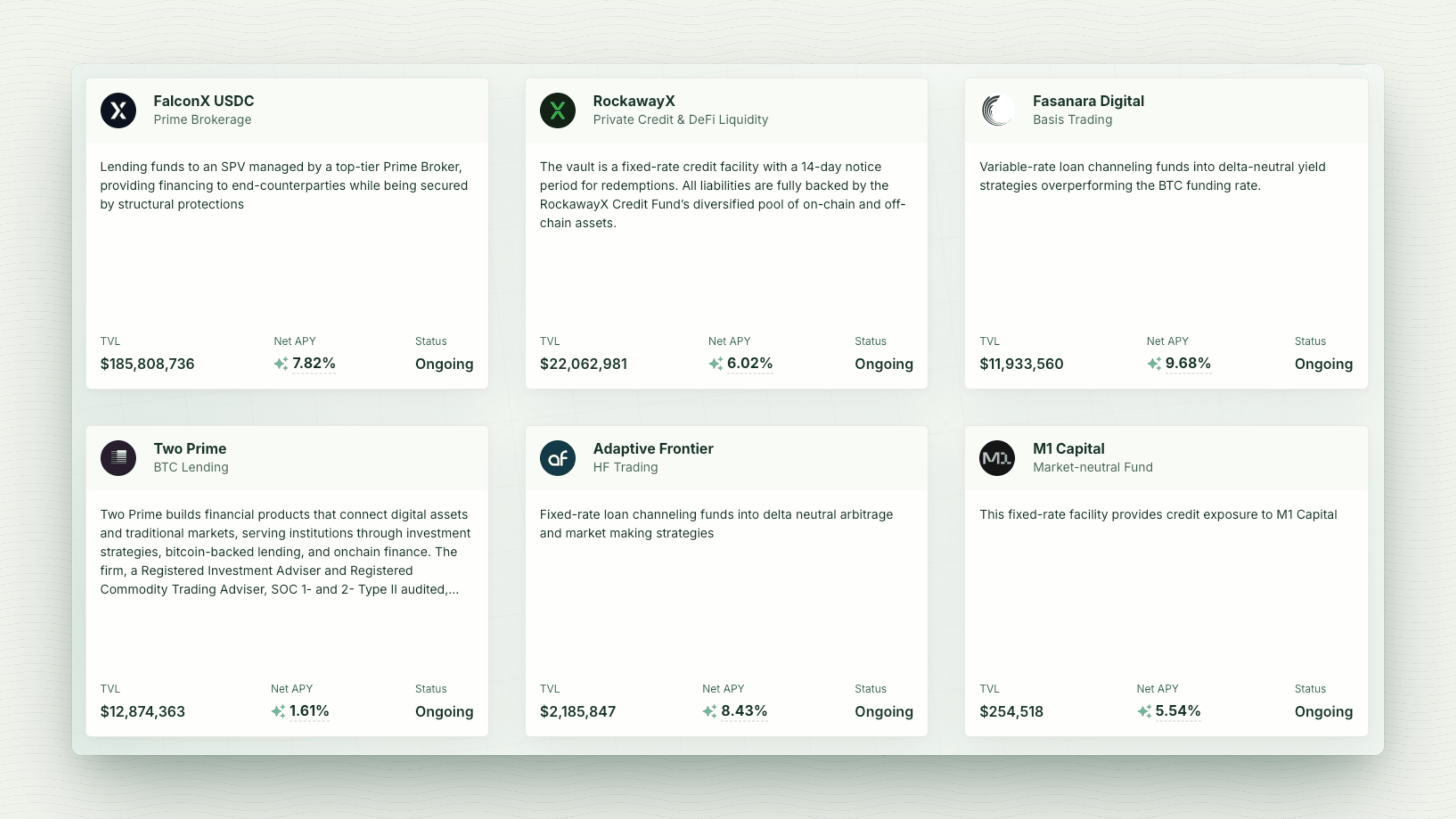
This is the architecture Pareto's Credit Vaults are built on: each one a segregated, single-borrower credit facility with a named institutional borrower, a named underwriter responsible for terms and risk parameters under a Master Loan Agreement, and KYB/KYC onboarding for every participant.
If your team is evaluating onchain credit structures and weighing these trade-offs, we're glad to compare notes.
Not investment advice. Always do your own research.
Pareto is an onchain private credit infrastructure provider for institutions and corporates, offering lenders yield-generating opportunities and borrowers seamless access to capital.
Tailored for asset managers, digital asset funds, fintechs and other professional market participants, Pareto provides access to regulatory-compliant alternative credit products through its Credit Vaults, alongside whitelabel infrastructure that enables partners to launch and distribute vaults under their own brand.