
Private credit pays lenders a premium for one thing above all: patience.
Capital goes in, a loan cycle runs, and the yield compensates for the wait. The model works - until a lender needs their capital back before the borrower is due to return it.
That moment - the early exit - is the one part of private credit that market infrastructure has never fully solved. It is also a trade in its own right: whoever fronts the cash for an early exit earns a premium for the wait. An entire class of capital specializes in it - credit secondaries funds in traditional markets and, increasingly, the teams providing instant liquidity for tokenized RWAs onchain.
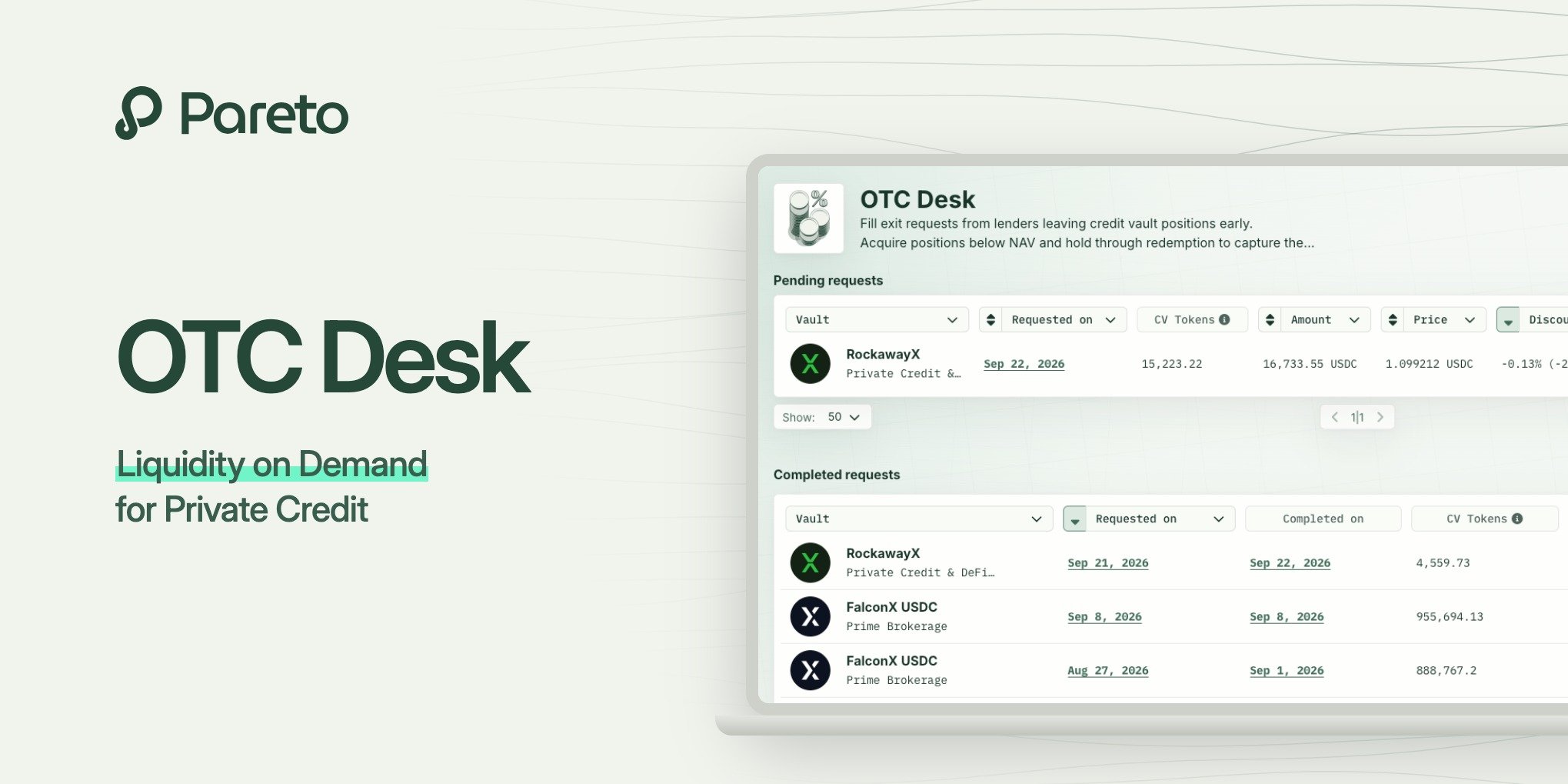
OTC Desk was built for both sides of that trade: an exit lane for liquidity providers in Pareto's Credit Vaults, and short-duration credit exposure for willing buyers on the other side - e.g. instant RWA liquidity providers, looking for higher yield on their idle stablecoins. To see why that matters, it helps to look at how exits work across credit markets today.
In traditional fund structures, exit means redemption windows and gates.
Semi-liquid vehicles - a segment that grew from roughly $10 billion in 2019 to over $300 billion by 2025 - typically cap withdrawals at around 5% of net assets per quarter.
Example: when redemption requests at Cliffwater's $33 billion interval fund hit 14% in March 2026 and ~17% in June, exiting lenders were paid out only pro rata, and the unfilled remainder had to wait for the next redemption window.
A stark reminder that in such cases a quarterly gate is a queue, not an exit.

The TradFi secondaries market is the other route: sellers accept a discount to NAV, and dedicated buyers like @ares_management and Coller Capital provide the liquidity - roughly $20 billion of it in 2025. But every sale is a bilateral negotiation: it takes weeks to months, and the price is visible only to the two parties in the room.
Onchain credit markets have already moved the needle here.
Positions live as transferable tokens, and redemption cycles typically run in weeks rather than quarters - a real improvement over the fund structures above.
But the underlying constraint carries over: exits still flow through redemption windows and withdrawal queues, and between those windows a credit token needs a venue to trade on.
To sum up - lenders can access liquidity early, but only through a gate, a queue, or a weeks-long negotiation. And in traditional markets, the premium for providing that liquidity goes to whoever has the relationships and legal infrastructure to run bilateral deals - a club most allocators will never join.
We built OTC Desk to compress the whole process into a single onchain transaction, and to open the buy side to anyone.
OTC Desk unlocks a native secondary liquidity mechanism, now available across selected Credit Vaults on Pareto. The mechanics fit in four steps:
A lender needs liquidity, so it posts a callback request. It offers its Credit Vault position at a discount it chooses. Example: a lender holding 1m Credit Vault tokens - CV tokens - valued at ~$1.075 each posts a request at a 30bps discount, offering to exit immediately at ~$1.072 per token instead of waiting out the loan cycle.
Credit Vaults positions normally lock capital until the end of the loan cycle.
OTC Desk adds an early exit lane: a lender offers their credit position at a discount, in exchange for immediate liquidity.
The size of the discount is up to LP.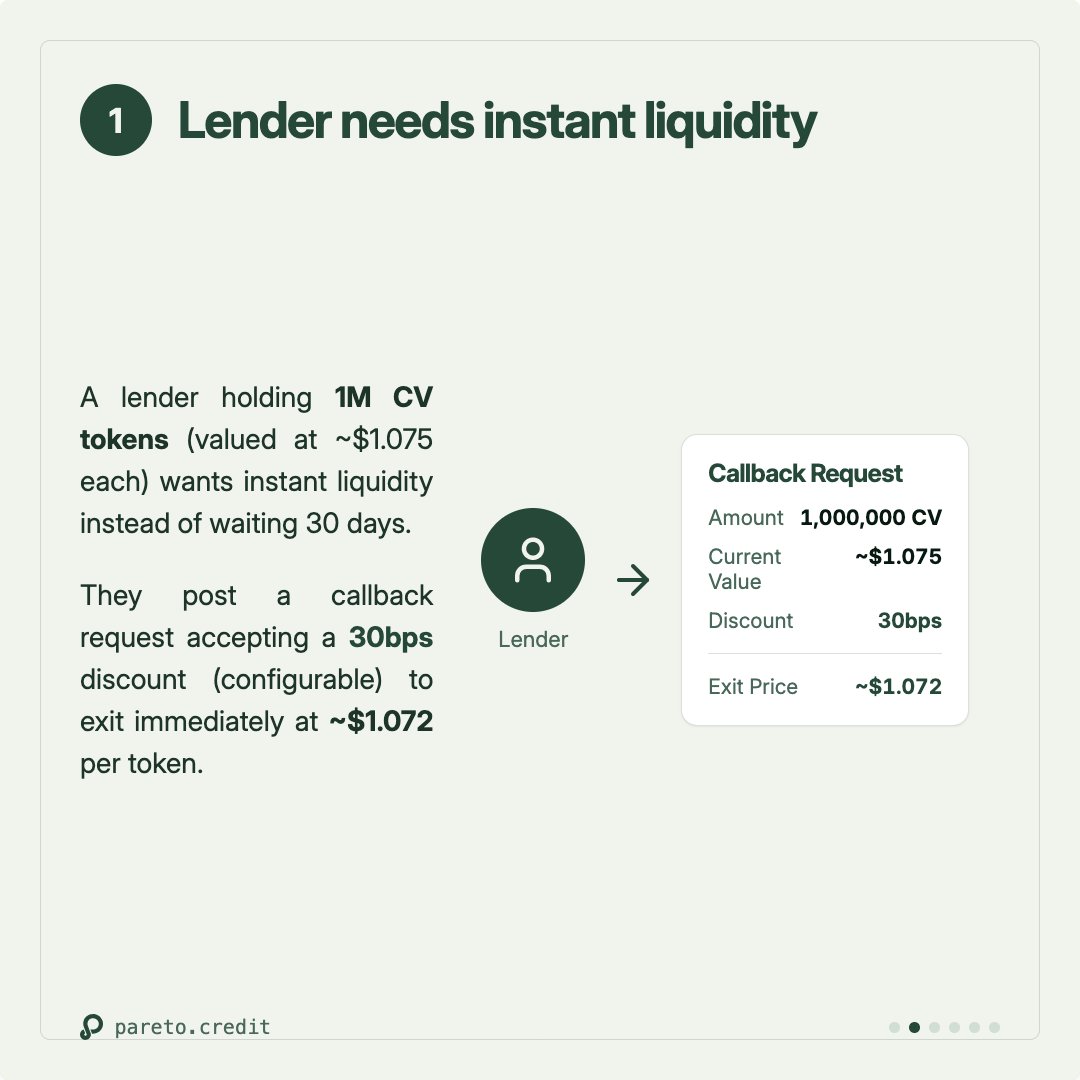
Anyone can settle it. Any willing buyer sends USDC and receives the CV tokens at the discounted price. The buyer locks in an immediate gain relative to the position's current value, and all future yield flows to them until maturity.
Redeeming the position requires the buyer to complete KYC.

The buyer pays the lender in stablecoins and gets the position in return - at a discount to its current value, with all future yield now flowing to them.
Both sides win.

If no one settles, the discount grows. The lender's asking price stays fixed in USDC, while the CV token keeps accruing value day by day. As time passes, the token's value rises further above the asking price, so the buyer's discount widens - much like in a Dutch auction - until it becomes attractive enough to fill. The lender takes no further action and always receives the USDC amount they requested and always receives the USDC amount they requested.
If no buyer steps in right away, the discount grows automatically over time until the offer becomes attractive enough to fill.
The lender doesn't have to take any extra action - the market finds its clearing price on its own.
The LP can, however, set the max. rebate it's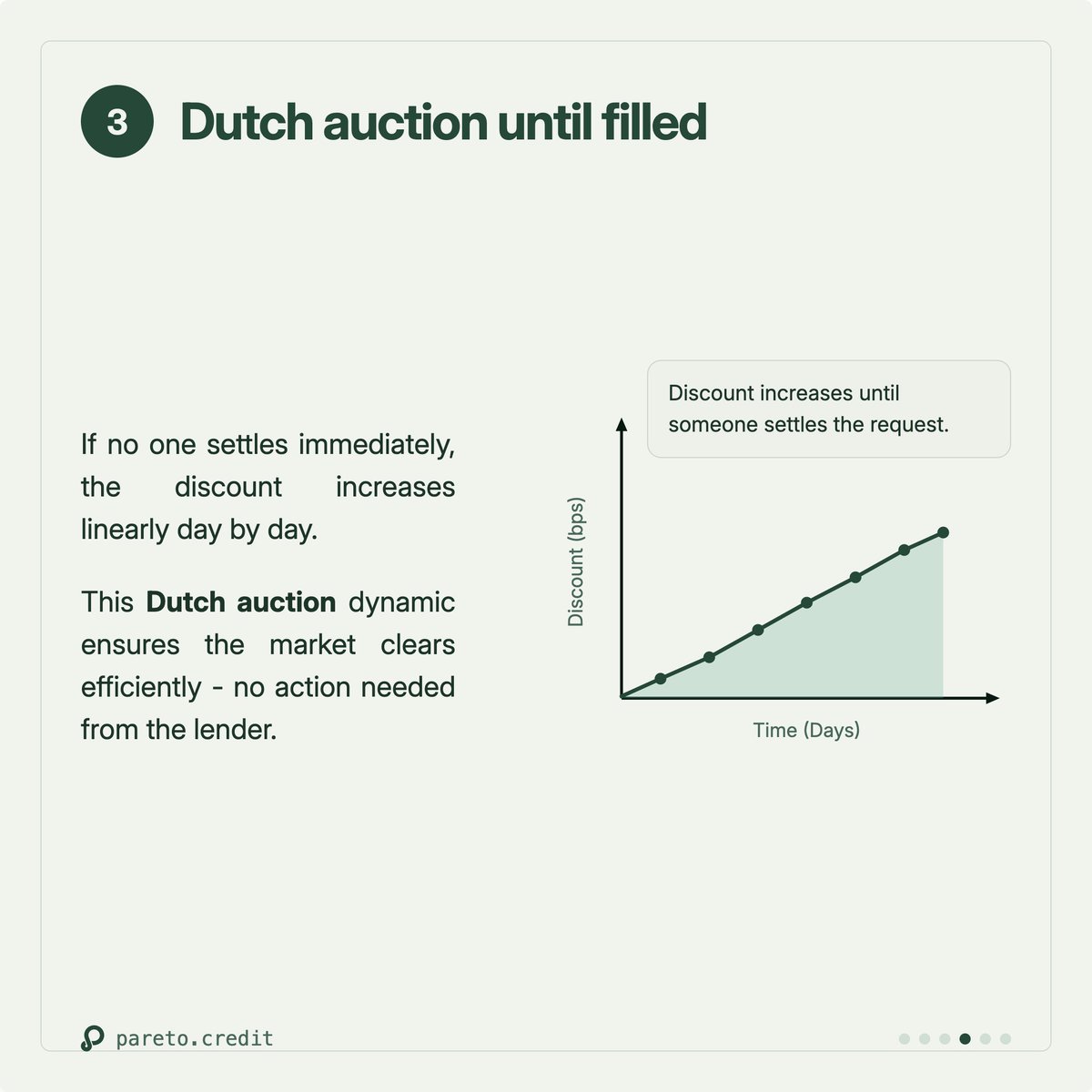
Settlement is atomic. Stablecoins and CV tokens change hands in one transaction. No transfer agreements, no settlement lag, no counterparty risk in between.
Net effect: Credit Vault positions get a built-in secondary market - open to anyone, transparently priced, settled onchain in one transaction.
Liquidity on demand for lenders, discounted credit exposure for buyers.
The net effect: Credit Vault positions carry a built-in secondary market - open to anyone, transparently priced, settled onchain in one transaction.
Lenders get liquidity on demand at a cost they control.
Buyers get discounted entry into credit positions that normally require waiting for a deposit window.
The buyer's side of that trade deserves a closer look, because it is what makes the market clear. A settled callback delivers three layers of return:
the discount itself, locked in at settlement
the position's full yield until maturity
repayment at face value when the loan cycle ends
In the TradFi secondaries market, that package is what allocators are paying record volumes to access.
Here, it sits onchain, open to any address, priced by auction rather than by negotiation.
A growing set of teams specializes in bridging settlement gaps for tokenized RWAs - fronting liquidity and earning a premium for the wait.
OTC Desk gives that standby capital a priced, onchain venue:
Grove Basin bridges the T+1/T+2 settlement gap for tokenized RWAs with up to $1B in committed daily liquidity. Between settlement events, that capital sits on standby. OTC Desk lets Basin put it to work: take over a discounted Credit Vault position, inherit its full yield until maturity, and post a callback of its own if the liquidity is needed back.
Symbiotic Liquid Lane gives RWA holders instant USDC exits: market makers buy the position and hold it until the issuer redeems. When that position is a Credit Vault token, a callback request lets them exit sooner and redeploy into the next trade. Between trades, Liquid Lane's vault capital can settle discounted callbacks for extra yield.
Upshift Clear keeps a USDC pool ready to pay out RWA redemptions instantly. Between redemptions, that pool earns basic lending yield. Discounted Credit Vault positions offer a higher-yielding alternative, and the Dutch auction lets Upshift wait for its target discount before stepping in.
3F and Keyring rwa [un]wind work the leverage side: building and exiting leveraged RWA positions, where the hard part is selling the underlying asset mid-cycle. When that underlying is a Credit Vault position, a callback request posted through the OTC Desk is the exit.
Agra runs liquidity vaults that buy tokenized credit below NAV - their core challenge is sourcing sellers. OTC Desk is exactly what those vaults look for, turning every Credit Vault position on Pareto into a potential buy.
Each of these is a variation on the same trade: deploy stablecoins, take a discounted credit position, earn the discount plus the residual yield, and recover full value at maturity.
Private credit's illiquidity has always been a consequence of market structure: bilateral deals, negotiated transfers, no shared venue.
OTC Desk replaces that structure with a standing, transparent, permissionless order flow for credit positions.
Live now for FalconX Credit Vault and RockawayX Credit Vault on Pareto: https://app.pareto.credit/otc-desk
Not investment advice. Always do your own research.
Pareto is an onchain private credit infrastructure provider for institutions and corporates, offering lenders yield-generating opportunities and borrowers seamless access to capital.
Tailored for asset managers, digital asset funds, fintechs and other professional market participants, Pareto provides access to regulatory-compliant alternative credit products through its Credit Vaults, alongside whitelabel infrastructure that enables partners to launch and distribute vaults under their own brand.