

The Aave protocol, canonically referred to as “Aave,” is a decentralized, open source, finance protocol that is designed to facilitate lending and borrowing of cryptocurrencies in a secure, trustless, and efficient manner through various interfaces and direct smart contract interactions. All of the financial services on Aave are fulfilled via code without any bank or other intermediary mixed in!
Depositors provide liquidity to the market and earn passive income, while borrowers have the flexibility to access funds either with over-collateralization for sustained borrowing or under-collateralization for quick liquidity (i.e., flash loans). Supplied funds are stored securely in audited smart contracts, known as liquidity pools, and users can withdraw them or convert supplied tokens into aTokens (e.g., if you supply ETH you can be given aETH in return) for trading as standard crypto assets within other decentralized finance (DeFi) platforms.
Known for it’s many services, Aave has 5 key sticking points and services that are as follows:
1. Lending and Borrowing: Aave allows users to lend their cryptocurrencies to the protocol, becoming liquidity providers. In return, they earn interest on their deposited assets. On the other side, borrowers can use their deposited assets as collateral to take out loans in the form of other cryptocurrencies. This creates a decentralized lending and borrowing marketplace.
2. Dynamic Interest Rates: Aave pioneered the concept of variable interest rates in DeFi. Interest rates are determined algorithmically based on the supply and demand for specific assets, creating competitive and dynamic borrowing costs.
3. Safety and Security: Aave prioritizes security through the use of smart contracts and decentralized governance. It also offers features like "Flash Loans," which are uncollateralized loans that must be repaid within a single Ethereum transaction, adding a layer of safety for borrowers.
4. Governance: Aave is a decentralized autonomous organization (DAO), meaning that governance decisions, such as protocol upgrades and changes to parameters, are made by AAVE token holders. This empowers the community to steer the protocol's direction.
5. Innovation: Aave has been at the forefront of DeFi innovation, introducing features like "Aavegotchi" and "Credit Delegation" that expand the utility of the protocol and push the boundaries of what DeFi can achieve.
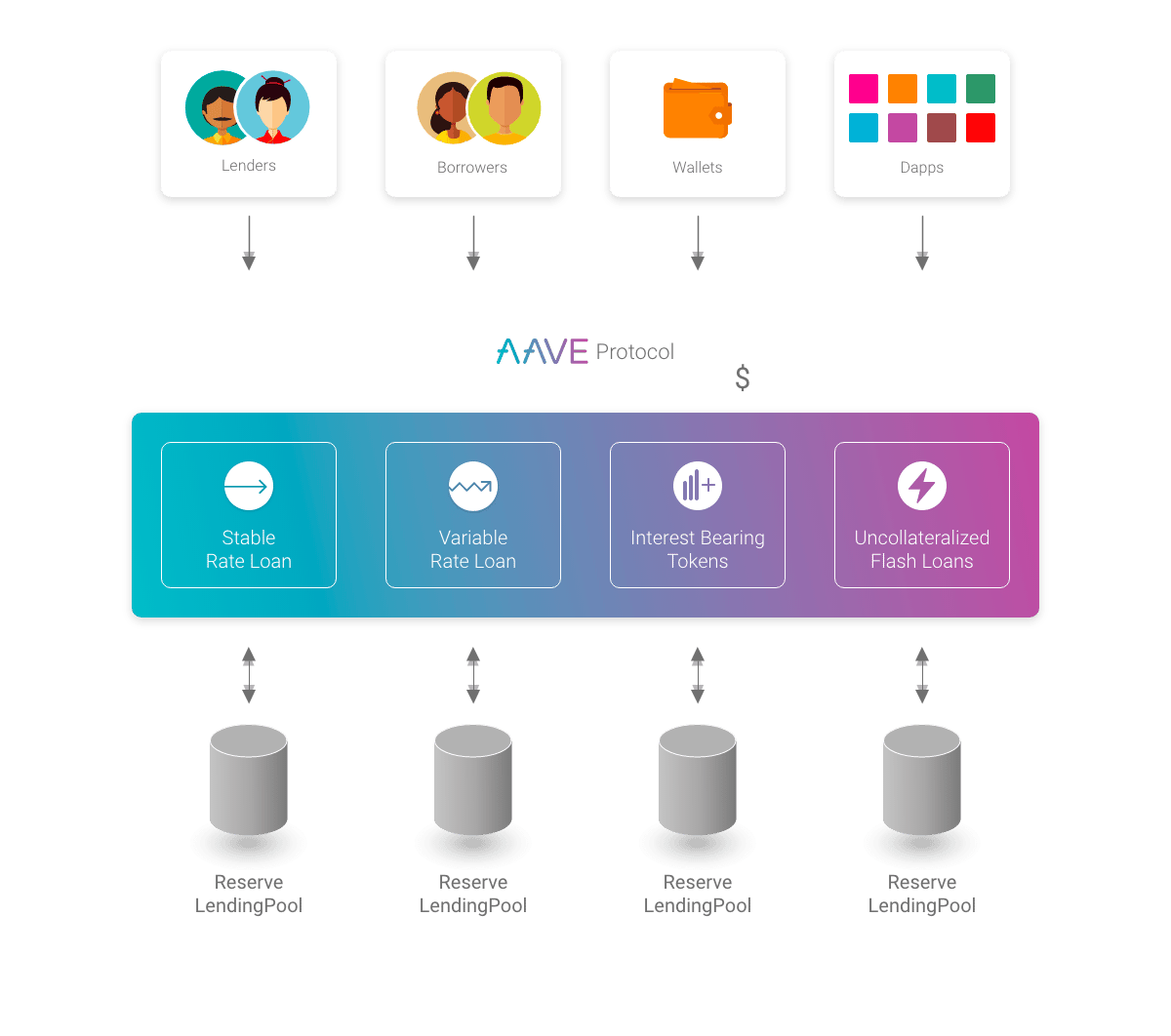
The Aave protocol sits on 9 distinct blockchain networks, comprised of:
Four Layer 1 chains: Ethereum, Fantom, Harmony, and Avalanche
Five Layer 2 solutions: Polygon, Optimism, Base, Arbitrum, and Metis
All contributing to a total value locked (TVL) of $7 billion across these various chains and networks.
Aave has played a significant role in the growth and development of the DeFi ecosystem by contributing to the financial empowerment of individuals and continues to drive innovation across Web3.
Every asset boasts its own unique supply and demand market, along with its evolving Annual Percentage Yield (APY). For an accurate rate evaluation, you can check the 30-day average annual rate trend within the app's home section, along with more in-depth asset information. To get started, you can simply connect your wallet to the Aave app and deposit your crypto asset(s) into your chosen liquidity pool.
Calculating the APY per token hinges on two factors:
Interest Rate Payment on Loans: Suppliers earn from borrower interest payments, proportional to the average borrow rate and utilization rate. Higher reserve utilization equates to increased supplier yields. You can visualize this mechanism in the borrow interest rate model spreadsheet.
Flash Loan Fees: Suppliers also get a share of Flash Loan fees, equal to 0.09% of the Flash Loan volume.
Additionally, Aave V3 introduced a supply cap parameter, subject to Aave Governance control. When a reserve has a supply cap, it imposes a ceiling on the total amount of an asset that can be supplied.
Borrowing on Aave is a very straightforward process:
Supply Collateral: Start by depositing assets as collateral on Aave.
Check Borrowing Limit: Aave calculates your borrowing capacity based on your collateral value.
Borrow: You can now borrow up to your calculated limit in the cryptocurrency of your choice.
Repay with Interest: Repay the loan in the same cryptocurrency, including any accrued interest.
No Fixed Term: Aave loans have no set term, but watch for interest accumulation and your health factor to avoid liquidation risk.
Additionally, Aave offers two types of interest rates:
Stable Rate: These rates are initially fixed, offering predictability in the short term. However, they can adjust in response to market changes over the long term, ensuring stability. It's ideal for planning interest payments and preventing excessive borrowing at rates below the market variable rate.
Variable Rate: These rates are influenced by supply and demand within the Aave platform. They fluctuate with market conditions, making them suitable when market rates are optimal.
Don’t sweat choosing which rate you want, if you pick one you are not satisfied with you can switch between the two rates at any time through the Aave dashboard!
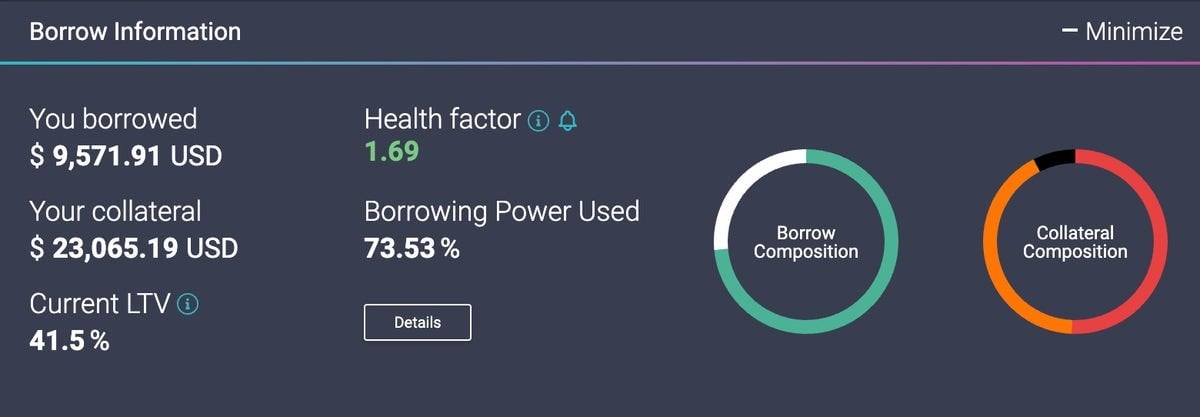
Aave uses a Health Factor (HF) — a numeric representation of the safety of your deposited assets against the borrowed assets and its underlying value — to measure the safety of your assets. A higher HF indicates safer funds, while a value of 1 or less can trigger liquidation.
Imagine this: You borrow $1,500 USDC worth of ETH at 0% APR, using 1.5 ETH as collateral when ETH is $1,500 in USD. Your Health Factor (HF) is 1.5 ($2,250/$1,500).
Fast forward 6 months, your $1,500 USDC loan is unpaid, and ETH's price has dropped to $1,000. Now, your HF is 1 ($1,500/$1,500), making you eligible for liquidation.
To keep things safe, aim to maintain a HF above 2—it's your cushion against liquidation risks!
Liquidation in Aave is a protective process triggered when a borrower's HF drops below 1, signifying an unsafe financial position. This decline might result from a decrease in collateral value or an increase in the borrowed amount. When liquidation occurs, the Aave protocol utilizes the borrower's collateral to repay the outstanding debt by selling it on the open market. Liquidators, participants in the process, purchase the collateral at a reduced rate, repay the loan, and earn a reward in the form of a portion of the liquidated assets. Any remaining collateral, obtained at a discounted rate, is then returned to the borrower. Liquidation is a vital mechanism that upholds the security of deposited assets and safeguards lenders' interests, emphasizing the importance of borrowers maintaining a healthy HF to prevent liquidation.
The Aave token, or AAVE, serves as the central element of the Aave Protocol's governance, enabling users to actively participate in the decision-making process through voting on Aave Improvement Proposals (AIPs). Additionally, AAVE can be staked in the protocol's Safety Module, enhancing the platform's security and offering insurance to both the protocol and suppliers. Stakers receive rewards and protocol fees for their contributions.
The AAVE token also comes with several advantages for users, such as: reduced fees on the platform and governance capabilities, empowering users to vote on crucial decisions that shape the platform's future and development. Additionally, as AAVE is an Ethereum-based token, it can be bought, traded, lent, and sold just like any other crypto asset within the DeFi ecosystem!
Governance and voting with the AAVE token on the Aave platform are essential for shaping the platform's future and making critical decisions. There are 5 distinct steps from initiation to implementation to pass an enhancement through Aave governance:
Proposal Submission: Any AAVE token holder can submit a proposal through the Aave Improvement Proposal (AIP) process. These proposals can encompass various topics, such as changes to protocol parameters, new features, or adjustments to the platform's smart contracts.
Discussion Period: Once a proposal is submitted, it undergoes a discussion period to allow the community to review and assess the proposal's merits. This enables open discourse and idea refinement.
Voting: After the discussion period, the proposal enters the voting phase. AAVE token holders can cast their votes to approve or reject the proposal. Voting weight is determined by the number of AAVE tokens held.
Quorum and Threshold: For a proposal to be accepted, it must meet specific quorum and approval thresholds. The quorum represents the minimum percentage of the total AAVE supply that needs to participate in the vote for it to be valid. The approval threshold is the minimum percentage of votes in favor required for the proposal to pass.
Execution: If a proposal meets the quorum and approval thresholds, it is executed, and the changes outlined in the proposal are implemented.
Overall, AAVE token holders play a vital role in shaping Aave's governance and direction, ensuring the platform remains secure, efficient, and adaptable to changing market conditions and user needs.

The Aave Grants DAO is dedicated to providing financial support to projects, initiatives, and events that contribute to the growth and enhancement of the Aave ecosystem. The program prioritizes the empowerment of a diverse network of developers, DeFi projects, community builders, and any endeavors that benefit the broader Aave community. It originated from a community-driven discussion in May 2021 and was reaffirmed in January 2023, emphasizing the ongoing commitment to fostering innovation and collaboration within the Aave ecosystem.
Eligible grant funding areas for Aave Grants DAO encompass protocol development, applications, developer tools, code audits, Aave ecosystem-serving committees and DAOs, community initiatives, and events/hackathons.
As of today, the Aave Grants DAO has supplied roughly $5M in funding since its inception and over $874k in 2023.

GHO is a decentralized stablecoin (i.e., pegged 1:1 with $USD) tied to the Aave Protocol. To create GHO, you need to supply assets into the Aave Protocol as collateral. You can then borrow GHO against this collateral, similar to how you'd borrow any other asset on the platform. Initially, assets available within the Aave Protocol, such as Ethereum, can be used as collateral for GHO. The Aave DAO manages GHO's supply, interest rates, and risk parameters, ensuring decentralized governance. Repaid interest from GHO loans contributes to the DAO's treasury.
Unlike many stablecoins, GHO has a fixed price determined by an oracle, and its interest rates are set by the Aave DAO. Those who stake AAVE tokens in the Safety Module are eligible for discounts on GHO borrowing rates, a model that can be adjusted by the Aave DAO. Additionally, GHO can be used in flashloans, a unique feature in the cryptocurrency world allowing quick borrowing and lending of GHO.
Currently, however, GHO has lost its peg and has had trouble reclaiming parity with the US Dollar — currently sitting at roughly $0.97 at the time of this writing. Experts blame the performance of GHO on the lack of a formal redemption mechanism and weak demand for the new token, with many believing the peg problem can only be solved by allowing users to exchange GHO for their underlying collateral.

The Lens Protocol, operating on the Polygon proof-of-stake blockchain as a Web3 social graph, aims to give creators control over their social connections. Unlike conventional social networks that centralize user data, Lens Protocol provides a user-owned, open social graph that can be seamlessly integrated into any application. This empowers users to move their data across different apps, ensuring data portability and eliminating concerns about content loss due to platform policies or algorithms. Lens Protocol also promotes collaboration within its ecosystem, allowing developers to craft meaningful social experiences without the need for aggressive user attention strategies. Currently, Lens is in a closed beta phase, and the only way to gain access is by requesting a Lens Profile via Mainnet here.
If you liked what you read please subscribe, share, and follow us on X!
https://nomics.substack.com/p/aave-explained-your-entry-into-the