

"Building a StoryBrand: Clarify Your Message So Customers Will Listen” by Donald Miller offers businesses a practical framework for enhancing their brand messaging. The book centers around the concept that businesses should position themselves as guides to help customers, the heroes of their own stories, resolve their problems and attain their goals. Miller provides a seven-part framework for crafting a compelling brand message, emphasizing storytelling elements and the importance of simplicity and clarity. Through practical examples and case studies, the book equips businesses with actionable insights for more effective communication and branding, making it a valuable resource for those seeking to create a captivating brand story and better engage their audience.

Miller underscores the fundamental principle that customers are primarily interested in their own stories, not the backstory of a brand. He emphasizes that attractive websites alone don't drive sales; it's the words used in the messages that make the difference. Successful brands are not only focused on delivering their products but also on clearly communicating why these products are essential in customers' lives. The power of simplicity and predictability in communication is stressed, as our brains naturally prefer easy-to-digest information. Storytelling is highlighted as a valuable tool for making sense of complex information. Two common mistakes brands make are failing to address how their offerings benefit customers' survival and well-being, and causing confusion by making the audience work too hard to understand their message. In an age where attention is a scarce commodity, clear and concise narratives are key to capturing and maintaining customer interest. As in skilled writing, it's not just about what is said but also about what is left unsaid that makes a message compelling and effective.
The unrivaled potency of storytelling is a means to break through the cacophony of information and distractions. Miller contends that a well-crafted narrative distills the essence of seemingly random events, making them profoundly relevant. The crux of successful marketing lies in presenting products or services in a way that swiftly resonates with the audience's understanding. In a world rife with competing messages, both businesses and compelling stories grapple with the same adversary: noise. Miller advocates for the art of streamlined storytelling, advocating that anything extraneous to the central plot should be excised. He underscores the critical importance of enabling customers to answer three fundamental questions within mere seconds of encountering a brand: What is offered, how it enhances their lives, and what steps are necessary to obtain it. These principles serve as a practical guide for crafting captivating brand narratives that effectively engage a time-poor and easily distracted audience.
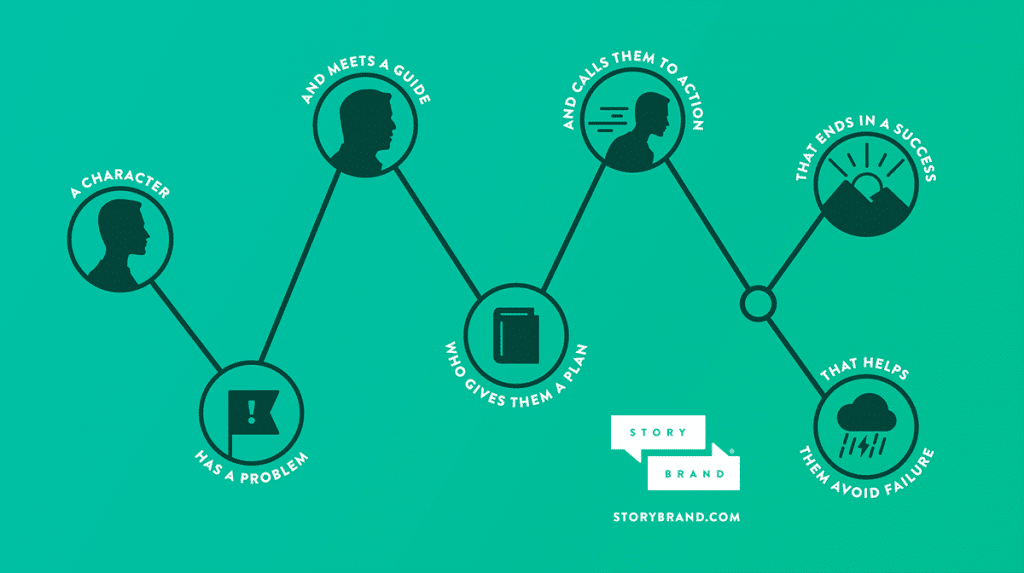
The StoryBrand framework focuses on and uses the “7 elements of great storytelling to grow your business,” which are as follows:
A Character – The Customer Is The Hero, Not Your Brand
Has A Problem – Companies Tend To Sell Solutions To External Problems, But Customers Buy Solutions To Internal Problems
And Meets A Guide – Customers Aren’t Looking for Another Hero; They’re Looking For A Guide
Who Gives Them A Plan – Customers Trust A Guide Who Has A Plan
And Calls Them To Action – Customers Do Not Take Action Unless They Are Challenged To Take Action
That Helps Them Avoid Failure – Every Human Being Is Trying To Avoid A Tragic Ending
And Ends In Success – Never Assume People Understand How Your Brand Can Change Their Lives; Tell Them
In branding, it is essential to identify and define something your customers want because doing so sets the stage for a compelling narrative. Once you've pinpointed a desire, you create a story question in your customer's mind: "Can this brand truly help me achieve what I want?" By defining what your customers desire, you invite them to align their story with your brand. Trust and reliability play a crucial role here; if they see your brand as a trustworthy guide, they're more likely to engage. This process introduces what's often referred to as a "story gap."
A common pitfall in defining customer desires is failing to focus on a single, clear objective. At the highest level, the challenge for business leaders is to identify something simple, yet highly relevant to their customers' survival, and then become known for consistently delivering on that promise. Consider desires tied to survival mechanisms, such as: conserving financial resources, conserving time, building social networks, gaining status, accumulating resources, and nurturing the innate desires for generosity and meaning. By addressing these core desires, brands can resonate deeply with their audience and craft a narrative that truly connects.
In the realm of storytelling and marketing, understanding the customer's problem is the essential "hook" for a compelling narrative. Without a clear identification of the problem, the story falls flat, as the resolution of conflict typically marks the point where audiences disengage. To maintain interest, it's crucial to delve into the problems customers face. A good villain, the source of the problem, should be relatable, singular, and real. Customers, like heroes, encounter three levels of problems: external, internal, and philosophical. Companies often focus on selling solutions to external issues, but the real power lies in addressing internal dilemmas. By framing products as solutions to both external and internal problems, their perceived and actual value increases. Furthermore, creating a narrative that addresses philosophical problems, using terms like "ought" and "shouldn't," adds depth and meaning to the customer's journey, making them part of a larger narrative. To foster business growth, it's critical to position products as resolutions to external, internal, and philosophical problems, with the "Buy Now" button signifying the customer's action to achieve story closure.

Understanding that heroes often need guides is vital. Trying to make your brand the hero is a common and risky mistake. The key to success lies in consistently positioning the customer as the hero and your brand as the trusted guide. This partnership is the foundation for a compelling brand narrative.
As a guide, your brand should embody two essential qualities: empathy and authority. Empathy builds trust by demonstrating a deep understanding of your customers' challenges, creating authentic connections. Recognizing shared values and thinking patterns can further strengthen this connection. Avoid coming across as a know-it-all or adopting a preachy tone, as these can alienate your audience. Instead, utilize tools like testimonials, statistics, awards, and logos to establish your brand's authority.
Trust and respect are pivotal in branding. People instinctively ask, "Can I trust this brand?" and "Can I respect this brand?" The ability to answer these questions shapes your brand's success. Trust forms the initial foundation, allowing customers to explore your brand more deeply. Ultimately, embracing the role of a guide paves the path to success. Empowering your customers as the heroes of their stories while you serve as the guide sets the stage for their triumph.
A plan acts as the bridge that guides the hero (your customer) towards the climactic scene (a successful business interaction). Plans come in various shapes and sizes, but their ultimate purpose is to achieve one of two key objectives: to clarify the process of doing business with your brand or to eliminate any reservations or risks customers might have when considering an investment in your products or services.
Two types of plans prove particularly effective in encouraging customer engagement:
The Process Plan outlines the steps customers need to take, whether it's purchasing your product or utilizing it after purchase, thereby simplifying their journey and removing confusion. To ensure success, it's recommended that such plans consist of at least three steps but no more than six, as inundating customers with information tends to deter purchases.
The Agreement Plan, on the other hand, is all about alleviating customer fears. It operates as a list of agreements made with your customers to assuage their concerns regarding doing business with your brand. By addressing potential customer worries and offering reassuring agreements, you not only ease apprehensions but also enhance the perceived value of the services you promise to deliver.
In essence, effective plans play a pivotal role in facilitating customer engagement by reducing confusion and dispelling fears, thereby paving the way for fruitful business interactions.

The art of a bold and compelling call to action is paramount. Soft or vague calls to action risk being overlooked in this sea of information. One common misconception hindering business success is the assumption that customers can read our minds. To capture attention and guide customers effectively, a strategically placed "Buy Now" button, uncluttered by other distractions, should grace the top right corner of your website. Repeating this clear call to action above the fold and in the center of your page, as customers scroll down, ensures it remains in focus.
Inviting customers on a journey is essential; passive selling often conveys a lack of belief in your product. Two types of calls to action prove invaluable: Direct Calls to Action, such as "Buy Now" or "Schedule an Appointment," directly leading to a sale or initiating the path toward one, and Transitional Calls to Action, inviting customers to watch webinars or download PDFs, which involve less risk and often offer something for free, gradually on-ramping potential customers towards a purchase. Effective transitional calls to action can stake a claim to your territory, create reciprocity, and position your brand as the guide. Ideas for transitional calls include free information, testimonials, samples, and free trials. To deepen the positive customer experience and increase the perceived value of products, defining the stakes in the customer's story, clarifying what's at risk in their decision to do business with you, is crucial for making the narrative engaging.
Highlighting potential loss as a storytelling and behavioral economics tactic holds significant sway. *Prospect theory *suggests that people are generally more dissatisfied with a loss than satisfied with a gain, reflecting a greater aversion to losing $100 than the joy of winning the same amount. This insight underscores that loss aversion serves as a more potent motivator in purchasing decisions than potential gains. Individuals are two to three times more driven to take action when seeking to avoid loss compared to pursuing gains.
A four-step fear appeal process becomes a valuable tool in leveraging this psychological aspect: it begins by making readers or listeners aware of their vulnerability to a threat. Subsequently, it emphasizes the need to take action to reduce this vulnerability and introduces a specific call to action for protection. Finally, it challenges individuals to undertake this specific action. The key lies in striking a balance; high levels of fear may be overwhelming, leading to psychological defense mechanisms, while low levels lack the necessary impact. Messages that contain moderate amounts of fear-rousing content tend to be most effective in influencing attitudes and behaviors. Ultimately, this approach prompts us to consider what negative consequences we are aiding customers in avoiding, thereby creating more compelling and effective marketing strategies.

A key principle is understanding that people seek guidance and direction. Successful leaders and brands effectively convey how life will improve through their products or services, promising a positive outcome. Avoid vague visions, as compelling stories are specific and clear. To craft a persuasive narrative, create a grid outlining the transformation customers will experience after engagement. Communicating this transformation is essential across all platforms, from keynotes to websites, while visual elements play a vital role in illustrating this vision. In storytelling, common conclusions involve achieving status, providing external support for completeness, and realizing one's full potential. Brands can fulfill the desire for status by offering access, creating scarcity, and establishing identity associations. Additionally, they can assist customers in attaining completeness by reducing anxiety, lightening their workload, and providing more time. Ultimately, brands can foster self-realization and acceptance through inspiration, acceptance, and the promise of transcendence.
At the core of every customer's motivation lies the powerful desire for transformation. People universally seek change and aspire to become better, different, or more self-accepting. As a brand, understanding how your customers wish to be perceived by their peers and how you can aid in their identity transformation is pivotal. By identifying who your customers want to become in relation to your products or services, you can craft compelling language for various marketing materials. Brands that acknowledge the human, emotional, and transformational aspects of their customers do more than sell products; they catalyze personal change. Participating in your customer's journey of transformation not only adds new purpose to your business but also elevates your role from merely assisting them in winning to genuinely helping them evolve into their desired selves.

In the digital age, your brand's online presence can yield significant results, primarily through a well-crafted website. The key to a great digital presence is a website that effortlessly passes the "grunt test," converting casual browsers into enthusiastic buyers. To achieve this, your website should incorporate five essential elements:
Ensure that above-the-fold content (things you see and read before you start scrolling down) meets one of three criteria: it promises an aspirational identity, offers solutions to a problem, or clearly states your brand's purpose.
Implement clear and conspicuous calls to action, ideally located at the top right and center of the screen above the fold, with distinct "Buy Now" buttons that stand out.
Complement your website with images of success, as visual elements are powerful motivators.
Break down your revenue streams in a bite-sized, easily digestible format to enhance clarity.
Use succinct and relevant copy, recognizing that website visitors tend to scan rather than read lengthy paragraphs. As customers scroll down, you can introduce more content but remember to keep it concise, with the option to "read more" for those interested, adhering to the principle that fewer words are more likely to be read and absorbed.
To foster business growth, consider editing your website and sharpening your message, which serves as a roadmap for progress. Your BrandScript can also be leveraged to transform employee engagement — customers aren’t the only ones who get confused when the message is unclear. This involves creating a compelling one-liner, a concise statement that conveys your value proposition and resonates with potential customers and employees. Repetition and refinement are key to spreading this message effectively.
Next, focus on generating leads by offering valuable content through lead generators, such as downloadable guides, online courses, or free samples. Ensuring that your lead generator has an enticing title is vital. Moreover, automate email marketing campaigns to nurture leads and guide them through a customer journey. Utilize nurturing and call-to-action emails to provide value, address problems, and highlight your products and services.
Additionally, leverage customer testimonials that showcase the transformation your products or services provide. Encourage satisfied customers to become brand evangelists, as referrals are highly effective in attracting new customers. Identifying your ideal customer, incentivizing referrals, and automating the process can help you harness the power of word-of-mouth marketing. Overall, these almost-free strategies can significantly impact your business, helping you attract, nurture, and retain customers effectively while promoting growth.
As Yoda once said, “Do or do not. There is no try.” So get out there and turn your company into a StoryBrand!

If you liked what you read please subscribe, share, and follow us on X!