

In July we put the full strategy loop in place: describe it, backtest it, paper test it, deploy it. In August we ran that loop with real funds, hundreds of strategies over the month, and built what running it that way demands. TLDR:
Describe a strategy in plain English and the adviser turns it into a validated Studio configuration.
14 editable strategy shapes, 20 presets, and backtesting that runs the exact rules you review.
Strategies get their own leverage and margin settings, native TP/SL alongside signal exits, and position-aware Kill and Archive.
Performance tracking comes straight from the venue. Fills paired into round trips, TP/SL attributed to the position that placed it, funding in PnL.
The portfolio page, strategies header, strategy pages, trade history and template flow were all redone after three weeks of using the product ourselves.
Genesis moves to September so it runs on this build. More at the end.
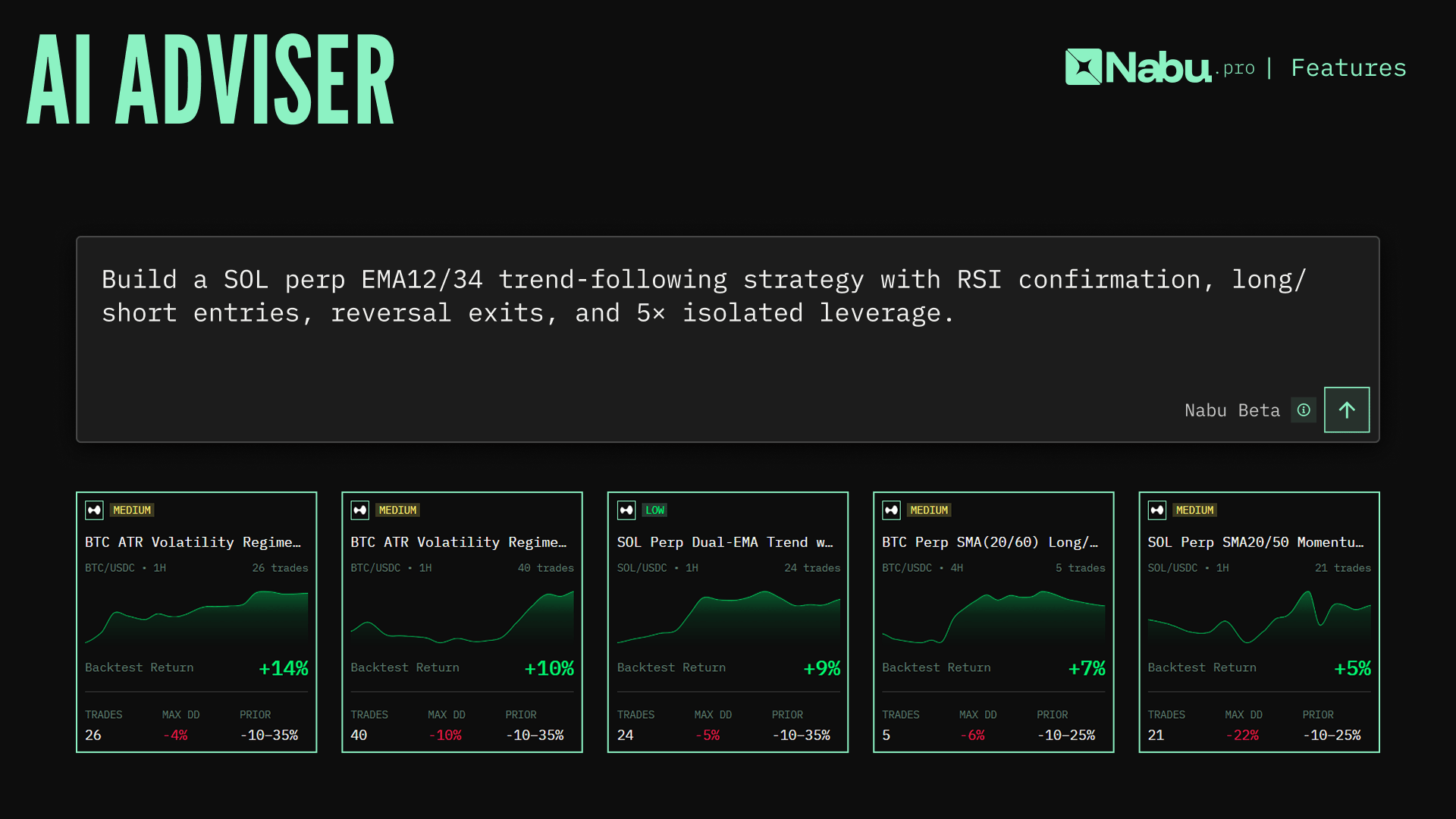
Describe a strategy in plain English and the adviser uses your balance, risk preferences and the markets on the platform to propose one you can test and run.
The output is a validated Strategy Studio configuration, not an answer in chat.
The adviser checks whether a requested market is supported and explains any substitution it makes.
If research, validation or a backtest runs long, the conversation resumes from the last completed step.
After a backtest, the adviser reviews the result with you and helps decide: adjust, go to Paper, or stop.
The chat gives one final answer per turn. Progress stays out of the transcript, and every answer is checked so it never points to an option it didn't show.
Stricter sourcing: market sentiment needs two independent news sources, social and influencer accounts are marked anecdotal, and derivatives figures only appear when there's typed data behind them.
Ask how to position for a macro event and it pulls the positioning picture (funding, liquidation clusters, rates, ETF flows, sentiment), leads with a verdict, sets trigger levels from the data, and offers each option as a Studio strategy you can backtest.
If a proposed strategy fails validation, the adviser repairs it in the same turn.
Ask for a token list and you get a list, plus a question about what's missing.
Binance authoring works the same as Hyperliquid.
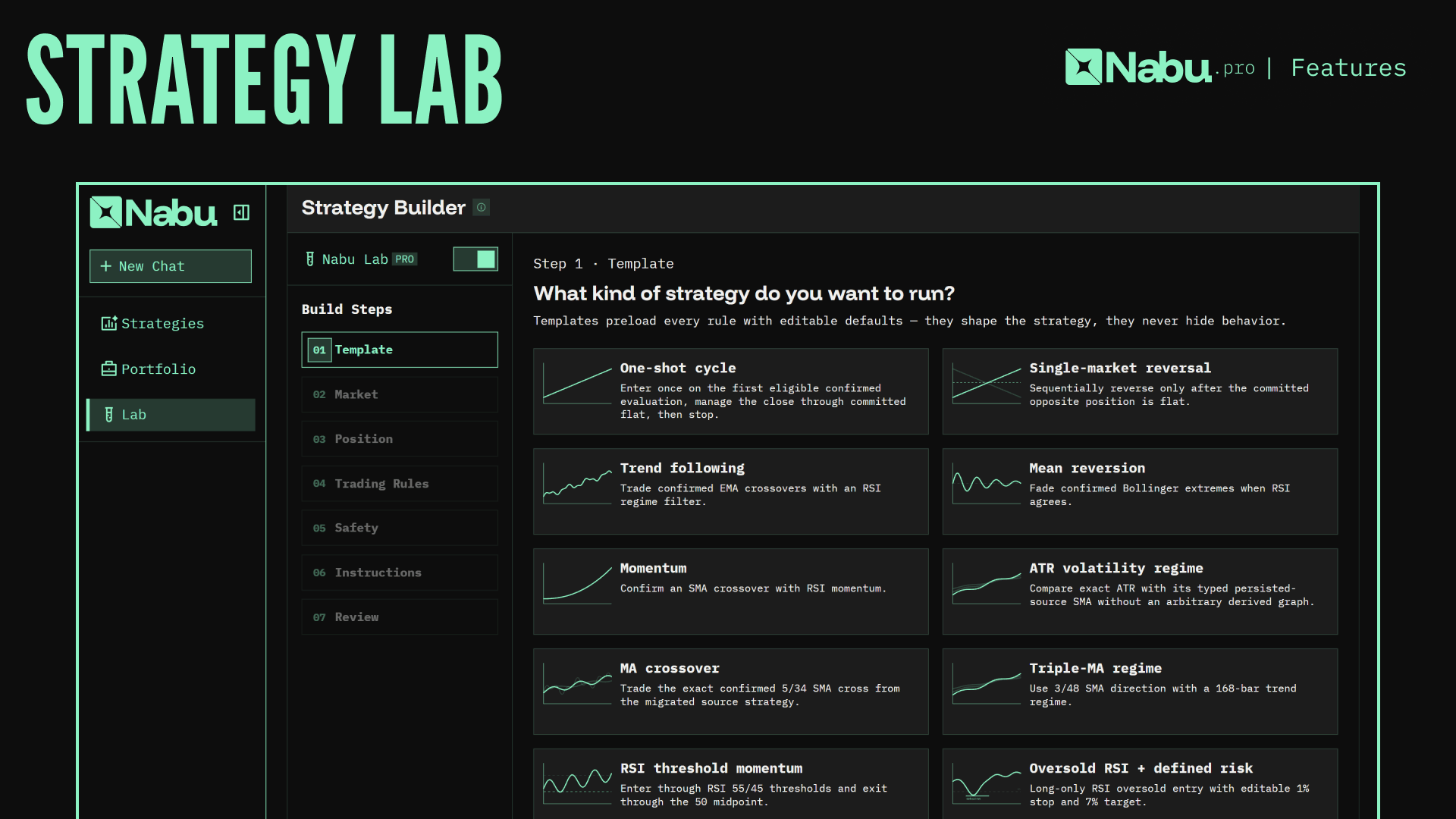
14 editable strategy shapes: trend following, momentum, mean reversion, moving-average systems, RSI and stochastic, volatility regimes, defined-risk and trailing exits.
20 curated presets, 10 spot and 10 perp. Each opens the same editable Studio form as an AI-generated or manual strategy.
Backtesting runs your generated PSL against prepared historical data, so the rules you review are the rules being tested.
Backtests are reproducible and handle ordinary data gaps. Run the same config twice, get the same answer.
Exit-rule validation catches conditions that can never fire.
Template library cleaned up: venues match actions, the ATR volatility template goes both ways, spot venues show spot parameters.
New template flow: pick one, sign in if needed, set your own size, deploy, land back where you started.
Confirmed-bar OHLCV data and the core indicator set: SMA, EMA, RMA, RSI, ATR, stochastic, Bollinger. Signed-flow inputs and lagged observations on top.
Fixed stop/target exits and three trailing-exit models.
Pine Script to PSL migration is now largely automated, so the tested strategy library grows faster.
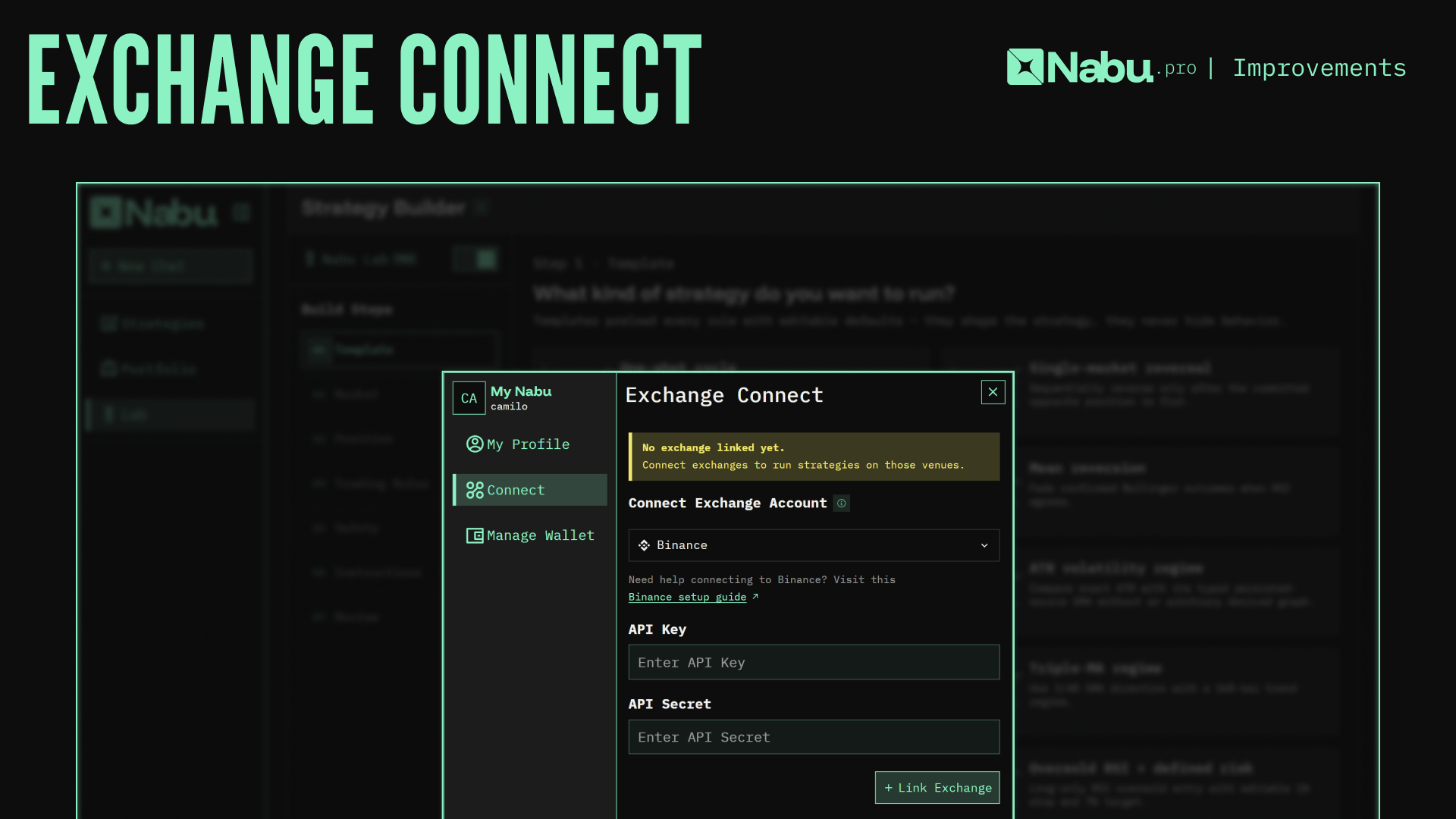
Nabu now reconciles against the venue on Binance and Hyperliquid perps. Positions, orders and reservations are checked venue-side; reservations release on rejection or archive, positions opened on the venue show up in Nabu, and Activity only logs what the venue confirmed.
Deploy runs pre-flight checks for minimum notional, available balance and concurrency limits before any order goes out.
Native stop-loss and take-profit can be combined with the strategy's own signal exits and close-before-reversal rules.
Live Signals shows the rule, the current indicator values and how far the condition is from firing. Values keep updating while a position is open.
Delayed orders, late fills, stale account data and failed protection placement are handled: the strategy keeps managing the position, recovers, or tells you why it needs you.
Kill closes the position on the venue. Archive waits until the strategy is flat.
Partial fills are handled: the strategy tracks what filled and works the rest.
Long/short reversal is a supported strategy shape: one signal flips the position.
Pause reasons and lifecycle events show in the Activity log.
Paper mode: pick a starting balance and follow the strategy through the same activity, signal, fill and PnL surfaces as live. Paper and real strategies are marked separately.
Fills are classified as open or close and paired into round trips. Realised PnL, win/loss and hold time come from the pair.
Venue-native TP and SL fills are tied to the position that placed them and labelled by whichever leg fired.
Funding is in Total PnL at venue precision.
Exchange-data failures are shown by venue, and an incomplete value says so instead of reading as a loss.
The strategies header shows Total Value Deployed: mark-to-market of open positions held by active strategies. Flat strategies show a dash.
Size a strategy by margin or by position notional, your choice.
Each strategy runs its own leverage, independent of the account setting.
Presets no longer come with a size filled in. Sizing, leverage and TP/SL are yours to set, and deploy checks them against your venue balance.
Hyperliquid connect and account-refresh reworked, with a direct link to the docs from the connect screen.
Binance perps token list refreshed.
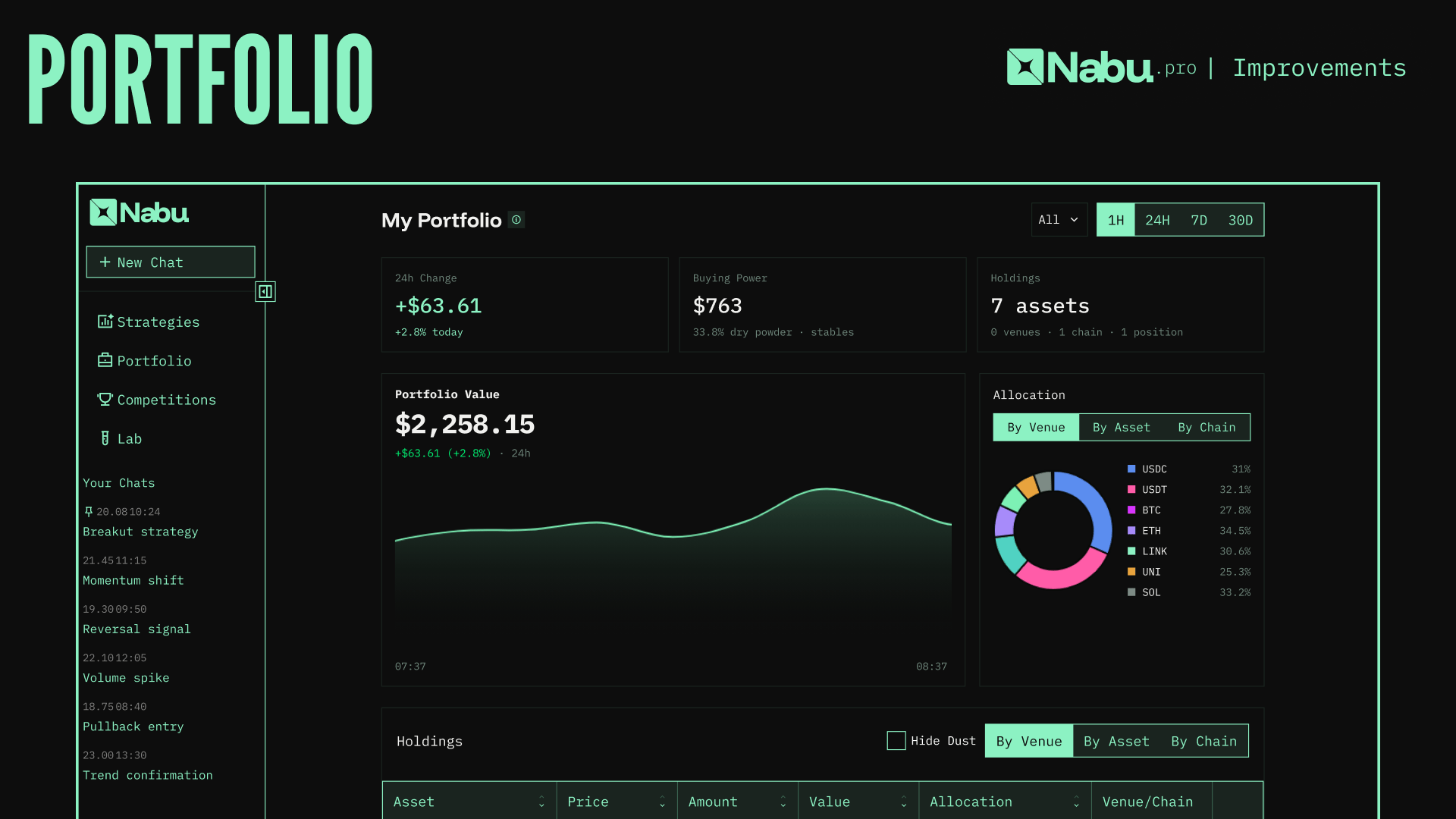
Portfolio page rebuilt. Everything you hold by asset, venue or chain, a hide-dust toggle that doesn't distort totals, unpriced tokens badged, and the last good state stays on screen if a refresh fails.
Strategies header redesigned, one number per card: Total Value Deployed, Today's PnL with all-time underneath, trades, active count, worst drawdown.
Strategy pages show the whole configuration, including every signal as compiled. Back takes you where you came from. Strategies can be reordered.
Trade history has a reason on every row, closes labelled as closes, TP and SL fills named by leg, prices at asset precision.
Activity shows orders and fills as separate events, with pause reasons.
Focus mode for popups, waitlist sign-in via X, USD everywhere, and a lot of small fixes from three weeks of daily use.
Faster page loads across the app and strategies pages, desktop and mobile.
Genesis, our first trading competition, moves to September so it runs on the August build. Everything is ready, from the rules and referral codes to the KOL partners and the $10,000 USDC pool. Waitlist spots hold.
Joint campaigns with upcoming venues are agreed and waiting on the integrations.
Incentivised feedback and debug program ready to launch: rewards for reproducible bug reports and product feedback, opening alongside Genesis.
We started reaching out to traders directly: profitable on-chain wallets with an X presence, invited to Genesis and the feedback program.
Genesis opens.
Locked capital allocation per strategy, with a Capital Under Management figure in the header.
HIP-3 markets on Hyperliquid.
GMX, 1inch and further venues, after Genesis.
August was about trusting the loop with real money before asking anyone else to. September is Genesis.
— Nicky, Evgenii and the Pelagos Team


