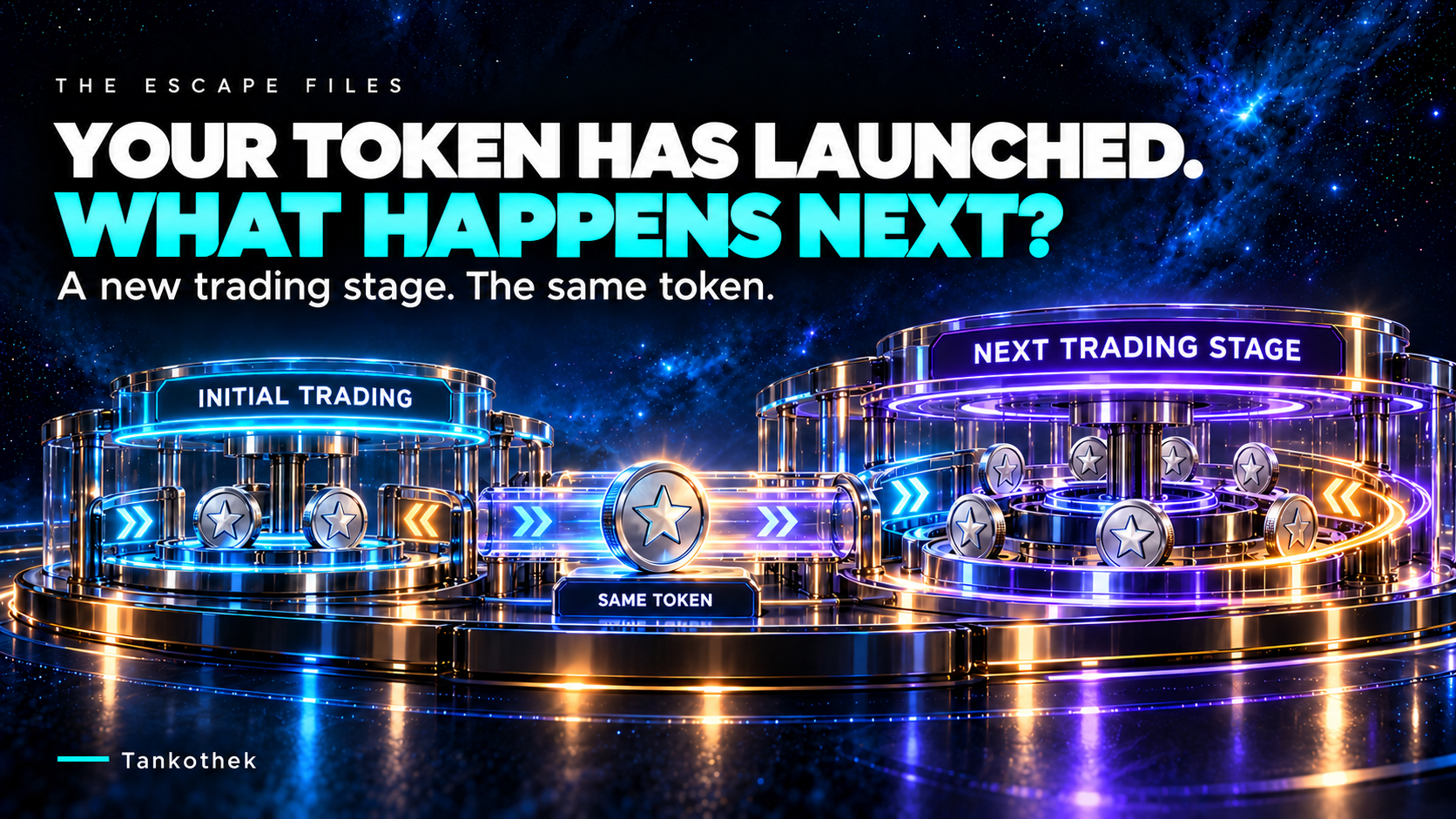
The name is chosen, the image is ready, and the idea has its own token—a digital unit that can be bought and sold. New questions follow. Where does its first price come from? What changes when people buy and sell? And what happens after that initial trading stage?
Creators need to be able to answer those questions clearly. People should see more than a name and a price chart; they should understand what is happening around the project.
After last week’s look at several networks on one platform, this week follows the journey after launch. Files 016 to 020 cover that process. The explanation draws on EscapeHub’s public descriptions of how it intends to organise initial trading and the transition that follows.
From an idea to the first purchase
A planned feature would let creators set up a token without first adding funds to their own EscapeHub account. The first purchase would then trigger its technical creation. This could make getting started easier and shorten the path from an idea to a token.
Once trading opens, the next question is: at what price?
A first price set by a rule
FILE 016 starts where trading begins: with the first price.
In its token creation guide, EscapeHub describes a bonding curve. This is a set calculation that determines the price during the initial stage and adjusts it as people buy and sell.
The project explains why its idea might interest people—perhaps a game, a creative project or a shared activity. That gives newcomers a way to understand both the trading process and what the people behind it want to build.
A fixed rule does not mean a fixed price
FILE 017 follows from that distinction. In the initial stage described by EscapeHub, purchases raise the price and sales lower it.
The calculation is fixed; its result changes with trading. The first price displayed is therefore not a permanent introductory price.
This answers a natural question: why might someone see a different price on their next visit? Explaining the process gives them more useful context than guessing where the price will go next.
What starts the next trading stage?
FILE 018 looks at the point when the initial stage ends.
In its EscapeSwap article, EscapeHub identifies the trigger as the purchase of all the tokens offered for sale in that initial stage. Once that condition is met, the described process provides for an automatic transition.
The timing therefore depends on trading activity, rather than a date set in advance.
Technical descriptions often call the completion of the initial stage “graduation” and the following transition “migration”. These terms describe the move from the initial pricing mechanism to the subsequent trading venue.
On Solana, the next venue is EscapeSwap
FILE 019 makes that next step concrete.
For tokens on Solana, EscapeHub plans for trading to continue on EscapeSwap. Solana is the network on which the token is recorded. EscapeSwap is the trading venue through which subsequent purchases and sales are intended to take place.
It remains the same token on the same network. The transition does not create a replacement token for the community to get to know.
That distinction matters: moving to a new trading venue does not mean the project starts over. Its idea, name and history continue with it.
On other networks, Uniswap v4 comes into play
FILE 020 widens the view to Base, Ethereum, Arbitrum and BSC. For those four networks, EscapeHub names Uniswap v4 as the subsequent venue in its EscapeSwap article.
Here, too, the token stays on its existing network. A shared entry point through EscapeHub does not mean that the same trading system operates behind every network.
Keep trading in the familiar app
EscapeHub is intended to remain the shared interface for buying and selling after the initial stage. Behind the scenes, trading then takes place through EscapeSwap on Solana or Uniswap v4 on the four networks mentioned above. For the community, the transition is intended to happen within the familiar app, without needing to open a different website to trade.
What this means for a project day to day
Imagine a small team developing a game and creating an associated token. An early playable version is already available, and people are suggesting new missions and characters.
The token then meets the condition for its next trading stage. EscapeHub describes the technical transition as automatic; its guide says the creator does not need to carry it out manually.
The team can keep working through feedback on the game while explaining what has changed in trading.
After a confirmed transition, an update might read:
Our token has reached its next trading stage. It remains on Solana, with trading now taking place on EscapeSwap. We’re working on the new missions suggested in your feedback. We’ll share a first look in the next update.
People learn both where the token is now traded and what they can look forward to in the game. The technical milestone becomes understandable without overshadowing the project itself.
The connection to creator fees
A brief connection to our earlier fee series belongs here. EscapeHub’s fee guide provides for a continuing creator share after the transition. Fee rates then depend on market capitalisation—a calculated total: the token price multiplied by the token quantity used for that measure. In the described fee tiers, a higher market capitalisation means lower trading fees.
Potential earnings could support design or development. Creators can also keep their share. The amount depends on actual trading and the applicable fees.
Tankothek’s take
The practical benefit is that the next trading stage is already part of the plan. Creators can understand that path early and explain to their community what happens when the next stage is reached.
That gives people who arrive because of an idea a useful point of reference, even if the technical terms are unfamiliar. They can understand what changes, what stays the same and what the team is working on.
A process like this gives trading a clear structure. The project’s story is still written by the people behind it, through their ideas and what they make of them.
Disclosure: I test EscapeHub and participated in its presale.