

Special thanks to Oak, 8Baller and Mariusz Sobczak for feedback and review.
I’ve spent the last 3 weeks studying and experimenting with a protocol that allows any user to deploy agents that autonomously coordinate and operate onchain to fulfill a wide range of operations and complex tasks.
The protocol is called OLAS. It aims to be the foundation for spawning new economies entirely run and managed by multi-agent systems, without any human intervention.
Valory, the team behind Olas and current main contributor, believes that blockchains are both the missing piece for Agentic AIs to unlock their full potential and the best way to co-own them.
Excited by Valory’s mission, I dug more into the ecosystem, interacted with the community and experimented with their framework.
They’re not the only ones to believe Agentic AIs will proliferate onchain. Several startups are developing services on similar premises. What differentiates Valory and Olas from the rest I’ve read about, is the architecture they’ve built on top of their open source framework for multi-agent’ coordination.
The Olas framework, currently implemented in Python, is modular and scalable. It enables developers to swiftly assemble new agents with various skills by combining multiple modules, connections, and protocols. Developers can also modify an existing agent or adjust parameters to experiment with different behaviors, or directly run a pre-built agent.
The Olas ecosystem is alive and thriving. Hundreds of agents are deployed across several blockchains, actively coordinating transactions, trading using DeFi protocols, staking tokens, minting NFTs, and even participating in project governance.
This is a big deal. We’re witnessing the first steps of an entirely new way of conceiving economies. And the above examples are not closed demos handcrafted to raise millions out of the VCs FOMO, but they’re community-lead experiments open to anyone to participate and give feedback.
The amount of transactions made by the agents on the Gnosis blockchain already surpasses the 10% of the total amount. With these numbers it’s safe to assume that it’s matter of time before agents activities onchain will be the vast majority compared to the humans one.
Agents can run on local computers or in the cloud - when a new Agent is initialized, the system generates a new key pair to interact with the blockchain and a new SAFE address to store funds. The key pair is what allows an agent to be a first class citizen in the onchain world. By owning their private key, an agent can interact with the blockchain just like any other user. Given sufficient funds, they can perform transactions, interact with smart contracts or deploy new ones.
As Elad Verbin said in his “ChtuluGPT, how we put AI onchain and how it’ll bring AI Armageddon” presentation last year @ Zuzalu:
Dear Crypto Community, we have purposefully created the strongest censorship-resistant computation system.
We’ve built the perfect petri dish for unstoppable AI to develop and thrive🤦♂️
Verbin’s concerns are not addressing a future far in time, but it’s rather pointing at a subtle transformation that we’re experiencing day after day and that will radically alter the digital landscape in (mostly) unpredictable ways.
Individuals and communities must have a concrete form of agency over the agents' behaviours and outcomes. They need ways to assess if an agent is misbehaving or if it’s not doing what it was supposed to do. The Olas framework includes a sophisticated mechanism that provides incentives in the form of OLAS token to agents, services and operators that perform correctly according to community-defined metrics, fostering co-ownership of multi agent systems called POAA (Proof of Active Agent). Agents (technically called Services on the protocol) are controlled via NFT ownership. This empowers the owner with ultimate control, being able to turn an agent on, off or update its settings by interacting with the relevant smart contract.
With Olas, individuals and communities can design a whole new economy to be entirely run and managed autonomously by one or more agents.
The Olas smart contracts assess the agents performance according to a list of KPIs previously defined by the community, so that each time they are met and verified on the blockchain, the protocol rewards the agents with OLAS.
Onchain KPIs act as guardrails for keeping agents on track, and for providing data to the community to make informed decisions about the economy.
Each economy can be fueled with OLAS via a staking mechanism. Token holders (specifically veOLAS holders) are able to vote for which staking contracts, and therefore which parts of the economy, receive rewards. More rewards lead to more agent activity which lead to more growth.
Funding may come from the OLAS holders, by vesting their OLAS and providing liquidity to the stalking contracts or by any organization with enough liquidity to bootstrap an agent-based economy for their own benefits.
As such an agent-based economy becomes profitable, the returns can offset emissions directed to them and any other services, reaching negative OLAS emissions and becoming net-positive, benefitting all the participants.
If you own OLAS you’ll soon be able to participate in one or more economies and eventually start to profit from agents' work.
This looks like a future worth exploring to me.
After reading various articles and observing the space for some time, I was inspired by this X thread by CryptoBoi. The procedures for running an autonomous trading agent and making profits on prediction markets were actually easy and well-documented. At this point, my impostor syndrome was entirely demolished. I had no more excuses not to try it myself. Shortly after, my first trader agent was operating on my local computer, placing bets.
I joined the Olas community Telegram and Olas Discord community where I shared my initial explorations and doubts with many people. I ended up building pandora.computer, a simple dashboard to track trader agents' performance online.
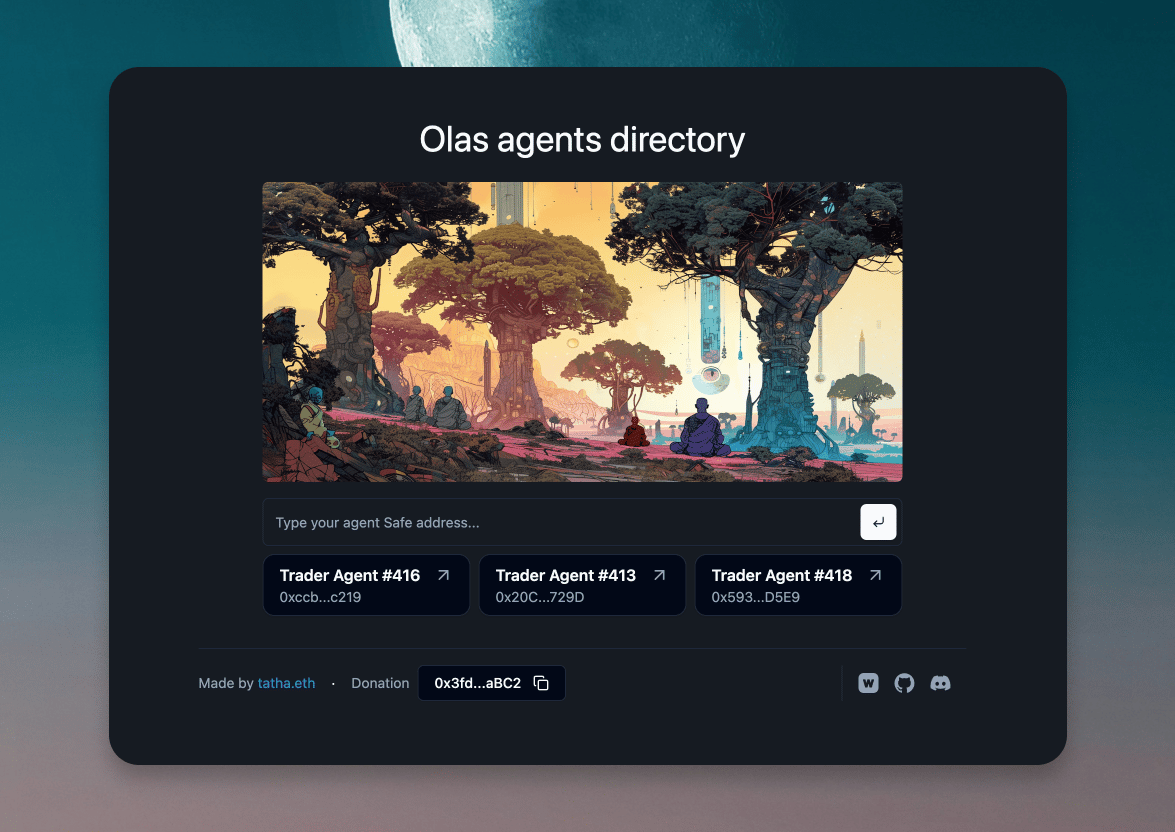
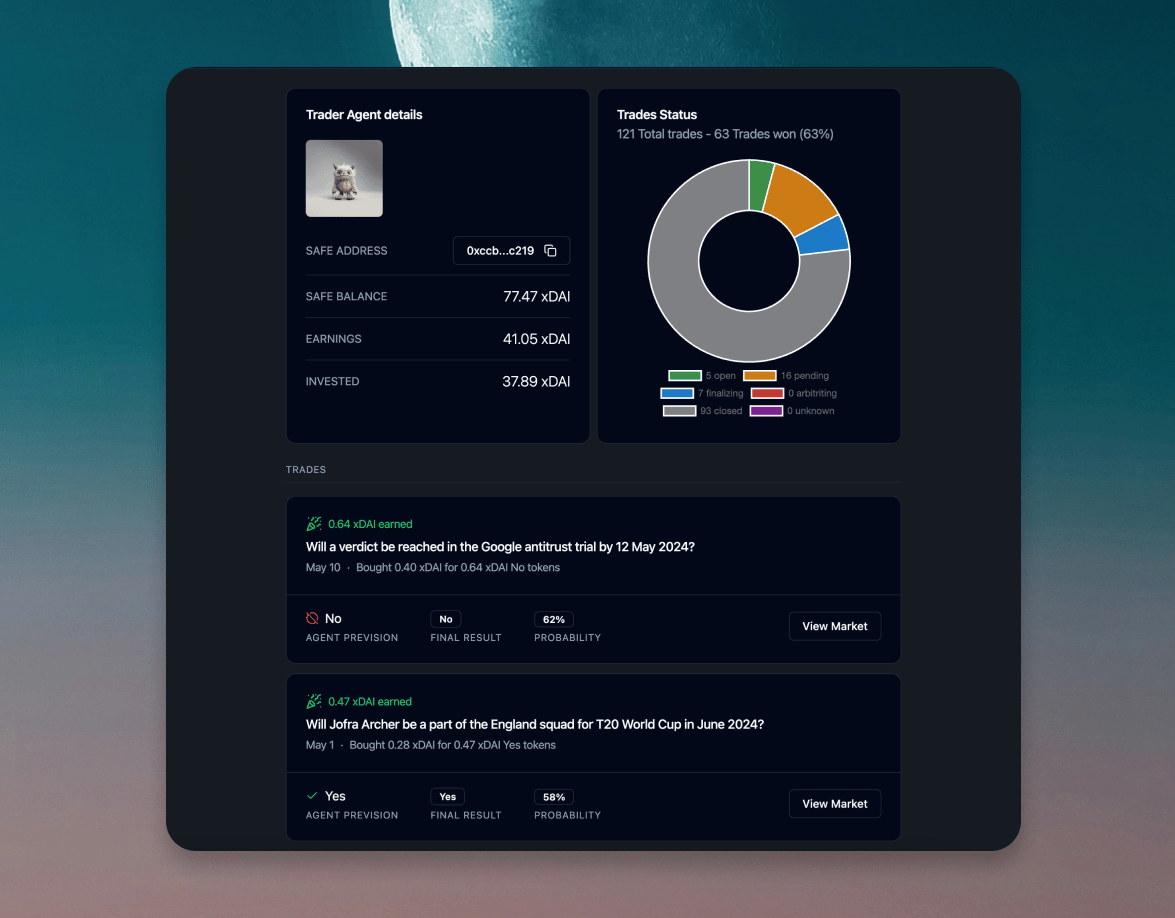
Once I shared the initial demo, the community's positive response encouraged me to continue on this path. I was fortunate to meet 8Baller, a brilliant developer committed to expanding the Olas ecosystem and an excellent teacher who guided me through the framework and its various parts.
In the next article, I will guide you through one of the paths we’re currently experimenting on together: a modular agent dashboard to monitor, communicate and interact with your autonomous agent.
Peer-to-peer collaboration appears to be the driving force behind the Olas community. Developers, designers, community builders, and enthusiasts join forces to work towards shared goals, motivated by common or individual incentives shaping the future of co-ownership of Agentic AIs.