

Abstract
Stablecoin competition has traditionally been framed around reserve composition, collateral quality, regulatory posture, or liquidity depth. The underlying assumption is straightforward: build a safer reserve, offer better yield, or secure broader distribution, and the market should naturally converge toward the superior dollar. Yet the last few years have demonstrated something noticeably different. Reserve portfolios can be reallocated, yield advantages disappear as interest rate cycles evolve, and competing issuers can replicate most technical innovations within months. Despite this, certain stablecoins continue to accumulate disproportionate economic activity while others remain largely interchangeable. The persistence of this gap suggests that the industry's conventional explanation for stablecoin adoption is incomplete. The question is therefore not simply why users choose a stablecoin, but why entire economic systems continue to organize themselves around one long after viable alternatives exist.
Existing discussions (that eventually shadow revenue side entrenchment)
In further reading we will argue and eventually prove that the answer may lie outside the reserve layer itself. Rather than viewing stablecoins as isolated financial products, it proposes treating them as participants in recurring financial workflows, that is, economic relationships that repeat predictably over time, such as remittances, payroll, merchant settlement, supplier payments, subscriptions, and treasury operations. Unlike the speculative trading/investing or short-lived yield incentives, these activities generate a persistent transactional demand and continuously reinforce the surrounding liquidity, market-making, wallet support, merchant acceptance, and operational infrastructure. Every recurring payment is therefore more than a transfer of value; it is another iteration in a self-reinforcing flywheel that gradually transforms a fungible digital dollar into an increasingly embedded financial rail. This paper explores whether those recurring workflows, rather than reserve composition itself, constitute an overlooked dimension of stablecoin entrenchment.
The stablecoin revenue entrenchment is only driven by recurring capital flow ergonomics and substitution cost
This angle of revenue entrenchment (infrastructure stickiness and compactness) of recurring payments workflow and shoulder to shoulder dependency (the competition of alternatives) is primarily the moat for the stablecoin primitive in the near future. We can discuss this angle in a more elaborate way by breaking it down into three different scenarios, backed by institutional data and non-reproducible design that can depict the hidden moat itself. This design or framework is driven by one of the core financial fundamentals saying "It's not how much you process once, but how often they come back at you"!
For most projects, the cold start is in the wrong place, which is a trillion-dollar transfer chart, supply league table or a reserve breakdown that says only numbers as if the biggest number on screen is the same thing as a moat, which actually isn't the case. When you strip out trading noise and internal shuffling, the part that actually looks like people and businesses paying each other iteratively over and over again is much smaller than the headlines suggest, and that's where the real framework that needs stress tuning but will be a good starter for this research. As said above, the moat isn't "projects moved a lot once." It's whether the same users, corridors, and rails keep showing up next month, quarter, and year and whether anyone at the end of that loop actually gets to keep the economics. That "anyone" can be a protocol establishing the completeness of this flow-as-a-service moat.
The Actual Framework (along with revenue defensibility and adjacent data bricks)
Let's name this framework "Cascade" which also means layered linear distribution which directly signifies the moat we are about to discuss.
Now, Cascade (the framework) runs in three drops, each one narrower than the last, each one showcasing a different take about substitution cost:
a/ is this even a payments playground? or is it something mainstream but hidden under the existing ux
b/ who would have to move capital
c/ who actually gets paid when they stay (is this is even significant)
These are the fundamental dots that when connected, projects can avoid fuzz and work on actual skeleton to derive their own whitepaper around Cascade aka the framework. And to be clear, this isn't a highly sophisticated engine that's built with all risk analysis, defi math or some overqualified quant simulation research but a plain execution flow moat.
Initial Drop
Any anon project pitch is based on the same deck everyone in the defi has access to: the transfer volume which is in the trillions, supply rank top positions or the reserve composition (literally the stablecoin vertical is over saturated in terms of huge reserve markets). Defi is mature now more than ever and mere rankings and leaderboards are drifting protocols away even from capturing legacy or proven moats. Clearly any amateur today grasps that alone Liquidity isn't the moat. Intentionally we need to attest to the fact that markets revolving around reserves, liquidity alone are prone to collapse on one depeg, bad counterparties or damaged reputation starts to spread. This is exactly why we should seek a more captive motivation especially for stablecoins.
The first drop is based on this questioning layer: how much of that is the same counterparty paying again next month, versus bots shuffling the size, exchanges moving float internally, and traders opening and closing the same loop before they call it a day? This is the basis of Cascade as a product out of this research. Cascade framework is the product of exploration and attested execution in the narrow funnel of recurring flow architecture that's observed easily with stables.
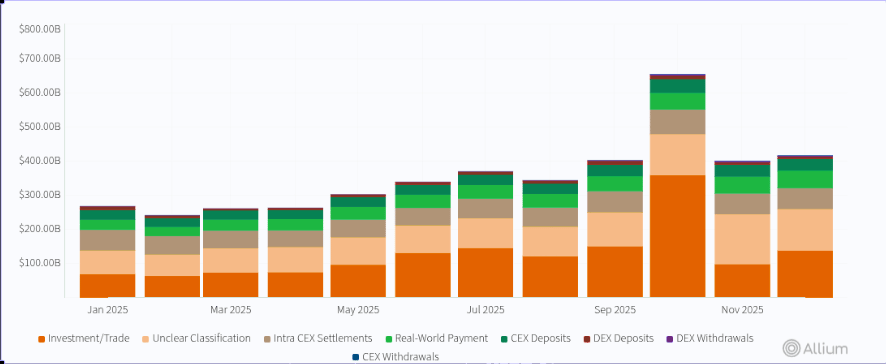
It's clearly visible with help of the reference (reference from https://digital-assets.fct.bcg.com it became the primary official source for usecase oriented study) that there is widest mouth for projects to fall for but only a narrow band can make them sustain over the cycles.
With almost $62T gross only ~$4.2T is completely adjusted that gives real-economy payments ~$350 to 550B, plus with the split (investments, tradings, CEX, real economy).
This issue does not directly come to notice since it needs a lot of market digest and a usecase which we shall discuss further. It's hard to find this perspective since it's most of the times hidden behind the underlying tech that's keeping this industry alive. This usecase forged the base layer of this research but on secondary basis, data backed findings and analogy was primary.
Just to be clear, the analogy will make sense as we iterate to next couple drops of the Cascade framework and can then easily conclude why this primitive might succeed the way it was meant to succeed.
Intermediate Drop
Drop 1 showed the mouth of the funnel with trillions of adjusted noise, thin green band of real-economy flow which stands vital for us at this stage. The natural mistake after that is to assume whoever wins that band wins the moat automatically. That's still the wrong layer if you're only counting dollars once and only once. The second drop is meant to ask who actually sits inside the narrow slice, and whether they're coming back because of reserve quality or because replumbing their life is a pain they won't repeat every quarter. UX is so heavy for the user end. We don't need to prove that here.
The questioning layer here is blunt: when a stablecoin wallet holds less than what a treasury desk would round away at every timestamp, is that user optimizing backing composition or running the same corridor, same counterparty, same rail, month after month until the loop becomes the infrastructure? The substitution cost at Drop 1 was near zero because the activity was reversible. Here it compounds as not only one swap, but breaking payroll templates, saved addresses, employer configs, local on-off-ramps, and the shoulder-to-shoulder habit of remittances (remember above we discussed about the perfect usecase - yes that is nothing but remittance). That is nothing but recurring capital flow ergonomics, infrastructure level stickiness in a compact form and it's a different moat physics than liquidity on a leaderboard. Remittance is a live, high value throughput example of this flywheel. It's clearly not payment end product or any institutional byproduct but a usecase which will never migrate.
It's only visible once you stop averaging the market into whales. That's the point which may distinguish projects success around stablecoin market in our scenario.
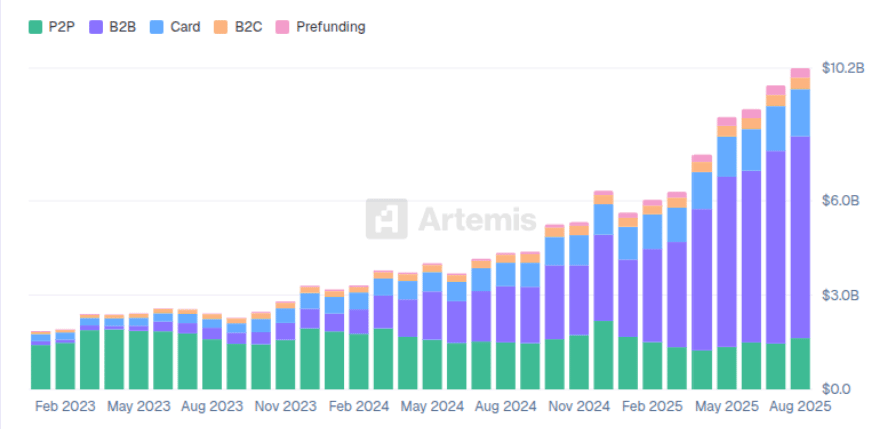
For Cascade Drop 2 / Intermediate drop, this is the attestation we should be talking about (find this data reference at: https://www.stablecoin.fyi/) Recurring demand in stablecoins is concentrating in enterprise settlement and habitual spending via fixed rails (mediums) or chains to be specific, and not the peer transfers. Substitution cost lives in purple and blue, not the green band everyone still uses to tell the story.
This might make more sense: The substitution cost is the friction of replumbing the recurring loops whereas enterprise settlement and card spend embed that friction. P2P mostly doesn't do that for us.
From other tertiary research legs, we get an estimate of around roughly 80% of stablecoin wallets hold under $100 at every sample time. Also, the activity spreads across chains and timezones rather than concentrated in a few allocator-controlled balances. This is where the funnel still has its radius big enough to play within.
The mass of the funnel isn't BlackRock rotating BUIDL at all but it is millions of small loops that look irrelevant on a supply chart but aren't irrelevant if the thesis is how often they come back. Eventually remittances bring this into picture. It's periodic and transactions compound for great volumes. We enter into new primitive of compounding (which is new around stablecoins but a jargon on Wall Street).
This clearly doesn't show up in headline transaction for the same reason Drop 1's split was buried. The usecase is iterative settlement between the same parties, and not volume that is bragging rights. That sets up the last drop and this is because a locked-in user base still can't point to who keeps the economics at the bottom of Cascade.
Rock bottom Drop (Final drop)
By Drop 2 / Intermediate drop we can conclude that a user or business that isn't going anywhere, that is, same ux or application, same corridor, same rail, long pay history (maybe months or years), substitution cost already paid in sweat and setup. Anyone may assume the win belongs to whoever minted the stable sitting in the middle of that loop. But the cascade shall not be designed that way. It's actually a total opposite to bring out more accrual out of this setup. That was entirely wrong handoff believing that minter is somewhere getting mentioned in this whole scenario.
The Drop 3 / Final drop is where Cascade stops asking who stays and starts asking who gets paid when they do because recurrence can lock in usage while economics leak to whatever wraps the flow, it may be exchange, off-ramp, venue, treasury deployer, the protocol that makes mint, settle, repeat feel like one product instead of four different vendors together. Literally the rock bottom can be anything (its like we dig deep enough the earth and find different entities exist before anyone knew it). Similarly these setups are made available to defi from the start, its just they are not utilized at fullest possible extensions.
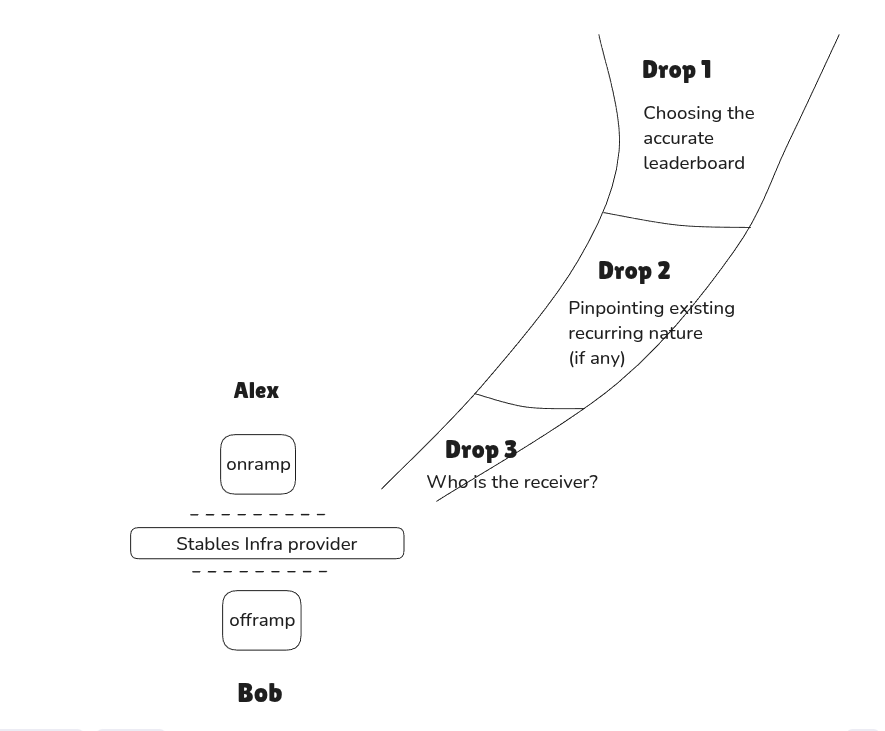
But the real questioning layer is ugly and simple: if the sender in Mexico or the importer paying forty suppliers monthly is already sticky, who actually taxes that loop and honestly it can be the issuer, or the stack around it? It can be anyone, this framework isnt about that but it certainly needs satisfactory solver application. This is where we can grasp the blurb about all three layers altogether which ends at very specific domain and which when executed aligned with data is the actual moat in 2026!
That domain is nothing but an application built through to receive this flow - some of them are already capturing the consistency.
Under GENIUS style (the act) economics or system, the overall yield/capture migrates to whoever completes the loop i.e. Coinbase and venues on USDC, Binance on USDT distribution, corridor apps like Felix and Yellow Card, B2B rails like Reap. Remember, all this while minting the token becomes the commodity layer in the middle. Cascade is never about which stables or which strategy but about depicting the moat - again which can be implemented by anyone or any protocol envisioning stablecoins as the future.
That is the beauty about this flowing framework. A flywheel indeed.