
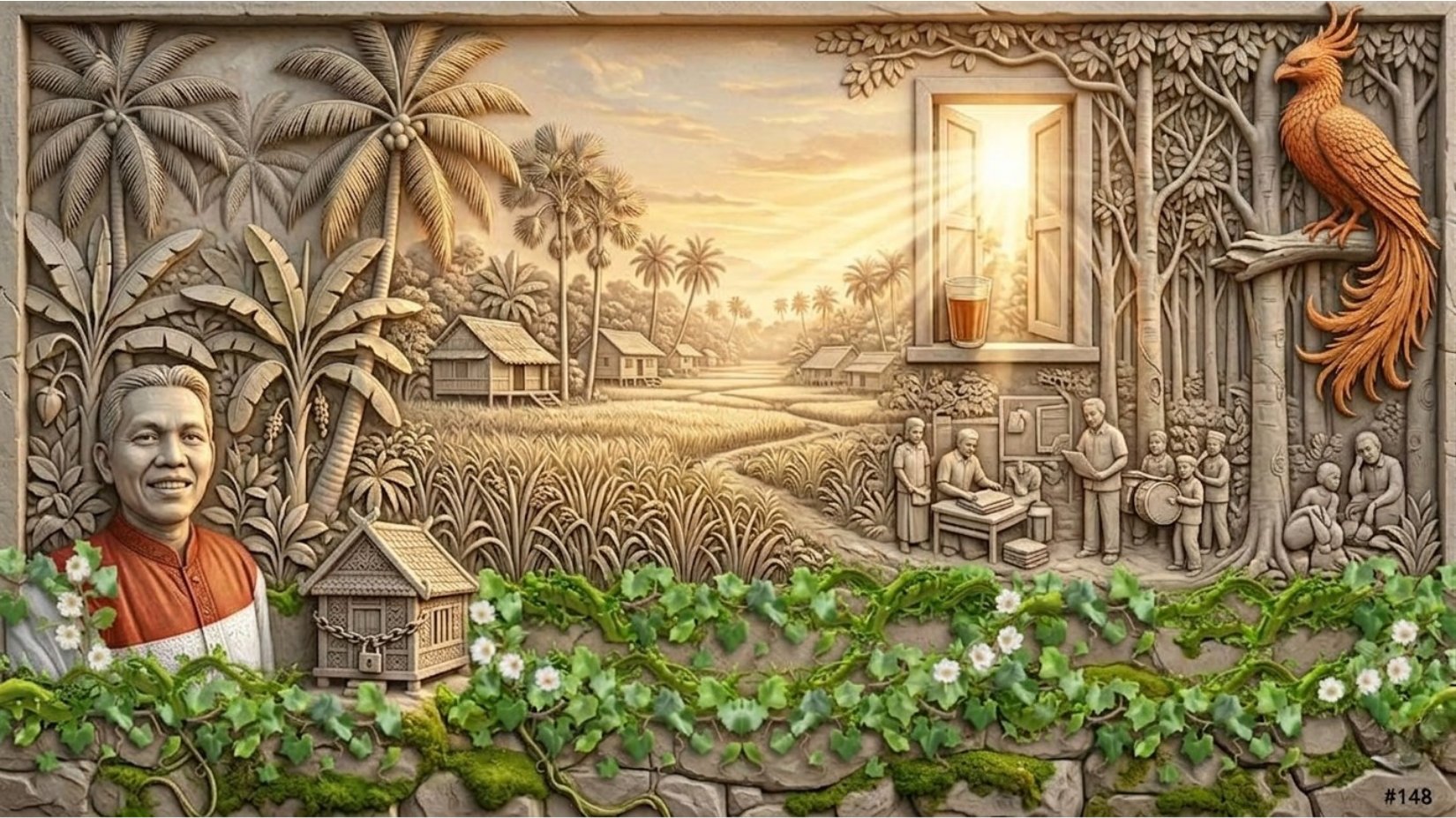
In the morning still damp with a thin layer of dew at the edge of town bordering the rubber plantations, he stood on the simple terrace of his house. The morning air touched his skin gently, carrying the scent of freshly watered earth and the faint aroma of rubber tree sap from the distance. He was in no hurry. His right hand held the garden hose, letting water flow slowly into the potted plants in the corner of the terrace — the green leaves beginning to glisten as droplets fell one by one. Each drop felt like a small prayer falling to the earth, washing away the dust that had settled overnight.
Inside his chest, he could feel his Phoenix regenerating. Its large wings were folded calmly against its back, no longer beating with the full energy it showed when he stood in front of his class. The red-orange fire in the bird’s chest glowed softly — not a wild blaze, but a carefully tended ember, like someone blowing gently on a hearth fire in the middle of the night to keep it from dying out. His body and soul, exhausted after months of burning themselves in front of the blackboard, were now recovering. He felt it clearly: the lingering stiffness in his shoulders, eyes that still wanted to stay closed a little longer, and a heart that carried the unfinished weight of the house mortgage. The burden followed him like a faint shadow — not crushing, but always present — reminding him that the struggle of a father and a teacher is never truly finished.
He looked inward, not with his eyes, but with quiet awareness. This Phoenix was not a wild fire that consumed everything in an instant. It was a wise ember. Today’s rest was not laziness. It was a sacred process — like soil left to rest after the harvest so it could give life again tomorrow. He knew that if the ember were allowed to go out from being forced to burn every single day, there would be nothing left to give the children tomorrow. So he let the wings stay folded. He let the fire glow softly. He allowed himself to be an ordinary human who also needed to fold his wings for a while.
With his left hand he picked up the pile of clothes still sitting on the chair. He folded them one by one with slow, attentive movements. Each fold was a way of tidying what felt scattered inside him. He swept the dust from the floor slowly. The sound of the broom moving across the floor was like the gentle wind moving through the rubber trees — steady, unhurried, clearing space for new breath. He washed the dirty dishes in the sink with warm water. Soap suds rose slowly, carrying away the tiredness that had clung to him from previous days. He did not rush. He let every movement become part of his recovery. In the quiet, a gentle gratitude flowed through him — gratitude that he could still stand, that he could still use his hands for these small things, that he could still take care of the home for his family.
When the housework was done, he walked slowly to the school garden where he worked. The morning streets were quiet, broken only by the sound of small birds and the distant hum of a passing motorbike. There, he checked the monthly extracurricular reports that still awaited the principal’s signature. He opened the papers one by one with calm hands — not out of obligation, but because he understood that responsibility does not pause, even on a rest day. From a distance he watched the children practicing with the drum band. The rhythm of drums and the soft notes of trumpets drifted toward him, full of young, unpolished enthusiasm. The children laughed lightly as they rehearsed their steps for welcoming the new students arriving next Monday. He stood at the edge of the field, hands clasped behind his back, watching them with a small smile he didn’t notice forming. In his chest, the Phoenix’s ember pulsed a little warmer. He saw the future in that rhythm — the generation he would accompany again in the coming year. Hope still glowed softly, even though its light was currently obstructed by tiredness that had not yet fully lifted.
He returned home before the midday heat grew strong. At the small mosque near the housing complex, he joined the congregation for the midday prayer. The cool ceramic floor touched his feet. He stood in the row, shoulder to shoulder with neighbors he had known for years. There was nothing rigid here — only movements that flowed naturally: hands raised, bodies bowing, foreheads touching the ground. In those moments, something warm moved from his chest through his entire body. Not a sudden rush of emotion, but a quiet calm that seeped in slowly, like rainwater reaching the roots of the rubber trees after a storm. The prayer became a space where he could set down the weight of the house mortgage, the weight of school preparations, and the small disappointment that would come later that night. He stayed in prostration a little longer than usual, letting his forehead rest on the floor, letting his breath grow deeper. In that moment, he felt his Phoenix receive a gentle breeze. The ember did not go out. It was simply being tended so it could burn more steadily later.
After returning from the mosque, he ate a simple lunch. Then he lay down in the bedroom where the curtains were drawn halfway, leaving the room softly dim. The afternoon nap came gently — not the deep sleep of total exhaustion, but a rest that felt like soaking the body in warm water. His dreams were vague, more a feeling of lightness than clear images. When he woke, afternoon light was already slipping through the gap in the curtains. He sat in the living room, opened an app on his phone, and watched a religious lecture he often listened to. The teacher’s voice flowed softly through the room — words about patience, about guarding the fire in one’s heart, about how humans are not asked to be perfect but to keep trying. He listened without taking notes. He simply let the words touch the tired parts inside him. In that moment, his faith did not feel forced; it felt nourished. The Phoenix in his chest lifted its wings slightly — not to fly, but to stretch its tired muscles.
Night arrived quietly. After the evening prayer, he sat in his favorite chair. His phone vibrated. He opened a message from his wife asking about the departure time for their trip back to their hometown the next day. He read it with a quiet heaviness in his chest. He knew she was disappointed. He felt it without needing more words. The afternoon meeting tomorrow meant he could not promise anything. He did not reply at length. He simply typed a short message saying he would try, then set the phone down. He stayed silent. Not a silence filled with anger or refusal, but one filled with acceptance. He let the quiet of the night wrap around the feeling. Outside, the night wind moved through the rubber leaves. Inside, his Phoenix still kept its wings folded, the fire still glowing softly. The radiance in his chest was indeed obstructed tonight — by the unfinished mortgage, by the meeting he had to attend, by the family longing that could not be fulfilled right away. Yet he did not let the ember go out. He simply guarded it with greater care.
He lay down in bed. His body already felt lighter than it had in the morning — not because every problem had disappeared, but because he had given his body and soul room to recover. He thought about the new school year ahead. He thought about the children he would accompany again. He thought about the small commitment he continued to hold, even on this rest day — to keep sharing, to keep setting aside something for better education. Not because he was forced to, but because he knew the fire he guarded was not only for himself. It was for those who would come tomorrow.
On the edge of sleep, he felt something soft yet deep. The tiredness slowly receded. Peace came gently to his heart, like dew settling on rubber leaves. He felt a quiet pride — not loud or boastful, but calm, because he knew he had given the best he could. As a father. As a teacher. As a human being who also needed rest. Hope in his chest still glowed softly, even though its light was obstructed tonight. He knew that tomorrow, or the day after, or when the new school year began, the Phoenix would open its wings again. Not with a wild blaze, but with a fire that was steadier and wiser, because he had given it time to regenerate.
He drew a deep breath. The cool night air filled his lungs. In the distance, the soft sound of night insects could be heard. He let his eyes close. The Phoenix inside him continued to glow softly. The ember had not gone out. It was simply resting — with full awareness — so that tomorrow it could fly higher, carrying a brighter light for the children who were waiting for him.
That night, at the edge of town beside the rubber plantations, a teacher fell asleep with a lighter heart, even though the burdens remained. Because he understood: conscious rest is part of the long journey from ash to fire, from exhaustion to renewed strength. And his Phoenix was guarding the fire with care, waiting for the next dawn.
Explore the documentary art collection and support the mission by acquiring your NFT on OpenSea.
Lost in the narrative?
[Return to the story map]