
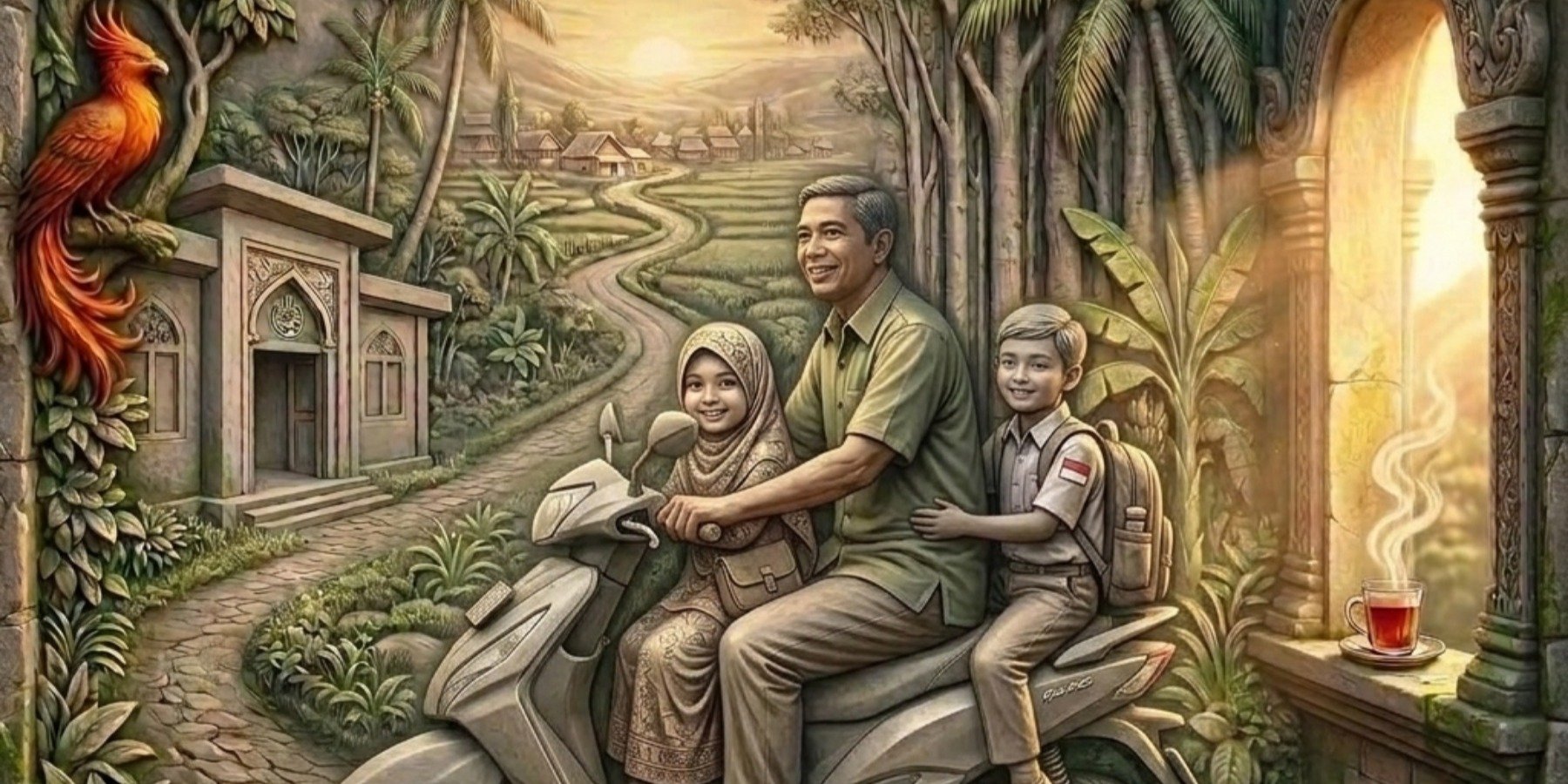
Saturday morning arrived like a soft breeze drifting through the rows of rubber trees at the edge of the city. Young sunlight slipped between the leaves and fell gently onto the still-damp earth. In that quiet, he stood for a moment on the front porch. His body, which only yesterday had still burned in front of the classroom, now felt lighter, though a quiet fatigue lingered in his bones. He imagined his Phoenix regenerating. Its wings were folded calmly—not collapsed, but carefully held. The red-orange fire in its chest glowed slowly, an ember that refused to die, only waiting for the right moment to burn again. Rest was never laziness. It was a sacred process of recharging, so that the fire of dedication could keep shining for the children waiting at their desks tomorrow.
After a simple breakfast, he took the motorcycle. His two children climbed on with small, contagious laughter. The road along the city edge was still quiet, lined with rubber trees standing tall like faithful guardians. The soft hum of the engine blended with the breeze carrying the scent of sap and moist soil. On the back of that motorcycle, he felt the first ocean. His two children were the two nearest, deepest, and most precious oceans. The light that reached them was not spectacular; it was the gentle light of morning—taking them to school, hearing their laughter between the rubber trees, feeling the quiet pride of being a father. Oceans of blood and flesh that must be continually tended, their dedication kept alive, and crossed every day with consistent love.
When he returned, his wife asked to be taken to the traditional market. They rode the same motorcycle. The sound of engines began to mix with the growing bustle of the market. Fresh tomatoes, the scent of spices, the laughter of vendors—all became part of an ordinary morning that felt special simply because it was shared. He realized that this everyday life was the harbour where the Phoenix’s ember was protected from being extinguished by the small burdens that never stopped arriving, including the remaining mortgage on the family home that followed him like a loyal shadow.
He rested briefly. Not long after, a digital screen called. The children had finished their morning lessons. He picked them up with calm movements. Then he went to the Garden of Paradise, the place where he usually worked. It was a holiday for most people, but not for him. He had been appointed as a mentor to supervise the nation’s children practicing their drum band. Beneath the shady trees, uneven music drifted. There were wrong beats, rhythms still searching for their shape. Yet in the spaces between, he opened his laptop and sent a work to the SKOG Open Call 2027 in Norway. His fingers moved across the keyboard with the same gentleness he used when correcting a student’s hand position in class.
Noon arrived. The call to prayer echoed from the mosque inside the Garden of Paradise. He joined the children of the nation. Usually he stood in front as imam, but today he chose the rows of the congregation. His body stood level with theirs, shoulder touching younger shoulders. Their voices blended in a simple prayer—not a rigid ritual, but a flowing warmth. He felt the presence of God not as a command, but as a gentle embrace in the midst of weariness. After the greeting of peace, a quiet calm descended slowly, filling the spaces inside him that had cracked from giving too much.
He returned home. At the green dining table they ate lunch together. The sound of spoons and plates, the aroma of home cooking, the children’s eyes still holding traces of morning laughter. Everything became stronger medicine than the one he took afterward. He lay down for a while. Eyes closed. Inside him the Phoenix folded its wings more tightly, the red-orange fire pulsing slowly, drawing strength from conscious rest. From ashes to fire. From fatigue to new strength.
In the afternoon he woke. His wife was watching something on her phone. He sat beside her without many words. Only presence. The light from the small screen fell on both their faces, soft like the morning light that slips through rubber leaves. Outside, the late breeze began to blow, carrying the scent of drying earth. He felt the fatigue slowly dissolving, replaced by a deep gratitude—for the struggles already endured, for the ability to keep standing, for the family that served as harbour, and for the small fire that continued to be guarded so it would not go out.
Evening came. He took his two children to the mosque near home. Their steps moved side by side under the dim streetlights. Inside the simple mosque they stood together. The night prayer felt like water soaking dry soil—warm, human, full of gentleness. Afterward they had dinner. Before sleep he opened the digital screen once more. Another work was sent to the Karen Village Art Competition 2026 in Kenya, under the theme “about me.” His fingers danced again, carrying a fragment of himself across great distances.
In that moment he felt the second ocean. Norway to the north and Kenya to the south became one vast ocean of dedication. The same light—his work and his good intention—pierced two directions at once, carrying a piece of his soul as an educator to places he had never physically visited. A distant ocean, yet still connected to the near ocean at home.
In the quiet darkness, his Phoenix lay with wings folded. The red-orange fire still glowed slowly, carefully tended. Not a wild blaze, but an ember that knew when to rest and when to burn again. He felt a deep peace in his heart, a quiet pride as both father and teacher, a hope that continued to pulse, and a clear awareness: an educator is also human. He needed time to fold his wings for a while, so that tomorrow he could fly higher, piercing two oceans at once—the ocean of blood and flesh at home, and the ocean of hope stretching all the way to Norway and Kenya—carrying a light that was slow, refreshing, and full of hope.
Explore the documentary art collection and support the mission by acquiring your NFT on OpenSea.
Lost in the narrative?
[Return to the story map]