
On a bright Tuesday, the Phoenix rode his black motorcycle along the road toward the garden of heaven. Coconut trees, banana plants, cassava, areca palms, wild grass, and weeds stood silent as witnesses. The morning wind accompanied him, and he arrived on time, as if his body had long ago learned to refuse lateness.
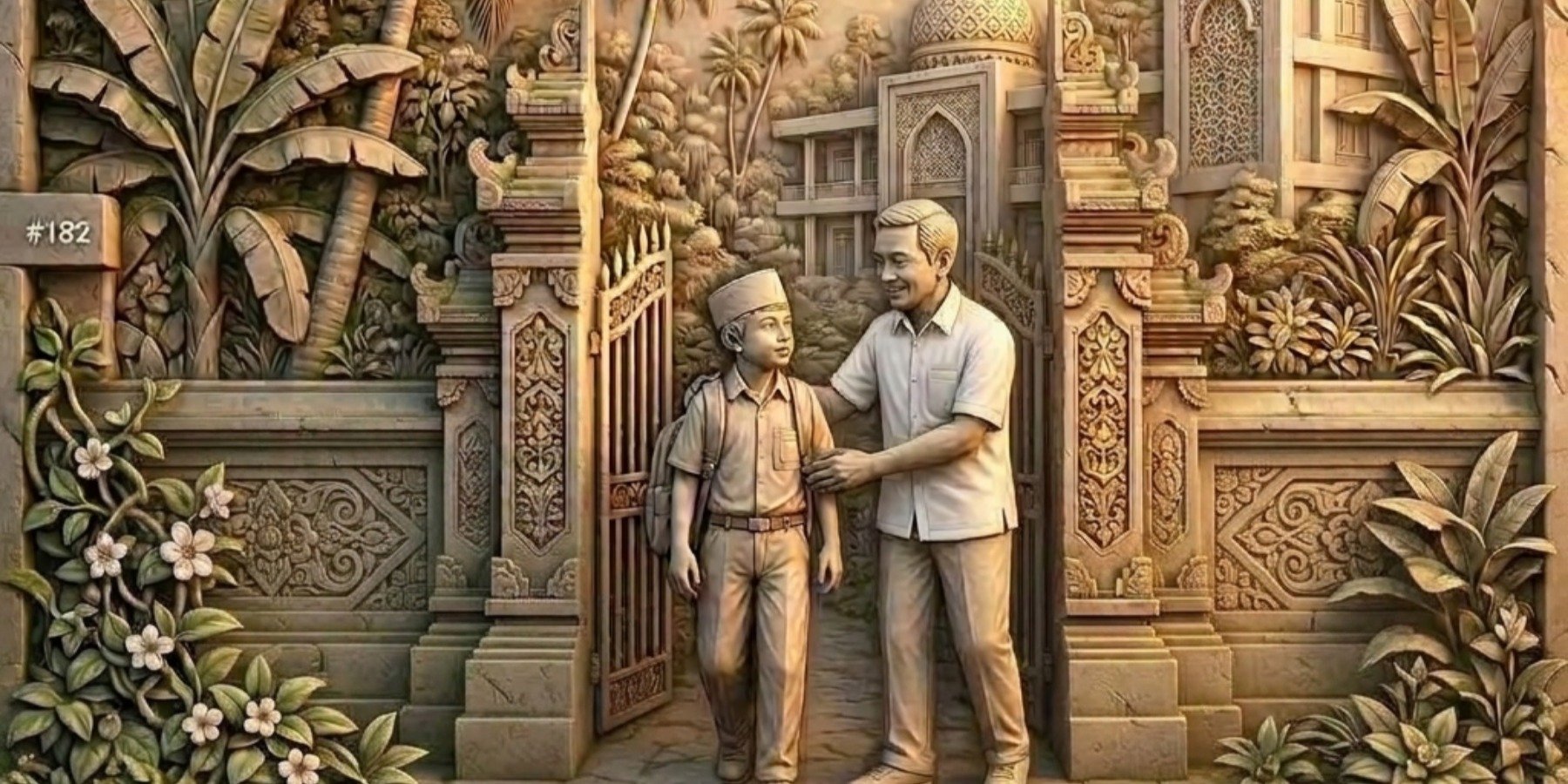
At his desk he was called. One of the children of the nation under his care would be moving to another garden of heaven. The Phoenix calmly accompanied the entire administrative process, then walked with the child to the gate. At that threshold he left a simple yet weighty message: success anywhere depends on the discipline you carry within yourself. The child left, and the Phoenix stood for a moment, feeling once more how every small farewell is ash that must be accepted before the fire can rise again. Releasing, not holding on.
He entered classroom XII F1. The children of the nation presented the theories of how Islam entered Indonesia—Indian, Arab, Chinese, Persian. Their voices still held uncertainty in places, yet the Phoenix strengthened each explanation with gentle clarity. Slowly understanding spread across the young faces. He saw small flames kindle in their eyes, and for a moment the weariness on his shoulders felt lighter.
Then he went to classroom XI F7, the room that was his responsibility. He checked the completeness of the class, counted attendance, and assessed the summaries of the strategies and policies of the Ottoman leaders. Every pencil mark he examined was a trace of effort. He gave the grades carefully, as if each number were recognition of hard work that is not always visible.
Noon approached. The call to prayer rose. The Phoenix invited the children of the nation to the mosque in the garden of heaven. He stood at the front as imam. The movements of bowing and rising were warm, never rigid—only rows of bodies releasing their burdens together for a while beneath the same roof. Their prayers were simple, and in that quiet the Phoenix felt the fire inside him cooled a little, then burn again more calmly.
After prayer he went to the guard post at the gate. The lunch his wife had entrusted that morning was waiting. He ate until the plate was empty. In the brief pause of rest he sent his artwork to Less Ordinary Studio in Istanbul. The same fingers that had just graded students’ work now sent a piece of his soul across the world, as if to say that the fire he tended was not only for the classroom, but for something wider still.
Then he entered classroom XII F5. The children of the nation completed the assessment on the Beautiful Names of God that had been left unfinished the week before. The Phoenix graded their work that same day. There was no delay. Every mark he gave was a small promise that their effort had been seen, valued, and answered.
Afternoon arrived without much warning. The Phoenix headed home at once on his black motorcycle. His wife relayed their mother’s request: bring the box of food. He carried his child and wife as passengers. The nearly half-hour journey was lit by a brilliant twilight, golden light touching their faces. That twilight released its radiance slowly, as if teaching that even light must know when to leave with calm. In the midst of that gold, the Phoenix briefly remembered the child of the nation he had walked to the gate that morning. The light that departed did not disappear; it only moved to another sky. So too with the child—released not out of reluctance, but because it was time to grow in a different place. Arriving at his mother’s house, his wife handed over the package. His mother looked happy. In that simple room the Phoenix felt again how presence itself is the most practical form of love.
Night came. They took their leave. The journey home was decorated with streetlights and vehicles. The air still held the warmth of the day. They arrived safely. While his wife fetched their second child, who had been left at a friend’s house after returning earlier from religious study, the Phoenix took a moment to send another of his artworks—theme Awakening II—to ChimiMora in China. When his child and wife returned, they ate dinner together, then rested.
That night the Phoenix sat for a while. His body was tired, yet the fire inside him had not gone out. He knew the mortgage on the family home still remained, a figure that each month demanded steadfastness. Every day of teaching, every assessment, every journey, every artwork sent, was a small installment toward freedom. Not freedom from work, but the freedom to keep giving without fear of running out.
The Phoenix rose from the ash of that day’s fatigue as usual. Not with an explosion, but with quiet consistency. The fire that continued to burn despite strong winds came from the road, from administration, from farewells, from the anxiety of a father, from the weight of being a husband. Transformation did not happen in a single night, but in small acts repeated with love: arriving on time, grading the same day, serving as a warm imam, walking a child of the nation to the gate and releasing him with calm, carrying a box of food for his mother, sending work to Istanbul and China, returning home with his family beneath a twilight that was releasing its light.
Daily consistency is the purest form of love. It is not dramatic. It does not ask for applause. It simply burns itself a little each day so that light remains for the children of the nation, for the family, and for the Education Impact Fund he is slowly building. From the ash of weariness is born an everlasting fire. From the twilight that releases its light is born a night that stays warm. And from an ordinary teacher who chooses every day to rise—including the courage to let go—is born a living monument that needs no stone or inscription, only dedication that continues to burn.
This is work day 104. One more proof that the Phoenix never truly goes out.
Explore the documentary art collection and support the mission by acquiring your NFT on OpenSea.
Lost in the narrative?
[Return to the story map]