
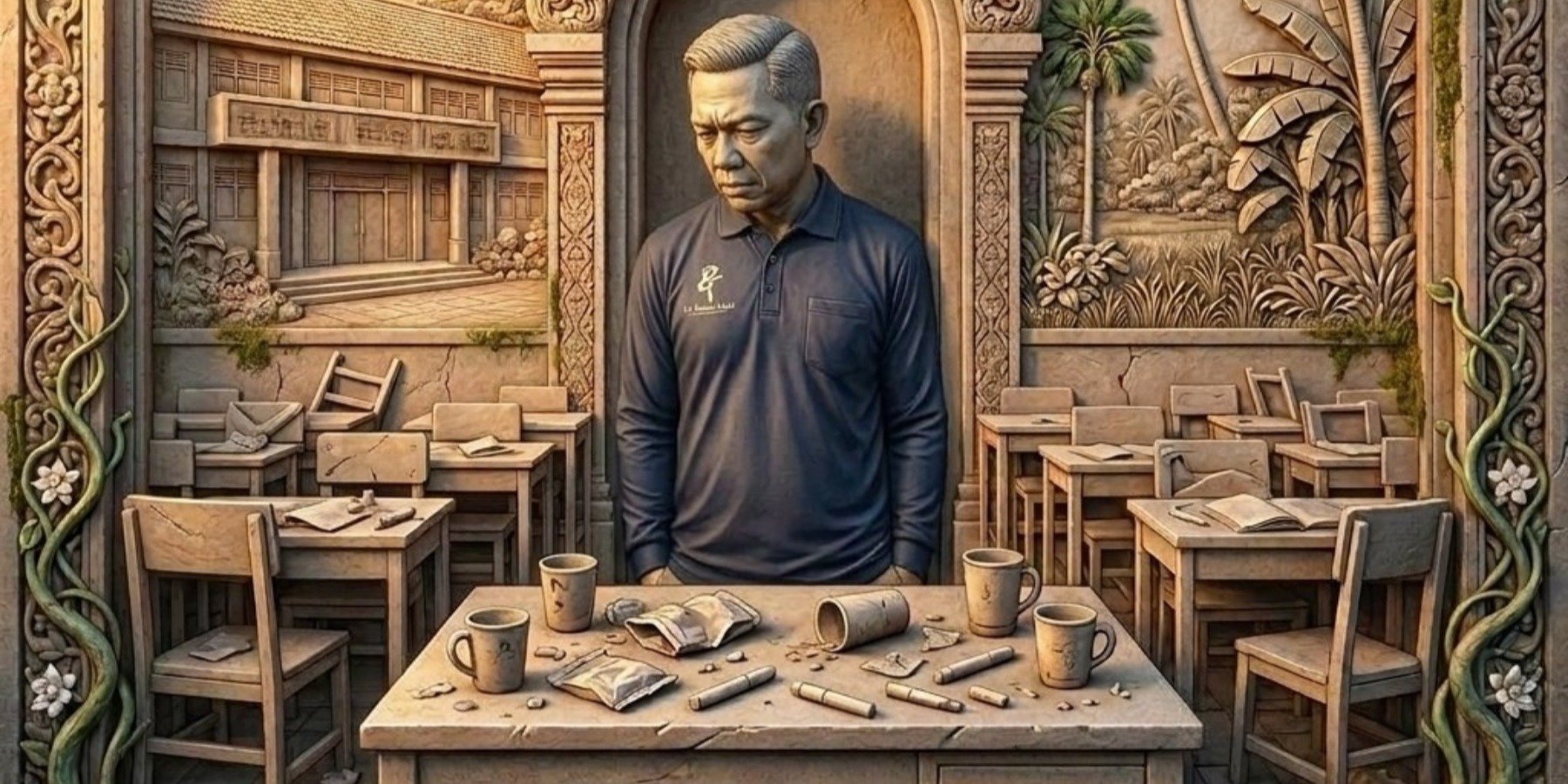
On a brilliantly clear Thursday morning, the Phoenix rode his black motorcycle along the road lined with coconut palms, banana trees, cassava, areca palms, wild grass, and tall weeds. All of them stood as silent witnesses to a journey he had repeated hundreds of times. He arrived on time at the Garden of Paradise, the place where, day after day, he burned himself for the children of the nation.
Dawn was still veiled in mist. The morning light looked faded, as if the sky itself hesitated to open its eyes. On the field, all the children and the teachers gathered for morning exercise before the inter-class competitions held in honor of Independence Day. The Phoenix stood at the front with his fellow educators. Movement after movement he performed with a body long familiar with fatigue. On ordinary days, mornings were filled with teaching; chances to move freely like this rarely came. He let his muscles speak, let his breath merge with the rhythm of the exercises, as though his own body were practicing how to rise once more from the ashes that had settled during the night.
After the exercises, he guided the children under his care. He offered encouragement through his gaze, through his quiet presence, through the way he stood beside them. In the first contest they lost. The light on the children’s faces dimmed, like dew that had not yet been touched by the sun. The Phoenix did not turn away. He kept smiling, kept standing near, kept being the small flame that refused to go out. In the second contest they won, first place. The disappointment that had clung to their faces slowly dissolved, replaced by something warmer. The Phoenix congratulated them in a silence full of meaning, not with words, but with the presence that had witnessed their small rising.
When the competitions ended, he asked them to prepare decorations for their classroom. He himself had to return to his desk to finish matters that could not wait. He would come to check later, once that work was done.
The call to prayer rose. The Phoenix invited the children he met along the way to join the midday prayer at the mosque in the Garden of Paradise. He led them. Beneath the gentle turning of the ceiling fans, under a sky growing brighter, the prayer unfolded in quiet warmth. It was not a rigid ritual, but a shared space, where young breaths and tired breaths met in the same stillness. For a few moments the weight on his shoulders seemed to rest on the floor, and the heart was allowed a brief rest beneath the same shelter.
Afterwards he rested. The lunch his wife had entrusted to him that morning at the gate of the Garden was finished to the last grain. The meal was simple, yet it felt like a small gift from the home whose mortgage was still being paid, installment by installment. Every bite reminded him that the fire he tended at school must also be tended at home, the slow, steady flame that would one day burn away the remaining debt so the house could truly belong to them.
Then he went to check the classroom. When the door opened, the light of hope that had briefly glowed in his chest faded at once. Five drinking glasses lay scattered across the teacher’s desk, food wrappers littered the floor, markers were strewn about, chairs stood in disarray. The room he had hoped would be clean had become a sight that pressed on the heart. The Phoenix drew a long breath. He did not raise his voice in anger. He simply stood for a moment, letting the disappointment settle, then, together with one child who was still there, he set everything right. Each movement of his hands restoring order was a quiet rising: from chaos toward order, from the ashes of disappointment toward a flame that still chose to burn.
Afternoon arrived. The Phoenix rode home on his black motorcycle. At the house he rested a while, letting the fan cool the heat that still clung to his clothes and skin. His wife asked to be taken to the ATM only twelve minutes away. They arrived, but the machine was under repair. The evening light that day was beautiful, yet in his wife’s eyes that light felt faded. They decided to return home and wait until morning. On the way back the Phoenix felt something familiar: a hope that had tightened, then softened by reality. He knew that, like the remaining mortgage payments, some things must be postponed without losing direction.
Night came. The Phoenix took his child to the neighborhood mosque. Together with the neighbors they performed the night prayer and recited Yasin. The atmosphere was warm, full of simple togetherness. After the shared prayer, boxes of cake were distributed. A few of the adult worshippers received none, because more of the cakes had been given to the children who had joined. The Phoenix watched without comment. There was beauty in an imperfect sharing, that the small ones were sometimes placed first, that warmth could not always be measured in equal portions.
When the night worship ended, he returned home. As he prepared for sleep, he remembered the one hundred thousand rupiah in the pocket of his work trousers, money reimbursed by a colleague for the purchase of phone credit. He checked the trousers that had already been washed. Nothing. That hope faded. The Phoenix sat for a moment on the edge of the bed, allowing the sense of loss to come, then released it. He thought, perhaps it was not meant to be his provision for this night. The fire within him did not go out; he simply chose not to let a small ash cover the larger ember.
Amid the burning fatigue, a quiet pride as an educator still glowed. The anxiety of a father, about the long remaining mortgage, about his children’s future, about the Education Impact Fund he kept as a living commitment, remained present. Yet above all of it rested a slowly hardening conviction: that daily consistency is the purest form of love. Not a great explosion, but a small flame tended again and again even when the wind is strong, even when the light so often appears faded.
The Phoenix knew that every morning he traveled, every disappointment he set right, every prayer he led with warmth, every hope he released with open hands, was ash he allowed to become fuel. From it he rose again. Not as a perfect hero, but as an ordinary human being who chose to keep burning.
The light may fade. Yet the fire tended with repeated love never truly dies. It only waits for the next dawn to rise once more, quieter, deeper, more enduring.
Explore the documentary art collection and support the mission by acquiring your NFT on OpenSea.
Lost in the narrative?
[Return to the story map]