
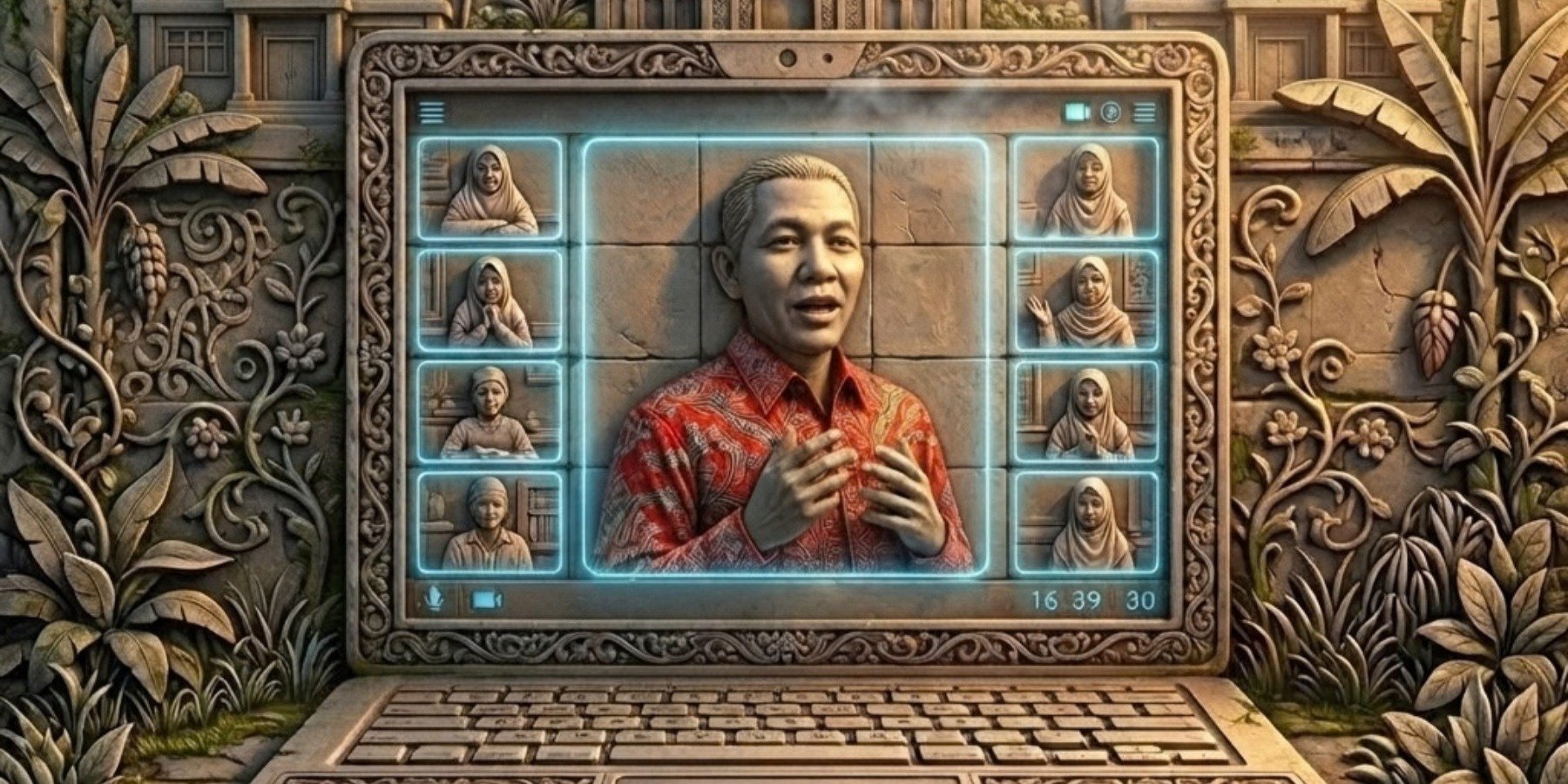
The morning haze of smoke lay over the road like a thin reluctant blanket. The air carried the faint scent of distant burning wood, remnants of fires that once consumed the forests, now turned into a veil that refracted every ray of sunlight into soft and blurred light. Through that haze he rode his black motorcycle, face covered by a mask, body long accustomed to rising even when fatigue still clung to the bones. Coconut trees, banana plants, cassava, betel palms, wild grass and reeds stood silent along the roadside, quiet witnesses to the same daily journey, a journey that never promised ease, only demanded perseverance.
The heavenly garden where he taught the children of the nation waited in stillness. He arrived on time, like a flame that refused to die even when strong winds kept blowing. This morning the haze grew thicker, the sky seeming to close the windows of the world, and the children of the nation learned from home. Digital light invitations entered the room of class XII F2. One by one faces appeared on the screen, some still rubbing sleepy eyes, others already ready with books on their laps. He began by revisiting the previous week’s lesson on strategies of Islamic dakwah in Indonesia, not merely repeating words but weaving the threads of meaning back together so they would not break in the middle of the haze. He gazed at those young faces through the refracted light, sensing how every patient and unhurried explanation became a bridge across the distance forced by the smoke. When understanding began to shine from their eyes, he gave them exercises, not as a burden but as an invitation to sharpen their own minds amid a blurred world.
The light of invitation then shifted to class XII F4. The material on praiseworthy character and the importance of moderation in a life of diversity flowed gently. He spoke of how differences are not walls but windows that refract light into beautiful colors when viewed with a calm heart. Faces on the screen seemed to reflect, some nodding slowly, as if finding space within themselves to accept others without losing themselves. Exercises followed afterward, small traces they would carry home, traces that might grow amid the haze of their own lives.
Next the light refracted toward class XI F4. Faces appeared one after another on the digital screen that trembled with an unstable signal. He explained the policies of the Ottoman leaders, conquerors of Constantinople, not merely as distant history but as a mirror of how steadfastness and wisdom can open gates once thought impossible. In the middle of the smoke haze that closed the windows of homes, he opened another window the window of imagination and understanding. After they grasped it, exercises were given again, like planting seeds in dry soil with the hope that the rain of comprehension would come.
In between those moments a message from his wife appeared, asking him to print several sheets of the children’s assignments. He rose at once, the printer releasing page after page, its mechanical sound becoming brief music in the quiet room. Those assignments would become a bridge between home and school, between himself and the children waiting beyond the screen.
Noon approached. The call to prayer sounded from afar, its voice muted by the haze yet still reaching the ear. This time he did not go to the mosque. Beside his work desk, in a room occupied only by himself, he stood, then sat, then bowed. The movements were simple and warm, like a breath drawn after holding it for a long time. There was no crowd, no rigid formality, only a weary body finding a place to lay down its burden for a moment before the One who knows all. In that stillness he felt how every prostration was an admission that the strength that made him rise each morning did not come from himself alone. Afterward, in a brief pause, he sent the refracted light of his work to The Kenyon Review in the United States, as if casting a beam of light from this haze toward a farther sky, hoping someone would see it.
Afternoon arrived. He rode home on the same black motorcycle, passing roads still veiled in smoke. At home the red sofa in the living room became the first place his body sank. Then he moved, lying down in front of the family room. His children came, small faces still carrying the brightness of a world not yet fully burdened. They asked for money to buy snacks at the small shop. He gave it, watching their eyes light up, and in that instant his fatigue softened into something quieter a silent pride as a father still able to offer small happiness amid the long journey of paying off the remaining mortgage on the family house.
Night came. He invited his children to the housing-complex mosque. Together with other residents they stood in congregational prayer. The evening prayer movements felt warmer, bodies side by side under a simple roof, breaths answering one another in the quiet. No one forced solemnity solemnity arrived on its own from a sincere sense of togetherness. Afterward they shared a simple dinner. Rice, modest side dishes, enough to fill both stomach and heart.
Not long after, his body told him he was unwell. The smoke haze seemed to have entered his breath. He started the motorcycle again and rode to a pharmacy some distance away. The night still shadowed by haze accompanied him along the road. He bought a bottle of honey and allergy medicine, then returned. At home a glass of warm tea mixed with honey was sipped slowly, the sweet warmth flowing down, soothing a dry throat.
Before sleep he still made time to send the refracted light of his work to DYONYZINE, an international multimedia magazine, and to Another Chicago Magazine in Illinois, United States. Those small beams of light were launched into a wider world, as if saying that from the smoke haze in one corner of Indonesia there remained someone trying to refract understanding and dedication.
Night closed his eyes. The weary body finally lay down. In the silence he knew that every day was ash that must be burned again into flame. Phoenix rose once more from fatigue, from the feeling of illness, from the weight of the remaining mortgage, from the quiet anxiety of a father and educator. That fire was not large, not spectacular. It simply kept burning through small acts repeated with love explaining lessons amid digital haze, giving exercises, printing assignment sheets, handing over snack money, offering warm prayer, sending work to distant places, and holding the intention for the Education Impact Fund.
Daily consistency is the purest form of love. Not because he is perfect, but because he keeps choosing to rise even when strong winds and thick haze try to extinguish him. Every touching online class, every prostration beside the desk, every bit of pocket money given, every piece of work sent, is a slow transformation from ash into refracted light. And in the smoke haze that bends everything, he discovers that dedication itself is the most enduring light, a light that needs no clear sky to keep shining.
Explore the documentary art collection and support the mission by acquiring your NFT on OpenSea.
Lost in the narrative?
[Return to the story map]