
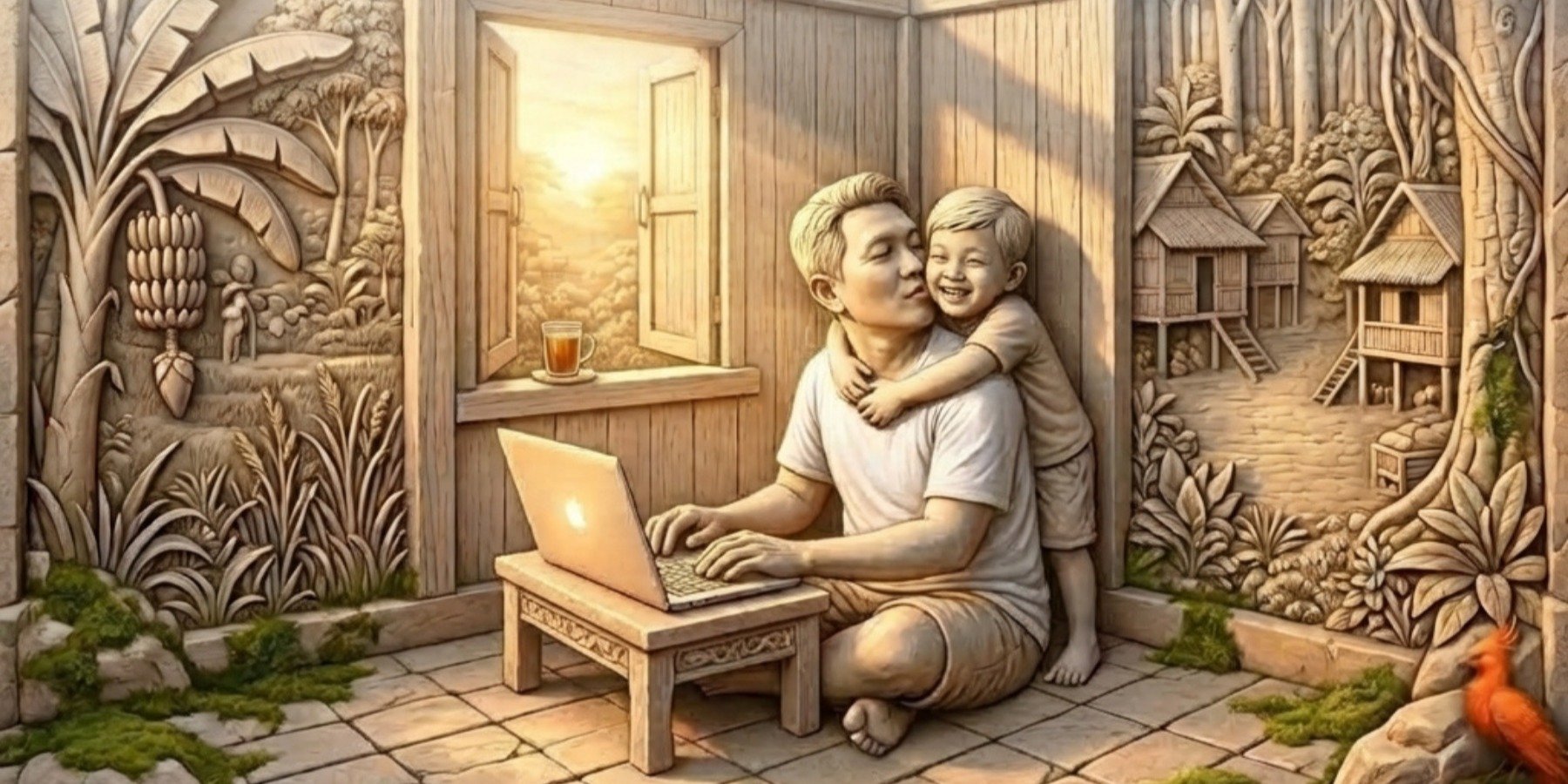
On a dry Sunday morning the veil of mist still covered the sky above the housing complex at the edge of the rubber-forest town. Cool damp air drifted slowly into the house, carrying the scent of dry earth and leaves not yet fully awake. He stood for a moment at the window, letting the silence settle into him. There, in the quietest corner of his being, he watched his Phoenix regenerating. Its wings folded calmly, the red-orange fire glowing gently like embers tended with care so they would not go out. Body and soul, weary after days of burning themselves before the classroom, were now restoring themselves while still carrying the remaining weight of the family home mortgage. Rest was not laziness. It was a sacred process of recharging so the fire of dedication could keep burning for his students tomorrow.
He returned to the breakfast table. A glass of warm tea steamed softly beside a small pile of plain biscuits. His children sat around him, faces still heavy with sleep yet eyes beginning to brighten. The warmth of that morning did not come from luxury but from their simple presence together. The sound of spoons touching plates, soft little breaths, and smiles not yet fully formed created a gentle rhythm. He sipped the tea, feeling its heat slide down his throat, as if reminding him that this body also needed care, not only the spirit that was always forced to stand upright before his students.
After breakfast he opened his laptop. The distance-learning reports still waited in a folder. A few typing errors had slipped into sentences written in haste on previous nights. His fingers began to move slowly across the keyboard, touching each letter with a patience he rarely found on working days. The rhythm of the typing became a kind of small prayer, mending what had cracked, completing what had been rushed. He knew every accurate report was a small bridge for students learning from afar, and even though today was a day of rest, that commitment never truly rested.
Suddenly small arms wrapped tightly around his neck from behind. He startled for a moment, then smiled. His youngest son pressed his face against his back, bringing the scent of morning soap and the warmth of a body still soft from sleep. He turned slowly, kissed the boy’s cheek, and let time pause. The child began to speak of his world, of small dreams just beginning to grow, of fears that had visited the night before, of simple joys found in the yard. He listened with his whole heart, smiling now and then, then gently tickled the small stomach until bright laughter filled the room. That moment felt like water soaking dry earth. The fatigue that had settled in his spine slowly melted, replaced by a quiet pride as a father. He realized that among all the burdens he carried, this embrace was a gift that could not be bought with salary or recognition.
When the boy was satisfied and wandered away, he returned to the laptop. Report after report was uploaded with care. Afterward he took a moment to send his visual work to several open calls. Y Gallery, the Billboard project at Reykjavík Art Museum, Commercial Break On Billboards. Each click of send felt like planting a seed in distant soil. He did not know whether the seed would grow, yet he believed that art and education were two wings that both needed wind.
Noon arrived. He walked with his children to the mosque inside the housing complex. The veil of mist still danced above the rooftops, yet their steps felt light. Inside the mosque, together with the other residents, they stood in rows. The prayer did not feel rigid. He felt the warmth of his children’s bodies beside him, heard their short breaths, watched small fingers trying to follow his movements. The prayer he offered silently was not only for himself but for all the children who would look at him in class the next day, for his wife who steadily supported him, and for himself who was still learning to become a whole human being. After the prayer the atmosphere in the mosque remained warm with light greetings and quiet smiles from the neighbors. There was no heavy formality, only a sense of togetherness that flowed like water in a small stream.
Back at home the children asked for fried eggs. He stood in the kitchen, cracked the eggs, and listened to the oil sizzle in the pan. The simple smell filled the kitchen, reminding him of his own childhood when his mother cooked with whatever was available. Lunch unfolded in comfortable quiet. Warm rice, fried eggs, and plain vegetables became a meal that felt abundant because it was shared. He looked at his children’s faces as they ate with quiet concentration, and a deep gratitude filled his chest. The struggles he had endured, the long nights, the pressures that had once weighed on his shoulders, all of it felt meaningful in this moment.
After the meal he lay down for a while. The tired body was finally allowed to be truly still. The afternoon nap arrived like dew settling slowly. In that sleep the fire inside him did not go out. He only rested, letting the embers stay alive beneath the ash, waiting for the right moment to glow again.
As the afternoon approached he and his wife rode the motorcycle toward a relative’s house. The veil of mist still danced in the sky, following the gentle rhythm of the engine. Dry-season dust rose along the road, settling on skin and clothes, yet it did not disturb. Their daughter was already waiting. When they arrived she climbed onto the motorcycle and sat between her parents, her small body leaning with quiet trust. The ride home was colored by mist growing thinner and dust growing thicker, yet the warmth of the family on the motorcycle made everything feel light. He felt his dedication as a father and as an educator merging into one. Both required the same endurance, both needed time to refill.
Night came. They returned to the mosque. After the congregational prayer he did not go straight home. He stayed with the neighborhood children, joining them in chanting sholawat. Their voices rose and answered one another, accompanied by the hadroh played by the children with lively spirit. The rhythm filled the mosque hall, creating a warmth that words could not fully describe. He felt a quiet vibration in his chest, not from the volume of sound but from the awareness that here, among children he might never teach in school, he remained an educator. Every chant was a prayer, every beat of the hadroh a pulse of hope. The atmosphere stayed warm and human, touched by soft laughter in the pauses, free of any stiffness that creates distance.
When the night grew late he was already home. His wife served steaming fried rice. They sat together and ate in peaceful quiet. The warmth of the fried rice soothed the body that had moved all day. Outside, the veil of mist still danced across the night sky, yet inside the house the small fire in his heart remained guarded.
Before sleep he opened the laptop once more. He sent his work to the open call of Galerie L’art de vivre in Quebec, Canada. That final click felt like closing the day with the same commitment. Even on a day of rest he continued to keep his promise to the Education Impact Fund, to students he might never meet, to a future that was still dark yet worth fighting for.
He lay down in bed. His body felt lighter. The fatigue that had once pressed upon him had turned into calm. He knew that tomorrow the fire would burn again, not with anger or exhaustion but with new strength born from conscious rest. From ash to flame, from weariness to renewed power, so that he might fly higher once more. In the stillness of the night still shrouded in mist he closed his eyes, allowing the rhythm of warmth to flow gently through his chest, soothing, filling, and preparing.
Explore the documentary art collection and support the mission by acquiring your NFT on OpenSea.
Lost in the narrative?
[Return to the story map]